Question Library
Browse, filter, and study verified past examination questions with step-by-step mathematical reasoning.
Searching 18,000+ Questions...
Sifting topics, KaTeX formulas & verified solutions
Showing 511–525 of 29811 verified questions
Sort by:
Chemistry
UTME / JAMB 2025
Electrochemistry and Redox
Solution
The compound in which the oxidation state of nitrogen is + 3 is
A
N\(_2\)O\(_5\)
B
N\(_2\)O\(_3\)
C
N\(_2\)O\(_4\)
D
N\(_2\)O
medium Difficulty
Verified Correct Answer: Option B
Chemical Principles & Mechanism
The oxidation state of nitrogen in N\(_2\)O\(_3\) is +3. This is calculated using the rule that oxygen typically has an oxidation state of -2 in compounds, and the sum of all oxidation states in a neutral compound is zero.
In N\(_2\)O\(_5\): N\(_2\)O\(_5\) = 0
2(N) + ( -2 x 5) = 0
2N - 10 = 0
N = \(\frac{10}{2}\) = +5
In N\(_2\)O\(_3\): N\(_2\)O\(_3\) = 0
2(N) + ( -2 x 3) = 0
2N - 6 = 0
N = \(\frac{6}{2}\) = +3
In N\(_2\)O\(_4\): N\(_2\)O\(_4\) = 0
2(N) + ( -2 x 4) = 0
2N - 8 = 0
N = \(\frac{8}{2}\) = +4
In N\(_2\)O: N\(_2\)O = 0
2(N) + (-2) = 0
2N - 2 = 0
N = \(\frac{2}{2}\) = +1
The correct option is B - N\(_2\)O\(_3\).
Source: Myschool Past Questions Archive (Record #74274)
Chemistry
UTME / JAMB 2025
Atomic Structure and Periodic Table
Solution
Na\(_2\)X ⇌ 2Na\(^+\) + X\(^{2-}\)
The bond between Na and X is likely to be
A
dative
B
ionic
C
metallic
D
covalent
medium Difficulty
Verified Correct Answer: Option B
Chemical Principles & Mechanism
The reaction given, \(\text{Na}_{2}\text{X}\rightleftharpoons 2\text{Na}^{+}+\text{X}^{2-}\), indicates that the compound \(\text{Na}_{2}\text{X}\) dissociates into positive sodium ions (\(\text{Na}^{+}\)) and a negative ion (\(\text{X}^{2-}\)). The formation of ions and their electrostatic attraction is characteristic of an ionic bond.
Sodium (Na) is a metal and typically loses electrons to form positive ions (cations) to achieve a stable electron configuration. Element X forms a negative ion (\(\text{X}^{2-}\)), meaning it is likely a non-metal that gains electrons.
Source: Myschool Past Questions Archive (Record #74275)
Chemistry
UTME / JAMB 2025
Stoichiometry & Mole Concept
Solution
The compound responsible for the pleasant scent of fruits and perfumes belongs to the class of
A
alkanamide
B
alkanone
C
alkanal
D
alkanoate
medium Difficulty
Verified Correct Answer: Option D
Chemical Principles & Mechanism
Compounds responsible for the pleasant, fruity scents of fruits and many perfumes belong to the class of organic compounds known as esters(alkanoates). Low-molecular-weight esters are responsible for the odours in fruits (e.g., isoamyl acetate in bananas, ethyl butyrate in pineapples).
Due to their, sweet-smelling, and often fruity nature, they are used extensively in synthetic flavours, perfumes, and cosmetics.
While other compounds like aldehydes and ketones can contribute to odours, esters are the primary class associated with these specific pleasant fruit-like aromas.
Source: Myschool Past Questions Archive (Record #74277)
Chemistry
UTME / JAMB 2025
Stoichiometry & Mole Concept
Solution
The most suitable indicator to be used when reacting ethanedioic acid with potassium hydroxide is
A
phenolphthalein
B
methyl orange
C
methyl red
D
methyl purple
medium Difficulty
Verified Correct Answer: Option A
Chemical Principles & Mechanism
The reaction involves ethanedioic acid (a weak acid, also known as oxalic acid) and potassium hydroxide (a strong base, KOH).
The titration of a weak acid with a strong base results in an equivalence point at a pH greater than 7 (in the alkaline range). Phenolphthalein is the most suitable indicator for this type of titration because its colour change range (pH 8.3-10.0) falls within the steep, alkaline portion of the titration curve. It changes from colourless in acid to pink in alkaline solution, which provides a sharp and distinct endpoint.
Source: Myschool Past Questions Archive (Record #74278)
Chemistry
UTME / JAMB 2025
Atomic Structure and Periodic Table
Solution
Electron configuration of Chlorine atom is
A
1S\(^2\)2S\(^2\)2P\(^6\)3S\(^2\)3P\(^5\)
B
1S\(^2\)2S\(^2\)2P\(^6\)3S\(^2\)3P\(^4\)
C
1S\(^2\)2S\(^2\)2P\(^6\)3S\(^2\)3P\(^6\)
D
1S\(^2\)2S\(^2\)2P\(^5\)3S\(^2\)3P\(^6\)
medium Difficulty
Verified Correct Answer: Option A
Chemical Principles & Mechanism
The electron configuration describes the arrangement of electrons within an atom's orbital shells. Chlorine (Cl) has an atomic number of 17, meaning a neutral chlorine atom has 17 electrons. The filling of electron orbitals follows the Aufbau principle (lowest energy levels first), resulting in the following configuration:
1s²: The first energy level, s-subshell, holds 2 electrons.
2s²: The second energy level, s-subshell, holds 2 electrons.
2p⁶: The second energy level, p-subshell, holds 6 electrons.
3s²: The third energy level, s-subshell, holds 2 electrons.
3p⁵: The third energy level, p-subshell, holds the remaining 5 electrons (2 + 2 + 6 + 2 + 5 = 17 electrons in total).
Source: Myschool Past Questions Archive (Record #74279)
Chemistry
UTME / JAMB 2025
Atomic Structure and Periodic Table
Solution
A table in which metals are arranged in series according to their comparative tendencies to give up their valence electrons is
A
periodic table
B
electrochemical series
C
table of elements
D
periodicals
medium Difficulty
Verified Correct Answer: Option B
Chemical Principles & Mechanism
The electrochemical series, also known as the activity series or electromotive series, is a list of metals (and other elements) arranged in order of their standard electrode potentials. This arrangement ranks them by their tendency to lose electrons (get oxidized, or "give up their valence electrons"). Metals higher in the series are more reactive and lose electrons more easily than those lower down.
A. periodic table: The periodic table arranges elements primarily by increasing atomic number, which helps show trends in properties, including the number of valence electrons and general reactivity, but it is not specifically a series of metals ranked by their comparative tendency to give up valence electrons in the manner of the electrochemical series.
C. table of elements: This is another name for the periodic table or a general list of all known elements, not a specific series ranking metals by their reactivity or tendency to lose electrons.
D. periodicals: Periodicals are publications (magazines, journals, etc.) that come out at regular intervals; this term has no relevance to the arrangement of metals by chemical properties.
Source: Myschool Past Questions Archive (Record #74280)
Chemistry
UTME / JAMB 2025
Acids, Bases, and Salts
Solution
An importance of solubility is that it
A
determines the amount of solute that can dissolve in a given amount of solvent
B
lowers the vapour pressure of the liquid
C
enables us to know the chemical reactions of the gas with the liquid
D
raises the boiling point of liquid
medium Difficulty
Verified Correct Answer: Option A
Chemical Principles & Mechanism
Solubility is defined as the maximum amount of a specific solute that can dissolve in a given amount of solvent under specific conditions (temperature and pressure) to form a saturated solution. This intrinsic property determines the limit of how concentrated a solution can become.
The correct option is A - determines the amount of solute that can dissolve in a given amount of solvent.
B. lowers the vapour pressure of the liquid: The addition of a non-volatile solute to a solvent lowers the vapor pressure (a colligative property), but solubility itself is a measure of the amount that can dissolve, not the phenomenon of vapor pressure lowering.
C. enables us to know the chemical reactions of the gas with the liquid: Solubility describes a physical property (dissolution), not the chemical reactivity between a gas and a liquid.
D. raises the boiling point of liquid: The addition of a non-volatile solute raises the boiling point (another colligative property), but again, solubility is the measure of the extent of dissolution.
Source: Myschool Past Questions Archive (Record #74283)
Chemistry
UTME / JAMB 2025
Acids, Bases, and Salts
Solution
The disintegration of radioactive phosphorus to silicon follows the first order kinetics with rate constant k\(_1\) = 3.85 x 10\(^{-3}\). Determine the half life of phosphorus.
A
8 s
B
180 s
C
80 s
D
100 s
medium Difficulty
Verified Correct Answer: Option B
Chemical Principles & Mechanism
Firstly, State the formula for the half-life of a first-order reaction.
Radioactive decay follows first-order kinetics.
The half-life (t\(_{1/2}\)) for a first-order reaction is related to the rate constant (k) by the formula:
t\(_{1/2}\) = \(\frac{ln 2}{k}\)
t\(_{1/2}\) ≈ \(\frac{0.693}{k}\)
Secondly, calculate the half-life using the assumed rate constant given in the question as k = 3.85 x 10\(^{-3}\)s\(^{-1}\)
t\(_{1/2}\) = \(\frac{0.693}{3.85 x 10{^-3}}\)
t\(_{1/2}\) = 180 s
Source: Myschool Past Questions Archive (Record #74287)
Chemistry
UTME / JAMB 2025
Atomic Structure and Periodic Table
Diagram
Solution
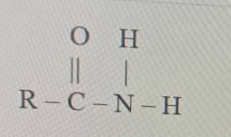
The above structure is
Attached Figure / Diagram
A
alkylamine
B
alkanone
C
alkanamide
D
amino acid
medium Difficulty
Verified Correct Answer: Option C
Chemical Principles & Mechanism
The structure RCONH₂ contains a carbonyl group (C=O) bonded directly to a nitrogen atom (NH₂). This specific functional group, CONH₂, is characteristic of an amide. In the general naming convention for this class of organic compounds, they are known as alkanamides.
Alkylamine: Amines have a general formula of RNH₂ (primary amine) without the carbonyl group (C=O) adjacent to the nitrogen.
Alkanone: Alkanones, also known as ketones, have a carbonyl group (C=O) bonded to two other carbon atoms (RCOR'), and do not contain a nitrogen atom.
Amino acid: Amino acids are organic compounds that contain both an amino group (–NH₂) and a carboxylic acid group (–COOH) attached to the same central carbon atom, along with a hydrogen atom and a variable side chain (R group). The structure RCONH₂ lacks a carboxyl group.
The correct option is C. alkanamide.
Source: Myschool Past Questions Archive (Record #74289)
Chemistry
UTME / JAMB 2025
Matter & Separation Techniques
Solution
The fractions of crude oil are best separated by
A
steam distillation
B
fractional crystallization
C
precipitation
D
fractional distillation
medium Difficulty
Verified Correct Answer: Option D
Chemical Principles & Mechanism
The fractions of crude oil are best separated by fractional distillation because the different hydrocarbons have different boiling points.
In this process, Crude oil is heated and vaporized. The vapour rises through a tall fractionating column which is hot at the bottom and cooler at the top.However, different fractions condense at different temperature levels (heights) in the column and are collected separately. Then, lighter fractions with lower boiling points condense at the top, while heavier fractions with higher boiling points condense at the bottom.
Source: Myschool Past Questions Archive (Record #74291)
Chemistry
UTME / JAMB 2025
Stoichiometry & Mole Concept
Diagram
Solution
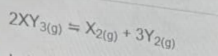
In the equation above, the expression for the equilibrium constant, k\(_c\) is
Attached Figure / Diagram
A
\(\frac{[2XY_3]}{[X_2][3Y_2]}\)
B
\(\frac{[X_2][3Y_2]}{2XY_3]}\)
C
\(\frac{[XY_3]^2}{[X_2][Y_2]}\)
D
\(\frac{[X_2][Y_2]^3}{[XY_3]^2}\)
medium Difficulty
Verified Correct Answer: Option D
Chemical Principles & Mechanism
The equilibrium constant expression, based on the law of mass action, is defined as the ratio of the concentrations of the products raised to their stoichiometric coefficients to the concentrations of the reactants raised to their stoichiometric coefficients.
The correct answer is option D - \(\frac{[X_2][Y_2]^3}{[XY_3]^2}\)
Source: Myschool Past Questions Archive (Record #74296)
Chemistry
UTME / JAMB 2025
Stoichiometry & Mole Concept
Solution
How many molecules are there in 4.0 moles of glucose?
[Avogadro's number = 6.02 x 10\(^{23}\)]
A
1.51 x 10\(^{23}\)
B
2.41 x 10\(^{24}\)
C
24.08 x 10\(^{24}\)
D
1.51 x 10\(^{24}\)
medium Difficulty
Verified Correct Answer: Option B
Chemical Principles & Mechanism
Given:
Number of moles, n = 4.0 moles
Avogadro's number, L = 6.02 x 10\(^{23}\)
Number of molecules, N = ?
To find the number of molecules, you need to first identify the formula that combines or form a relationship among the three parameters above.
Number of moles, n = \(\frac{Number of molecules}{Avogadro number}\)
n = \(\frac{N}{L}\)
N = n x L
= 4 X 6.02 x 10\(^{23}\)
= 24.08 x 10\(^{23}\)
= 2.408 x 10\(^{24}\)
The correct answer is option B - 2.41 x 10\(^{24}\)
Source: Myschool Past Questions Archive (Record #74389)
Chemistry
UTME / JAMB 2025
Acids, Bases, and Salts
Solution
What is the product obtained at the anode in the electrolysis of concentrated sodium chloride using graphite electrode?
A
Chlorine gas
B
oxygen gas
C
water vapour
D
hydrogen gas
medium Difficulty
Verified Correct Answer: Option A
Chemical Principles & Mechanism
In the electrolysis of a concentrated sodium chloride solution (brine) using inert graphite electrodes, both chloride ions (Cl\(^-\)) and hydroxide ions (OH\(^−\)) (from the water) are attracted to the positive anode. Although, based on standard electrode potentials, the oxidation of hydroxide ions to oxygen gas should be preferred, the high concentration of chloride ions and the overpotential for oxygen evolution means that chloride ions are preferentially discharged to produce chlorine gas (Cl\(_2\)) at the anode.
The reaction is : 2Cl\(^-\) → Cl\(_2\) + 2e\(^-\)
The correct option is A. Chlorine gas.
Source: Myschool Past Questions Archive (Record #74390)
Chemistry
UTME / JAMB 2025
Acids, Bases, and Salts
Solution
Freons pollution in the air are released from
A
fossil fuel
B
aerosol can
C
photosynthesis
D
organic decay
medium Difficulty
Verified Correct Answer: Option B
Chemical Principles & Mechanism
Freons, also known as chlorofluorocarbons (CFCs) and hydrofluorocarbons (HCFCs), are man-made chemicals that were widely used as refrigerants and propellants in aerosol applications. They are released into the air from various human-made sources, including aerosol cans. Once in the atmosphere, these stable compounds eventually reach the stratosphere, where powerful UV radiation breaks them down, releasing chlorine atoms that deplete the ozone layer.
A. fossil fuel: Burning fossil fuels releases pollutants like carbon dioxide, sulphur dioxide, and nitrogen oxides, but is not a source of freon emissions.
C. photosynthesis: Photosynthesis is a natural process used by plants to remove carbon dioxide from the atmosphere and release oxygen; it is not a source of freon pollution.
D. organic decay: The bacterial breakdown of organic matter typically produces gases such as methane and hydrogen sulfide, not freons.
Source: Myschool Past Questions Archive (Record #74391)
Chemistry
UTME / JAMB 2025
Matter & Separation Techniques
Solution
In welding and cutting of metals, the organic gas commonly used in the heating process is
A
methane
B
propene
C
butane
D
ethyne
medium Difficulty
Verified Correct Answer: Option D
Chemical Principles & Mechanism
Ethyne, commonly known as acetylene (C\(_2\)H\(_2\)), is the most widely used organic fuel gas in oxy-fuel welding and cutting. Ethyne is the only fuel gas generally suitable for welding steel.
When combined with oxygen, ethyne produces the hottest flame among common fuel gases, reaching temperatures between 3,200 to 3,500 degrees Celsius. This high temperature is necessary to melt steel and other ferrous metals for welding and to rapidly preheat the metal to its kindling temperature for cutting.
Source: Myschool Past Questions Archive (Record #74392)