Question Library
Browse, filter, and study verified past examination questions with step-by-step mathematical reasoning.
Searching 18,000+ Questions...
Sifting topics, KaTeX formulas & verified solutions
Showing 451–465 of 29811 verified questions
Sort by:
Chemistry
UTME / JAMB 2025
Atomic Structure and Periodic Table
Solution
Alkenes are represented with the general molecular formula
A
C\(_n\)H\(_{2n}\)
B
C\(_n\)H\(_{2n-2}\)
C
C\(_n\)H\(_{2n+2}\)
D
C\(_n\)H\(_{2n+1}\)OH
medium Difficulty
Verified Correct Answer: Option A
Chemical Principles & Mechanism
Alkenes, which are hydrocarbons with at least one carbon-carbon double bond, are represented by the general molecular formula C\(_n\)H\(_{2n}\), where 'n' is the number of carbon atoms (n \ge 2). The first member of the alkene family is ethene, C\(_2\)H\(_4\).
Source: Myschool Past Questions Archive (Record #74123)
Chemistry
UTME / JAMB 2025
Atomic Structure and Periodic Table
Solution
The major product when 2-methylpropene reacts with HCl is
A
2-chloro, 2-methylpropane
B
1-chloro,2-methylpropane
C
3-chloro, 2-methylpropane
D
2-chloro,3-methylbutane
medium Difficulty
Verified Correct Answer: Option A
Chemical Principles & Mechanism
The reaction between 2-methylpropene and HCl is an electrophilic addition reaction that follows Markovnikov's rule. This rule states that in the addition of a hydrogen halide (HX) to an unsymmetrical alkene, the hydrogen atom (H) adds to the carbon atom of the double bond that already has more hydrogen atoms, and the halide atom (Cl) adds to the carbon atom with fewer hydrogen atoms.
CH\(_3\)C(CH\(_3\))=CH\(_2\) + HCl → CH\(_3\)C(CH\(_3\))Cl - CH\(_3\)
2-methylpropene 2 -Chloro, 2-methylpentane
This results in the formation of a more stable tertiary carbocation intermediate, leading to the major product 2-chloro, 2-methylpropane.
Source: Myschool Past Questions Archive (Record #74124)
Chemistry
UTME / JAMB 2025
Matter & Separation Techniques
Solution
In the laboratory preparation of Chlorine, the gas is passed through a wash bottle of water to
A
dilute it
B
absorb HCl gas
C
neutralize it
D
absorb the Cl\(_2\) gas
medium Difficulty
Verified Correct Answer: Option B
Chemical Principles & Mechanism
During the laboratory preparation of chlorine gas, hydrogen chloride (HCl) gas is also produced as an impurity. The gas mixture is passed through a wash bottle containing water, in which the HCl gas is highly soluble and is absorbed, while chlorine is only fairly soluble. This step removes the majority of the HCl impurity from the chlorine gas stream.
A. dilute it: The primary purpose is the removal of a specific impurity (HCl), not general dilution. The gas is passed through water to remove a contaminant, not just to reduce its concentration.
C. neutralize it: While water can be used with a base to neutralize an acid, in this specific setup, water primarily acts as a solvent for the highly soluble HCl gas to separate it from the less soluble chlorine gas.
D. absorb the Cl₂ gas: Chlorine gas is only fairly soluble in water, and the goal is to collect the chlorine, not absorb it.
Therefore, the correct answer is to absorb HCl gas - option B
Source: Myschool Past Questions Archive (Record #74125)
Chemistry
UTME / JAMB 2025
Stoichiometry & Mole Concept
Solution
Carbohydrates can generally be represented by the general formula C\(_x\)(H\(_2\)O)\(_y\), for fructose the value for "X" is
A
3
B
12
C
5
D
6
medium Difficulty
Verified Correct Answer: Option D
Chemical Principles & Mechanism
Fructose is a monosaccharide with the molecular formula C\(_6\)H\(_{12}\)O\(_6\). When represented by the general formula C\(_x\)(H2O)\(_y\), it can be written as C\(_6\)(H\(_2\)O)\(_6\). Therefore, the value for "X" (the number of carbon atoms) is 6.
A. 3 is incorrect because a 3-carbon sugar (triose) like glyceraldehyde has the formula C\(_3\)H\(_6\)O\(_3\), which is not fructose.
B. 12 is incorrect because 12 carbons indicates a disaccharide (like sucrose,C\(_{12}\)H\(_{22}\)O\(_{11}\)) or a polysaccharide, not a single fructose molecule.
C. 5 is incorrect because a 5-carbon sugar (pentose) like ribose has the formula C\(_5\)H\(_{10}\)O\(_5\), which is not fructose.
The correct answer is option D.
Source: Myschool Past Questions Archive (Record #74126)
Chemistry
UTME / JAMB 2025
Stoichiometry & Mole Concept
Solution
If a gold bar and a silver bar are tied together firmly and left for years, some of the gold particles will be found in the silver bar due to
A
Brownian movement
B
diffusion
C
displacement
D
osmosis
medium Difficulty
Verified Correct Answer: Option B
Chemical Principles & Mechanism
The phenomenon where particles from a gold bar migrate into a silver bar (and vice versa) when tied together for years is due to diffusion in solids.
Diffusion is the process by which particles move from a region of higher concentration to a region of lower concentration, resulting in an even distribution.
A. Brownian movement: This is the random motion of microscopic particles suspended in a fluid (liquid or gas), not the slow intermingling of atoms within solid metal bars.
C. Displacement: This term generally refers to a change in position or the replacement of one element by another in a chemical reaction. It does not describe the physical process of gradual intermingling of atoms in the context of the question.
D. Osmosis: This is a special case of diffusion that involves the movement of solvent molecules through a selectively permeable membrane. It is a process specific to fluids and membranes and does not apply to solid metals.
:. The correct answer is Diffusion - option B
Source: Myschool Past Questions Archive (Record #74127)
Chemistry
UTME / JAMB 2025
Acids, Bases, and Salts
Solution
A metal that can be found in the free state in nature is
A
silver
B
Zinc
C
Iron
D
copper
medium Difficulty
Verified Correct Answer: Option A
Chemical Principles & Mechanism
The correct options should be either option A. silver (or D. copper) as both metals can be found in the free state in nature. However, metals found in their free state in nature are typically the least reactive metals, often called noble metals, which do not readily combine with oxygen, water, or other elements in the atmosphere to form compounds. Based on this, we should go for option A since Silver is less reactive when compared to copper.
B. Zinc: is a moderately reactive metal. It readily reacts with other elements and is found in nature as compounds like zinc sulphide (zinc blende). It is never found in a free state in large amounts.
C. Iron: is more reactive than zinc and copper. It easily oxidizes (rusts) in the presence of air and moisture, so it is almost exclusively found in nature as iron oxides (ores like haematite and magnetite).
Source: Myschool Past Questions Archive (Record #74128)
Chemistry
UTME / JAMB 2025
Atomic Structure and Periodic Table
Solution
Which of the following has the highest boiling point?
A
CH\(_3\)CH\(_2\)OH
B
CH\(_3\)CH\(_2\)CH\(_2\)Cl
C
CH\(_3\)CH\(_2\)CH\(_2\)CH\(_2\)CH\(_2\)CH\(_3\)
D
CH\(_3\)CH\(_2\)CH\(_2\)OH
medium Difficulty
Verified Correct Answer: Option D
Chemical Principles & Mechanism
Propanol, CH\(_3\)CH\(_2\)CH\(_2\)OH has the highest boiling point among ethanol,(CH\(_3\)CH\(_2\)OH) propanol,(CH\(_3\)CH\(_2\)CH\(_2\)OH) hexane,(CH\(_3\)CH\(_2\)CH\(_2\)CH\(_2\)CH\(_2\)CH\(_3\) )and chloropropane, (CH\(_3\)CH\(_2\)CH\(_2\)Cl ) because its longer carbon chain and ability to hydrogen bond (like ethanol) create stronger intermolecular forces, requiring more energy to vaporize, with propanol (around 97^\circC) significantly beating ethanol (~78^\circC), hexane (~69^\circC), and chloropropane (similar to hexane/slightly higher due to polarity but less H-bonding than alcohols).
Source: Myschool Past Questions Archive (Record #74129)
Chemistry
UTME / JAMB 2025
Acids, Bases, and Salts
Diagram
Solution
From the graph, it can be inferred that
Attached Figure / Diagram
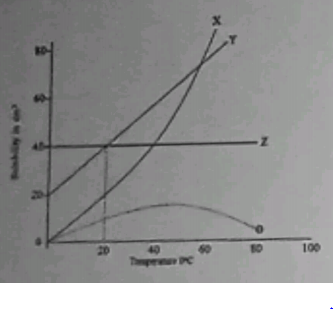
A
the solubility of X and Y is the same at all temperature
B
the solubility of X, Y and Z is temperature dependent
C
solubility of Z increases as temperature increases
D
solubility of Y increases steadily as temperature increases
medium Difficulty
Verified Correct Answer: Option D
Chemical Principles & Mechanism
The correct inference from the graph is that solubility of Y increases steadily as temperature increases- option D.
A. the solubility of X and Y is the same at all temperature: Incorrect. The lines for X and Y cross at a single temperature (~50^\circC), but at all other temperatures, their solubilities are different (e.g., Y is more soluble below ~50^\circC, X is more soluble above ~50^\circC).
B. the solubility of X, Y and Z is temperature dependent: Incorrect. The line for Z is horizontal, indicating that its solubility is constant and does not change with temperature.
C. solubility of Z increases as temperature increases: Incorrect. The horizontal line for Z shows that its solubility remains the same as the temperature increases.
However, in option D, the solubility of Y increases steadily as temperature increases. This statement is Correct. Following the line for Y from left to right (increasing temperature), the line moves upwards, indicating a steady increase in solubility.
Source: Myschool Past Questions Archive (Record #74130)
Chemistry
UTME / JAMB 2025
Acids, Bases, and Salts
Solution
The gas that is commonly used to demonstrate the fountain experiment is
A
hydrogen chloride
B
hydrogen sulphide
C
dinitrogen(I) oxide
D
nitrogen(II) oxide
medium Difficulty
Verified Correct Answer: Option A
Chemical Principles & Mechanism
Hydrogen chloride (HCl) is the gas commonly used in the fountain experiment because of its exceptionally high solubility in water. When a small amount of water is introduced into a flask filled with HCl gas, the gas dissolves rapidly, creating a partial vacuum.
B. hydrogen sulphide (H\(_2\)S) is not typically used for the fountain experiment. While it has some solubility, it is not as highly soluble as HCl or NH\(_3\), which are necessary for the dramatic effect of the fountain. It is also a toxic gas with a foul odor.
C. dinitrogen(I) oxide (nitrous oxide, N\(_2\)O) and D. nitrogen(II) oxide (nitric oxide, NO) are gases with low solubility in water compared to HCl, and would not produce the significant pressure drop required for a successful fountain experiment.
Therefore, the correct answer is option A.
Source: Myschool Past Questions Archive (Record #74131)
Chemistry
UTME / JAMB 2025
Matter & Separation Techniques
Solution
Which of the following statements is false about hard water?
A
Helps animals to build strong teeth
B
Cannot be supplied in pipes made of leads
C
Tastes better than soft water
D
Helps animals to build strong bones.
medium Difficulty
Verified Correct Answer: Option B
Chemical Principles & Mechanism
The statement in option B is false because hard water can be supplied in lead pipes. The high mineral content in hard water (specifically calcium carbonate) forms an insoluble protective layer of scale on the inside of the pipes. This coating prevents the poisonous lead from dissolving and leaching into the water. It is soft water that can cause lead poisoning when supplied in lead pipes.
A. Helps animals to build strong teeth is a correct statement. The dissolved calcium in hard water contributes to strong teeth and bones in animals and humans.
C. Tastes better than soft water is generally considered a correct statement. The minerals present in hard water give it a distinct, often preferred, "full-bodied" or "mineral" taste compared to soft water.
D. Helps animals to build strong bones is a correct statement, for the same reason as option A. Hard water is a natural source of essential minerals like calcium, which are vital for maintaining bone density and overall skeletal health.
The correct answer is option B.
Source: Myschool Past Questions Archive (Record #74132)
Chemistry
UTME / JAMB 2025
Stoichiometry & Mole Concept
Solution
The empirical mass of C\(_6\)H\(_{12}\)O\(_6\) is
[H =1, C = 12, O = 16]
A
90
B
180
C
45
D
30
medium Difficulty
Verified Correct Answer: Option D
Chemical Principles & Mechanism
Firstly, determine the empirical formula.
Molecular formula for the compound : C\(_6\)H\(_{12}\)O\(_6\)
To find the empirical formula, the subscripts of each element must be divided by their greatest common divisor, which is 6.
C\(_6\)H\(_{12}\)O\(_6\) → CH\(_2\)O
Empirical formula : CH\(_2\)O
Now, we can calculate the empirical mass of CH\(_2\)O = 12 + (1 x 2) + 16
= 30.
:. The correct answer is option D
Source: Myschool Past Questions Archive (Record #74133)
Chemistry
UTME / JAMB 2025
Acids, Bases, and Salts
Solution
The nitrogenous compound in dead materials in the soil is converted to
A
ammonia
B
trioxonitrate(V)
C
ammonium salts
D
dioxonitrate(III)
medium Difficulty
Verified Correct Answer: Option A
Chemical Principles & Mechanism
The process by which microorganisms (bacteria and fungi) break down complex organic nitrogen compounds in dead plants, animals, and waste materials is called ammonification. This process releases simpler inorganic forms, primarily ammonia (NH\(_3\)). In the soil, this ammonia reacts with water to form ammonium ions.
B. trioxonitrate(V) is formed in a later stage of the nitrogen cycle called nitrification, where nitrifying bacteria convert the initial ammonia/ammonium into nitrites and then nitrates.
C. ammonium salts are formed in the soil after ammonia is produced and dissolves in water, forming ammonium ions which are a component of the salts. However, the initial conversion of the organic material itself yields ammonia.
D. dioxonitrate(III) is an intermediate compound in the nitrification process, produced when ammonia is converted by bacteria like Nitrosomonas. It is then further converted to trioxonitrate(V) by Nitrobacter.
The correct answer is ammonia - option A
Source: Myschool Past Questions Archive (Record #74134)
Chemistry
UTME / JAMB 2025
Atomic Structure and Periodic Table
Solution
CH\(_3\)C ≡ CCH(CH\(_3\))\(_2\)
The IUPAC nomenclature of the compound above is
A
3-ethyl but-2-yne
B
4-methylpent-2-yne
C
2-ethyl but-2-yne
D
2-methyl pent-2-yne
medium Difficulty
Verified Correct Answer: Option B
Chemical Principles & Mechanism
The IUPAC name for the compound CH\(_3\)C ≡ CHCH(CH\(_3\))\(_2\) is 4-methylpent-2-yne.
First: Name the longest Carbon atom chain, with reference to the shorter route of the position of the triple bond ≡ i.e pent-2-yne (5 Carbon atom with ≡ on C-2)
Secondly: name the substituent functional group. i.e the CH\(_3\) - methyl on C-4 ( 4- methyl)
Thirdly: Combine second and first steps together. i.e 4-methyl and pent-2-yne.
IUPAC Nomenclature of the compound above is 4-methylpent-2-yne - option B
Source: Myschool Past Questions Archive (Record #74135)
Chemistry
UTME / JAMB 2025
Matter & Separation Techniques
Solution
In the laboratory preparation of oxygen using potassium trioxochlorate(V), tetraoxomanganate (VII), usually not recommended in modern laboratory because
A
it forms explosive mixture with carbonaceous materials
B
it is explosive.
C
it reacts with the catalyst
D
it is hazardous
medium Difficulty
Verified Correct Answer: Option A
Chemical Principles & Mechanism
Potassium chlorate (KClO\(_3\)) itself is not explosive under normal laboratory heating conditions (especially when mixed with a catalyst, which lowers the decomposition temperature). However, it is a very strong oxidizing agent. If the potassium chlorate comes into contact with easily oxidizable substances (carbonaceous materials like dust, rubber tubing, or grease) during the preparation, the mixture can become highly sensitive and explosive. This high risk of forming an explosive mixture is the primary reason why this method is usually not recommended in modern laboratories, favoring safer alternatives like the decomposition of hydrogen peroxide (H\(_2\)O\(_2\)).
The correct option is A - it forms explosive mixture with carbonaceous materials.
Source: Myschool Past Questions Archive (Record #74136)
Chemistry
UTME / JAMB 2025
Atomic Structure and Periodic Table
Solution
Mg\(_{(s)}\) + 2HCl\(_{(aq)}\) → MgCl\(_2\)\(_{(aq)}\) + H\(_2\)\(_{(g)}\)
In the reaction above, magnesium is a reducing agent because
A
oxidized
B
reduced
C
a metal
D
a solid
medium Difficulty
Verified Correct Answer: Option A
Chemical Principles & Mechanism
Magnesium (Mg) is a reducing agent because it is oxidized during the reaction. Since a substance that is oxidized (loses electrons) is the reducing agent, while the substance that is reduced (gains electrons) is the oxidizing agent.
In this specific reaction, the oxidation state of magnesium changes from 0 (in Mg(s)) to +2 (in MgCl₂(aq)), an increase in oxidation state, which means it loses electrons and is oxidized.
B. reduced: A substance that is reduced is the oxidizing agent, not the reducing agent. Hydrogen ions (H+) are reduced in this reaction (from +1 to 0).
C. a metal: While magnesium is a metal, being a metal is its physical and chemical classification, not the reason it acts as a reducing agent in the context of a specific redox reaction. The reason is rooted in the change in its oxidation state.
D. a solid: The state of magnesium (solid) is a physical property. The chemical reason it acts as a reducing agent is its tendency to lose electrons (get oxidized) during the reaction.
:. The correct answer is oxidized - option A
Source: Myschool Past Questions Archive (Record #74138)