Question Library
Browse, filter, and study verified past examination questions with step-by-step mathematical reasoning.
Searching 18,000+ Questions...
Sifting topics, KaTeX formulas & verified solutions
Showing 421–435 of 29811 verified questions
Sort by:
Physics
UTME / JAMB 2025
Mechanics and Properties of Matter
Diagram
Solution
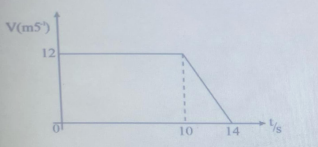
From the above graph, what is the distance covered in the last stage of the motion?
Attached Figure / Diagram
A
56m
B
24m
C
140m
D
46m
medium Difficulty
Verified Correct Answer: Option B
Physical Principles & Numerical Solution
The velocity-time graph has three stages:
0 - 10s: constant \(12 \, \text{m/s}\)
10 - 14s: deceleration from \(12 \, \text{m/s}\) to \(0 \, \text{m/s}\) (last stage)
The area of the triangle gives the distance in the last stage:
\(\text{Area} = \frac{1}{2} \times \text{base} \times \text{height} = \frac{1}{2} \times (14 - 10) \, \text{s} \times 12 \, \text{m/s}\)
\(= \frac{1}{2} \times 4 \times 12 = 24 \, \text{m}\).
Source: Myschool Past Questions Archive (Record #74658)
Physics
WAEC / WASSCE 2025
Mechanics and Properties of Matter
Diagram
Solution
1a. (i) Using the spring balance provided, determine the weight of an object of mass M = 5.0 g. Record this weight as W\(_1\).
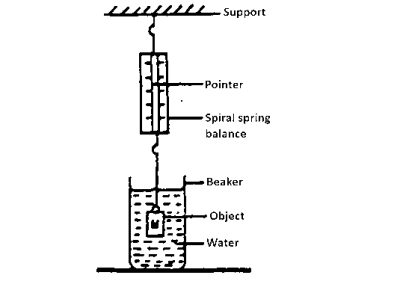
(ii) Determine the weight of the object when completely immersed in water contained in a beaker as shown in the diagram. Record the weight as W\(_2\).
(iii) Determine the weight of the object when it is completely immersed in the liquid labelled "L". Record the weight as W\(_3\). Evaluate u = (W\(_1\) - W\(_2\)) and v = (W\(_1\) - W\(_3\)).
(iv) Repeat the procedure with the objects of masses M = 10, 15, 20, and 25 g. In each case, evaluate v = (W\(_1\) - W\(_3\)) on the vertical axis against u = (W\(_1\) - W\(_2\)) on the horizontal axis.
(v) Determine the slope, s, of the graph.
(vi) State two precautions taken to ensure accurate results.[21 marks]
bi. A piece of brass of mass 20.0 g is hung on a spring balance from a rigid support and completely immersed in kerosene of density 8.0 \times 10\(^2\) kgm\(^{-3}\). Determine the reading on the spring balance. [g = 10 ms\(^{-2}\), density of brass = 8.0 \times 10\(^3\) kgm\(^{-3}\)]
(Provide your answer with unit e.g 123.123 m)
bii. Archimedes' Principle and Law of Floatation [2 marks]
Attached Figure / Diagram
medium Difficulty
Verified Correct Answer: Option
Physical Principles & Numerical Solution
1a. Tables of values
M(g)
W\(_1\)(g)
W\(_2\)(g)
W\(_3\)(g)
U = (W\(_1\) - W\(_2\)(g)
V = (W\(_1\) - W\(_3\)(g)
5.0
5.00
4.20
4.70
0.80
0.30
10.0
10.00
7.90
8.60
2.10
1.40
15.0
15.00
12.75
13.50
2.25
1.50
20.0
17.10
17.10
16.40
2.90
3.60
25.0
22.10
22.10
21.40
2.90
3.60
S = \(\frac{y_2 - y_1}{x_2 - x_1}\) = \(\frac{3 - 0.8}{2.8 - 1.4}\) = \(\frac{11}{7}\) = 1.57.
Precaution
(i) I carefully avoided parallax error while reading the scale of the spring balance to ensure accurate measurements.
(ii) I checked and accounted for any zero error on the spring balance before taking measurements.
(iii) I handled the liquid carefully to prevent any splashing, which could lead to loss of material or inaccurate readings.
(iv) I ensured that the object did not touch the bottom or sides of the beaker to avoid interference with the force readings.
(v) I thoroughly cleaned the object (mass) before dipping it into the liquid to prevent contamination or alteration of the liquid's properties.
bii) Law of Floatation: The law of floatation states that an object will float in a fluid if its weight is equal to the weight of the fluid it displaces. For a floating object, the weight of the object is balanced by the upward buoyant force.
Source: Myschool Past Questions Archive (Record #76565)
Physics
UTME / JAMB 2025
Heat Energy & Temperature
Solution
A method of demagnetization is
A
placing the magnetic bar in a solenoid
B
double-stroking the magnet with soft in n-s direction
C
heating a magnetic bar red hot and allowed to cool e-w direction
D
hammering the magnetic bar repeatedly in n-s direction
medium Difficulty
Verified Correct Answer: Option C
Physical Principles & Numerical Solution
This process disrupts the alignment of magnetic domains, effectively demagnetizing the bar.
Source: Official Exam / Past Question Archive
Physics
WAEC / WASSCE 2025
Heat Energy & Temperature
Solution
2a.
(i) Fix a metre rule on the bench with the graduated face up.
(ii) Place the illuminated object at the zero end of the rule and the screen at the other end as illustrated in the diagram above.
(iii) Measure and record D, the distance between the object and the screen. Evaluate D\(^2\)
(iv) Place and move the converging lens between the illuminated object and the screen until a diminished, sharp image of the object is formed on the screen. Read and record the position, x\(_1\), of the lens. From this position, move the lens towards the object until another sharp image of the object is formed on the screen. Read and record the position, x\(_2\), of the lens.
(v) Evaluate and record L = (x\(_1\) - x\(_2\)), L\(^2\) and (D\(^2\) - L\(^2\)).
(vi) Repeat the procedure for D = 90, 80, 70, and 60 cm. In each case, evaluate L, L\(^2\), and (D\(^2\) - L\(^2\)). Tabulate your readings.
(vii) Plot a graph of D\(^2\) - L\(^2\) on the vertical axis against D on the horizontal axis.
(viii) Determine the slope, s, of the graph and evaluate K = \(\frac{\text{s}}{4}\). State two precautions taken to ensure accurate results.[21 marks]
bi. Distinction Between Real and Virtual Images [2 marks]
ii. Draw a ray diagram to show how a converging lens may be used to form a real diminished image of an object [2 marks]
A
50.0\(\Omega\)
B
0.50\(\Omega\)
C
5.00\(\Omega\)
D
0.05\(\Omega\)
medium Difficulty
Verified Correct Answer: Option A
Physical Principles & Numerical Solution
2a. Table of observations
D(cm)
D\(^2\)(cm\^2\)
X\(_1\)(cm)
L = (X\(_1 - X_2\))
L\(^2\)(cm\(^2\))
100
10000
80.50
62.20
3868.8
90
8100
70.20
51.20
2621.4
80
6400
59.10
39.10
1528.8
70
4900
46.70
24.70
610.09
60
3600
29.00
21.40
457.96
S = \(\frac{y_2 - y_1}{x_2 - x_1}\) = \(\frac{6250 - 3250}{100 - 60}\) = \(\frac{3000}{40}\) = 75
K = \(\frac{\text{s}}{4}\) = \(\frac{75}{4}\) = 18.75
Precautions:
(i) I carefully avoided parallax error by ensuring my eyes were directly in line with the markings on the metre rule while taking measurements to improve accuracy.
(ii) I adjusted the setup and focused precisely to ensure a sharp and well-defined image was formed on the screen, minimizing errors due to blurriness or misalignment.
(iii) I made sure that the experimental apparatus was stable and free from vibrations to avoid any disturbance during measurements.
(iv) I ensured that the metre rule was properly calibrated and positioned perpendicular to the setup to prevent measurement inaccuracies due to angle errors.
bi. A real image is formed when light rays converge and meet at a point, allowing it to be projected onto a screen. It is typically inverted relative to the object, as seen in concave mirrors or convex lenses when the object is beyond the focal point.
On the other hand, a virtual image is formed when light rays appear to diverge from a point but do not actually meet. This type of image cannot be projected onto a screen and is always upright, as seen in plane mirrors or convex mirrors.
bii. See diagram above.
Source: Official Exam / Past Question Archive
Chemistry
UTME / JAMB 2025
Atomic Structure and Periodic Table
Solution
The molecule with the highest number of lone pair of electrons is
A
H\(_2\)O
B
NH\(_3\)
C
CH\(_4\)
D
C0\(_2\)
medium Difficulty
Verified Correct Answer: Option D
Chemical Principles & Mechanism
A lone pair of electrons is a pair of valence electrons in an atom that are not shared with another atom in a chemical bond, also known as a non-bonding pair. These electrons reside in the outermost electron shell, occupy space, and significantly influence a molecule's shape, polarity, and reactivity, often depicted as dots in Lewis structures.
To determine the number of lone pairs, we analyze the Lewis structure of each molecule:
CH\(_4\)(Methane): Carbon forms four single bonds with hydrogen atoms. There are zero lone pairs in the molecule.
NH\(_3\)(Ammonia): Nitrogen forms three single bonds with hydrogen atoms and has one lone pair of electrons.
H\(_2\)O(Water): Oxygen forms two single bonds with hydrogen atoms and has two lone pairs of electrons.
CO\(_2\)(Carbon Dioxide): Carbon forms two double bonds with oxygen atoms. Each oxygen atom has two lone pairs, totaling four lone pairs of electrons in the molecule. :. The molecule with the highest number of lone pairs of electrons is CO\(_2\) - Option D
Source: Myschool Past Questions Archive (Record #74083)
Chemistry
UTME / JAMB 2025
Matter & Separation Techniques
Solution
The composition of petroleum varies because it is a
A
hydrocarbon
B
liquid
C
mixture
D
natural resource
medium Difficulty
Verified Correct Answer: Option C
Chemical Principles & Mechanism
The correct option is C. mixture.
Petroleum is a naturally occurring complex mixture of various organic compounds, predominantly hydrocarbons, including alkanes, cycloalkanes and hydrocarbons. The exact composition of crude oil can vary depending on its source, location and geological history of the oil deposit.
The other options are not correct because:
A. hydrocarbon is a component of crude oil, but does not explain the variation in composition.
B. liquid is a state of matter, not a reason for variation in composition.
D. natural resources is a broad term that includes petroleum, but it doesn't specifically address the variation in composition.
Source: Myschool Past Questions Archive (Record #74084)
Chemistry
UTME / JAMB 2025
Matter & Separation Techniques
Diagram
Solution
In the table above, the two compounds that will combine in the presence of an acid-catalyzed compound, V is
Attached Figure / Diagram

A
I and IV
B
III and IV
C
I and II
D
II and III
medium Difficulty
Verified Correct Answer: Option A
Chemical Principles & Mechanism
Th formula RCOOR' represents alkanoates (esters). However, the two compounds that combine in the presence of an acid catalyst to form an alkanoate (ester) and water are an alkanoic acid (carboxylic acid) and an alkanol (alcohol). This reaction is known as esterification. The general equation is:
I IV Acid catalyst V
ROH + RCOOH → RCOOR' + H\(_2\)O
alkanol alkanoic acid esters water
B. The reaction between a carboxylic acid (RCOOH) and an ether (ROR′) generally does not readily occur under normal conditions because ethers are relatively unreactive. Ethers are stable compounds and do not typically react directly with carboxylic acids to form a new product.
C. The reaction between an alcohol (ROH) and a ketone (RCOR') can produce hemiacetals and, with excess alcohol and an acid catalyst, acetals.
ROH + RCOR' ⇌ R\(_2\)C(OH)(OR')
D. The functional groups involved are an ether (R-O-R′) and a ketone (R-CO-R′). Ethers are known for being generally unreactive, often used as solvents because they do not easily undergo chemical reactions. In the absence of specific strong reagents (like strong acids, bases, or reducing/oxidizing agents) or extreme conditions, these two stable organic compounds will simply coexist as a mixture, with no new product formed
The correct answer is option A
Source: Myschool Past Questions Archive (Record #74085)
Chemistry
UTME / JAMB 2025
Atomic Structure and Periodic Table
Solution
An example of an alkaline gas is
A
HCl
B
N\(_2\)
C
NH\(_3\)
D
NO\(_2\)
medium Difficulty
Verified Correct Answer: Option C
Chemical Principles & Mechanism
The correct answer is NH\(_3\) - option C
A. HCl (Hydrogen Chloride) is a colourless, pungent gas that is highly soluble in water, forming a strong acid (hydrochloric acid), and is classified as a hydrogen halide. While the gas itself isn't acidic (it needs water), it's highly corrosive and an air pollutant, reacting with moisture to create corrosive acid aerosols.
B. N\(_2\) is a neutral gas and not an alkaline gas because it's very unreactive and doesn't readily donate or accept protons or electron pairs when dissolved in water, showing no effect on litmus paper.
C. NH\(_3\) is an example of an alkaline gas. Ammonia (NH\(_3\)), which is a colourless gas with a pungent smell, forms basic (alkaline) solutions when dissolved in water, producing hydroxide ions.
D. NO\(_2\) is an acidic gas and not an alkaline gas because it reacts with water in the atmosphere to form nitric acid (HNO\(_3\) and nitrous acid(HNO\(_2\)), thereby forming acid rain.
:. The answer is NH\(_3\) - option C
Source: Myschool Past Questions Archive (Record #74086)
Chemistry
UTME / JAMB 2025
Matter & Separation Techniques
Solution
The dusty and sand particles present in the air is an example of
A
a suspension
B
a dispersion
C
an emulsion
D
a saturated solution
medium Difficulty
Verified Correct Answer: Option A
Chemical Principles & Mechanism
Dusty and sand particles present in the air form a suspension because it is a heterogeneous mixture where solid particles are dispersed in a gas (air).
B. a dispersion: is a general term for any system in which particles of one material are distributed in a continuous phase of another. Suspension is a specific type of dispersion.
C. an emulsion: is a specific type of colloid where both the dispersed phase and the dispersion medium are liquids that are typically immiscible (do not mix). Eg milk.
D. a saturated solution: is a homogeneous mixture (a true solution) where the maximum amount of a solute has been dissolved in a solvent at a specific temperature. The particles are molecular in size and do not settle. Air with dust and sand is not a solution as the particles do not dissolve.
The correct answer is suspension - option A
Source: Myschool Past Questions Archive (Record #74087)
Chemistry
UTME / JAMB 2025
Atomic Structure and Periodic Table
Solution
The property of metal that makes it suitable as a catalyst is
A
filled f-orbital
B
partially filled d-orbitals
C
partially filled f-orbital
D
filled d-orbital
medium Difficulty
Verified Correct Answer: Option B
Chemical Principles & Mechanism
Transition metals are elements in the d-block (Groups 3-12) of the periodic table, defined by having partially filled d-orbitals, allowing them to form multiple ions with varying charges, create coloured compounds, act as catalysts, and form strong alloys.
The catalytic activity of metals, particularly transition metals, is largely due to the presence of partially filled d-orbitals- Option B
A. filled f-orbital and C. partially filled f-orbital: These orbitals are characteristic of f-block elements (lanthanides and actinides), which have different properties and are not typically the primary metals used as catalysts in the way transition metals are.
D. filled d-orbital: Elements with completely filled d-orbitals in their common oxidation states (like zinc, cadmium, and mercury) are not considered transition metals and do not exhibit the same significant catalytic properties.
Source: Myschool Past Questions Archive (Record #74088)
Chemistry
UTME / JAMB 2025
Kinetics, Energetics and Equilibrium
Solution
When \DeltaH is positive and small, and \DeltaS is positive and large, the reaction will be
A
Non-spontaneous
B
favour forward reaction only
C
favour backward reaction only
D
spontaneous
medium Difficulty
Verified Correct Answer: Option D
Chemical Principles & Mechanism
The spontaneity of a reaction is determined by the Gibbs free energy change (\DeltaG), given by the equation: \DeltaG = \DeltaH − T\DeltaS.
For a reaction to be spontaneous, \DeltaG must be negative (\DeltaG < 0).
When a small positive number is subtracted from a large negative number (or a large positive T\DeltaS term) is subtracted from a small \DeltaH, the resulting \DeltaG. Therefore, a reaction with a positive (endothermic) and small \DeltaH, and a positive (increase in disorder) and large \DeltaS, will be spontaneous, especially at high temperatures where the T\DeltaS term dominates.
A. Non-spontaneous: A non-spontaneous reaction would have a positive \DeltaG. Under the given conditions, \DeltaG is negative, so the reaction is not non-spontaneous.
B. favour forward reaction only: A spontaneous reaction inherently favors the forward reaction, leading to the formation of products. Thus, "spontaneous" is a more complete and accurate thermodynamic description than just "favor forward reaction only," which could imply specific equilibrium conditions not fully defined by spontaneity alone (though they are related).
C. favour backward reaction only: The backward reaction is spontaneous if the forward reaction is non-spontaneous (\DeltaG>0). Since the forward reaction is spontaneous under these conditions, the backward reaction is non-spontaneous.
The correct answer is spontaneous - option D.
Source: Myschool Past Questions Archive (Record #74089)
Chemistry
UTME / JAMB 2025
Acids, Bases, and Salts
Solution
Calculate the pH of 0.001M KOH solution.
A
11
B
14
C
12
D
3
medium Difficulty
Verified Correct Answer: Option A
Chemical Principles & Mechanism
Given:
Concentration of OH = [OH\(^-\)] = 0.001 M
At 25\(^0\)C, pH + pOH = 14
Hence, to find pH of KOH, we need to find the pOH first, then substitute the value into the equation above.
Recall, pOH = - Log [OH\(^-\)]
= - Log [0.001]
= - ( - 3)
pOH = 3
pH + pOH = 14
pH + 3 = 14
pH = 14 - 3 = 11
;. pH = 11 - option A
Source: Myschool Past Questions Archive (Record #74103)
Chemistry
UTME / JAMB 2025
Acids, Bases, and Salts
Solution
The acid used in making baking soda and soft drink is
A
tartaric acid
B
fatty acid
C
boric acid
D
citric acid
medium Difficulty
Verified Correct Answer: Option A
Chemical Principles & Mechanism
Tartaric acid is a common edible acid used as a component of baking powder. It reacts with the baking soda (sodium bicarbonate) in the presence of moisture and heat to produce carbon dioxide gas, which causes baked goods to rise and become fluffy. It is also used industrially as an acidulant in many food products, including carbonated soft drinks, fruit jellies, and candies.
B. fatty acid: Fatty acids are carboxylic acids with long aliphatic chains and are a major component of fats and lipids. They are not used as an acidulant in soft drinks or as a component in baking powder.
C. boric acid: Boric acid is a weak acid often used as an antiseptic, insecticide, or fire retardant. It is not an edible acid used in food products like baking soda or soft drinks.
D. citric acid: While citric acid is a very common acidulant in soft drinks and other food products, where it provides a sharp, tangy flavor, tartaric acid is the option specifically associated with both baking soda (as a baking powder component) and soft drinks.
The correct answer is tartaric acid - option A
Source: Myschool Past Questions Archive (Record #74104)
Chemistry
UTME / JAMB 2025
Stoichiometry & Mole Concept
Solution
NH\(_3\) \((_g\)) + HCl\((_g\)) → NH\(_4\)Cl \(_(g)\)
In the reaction above, increase in pressure will
A
lower the equilibrium constant
B
favour the product
C
favour the reactant
D
increase the equilibrium constant
medium Difficulty
Verified Correct Answer: Option B
Chemical Principles & Mechanism
An increase in pressure will favour the forward reaction (production of NH\(_4\)Cl).
According to Le Chatelier's principle, increasing the pressure on a system at equilibrium will cause the equilibrium to shift in the direction that reduces the total number of moles of gas. In this reaction, the reactant side has two moles of gas (one NH\(_3\) and one HCl), while the product side has zero moles of gas (solid NH\(_4\)Cl). The system relieves the pressure by favoring the side with fewer gas molecules, thus promoting the formation of the solid product.
NH\(_3\) + HCl ⇌ NH\(_4\)Cl
An increase in pressure will favour the forward reaction (production of NH\(_4\)Cl).
Source: Myschool Past Questions Archive (Record #74105)
Chemistry
UTME / JAMB 2025
Atomic Structure and Periodic Table
Solution
The compound CH\(_3\)CH(NH\(_2\))CH\(_2\)CH\(_2\)CH\(_3\) is an example of a
A
primary amine
B
tertiary amine
C
quaternary amine
D
secondary amine
medium Difficulty
Verified Correct Answer: Option A
Chemical Principles & Mechanism
An amine is classified based on the number of carbon atoms directly bonded to the nitrogen atom. An amine is classified as primary, secondary, or tertiary based on the number of alkyl or aryl groups (carbon-containing groups) attached directly to the nitrogen atom.
B. tertiary amine: A tertiary amine has the nitrogen atom bonded to three carbon-containing groups and no hydrogen atoms.
C. quaternary amine: A quaternary amine (or quaternary ammonium salt) has the nitrogen atom bonded to four carbon-containing groups and carries a positive charge (it is an ion, not a neutral amine).
D. secondary amine: A secondary amine has the nitrogen atom bonded to two carbon-containing groups and one hydrogen atom.
In the compound CH\(_3\)CH(NH\(_2\))CH\(_2\)CH\(_2\)CH\(_3\),(also known as 2-pentanamine), the nitrogen atom is bonded to two hydrogen atoms and one alkyl group (the pentan-2-yl group). However, since the nitrogen atom is bonded to only one carbon-containing group, it is a primary amine.
The correct answer is primary amine - option A
Source: Myschool Past Questions Archive (Record #74106)