Question Library
Browse, filter, and study verified past examination questions with step-by-step mathematical reasoning.
Searching 18,000+ Questions...
Sifting topics, KaTeX formulas & verified solutions
Showing 376–390 of 29811 verified questions
Sort by:
Chemistry
UTME / JAMB 2025
Chemical Bonding
Solution
The type of bond between copper(II) tetraamine and chlorine in [Cu(NH\(_3\))\(_4\)]Cl\(_2\)
A
dative
B
van der waals
C
ionic
D
covalent
medium Difficulty
Verified Correct Answer: Option C
Chemical Principles & Mechanism
The compound [Cu(NH\(_3\))\(_4\)]Cl\(_2\) is an ionic compound composed of a complex cation, the tetraamminecopper(II) ion ([Cu(NH\(_3\))\(_4\)]\(^{2+}\)), and two chloride anions (Cl\(^−\)).
The primary force connecting the positively charged complex ion and the negatively charged chloride ions is the electrostatic attraction known as an ionic bond. This bond forms between species with a significant difference in electronegativity, specifically between a cation and an anion.
Dative bonds (coordinate covalent bonds) exist within the complex ion itself, specifically between the central copper(II) ion and the nitrogen atoms of the ammonia ligands.
Van der Waals forces and typical covalent bonds are not the main attractive forces between the distinct cation and anion units in this solid salt structure.
The correct answer is ionic - option C
Source: WAEC / JAMB / NECO Classroom Archive (Record #74137)
Chemistry
UTME / JAMB 2025
Unsaturated Saturated and Supersaturated Solutions
Solution
Commercial deodorant is an example of a colloid called
A
aerosol
B
sol
C
foam
D
emulsion
medium Difficulty
Verified Correct Answer: Option A
Chemical Principles & Mechanism
The commercial deodorant (specifically spray or mist form) is an example of a colloid called an aerosol.
In this type of colloid, the dispersed phase (the substance being spread out) is a liquid, while the dispersion medium (the substance the phase is dispersed in) is a gas (air or propellant).
Source: WAEC / JAMB / NECO Classroom Archive (Record #74248)
Chemistry
UTME / JAMB 2025
Endothermic and Exothermic Reactions
Diagram
Solution
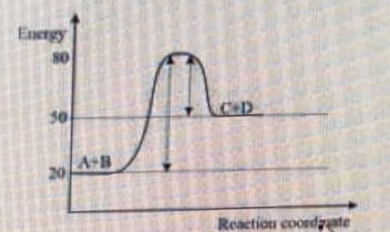
The reaction above illustrated is
Attached Figure / Diagram
A
spontaneous
B
endothermic
C
exothermic
D
reversible
medium Difficulty
Verified Correct Answer: Option B
Chemical Principles & Mechanism
In the reaction given, the chemical reaction can be re-written as A + B → C + D
This implies, A and B are the reactants, while C and D are the products.
The energy level of the products (C+D) is higher (50) on the graph than the energy level of the reactants (A+B), (20). The arrow representing the overall enthalpy change (\DeltaH) points upward, showing a gain in energy, resulting in a positive \DeltaH value.
i.e \DeltaH\(_{reaction}\) = \DeltaH\(_{product}\) - \DeltaH\(_{reactant}\)
\DeltaH\(_{reaction}\) = (C+D) - ( A+B)
= 50 - 20 = +30
\DeltaH\(_{reaction}\) = + ve , hence, it is an endothermic reaction - option B
Source: WAEC / JAMB / NECO Classroom Archive (Record #74881)
Physics
UTME / JAMB 2025
Waves and Optics
Solution
Which of these colours in the visible spectrum has the longest wavelength?
A
Red
B
Blue
C
Yellow
D
Violet
medium Difficulty
Verified Correct Answer: Option A
Physical Principles & Numerical Solution
Answer: A. Red (Visible spectrum: red ~700 nm, longest; violet ~400 nm, shortest.)
Source: Myschool Past Questions Archive (Record #74347)
Physics
UTME / JAMB 2025
Mechanics and Properties of Matter
Solution
The power of a lens in diopters is
A
3f
B
\(\frac{1}{\text{f}}\)
C
2f
D
f
medium Difficulty
Verified Correct Answer: Option B
Physical Principles & Numerical Solution
Lens power P = 1/f, where f is focal length in meters; unit is diopter.
Source: Myschool Past Questions Archive (Record #74348)
Physics
UTME / JAMB 2025
Heat Energy & Temperature
Solution
A man moves 6.0m East and then 10.0m N30ºE. How far is he from his starting point?
A
15.0m
B
17.0m
C
14.0m
D
12.0m
medium Difficulty
Verified Correct Answer: Option C
Physical Principles & Numerical Solution
The two displacements are 6.0 m East and 10.0 m at N30ºE.
The angle between East and N30ºE is 60^\circ.
Using the cosine rule:
R\(^2\) = 6\(^2\) +10\(^2\) +2(6)(10)cos60º
R\(^2\) = 36 + 100 +120 (0.5) = 196
R = \(\sqrt{196}\) = 14.0m
Source: Myschool Past Questions Archive (Record #74349)
Physics
UTME / JAMB 2025
Mechanics and Properties of Matter
Solution
The density of water is 1g/cm\(^3\) while that of ice is 0.9g/cm\(^3\). Calculate the change in volume when 90g of ice is completely melted.
A
9cm\(^3\)
B
90cm\(^3\)
C
0cm\(^3\)
D
10cm\(^3\)
medium Difficulty
Verified Correct Answer: Option D
Physical Principles & Numerical Solution
Answer: D. 10cm³
(Volume ice = \(\frac{90}{0.9}\) = 100 cm\(^3\);
volume water = \(\frac{90}{1}\) = 90 cm\(^3\);
change = 10 cm\(^3\) decrease.)
Source: Myschool Past Questions Archive (Record #74350)
Physics
UTME / JAMB 2025
Mechanics and Properties of Matter
Solution
The graphical representation of the pressure law is always a straight line passing through the origin, only if the temperature scale is
A
Rankine
B
Celsius
C
Fahrenheit
D
thermodynamic
medium Difficulty
Verified Correct Answer: Option D
Physical Principles & Numerical Solution
Answer: D. thermodynamic (Pressure law P ∝ T requires an absolute scale like Kelvin (thermodynamic) for a line through the origin at T= 0, P= 0. Rankine is also absolute but less common in this context.)
Source: Myschool Past Questions Archive (Record #74351)
Physics
UTME / JAMB 2025
Mechanics and Properties of Matter
Solution
According to the kinetic theory of gases, the pressure exerted by a gas on the walls equals.
A
Momentum imparted to the walls per unit area.
B
Change in momentum per unit volume.
C
Change in momentum imparted to the walls per unit area.
D
Rate of change of momentum imparted to the walls per second per unit area.
medium Difficulty
Verified Correct Answer: Option D
Physical Principles & Numerical Solution
D. Rate of change of momentum imparted to the walls per second per unit area. (Pressure = force/area = (rate of momentum change)/area from molecular collisions.)
Source: Myschool Past Questions Archive (Record #74352)
Physics
UTME / JAMB 2025
Waves and Optics
Solution
Which of the following is not true about a wave in a plucked string?
A
It is mechanical
B
It has a crest
C
It is transverse
D
It is longitudinal
medium Difficulty
Verified Correct Answer: Option D
Physical Principles & Numerical Solution
Answer: D.
It is longitudinal (String waves are transverse; perpendicular to propagation.
Source: Myschool Past Questions Archive (Record #74353)
Physics
UTME / JAMB 2025
Electricity and Magnetism
Solution
The emf of a cell is the potential difference across its terminals when it is in
A
series connection
B
closed circuit
C
open circuit
D
parallel connection
medium Difficulty
Verified Correct Answer: Option C
Physical Principles & Numerical Solution
Answer: C.
open circuit (EMF is maximum PD with no current drawn.
Source: Myschool Past Questions Archive (Record #74354)
Physics
UTME / JAMB 2025
Thermal Physics
Solution
The thermometric property of mercury is best on the change in
A
density with temperature
B
volume with temperature
C
pressure with temperature
D
resistance with temperature
medium Difficulty
Verified Correct Answer: Option B
Physical Principles & Numerical Solution
Answer: B.
volume with temperature (Mercury thermometers rely on thermal expansion of volume.)
Source: Myschool Past Questions Archive (Record #74355)
Physics
UTME / JAMB 2025
Waves and Optics
Solution
Some of the features of the human eye that greatly help to refract light entering the eyes are
A
cornea and lens
B
cornea and aqueous humor
C
lens and vitreous humor
D
aqueous humor and lens
medium Difficulty
Verified Correct Answer: Option A
Physical Principles & Numerical Solution
Answer: A.
cornea and lens (Main refractive structures.)
Source: Myschool Past Questions Archive (Record #74356)
Physics
UTME / JAMB 2025
Heat Energy & Temperature
Solution
The gravitational pull between two bodies is 20N. Find the gravitational pull when their distance of separation is doubled.
A
10N
B
5N
C
13N
D
20N
medium Difficulty
Verified Correct Answer: Option B
Physical Principles & Numerical Solution
Answer: B. 5N
(F ∝ \(\frac{1}{r^2}\);
doubled r → \(\frac{\text{F}}{4}\) = \(\frac{20}{4}\) = 5 N.)
Source: Myschool Past Questions Archive (Record #74363)
Physics
UTME / JAMB 2025
Thermal Physics
Solution
The volume of a 1 cm\(^3\) metal ball increases by 0.0018 cm\(^3\) when heated through temperature \theta. If the linear expansivity of the ball is 2.0 x 10\(^{-5} K^{-1}\), find \theta.
A
20°C
B
50°C
C
30°C
D
25°C
medium Difficulty
Verified Correct Answer: Option C
Physical Principles & Numerical Solution
Answer: C. 30^\circC
(Volume exp. γ = 3 \alpha = 6\times10\(^{-5}\)K\(^{-1}\);
\DeltaV = V γ \theta;
\theta = \(\frac{0.0018}{1 \times 6\times 10^{-5}}\) = 30^\circC.
Source: Myschool Past Questions Archive (Record #74364)