Question Library
Browse, filter, and study verified past examination questions with step-by-step mathematical reasoning.
Searching 18,000+ Questions...
Sifting topics, KaTeX formulas & verified solutions
Showing 29791–29805 of 29811 verified questions
Sort by:
Biology
UTME / JAMB 1978
Transport System in Plants & Animals
Solution
A potometer was used to compare the rate of loss of the same volume of water from a plant under different environmental conditions as under a fan, at the sea shore, under the sun, in the airy laboratory and in cupboard. What time was likely to have been obtained in a cupboard?
A
15 secs
B
30secs
C
25secs
D
20secs
E
28secs
medium Difficulty
Verified Correct Answer: Option B
Biological Concept & Syllabus Guide
A potometer is a scientific instrument used to measure the rate of water uptake in a leafy shoot, which is closely related to the rate of transpiration (water loss) from the plant. In other words, this is to test for rate of transpiration of the plant. This process of water loss from plants, is influenced by both internal and external factors, including temperature, humidity, light intensity, air movement, leaf structure, and water availability. However, the plant when kept in the cupboard will be deprived of those factors, thereby prolonging the time taken for transpiration to occur.
Consequently, the longest time which is 30 seconds is the best option.
Source: Myschool Past Questions Archive (Record #342)
Biology
UTME / JAMB 1978
Digestive System & Feeding Mechanisms
Solution
The mammalian stomach can carry out a number of processes except
A
absorption of glucose
B
secretion of hydrochloric acid
C
secretion gastric juice
D
churning of food
E
production of trypsin
medium Difficulty
Verified Correct Answer: Option E
Biological Concept & Syllabus Guide
Trypsin is a serine protease from the PA clan superfamily, found in the digestive system of many vertebrates, where it hydrolyzes proteins. Trypsin is formed in the small intestine
Source: Myschool Past Questions Archive (Record #343)
Biology
UTME / JAMB 1978
Cell & Its Environment (Diffusion, Osmosis & Transport)
Solution
A spirogyra cell placed was placed in solution X after 1 minute the cell has been plasmolysed, solution X was
A
Tap water
B
a very strong sugar solution
C
a weak sugar solution
D
a very weak salt solution
E
distilled water
medium Difficulty
Verified Correct Answer: Option B
Biological Concept & Syllabus Guide
When a plant cell is put in highly concentrated solution, it increases the pressure on the cell. Hence, plasmolysis holds in a highly concentrated solution.
Source: Myschool Past Questions Archive (Record #344)
Biology
UTME / JAMB 1978
Growth, Micro-organisms & Public Health
Solution
A farmer X working in a swamp did not eat any food nor drink any water. Which of this diseases can he not contact
A
Cholera
B
Bilharzia
C
River blindness
D
Malaria
E
Sleeping sickness
medium Difficulty
Verified Correct Answer: Option A
Biological Concept & Syllabus Guide
Cholera is a water-borne disease hence, it cannot be contacted by the farmer.
Source: Myschool Past Questions Archive (Record #345)
Biology
UTME / JAMB 1978
Transport System in Plants & Animals
Solution
A carbohydrate molecule in the blood in the right ventricles of the heart is pumped into the cell of the toe of a man. Which of these structure is it unlikely to pass through en-route
A
pulmonary artery
B
lungs
C
Heart
D
liver
E
aorta
medium Difficulty
Verified Correct Answer: Option D
Biological Concept & Syllabus Guide
Blood circulation holds in the circulatory system, the liver is a part of the digestive system. Hence, the liver can't be a part of the circulation process.
Source: Myschool Past Questions Archive (Record #346)
Biology
UTME / JAMB 1978
Nervous, Hormonal Coordination & Sense Organs
Solution
In a photo-tropic experiment, young seedlings in a box were subjected to light from one direction. The seedling continue to grow erect. Which of the following statement is correct
A
Only the tip of the seedling received the light
B
The light was not strong enough
C
The seedlings were rather too young
D
The tip of the seedling may have been covered
E
The box containing the seedling should have been placed on a laboratory bench
medium Difficulty
Verified Correct Answer: Option D
Biological Concept & Syllabus Guide
The correct answer is "the tip of the seedling may have been covered". If the tip of the seeding is covered, it would prevent the seedling from receiving the light signal, which is necessary for phototropism. As a result the seedling will continue to grow erect, without bending towards the light.
On the other hand, if only the tip of the seedling received the light, it would like respond by bending towards the light source.
Source: Myschool Past Questions Archive (Record #347)
Biology
UTME / JAMB 1978
Reproduction in Plants & Animals
Solution
Which of these is not a characteristics of a wind pollinated flowers?
A
A smaller quantities of sticky pollen produce
B
Feathery styles of stigmas pendulously hang outrside the flower
C
small inconspicuous scentless flower
D
large anthers which are loosley attached to the filament
E
Light pollen grains produced in large quantities from the anthers
medium Difficulty
Verified Correct Answer: Option A
Biological Concept & Syllabus Guide
Wind-pollinated grains are non-sticky and light, to ensure they can be blown by the wind.
Source: Myschool Past Questions Archive (Record #348)
Biology
UTME / JAMB 1978
Nutrition in Plants & Animals (Photosynthesis & Food Substances)
Solution
A germinating seed requires oxygen which is essential for
A
Converting carbohydrate into glucose
B
Transporting energy from one part of the plant to another
C
The production of energy by oxidising essential carbohydrate
D
Hydrolysis of proteins
E
The formation of water molecules within the germinating seed
medium Difficulty
Verified Correct Answer: Option C
Biological Concept & Syllabus Guide
A germinating seed requires oxygen, which is essential for cellular respiration to produce energy. This energy is vital for the seed to grow and develop, powering the metabolic activities needed for sprouting. Oxygen allows the seed to break down stored carbohydrates through oxidation, releasing energy in the form of ATP.
Source: Myschool Past Questions Archive (Record #349)
Biology
UTME / JAMB 1978
Excretion & Homeostasis
Solution
Which of these products obtained from analyzing sweat from skin is not an excretory product?
A
water
B
Salts
C
Dust
D
Urea
E
Urates
medium Difficulty
Verified Correct Answer: Option C
Biological Concept & Syllabus Guide
Dust is not an excretory product from the human.
Source: Myschool Past Questions Archive (Record #350)
Biology
UTME / JAMB 1978
Variation & Genetics (Heredity)
Solution
In a breeding program a cross was made between two true breeding cow-pea types: one with round seeds and the other with wrinkled seed. If roundness is dominant why wrinkleness is recessive, in the first filial generation all the seeds produced will be
A
25% wrinkled, 75% round
B
100% wrinkled
C
50% wrinkled, 50% round
D
75% wrinkled, 25% round
E
100% round
medium Difficulty
Verified Correct Answer: Option E
Biological Concept & Syllabus Guide
Owing to the dominance of roundness, the crossing of the two seeds regularly would see all the offsprings having mixed genes but will be round.
Let RR = round seeds while RR = wrinkled seed
In the first filial generation, if we cross RR x rr
We'll have Rr, Rr, Rr, Rr
Remember that RR is dominant while rr is recessive
Therefore, All the four offsprings will be Dominant Round i.e 100% Round
Source: Myschool Past Questions Archive (Record #351)
Biology
UTME / JAMB 1978
Cell Structure, Organization & Cell Division
Diagram
Solution
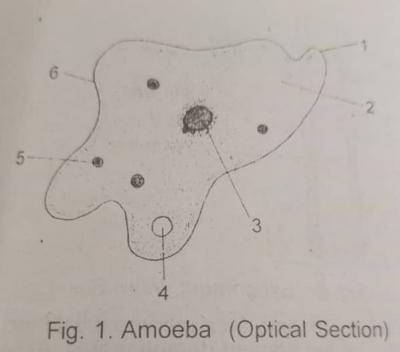
During reproduction of the organism in figure above(ameoba) the first structure to divide is?
Attached Figure / Diagram
A
1
B
2
C
3
D
4
E
5
medium Difficulty
Verified Correct Answer: Option C
Biological Concept & Syllabus Guide
The part labeled 3 is the Nucleus which is the first to divide by BINARY FISSION.
Source: Myschool Past Questions Archive (Record #15470)
Biology
UTME / JAMB 1978
Respiration & Gaseous Exchange
Diagram
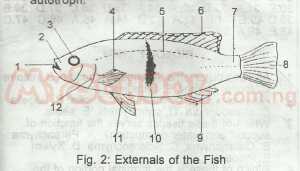
The part numbered 12 is
Attached Figure / Diagram
A
pectoral fin
B
scale
C
opercular plate
D
gill plate
E
pectoral girdle
medium Difficulty
Verified Correct Answer: Option C
Biological Concept & Syllabus Guide
No expanded working has been attached for this question yet. The verified answer is Option C.
Source: Myschool Past Questions Archive (Record #15471)
Biology
UTME / JAMB 1978
Variety of Organisms & Classification of Living Things
Diagram
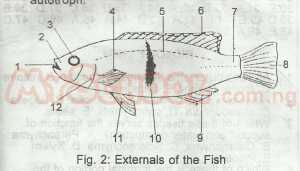
During the movement of the fish from point A to target B, one of these parts is not involved
Attached Figure / Diagram
A
7
B
5
C
3
D
6
E
10
medium Difficulty
Verified Correct Answer: Option E
Biological Concept & Syllabus Guide
No expanded working has been attached for this question yet. The verified answer is Option E.
Source: Myschool Past Questions Archive (Record #15474)
Biology
UTME / JAMB 1978
Respiration & Gaseous Exchange
Diagram
Solution
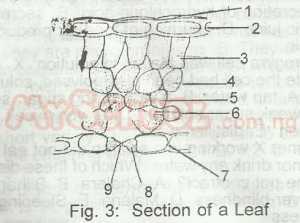
The number shown as 8 refers to
Attached Figure / Diagram
A
upper epidermise
B
cuticle
C
stoma
D
guard cell
E
lower epidermis
medium Difficulty
Verified Correct Answer: Option D
Biological Concept & Syllabus Guide
The part labelled 8 is the guard cell. It's function is to regulate the opening and closing of stomata, which are small pores on the leaf surface. This regulation is crucial for controlling gas exchange (primarily CO\(_2\) uptake for photosynthesis and O\(_2\) release) and water loss (transpiration).
(See diagram above for better understanding)
Source: Myschool Past Questions Archive (Record #15475)
Biology
UTME / JAMB 1978
Nutrition in Plants & Animals (Photosynthesis & Food Substances)
Diagram
The structure responsible for trapping the sun's energy during photosynthesis is
Attached Figure / Diagram
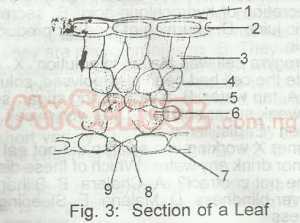
A
5
B
6
C
3
D
2
E
8
medium Difficulty
Verified Correct Answer: Option C
Biological Concept & Syllabus Guide
No expanded working has been attached for this question yet. The verified answer is Option C.
Source: Myschool Past Questions Archive (Record #15477)