Question Library
Browse, filter, and study verified past examination questions with step-by-step mathematical reasoning.
Searching 18,000+ Questions...
Sifting topics, KaTeX formulas & verified solutions
Showing 29746–29760 of 29811 verified questions
Sort by:
Physics
UTME / JAMB 1978
Current Electricity & Electric Circuits
Solution
Two lamps are rated 40W and 220V each are connected in series. The total power dissipated in both lamps is
A
10W
B
20W
C
40W
D
80W
E
None of the above
medium Difficulty
Verified Correct Answer: Option D
Physical Principles & Numerical Solution
The total power dissipated by both lamps = 40W + 40W = 80W
Since they are connected in series, the total power dissipated will be equal to the sum of the power dissipated in each lamp.
Source: Myschool Past Questions Archive (Record #41580)
Physics
UTME / JAMB 1978
Current Electricity & Electric Circuits
Diagram
Solution
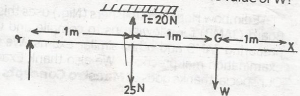
In The Diagram, what is the value of W
Attached Figure / Diagram
A
5N
B
10N
C
15N
D
20N
E
30N
medium Difficulty
Verified Correct Answer: Option B
Physical Principles & Numerical Solution
W x 2 = 20 x 1
2W = 20
W = \(\frac{20}{2}\) = 10N
(the given diagram is incomplete)
Source: Myschool Past Questions Archive (Record #41593)
Physics
UTME / JAMB 1978
Electrostatics & Capacitors
Diagram
Solution
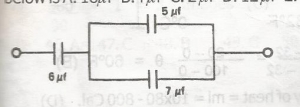
The equivalent capacitance for the circuit drawn above is
Attached Figure / Diagram
A
18µf
B
4µf
C
2µf
D
12µf
E
13µf
medium Difficulty
Verified Correct Answer: Option B
Physical Principles & Numerical Solution
capacitors 5microfarad and 7microfarad are parallel to each other, hence effective capacitance = 5 + 7 = 12microfarad
12microfarad and 6 microfarad are in series then effective capacitance =
\(\frac{1}{6} + \frac{1}{12}\)
= \(\frac{3}{12}\)
then effective capacitance = \(\frac{12}{3}\) = 4microfarad
Source: Myschool Past Questions Archive (Record #41594)
Physics
UTME / JAMB 1978
Reflection, Refraction & Dispersion of Light
Diagram
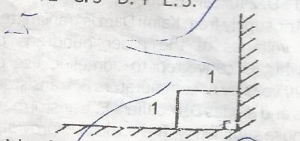
An object is positioned between two plane mirrors inclined at right angles to each other. The object is 1 unit from each mirror. The number of images formed is
Attached Figure / Diagram
A
1
B
2
C
3
D
4
E
5
medium Difficulty
Verified Correct Answer: Option C
Physical Principles & Numerical Solution
No expanded working has been attached for this question yet. The verified answer is Option C.
Source: Myschool Past Questions Archive (Record #41595)
Chemistry
UTME / JAMB 1978
Stoichiometry, Mole Concept & Volumetric Analysis
A gas jar was inverted over burning yellow phosphorus floating over water in a beaker. After burning, the water level was found to rise in the gas jar. The water level rises because
A
pressure inside the gas jar is greater than pressure outside it
B
the air in the gas jar had been used up by burning
C
oxygen in the gas jar had been used up by burning
D
nitrogen in the gas jar had been used up by burning
E
the temperature in the jar had risen considerably
medium Difficulty
Verified Correct Answer: Option C
Chemical Principles & Mechanism
No expanded working has been attached for this question yet. The verified answer is Option C.
Source: Myschool Past Questions Archive (Record #768)
Chemistry
UTME / JAMB 1978
Non-Metals & Their Compounds
Solution
You are provided with five gas jars containing SO2, CO2, H2, CO and NO respectively. Select a test from A to E which will identify ANY ONE of the gases completely
A
pass each gas into lime water
B
pass each gas into water and test with litmus paper
C
pass each gas into concentrated sulphuric acid
D
expose each gas to atmospheric air
E
expose each gas to fumes of hydrogen chloride
medium Difficulty
Verified Correct Answer: Option D
Chemical Principles & Mechanism
Option D is correct because exposing the gas jars to atmospheric air allows Nitrogen(II) oxide (NO) to be definitively identified. (NO) is a colourless gas that immediately reacts with oxygen in the atmospheric air to form Nitrogen(IV) oxide ((NO\(_2\)), which is a highly visible reddish-brown gas.
Option A is incorrect because passing the gases into lime water (Ca(OH)\(_2\)) cannot completely isolate a single gas. While carbon dioxide (CO\(_2\)) turns lime water milky due to the formation of insoluble calcium carbonate (CaCO\(_3\)), sulphur dioxide (SO\(_2\)) also turns lime water milky by forming an insoluble precipitate of calcium sulfite (CaSO\(_3\)). Therefore, it fails to identify just one gas completely.
Source: Myschool Past Questions Archive (Record #776)
Chemistry
UTME / JAMB 1978
Acids, Bases, pH & Salts
Which of the following substances would you see as an indicator in the titration of sodium carbonate solution against hydrochloric acid (complete neutralisation)?
A
Litmus paper
B
Phenolphthalein
C
Methyl orange
D
Universal indicator
E
None of these
medium Difficulty
Verified Correct Answer: Option C
Chemical Principles & Mechanism
No expanded working has been attached for this question yet. The verified answer is Option C.
Source: Myschool Past Questions Archive (Record #779)
Chemistry
UTME / JAMB 1978
Atomic Structure, Orbitals & Nuclear Chemistry
Diagram
Solution
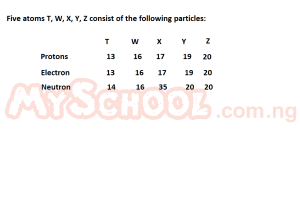
Which of the five atoms can be described by the following properties: Relative atomic mass is greater than 30 but less than 40, it has odd atomic number and forms a unipositive ion in solution?
Attached Figure / Diagram
A
T
B
W
C
X
D
Y
E
Z
medium Difficulty
Verified Correct Answer: Option D
Chemical Principles & Mechanism
Y = 19 protons, 19 electrons and 20 neutrons.
Y has electronic configuration 2, 8, 8, 1. Hence, it has one valence electron in the outer shell (Valency of +1).
Mass number = protons + neutrons
= 19 + 20
= 39.
Source: Myschool Past Questions Archive (Record #7493)
Chemistry
UTME / JAMB 1978
Stoichiometry, Mole Concept & Volumetric Analysis
Solution
A solid X when heated gives off a brown gas. If X is soluble in excess sodium hydroxide solution but insoluble in excess ammonium hydroxide solution, then X is
A
basic lead carbonate
B
lead (II) nitrate
C
sodium carbonate
D
zinc nitrate
E
sodium nitrate
medium Difficulty
Verified Correct Answer: Option B
Chemical Principles & Mechanism
Lead nitrate reacts with ammonium hydroxide solution to form a white precipitate. This white precipitate does not dissolve in excess ammonium hydroxide.
Source: Myschool Past Questions Archive (Record #7494)
Chemistry
UTME / JAMB 1978
Water, Solutions & Solubility
Diagram
Solution
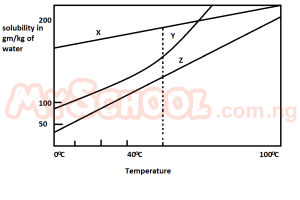
Consider the solubility curves of three salts X, Y and Z given in the diagram. If each solution of the salt contains 200 g, and is heated to 100\(^o\)C, which solution or solutions will deposit 100 g of the solute when suddenly cooled to 0\(^o\)C?
Attached Figure / Diagram
A
X only
B
Y only
C
Z only
D
X and Z
E
Y and Z
medium Difficulty
Verified Correct Answer: Option E
Chemical Principles & Mechanism
If you study the curve very well, looking at the y-axis where we have the solubility, you will discover that Salt X exceeds the 100g/kg mark while Salt Y and do not. This simply implies that solutions Y and Z will deposit 100 g of the solute when suddenly cooled to 0\(^o\)C, since they didn't exceed the solubility value of 100g, abinitio.
Source: Myschool Past Questions Archive (Record #7501)
Chemistry
UTME / JAMB 1978
Particulate Nature of Matter, Laws & Formulae
Diagram
Solution
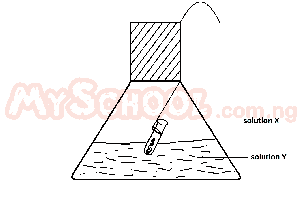
An experiment test of the Law of conservation of Mass is illustrated in the diagram. In practice, the flask is weighed before and after reaction between solutions X and Y. Which of the following pairs of solutions will be unsuitable for the experiments
Attached Figure / Diagram
A
X = hydrochloric acid; Y = silver nitrate
B
X = barium chloride; Y = dilute sulphuric acid
C
X = hydrochloric acid; Y = sodium hydroxide
D
X = hydrochloric acid; Y = lead nitrate
E
X = hydrochloric acid; Y = sodium carbonate
medium Difficulty
Verified Correct Answer: Option E
Chemical Principles & Mechanism
Option E won't be suitable because it contains HCl (acid) and Sodium carbonate ( Carbonate) which will liberate CO\(_2\). Hence the mass of the product will not be same as the mass before the reaction.
Source: Myschool Past Questions Archive (Record #7509)
Chemistry
UTME / JAMB 1978
Stoichiometry, Mole Concept & Volumetric Analysis
Five compounds R,T,W,X and Y form the following compounds: a basic hydride R.H, an acidic hydride YH, atmospheric oxide W2O3, XO2. which of the elements is an alkali
A
R
B
T
C
W
D
X
E
Y
medium Difficulty
Verified Correct Answer: Option A
Chemical Principles & Mechanism
No expanded working has been attached for this question yet. The verified answer is Option A.
Source: Myschool Past Questions Archive (Record #7512)
Chemistry
UTME / JAMB 1978
Stoichiometry, Mole Concept & Volumetric Analysis
Solution
The size (diameter) of five elements are in the order R < T < W < X < Y, Y being the largest. If each atom has an electron situated on its circumference, and neglecting other factors, which of the atoms will lose its electron most reluctantly?
A
R
B
T
C
W
D
X
E
Y
medium Difficulty
Verified Correct Answer: Option A
Chemical Principles & Mechanism
The larger the circumference of the atom, the farther the distance from the nucleus and the lesser the effect of the positively charged nucleus on the outermost electron, and vice versa hence R is the correct option
Source: Myschool Past Questions Archive (Record #7516)
Chemistry
UTME / JAMB 1978
Stoichiometry, Mole Concept & Volumetric Analysis
Solution
The size (diameter) of five elements are in the order R < T < W < X < Y, Y being the largest. If each atom has an electron situated on its circumference, and neglecting other factors, which of the atoms will lose its electron most reluctantly?
A
R
B
T
C
W
D
X
E
Y
medium Difficulty
Verified Correct Answer: Option A
Chemical Principles & Mechanism
The larger the circumference of the atom, the farther the distance from the nucleus and the lesser the effect of the positively charged nucleus on the outermost electron, and vice versa hence R is the correct option
Source: Official Exam / Past Question Archive
English Language
UTME / JAMB 1978
Synonyms (Nearest in Meaning)
Solution
Choose the option which is nearest in meaning to the sentences in each of the following questions.
We visited the home of one boy. That's the boy I mean.
A
that's the boy whom we visited his home
B
that's the boy whose home we visited
C
that's the boy to whose home we visited
D
that's the boy the home of whom we visited
E
purposely find a balance
medium Difficulty
Verified Correct Answer: Option B
Grammar & Contextual Explanation
"Whom" should be used as the object of a verb or preposition, not to indicate possession. "Whose" correctly indicates possession, referring to the home belonging to the boy.
Source: Official Exam / Past Question Archive