Question Library
Browse, filter, and study verified past examination questions with step-by-step mathematical reasoning.
Searching 18,000+ Questions...
Sifting topics, KaTeX formulas & verified solutions
Showing 29566–29580 of 29811 verified questions
Sort by:
Chemistry
UTME / JAMB 1978
Water, Solutions & Solubility
Solution
Which of the following compounds will form a solution if exposed to air?
A
Na2CO3.10H2O
B
NaNO3
C
CuSO4
D
CaCl2
E
Na2SO4.10H2O
medium Difficulty
Verified Correct Answer: Option D
Chemical Principles & Mechanism
Calcium chloride is a deliquescent substance. It attracts water from the atmosphere and then forms a solution.
Source: Myschool Past Questions Archive (Record #741)
Chemistry
UTME / JAMB 1978
Organic Chemistry I: Hydrocarbons & Crude Oil
The most common type of chemical reaction which alkanes undergo is
A
substitution
B
addition
C
condensation
D
polymerisation
E
double decomposition
medium Difficulty
Verified Correct Answer: Option A
Chemical Principles & Mechanism
No expanded working has been attached for this question yet. The verified answer is Option A.
Source: Myschool Past Questions Archive (Record #742)
Chemistry
UTME / JAMB 1978
Chemical Energetics & Thermochemistry
Consider the following exothermic reaction
2SO2(g) + O2(g) ↔ 2SO3(g)
If the temperature of the reaction is reduced from 800°C to 500°C, an no other change takes place, then
A
the reaction rate increases
B
concentration of SO3 decreases
C
concentration of SO3 increases
D
SO2 gas becomes unreactive
E
O3 gas becomes unreactive
medium Difficulty
Verified Correct Answer: Option C
Chemical Principles & Mechanism
No expanded working has been attached for this question yet. The verified answer is Option C.
Source: Myschool Past Questions Archive (Record #743)
Chemistry
UTME / JAMB 1978
Oxidation, Reduction & Redox Reactions
Solution
If excess zinc is added to a bluish green solution of copper (II) sulphate, and the excess zinc filtered off after completion of reaction, a colourless solution is obtained because
A
both zinc and copper are metals
B
the sulphate radical and the zinc ion are divalent
C
zinc is more electropositive than copper
D
both zinc and copper form depositive ions in solution
E
zinc is a reducing agent
medium Difficulty
Verified Correct Answer: Option C
Chemical Principles & Mechanism
Zinc displaces copper from copper sulphate and generates zinc sulphate solution when added to CuSO\(_4\) solution because zinc is a more reactive metal that displaces less reactive metal from its solution. This implies Zinc is more electropositive than Copper. The colour change shows it.
Source: Myschool Past Questions Archive (Record #745)
Chemistry
UTME / JAMB 1978
Acids, Bases, pH & Salts
Solution
Three solutions contain carbonate, sulphate and sulphide ions respectively. One test that will identify just ONE of them completely is by addition to each of them of
A
barium chloride solution
B
dilute hydrochloric acid
C
lead nitrate solution
D
calcium chloride solution
E
sodium hydroxide solution
medium Difficulty
Verified Correct Answer: Option C
Chemical Principles & Mechanism
To distinguish between carbonate, sulphate, and sulphide ions, you can use dilute hydrochloric acid (HCl) and barium chloride (BaCl\(_2\)). Carbonates will react with HCl to produce a gas that turns limewater milky, sulphates react with BaCl\(_2\) to form a white precipitate, and sulphides will produce a gas with a rotten egg smell when reacted with HCl.
Silver nitrate solution is used to distinguish Cl-
When an aqueous solution of silver nitrate is added to the Cl- ion, white ppt of silver chloride is formed.
AgNO\(_3\)(aq) + Cl\(^-\)(aq) → AgCl(s) + NO\(_3\)\(^–\)(aq)
Barium chloride solution is used to distinguish SO\(_4\)\(^{2–}\) ion.
Again,when an aqueous solution of barium chloride is added to the SO\(_4\)\(^{2–}\) ion, a white ppt of barium sulphate is formed which is not soluble in weak or strong acids.
BaCl\(_2\)(aq) + SO\(_4\)\(^{2–}\)(aq) → BaSO\(_4\)(s) + 2Cl\(^-\)(aq)
Since dilute HCl can give reaction with both Carbonate ion and Sulphide ion, then it can not be the answer because the question says "one test that will identify just one of them".
Also, Pb(NO₃)₂ can distinguish between carbonate, sulphate, and sulphide solutions based on the formation of precipitates: PbCO₃ (white ppt), PbSO₄ (white ppt), and PbS (black) respectively.
Consequently, since Pb(NO₃)₂ can distinguish between carbonate, sulphate, and sulphide solutions, it implies it is the best option, and definitely our valid answer.
Source: Myschool Past Questions Archive (Record #746)
Chemistry
UTME / JAMB 1978
Organic Chemistry I: Hydrocarbons & Crude Oil
Solution
Two gas cylinders contain ethylene (ethene) and acetylene respectively. One test which can be used to distinguish between them is by?
A
passing each gas through bromine water
B
passing each gas through dilute potassium permanganate solution
C
passing each gas through silver nitrate solution
D
treating each gas catalytically with excess hydrogen gas
medium Difficulty
Verified Correct Answer: Option C
Chemical Principles & Mechanism
Acetylene reacts with ammoniacal AgNO3 solution to form a white precipitate of silver acetylide (AgC-=Cag) but ethylene does not
Source: Myschool Past Questions Archive (Record #756)
Chemistry
UTME / JAMB 1978
Oxidation, Reduction & Redox Reactions
Solution
Consider the following equation H2O + 2Fe2+ + Cl2 ↔ 2Fe3+ + 2Cl- + H2O. Which behaves as an oxidizing agent?
A
Fe2+
B
Cl2
C
Fe3+
D
Cl-
E
H2O
medium Difficulty
Verified Correct Answer: Option B
Chemical Principles & Mechanism
- An oxidizing agent is a substance that causes oxidation by accepting electrons; therefore, it gets reduced. A reducing agent is a substance that causes reduction by losing electrons; therefore it gets oxidized.
- Common examples of oxidizing agents include halogens (such as chlorine and fluorine)
Source: Myschool Past Questions Archive (Record #759)
Chemistry
UTME / JAMB 1978
Non-Metals & Their Compounds
If hydrogen sulphide gas is passed into a solution of a pure iron chloride, a yellow deposit appears. If the deposit is filtered, a pale green solution is left behind. The pale green solution is
A
dilute sulphuric acid
B
dilute hydrochloric acid
C
unreacted hydrogen sulphide in water
D
iron (III) chloride
E
Iron (II) chloride
medium Difficulty
Verified Correct Answer: Option E
Chemical Principles & Mechanism
No expanded working has been attached for this question yet. The verified answer is Option E.
Source: Myschool Past Questions Archive (Record #761)
Chemistry
UTME / JAMB 1978
Stoichiometry, Mole Concept & Volumetric Analysis
Which of the following changes is physical?
A
Adding iron filing to aerated water
B
Adding sodium metal to water
C
Cooling a solution of Iron (II) sulphate to obtain the hydrated salt
D
Cooling water to obtain ice
E
Burning the domestic gas (Utilgas) for cooking
medium Difficulty
Verified Correct Answer: Option D
Chemical Principles & Mechanism
No expanded working has been attached for this question yet. The verified answer is Option D.
Source: Myschool Past Questions Archive (Record #762)
Chemistry
UTME / JAMB 1978
Organic Chemistry II: Functional Groups, Polymers & Biomolecules
Solution
By means of filtration, one component can be obtained pure from an aqueous mixture of sodium chloride and?
A
potassium nitrate
B
sand
C
lead nitrate
D
sugar (glucose)
E
starch
medium Difficulty
Verified Correct Answer: Option B
Chemical Principles & Mechanism
Use enough water to completely submerge the sand-salt mixture. Stir or shake the mixture for a few minutes so that the salt dissolves in the water.
The sand is insoluble, so it will remain visible.
Source: Myschool Past Questions Archive (Record #766)
Chemistry
UTME / JAMB 1978
Stoichiometry, Mole Concept & Volumetric Analysis
Solution
In titration involving sodium hydroxide and dilute hydrochloric acid, where would you place the base?
A
in the beaker
B
in the conical flask
C
in a burette
D
in the standard flask
E
in the measuring cylinder
medium Difficulty
Verified Correct Answer: Option B
Chemical Principles & Mechanism
Add a few drops of indicator and put the conical flask on a white tile. Fill the burette with acid and note the starting volume. Slowly add the acid from the burette to the alkali in the conical flask, swirling to mix.
Source: Myschool Past Questions Archive (Record #767)
Mathematics
UTME / JAMB 1978
Trigonometry, Elevation & Bearings
Solution
Evaluate without using tables sin(-1290º)
A
\(\frac{3}{2}\)
B
-\(\frac{3}{2}\)
C
\(\frac{2}{2}\)
D
1
E
\(\frac{1}{2}\)
medium Difficulty
Verified Correct Answer: Option E
Step-by-Step Mathematical Solution
sin(-1290º) = -sin(1290º)
sin([3*360] + 210)
where sin 360 = 0 and sin 210 = 180 + 30 ⇔ -30º
-sin ([3* 0] + [-30])
-sin(-30)
sin30 = \(\frac{1}{2}\)
Source: WAEC / JAMB / NECO Classroom Archive (Record #32724)
Mathematics
UTME / JAMB 1978
Indices, Logarithms & Surds
Diagram
Solution
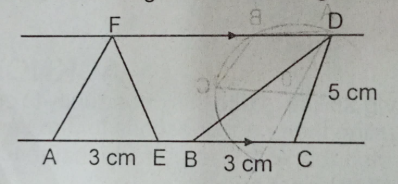
In the Figure FD\\AC, the area of AEF = 6sq.cm. AE = 3cm, BC = 3cm, CD = 5cm, < BCD is an obtuse angle. Find the length of BD.
Attached Figure / Diagram
A
\(\sqrt{33}\)
B
6
C
4
D
2\(\sqrt{13}\)
E
4\(\sqrt{5}\)
medium Difficulty
Verified Correct Answer: Option D
Step-by-Step Mathematical Solution
Area of triangle AEF = 6sq. cm
area of triangle = \(\frac{1}{2}\)bh (Line DX makes right angles with the parallel lines)
6 = \(\frac{1}{2}\) x 3 x h
6 = 3h
3h = \(\frac{12}{3}\)
h = 4 = DX
From D, C x D, CX\(^2\) = 5\(^2\)
- 4\(^2\) = 25 - 16 = 9
Cx = 3. From angle B x D, Bx = 6(i.e. 3 + 3)
BD\(^2\) = 4\(^2\) + 6\(^2\)
= 16 + 36 = 52
BD = \(\sqrt{4 \times 13}\)
= 2\(\sqrt{13}\)
Source: WAEC / JAMB / NECO Classroom Archive (Record #32731)
Mathematics
UTME / JAMB 1978
Plane Geometry, Polygons & Circle Theorems
Diagram
Solution
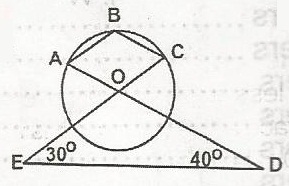
In the figure, 0 is the centre of the circle ABC, < CED = 30o, < EDA = 40o. What is the size of < ABC?
Attached Figure / Diagram
A
70o
B
110o
C
130o
D
125o
E
145o
medium Difficulty
Verified Correct Answer: Option D
Step-by-Step Mathematical Solution
If < CED = 30º, and < EDA = 40º then
Source: WAEC / JAMB / NECO Classroom Archive (Record #32732)
Mathematics
UTME / JAMB 1978
Indices, Logarithms & Surds
Solution
If x\(^2\) + 4 = 0, then x ?
A
4
B
-4
C
2
D
-2
E
None of the above
medium Difficulty
Verified Correct Answer: Option E
Step-by-Step Mathematical Solution
x\(^2\) + 4 = 0
x\(^2\) = -4
You can't apply a square root to a negative number. So the answer is None of the above.
Source: WAEC / JAMB / NECO Classroom Archive (Record #32692)