Question Library

Browse, filter, and study verified past examination questions with step-by-step mathematical reasoning.

Launch Interactive Practice
Searching 18,000+ Questions... Sifting topics, KaTeX formulas & verified solutions
Showing 29161–29175 of 29811 verified questions
Sort by:
Chemistry UTME / JAMB 1980 Atomic Structure, Orbitals & Nuclear Chemistry
Given the mean atomic mass of chlorine prepared in the laboratory to be 35.5 and assuming that chlorine contains two isotopes of mass number 35 nad 37, what is the percentage composition of the isotope of mass number 35?
A
20
B
25
C
50
D
75
E
90
medium Difficulty
Chemistry UTME / JAMB 1980 Oxidation, Reduction & Redox Reactions
In which of the following is the oxidation state of oxygen different from its value in water?
A
OH-
B
H3O+
C
O-
D
H2O2
E
SO2
medium Difficulty
Chemistry UTME / JAMB 1980 Stoichiometry, Mole Concept & Volumetric Analysis
Which of the following silver halides is readily soluble in ammonium hydroxide?
A
Agl
B
AgBr
C
AgCl
D
AgF
E
None of the above
medium Difficulty
Chemistry UTME / JAMB 1980 Electrolysis & Electrochemical Cells
The chemical reaction which takes place at the anode (positive electrode) in electrolysis is?
A
oxidation
B
hydrolysis
C
dissociation
D
reduction
E
disproportionation
medium Difficulty
Chemistry UTME / JAMB 1980 Stoichiometry, Mole Concept & Volumetric Analysis
Which of the following does NOT happen when a zinc rod is introduced into a solution of copper (ll) sulphate?
A
Electrons flow towards the zinc rod
B
The zinc rod dissolves
C
The temperature of the soil changes
D
The blue colour of the solution gradually disappears
E
Copper metal is deposited
medium Difficulty
Chemistry UTME / JAMB 1980 Stoichiometry, Mole Concept & Volumetric Analysis
Hardening of an oil may be achieved by?
A
boiling the oil with water
B
boiling the oil with a catalyst
C
treating the oil with sodium hydroxide
D
treating the oil with hydrogen and catalyst
E
distilling oil under reduced pressure
medium Difficulty
Chemistry UTME / JAMB 1980 Stoichiometry, Mole Concept & Volumetric Analysis
Hardening of an oil may achieved by?
A
boiling the oil with water
B
boiling the oil with a catalyst
C
treating the oil with sodium hydroxide
D
treating the oil with hydrogen and catalyst
E
distilling oil under reduced pressure
medium Difficulty
Chemistry UTME / JAMB 1980 Electrolysis & Electrochemical Cells
A cold aqueous solution of sodium chloride is electrolyzed using a graphite anode and an iron cathode. In the course of the electrolysis the electrolyte is continuously stirred. The liquid left after electrolysis will therefore consist of?
A
sodium hydroxide solution
B
chlorine water
C
pure water
D
sodium hypochlorite solution
E
hydrochloric acid solution
medium Difficulty
Chemistry UTME / JAMB 1980 Stoichiometry, Mole Concept & Volumetric Analysis
The best way of collecting chlorine is?
A
by downward displacement of air
B
by upward displacement of air
C
over water
D
under water
E
over mercury
medium Difficulty
Chemistry UTME / JAMB 1980 Organic Chemistry II: Functional Groups, Polymers & Biomolecules
Cellulose and starches can be classified as one of the following?
A
sugars
B
sucrose
C
hydrocarbons
D
carbohydrates
E
isomers
medium Difficulty
Chemistry UTME / JAMB 1980 Stoichiometry, Mole Concept & Volumetric Analysis
If one of the following oxides is heated with hydrogen or carbon using a bunsen burner, it is not reduced to the metal. Which one is it?
A
Lead oxide
B
Magnesium oxide
C
Copper oxide
D
Tin oxide
E
Iron oxide
medium Difficulty
Chemistry UTME / JAMB 1980 Organic Chemistry II: Functional Groups, Polymers & Biomolecules
A mixture of ethanol, sodium dichromate, and water is allowed to drop gradually into a boiling solution containing one part concentrated H2SO 4 and the liberate gas is collected by cooling it with ice water to give a liquid. This liquid is?
A
ethanoic acid
B
acetaldehyde
C
ethyl acetate
D
methanol
E
ethylene
medium Difficulty
Chemistry UTME / JAMB 1980 Organic Chemistry II: Functional Groups, Polymers & Biomolecules
Detergents are more advantageous than soaps in hard water districts because
A
on treatment with hard water they either form soluble calcium salts or do not react with calcium ion
B
on treatment with hard water they form soluble calcium salts
C
on treatment with hard water they form sodium salts
D
on treatment with hard water they are converted into soaps
E
on treatment with hard water they form more lather than soaps does
medium Difficulty
Chemistry UTME / JAMB 1980 Periodic Table & Periodicity
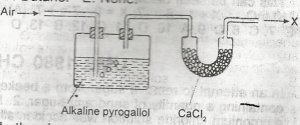
In the above experiment X is?
Attached Figure / Diagram
Question diagram
A
pure nitrogen
B
a mixture of nitrogen and oxygen
C
a mixture of nitrogen and carbondioxide
D
a mixture of oxygen and inert gases
E
a mixture of nitrogen and inert gases
medium Difficulty
Chemistry UTME / JAMB 1980 Stoichiometry, Mole Concept & Volumetric Analysis
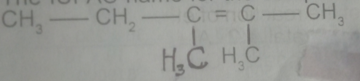
The IUPAC name for the compound is
Attached Figure / Diagram
Question diagram
A
2,3-dimethylpent-2,3-ene
B
2, 3- dimethylpent-2-ene
C
3, 4-dimethylpent-3-ene
D
3,4-dimethylpentene
E
3,4-dimethlhept-2-ene
medium Difficulty
Page 1945 of 1988