Question Library
Browse, filter, and study verified past examination questions with step-by-step mathematical reasoning.
Searching 18,000+ Questions...
Sifting topics, KaTeX formulas & verified solutions
Showing 28981–28995 of 29811 verified questions
Sort by:
Mathematics
UTME / JAMB 1980
Indices, Logarithms & Surds
Solution
Solve the system of equation 2\(^{x + y}\) = 32, \(3^{3y - x}\) = 27
A
(3, 2)
B
(-3, 2)
C
(3, -2)
D
(-3, -2)
E
(2, 2)
medium Difficulty
Verified Correct Answer: Option A
Step-by-Step Mathematical Solution
\(2^{x + y} = 32, 3^{3y - x}\) = 27
\(2^{x + y} = 2^5\)
\(3^{3y - x} = 3^3\)
equating powers, we have
x + y = 5 ------------1
3y - x = 3 ------------2
solving simultaneously(any method)
x = 3 and y = 2
Source: Myschool Past Questions Archive (Record #32632)
Mathematics
UTME / JAMB 1980
Plane Geometry, Polygons & Circle Theorems
Solution
Simplify the given expression \(\sqrt{\frac{1 - cos x}{1 + cos x}}\)
A
\(\frac{1 - cos x}{sin x}\)
B
1 - cos x
C
sin x
D
1 + cos x
E
\(\frac{1 + cos x}{sin x}\)
medium Difficulty
Verified Correct Answer: Option A
Step-by-Step Mathematical Solution
\(\sqrt{\frac{1 - cos x}{1 + cos x}}\) = a
a2 = \(\frac{1 - cosx}{1 + cosx}\)
\(\frac{1 - cosx}{1 + cosx}\) = \(\frac{1 - cosx}{1 - cosx}\)
= \(\frac{(1 - cosx)^2}{cos^2 x}\)
a2 = \(\frac{(1 - cos x)^2}{sin^2 x}\)
a = \(\frac{1 - cos x}{sin x}\)
Source: Myschool Past Questions Archive (Record #32633)
Mathematics
UTME / JAMB 1980
Mensuration (Areas, Perimeters & Volumes)
Solution
Find the area of the curved surface of a cone whose base radius is 6cm and whose height is 8cm. (take \(\pi\) = \(\frac{22}{7}\))
A
188.57cm2
B
1320cm2
C
188cm2
D
188.08cm2
E
10cm2
medium Difficulty
Verified Correct Answer: Option A
Step-by-Step Mathematical Solution
S = curved surface area = \(\pi\)rL
= \(\frac{22}{7}\) x 6 x 10
= 188.57cm2
Source: Myschool Past Questions Archive (Record #32634)
Mathematics
UTME / JAMB 1980
Linear, Simultaneous & Quadratic Equations
Solution
Solve the equation for the positive values of \(\theta\) less than 360o. 3 tan \(\theta\) + 2 = -1
A
135o or 315o
B
45o or 135o
C
315o or 180o
D
315v + 45o
E
360o or 315o
medium Difficulty
Verified Correct Answer: Option A
Step-by-Step Mathematical Solution
3 tan \(\theta\) + 2 = -1
3 tan \(\theta\) \(\frac{-3}{3}\) = -1
\(\theta\) = tan -1(-1)
\(\theta\) = 360o - 45o
= 315o
\(\theta\) = 180 - 45o = 135o
Source: Myschool Past Questions Archive (Record #32635)
Mathematics
UTME / JAMB 1980
Indices, Logarithms & Surds
Solution
Given log 2 = 0.69, log3 = 1, 10 and log7 = 1.90, all to a fixed base, find log 10.5 to the same base without using tables.
A
1.03
B
2.31
C
3.69
D
10.5
E
25
medium Difficulty
Verified Correct Answer: Option B
Step-by-Step Mathematical Solution
log 10.5 = log \(\frac{21}{2}\)
= log 21 - log 2
= log(3 x 7) - log 2
= log 3 + log 7 - log 2
= 1.10 + 1.90 - 0.69
= 3 - 0.69
= 2.31
Source: Myschool Past Questions Archive (Record #32636)
Mathematics
UTME / JAMB 1980
Plane Geometry, Polygons & Circle Theorems
Solution
Simplify 102 + log105
A
500
B
2 log10 5
C
10
D
25
E
log105 x 10100
medium Difficulty
Verified Correct Answer: Option E
Step-by-Step Mathematical Solution
102 + log105 = log10 10100 + log105
= log105 x 10100
Source: Myschool Past Questions Archive (Record #32637)
Mathematics
UTME / JAMB 1980
Plane Geometry, Polygons & Circle Theorems
Solution
Find the missing numerator \(\frac{5}{x + 1}\) - \(\frac{3}{1 - x}\) - \(\frac{7x - 1}{x^2 - 1}\) = \(\frac{?}{x + 1}\).
A
-1
B
x - 1
C
\(\frac{3(1 - 5x)}{x + 1}\)
D
1
E
3(1 - 5x)
medium Difficulty
Verified Correct Answer: Option D
Step-by-Step Mathematical Solution
\(\frac{5}{x + 1} - \frac{3}{1 - x} - \frac{7x - 1}{x^{2} - 1} = \frac{?}{x + 1}\)
\(\frac{5(x - 1) - 3(- (x + 1)) - (7x - 1)}{x^{2} - 1}\)
= \(\frac{5x - 5 + 3x + 3 - 7x + 1}{x^{2} - 1}\)
= \(\frac{x - 1}{x^{2} - 1}\)
= \(\frac{x - 1}{(x - 1)(x + 1)}\)
= \(\frac{1}{x + 1}\).
The numerator = 1.
Source: Myschool Past Questions Archive (Record #32638)
Mathematics
UTME / JAMB 1980
Linear, Simultaneous & Quadratic Equations
Solution
The expression x\(^3\) - 4x\(^2\) + cx + d is such that x + 1 is its factor, and its value is 1 when x is -2. Find c and d.
A
c = 4 and d = -9
B
c = -4 and d = 9
C
c = -20 and d = -15
D
c = 20 and d = -15
E
c = -20 and d = 15
medium Difficulty
Verified Correct Answer: Option C
Step-by-Step Mathematical Solution
F(X) = x\(^3\) - 4x\(^2\) + cx + d
= (X + 1) Q(X) + R
x = -1, R = 0,f(-1) = -1\(^3\) - 4(-1)\(^2\) + c(-1) + d = 0
-1 - 4 - c + d = 0
d - c = 5................(i)
f(-2) = -2\(^3\) - 4(-2)\(^2\) + c(-2) + d = 1
= -8 - 16 - 2c + d
= 1
-8 - 16 - 2c + d = 1
-24 - 2c + d = 1
d - 2c = 1 + 24
d - 2c = 25.................(ii)
\(\frac{d - c = 5}{-c = 20}\) d - c = 5
c = -20
d - (-20) = 5
d + 20 = 5
d = 5 - 20
= -15
c = -20, d = -15
Source: Myschool Past Questions Archive (Record #32639)
Mathematics
UTME / JAMB 1980
Plane Geometry, Polygons & Circle Theorems
Solution
If a function is defined by f(x + 1) = 3x2 - x + 4, Find f(0).
A
4
B
6
C
9
D
8
E
2
medium Difficulty
Verified Correct Answer: Option D
Step-by-Step Mathematical Solution
f(x + 1) = 3x2 - x + 4
f(0) = f(x + 1)
x + 1 = 0 ===> x = -1
f(0) = 3(-1)2 - (-1) + 4
f(0) = 3 + 1 + 4
= 8
Source: Myschool Past Questions Archive (Record #32640)
Mathematics
UTME / JAMB 1980
Mensuration (Areas, Perimeters & Volumes)
Solution
A cylindrical motor of height 12cm has uniform thickness of 2cm. If the diameter of its outer cross section is 10cm, Find the volume of the constituent material. (take \(\pi\) = \(\frac{22}{7}\)
A
\(\frac{6600}{7}\)cm3
B
270cm3
C
660cm3
D
\(\frac{4224}{7}\)cm3
E
\(\frac{1980}{7}\)cm3
medium Difficulty
Verified Correct Answer: Option D
Step-by-Step Mathematical Solution
V = \(\pi\)r2h
= \(\frac{22}{7}\) x 52 x 12 - \(\frac{22}{7}\) x 32 x 12
= \(\frac{22}{7}\) x 12(52 - 32)
= \(\frac{4224}{7}\)
Source: Myschool Past Questions Archive (Record #32641)
Mathematics
UTME / JAMB 1980
Variations
If x varies inversely as y, and y varies directly as the square root of z, and z varies directly \(\frac{1}{w^2}\) write down in words how x varies with w
A
x varies inversely as w2
B
x varies directly as w2
C
x varies directly as w
D
x varies inversely as w
E
x varies directly as square root of w
medium Difficulty
Verified Correct Answer: Option B
Step-by-Step Mathematical Solution
No expanded working has been attached for this question yet. The verified answer is Option B.
Source: Myschool Past Questions Archive (Record #32642)
Mathematics
UTME / JAMB 1980
Number Bases & Modular Arithmetic
Solution
Write the decimal number 39 to base 2
A
100111 base 2
B
110111 base 2
C
111001 base 2
D
100101 base 2
E
19.5 base 2
medium Difficulty
Verified Correct Answer: Option A
Step-by-Step Mathematical Solution
To convert the decimal number 39 to base 2, we can use the method of successive division by 2 and record the remainders. Here’s the process:
1. Divide 39 by 2:
\(39 \div 2 = 19 \quad \text{remainder: } 1\)
2. Divide 19 by 2:
\(19 \div 2 = 9 \quad \text{remainder: } 1\)
3. Divide 9 by 2:
\(9 \div 2 = 4 \quad \text{remainder: } 1\)
4. Divide 4 by 2:
\(4 \div 2 = 2 \quad \text{remainder: } 0\)
5. Divide 2 by 2:
\(2 \div 2 = 1 \quad \text{remainder: } 0\)
6. Divide 1 by 2:
\(1 \div 2 = 0 \quad \text{remainder: } 1\)
Now, we read the remainders from bottom to top:
Thus, the binary representation of 39 is: 100111\(_2\)
Source: Myschool Past Questions Archive (Record #32643)
Mathematics
UTME / JAMB 1980
Plane Geometry, Polygons & Circle Theorems
Diagram
Solution
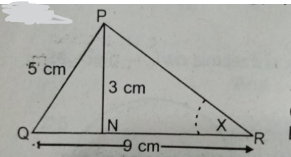
If PN is perpendicular to QR, find the value of tan x.
Attached Figure / Diagram
A
\(\frac{5}{9}\)
B
\(\frac{3}{5}\)
C
\(\frac{3}{4}\)
D
\(\frac{4}{3}\)
E
\(\frac{5}{3}\)
medium Difficulty
Verified Correct Answer: Option B
Step-by-Step Mathematical Solution
By Pythagoras QN = 4
Since, QR = 9, and QN = 4, then, NR = 5
Tan x = \(\frac{3}{5}\)
Source: Myschool Past Questions Archive (Record #32743)
Mathematics
UTME / JAMB 1980
Fractions, Decimals, Percentages & Approximations
Diagram
Solution
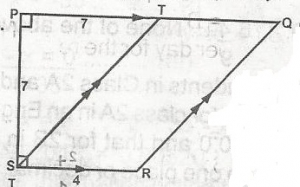
In the figure, PQ\\SR, ST\\, ST\\RQ, PS = 7cm, PT = 7cm, SR = 4cm. Find the ratio of the area QRST to the area of PQRS.
Attached Figure / Diagram
A
56.77
B
56.105
C
28:105
D
28:49
E
56:49
medium Difficulty
Verified Correct Answer: Option B
Step-by-Step Mathematical Solution
Area of QRST = 4 x 7 = 28
Area of PQRS = \(\frac{1}{2}\)(4 + 11) x 7
= \(\frac{7}{2}\) x \(\frac{15}{1}\)
= 28:52.5
= 56:105
Source: Myschool Past Questions Archive (Record #32744)
Mathematics
UTME / JAMB 1980
Plane Geometry, Polygons & Circle Theorems
Diagram
Solution
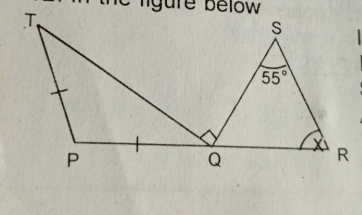
In the figure, If PT is parallel to RS, PQ = PT, and angle SQT = 90o, Find x
Attached Figure / Diagram
A
35o
B
50o
C
55o
D
70o
E
80o
medium Difficulty
Verified Correct Answer: Option D
Step-by-Step Mathematical Solution
from the diagram above, angle b = 180º - 55º - x ( 55º not 56º)
sum of angle at Q = y + 90º + 180º - 55º - x = 180º( sum of angles on a straight line)
y - x = -35 ..................................... eq1
sum of angle in triangle TPQ = 180º - x + 2y = 180º ( sum of angles in a triangle )
2y - x = 0 ............................................eq2
solving eq1 and eq 2 simultaneously
x = 70º
Source: Myschool Past Questions Archive (Record #32745)