Question Library
Browse, filter, and study verified past examination questions with step-by-step mathematical reasoning.
Searching 18,000+ Questions...
Sifting topics, KaTeX formulas & verified solutions
Showing 28576–28590 of 29811 verified questions
Sort by:
Chemistry
UTME / JAMB 1982
Electrolysis & Electrochemical Cells
Solution
A current of 10.0A was passed for 1 hour through a solution of copper (ll) sulphate between the copper electrodes. Which of the following observation would be correct?
(1 Faraday = 96,500 coulombs) (i) 0.186 mole of copper is dissolved from the anode. (ii) 0.372 mole of copper is deposited on the cathode. (iii) the original Cu2+ ion concentration of the solution remains unchanged. (iv) the original Cu2+ ion concentration of the solution decreases.
A
i and ii
B
i and iii
C
i and iv
D
ii and iii
E
ii and iv
medium Difficulty
Verified Correct Answer: Option C
Chemical Principles & Mechanism
Cu\(^{2+}\) + 2e- → Cu
1mole of electron = 1F = Number of moles of Cu ions
2moles = 2F = 1 mole of Cu
2 x 96500C = I mole of Cu
10 x 3600C = x moles
X = \(\frac{36000}{193000}\)
X = 0.186 mole of Cu dissolved from the anode.
Also, during electrolysis, copper ions are reduced to copper metals at the cathode(negative electrode). This, however, decreases the concentration of Cu ions present in the solution due to the reduction reaction at the cathode.
These make option C the correct answer.
Source: Myschool Past Questions Archive (Record #14070)
Chemistry
UTME / JAMB 1982
Oxidation, Reduction & Redox Reactions
In the preparation of carbon monoxide by heating ethanedioic acid with concentrated sulphuric acid, the concentrated sulphuric acid act as?
A
an oxidizing agent
B
a reducing agent
C
a dehydrating agent
D
a reaction medium
E
a catalyst
medium Difficulty
Verified Correct Answer: Option C
Chemical Principles & Mechanism
No expanded working has been attached for this question yet. The verified answer is Option C.
Source: Myschool Past Questions Archive (Record #14071)
Chemistry
UTME / JAMB 1982
Non-Metals & Their Compounds
When copper powder is heated with concentrated sulphuric acid, the gas produced is?
A
hydrogen sulphide
B
sulphur dioxide
C
sulphur trioxide
D
hydrogen pentasulphide
E
sulphur pentoxide
medium Difficulty
Verified Correct Answer: Option B
Chemical Principles & Mechanism
No expanded working has been attached for this question yet. The verified answer is Option B.
Source: Myschool Past Questions Archive (Record #14073)
Chemistry
UTME / JAMB 1982
Stoichiometry, Mole Concept & Volumetric Analysis
Magnesium ribbon was added to each of the following aqueous solution in turn: H2SO4, AgNO3, HNO3, HCl, NH3, HCl, NH3. In which case does the magnesium become covered with a dark precipitate?
A
H2SO4
B
AgNO3
C
HNO3
D
NH3
E
HCl
medium Difficulty
Verified Correct Answer: Option B
Chemical Principles & Mechanism
No expanded working has been attached for this question yet. The verified answer is Option B.
Source: Myschool Past Questions Archive (Record #14075)
Chemistry
UTME / JAMB 1982
Stoichiometry, Mole Concept & Volumetric Analysis
Solution
How many grams of methylacetylene (propyne) CH\(_3\) — C Ξ CH will completely discharge the colour of 8g of bromine?
(Br = 80, C = 12, H = 1)
A
0.5
B
1.0
C
2.0
D
3.0
E
4.0
medium Difficulty
Verified Correct Answer: Option B
Chemical Principles & Mechanism
CH\(_3\) - C≡CH + 2Br\(_2\) → CH\(_3\)-CBr\(_2\) -CH(Br\(_2\))
1 mole : 2 moles
Recall that n = \(\frac{m}{M}\)
Molar mass of Br\(_2\) = 80 x 2 = 160 g/mol
n = \(\frac{8}{160}\)
n = 0.05 mole
If 1 mole of CH\(_3\) - C≡CH reacts with 2 moles of Br\(_2\)
then X mole of CH\(_3\) - C≡CH will react with 0.05 mole of Br\(_2\)
X = \(\frac{0.05}{2}\)
X = 0.025 mole of CH\(_3\) - C≡CH
Also, recall that n = \(\frac{m}{M}\)
Molar mass of CH\(_3\) - C≡CH = C3H4 = (12 X 3) + (1 X 4) = 40 g/mol
n = \(\frac{m}{M}\)
n = 0.025 x 40 = 1.0 g
Source: Myschool Past Questions Archive (Record #14076)
Chemistry
UTME / JAMB 1982
Stoichiometry, Mole Concept & Volumetric Analysis
Solution
What weight of sodium hydroxide is required to make 500 cm\(^3\) of 0.2 M solution?
(Na = 23, O = 16, H = 1)
A
40 g
B
20 g
C
10 g
D
4 g
E
2 g
medium Difficulty
Verified Correct Answer: Option D
Chemical Principles & Mechanism
Given:
Volume, V = 500cm\(^3\)
Concentration , C = 0.2 M
n = \(\frac{CV}{1000}\)
n = \(\frac{{0.2}\times{500}}{1000}\)
n = 0.1 mole
Also, recall that n = \(\frac{mass}{Molar mass}\) = \(\frac{m}{M}\)
m = n X M
Molar mass of NaOH = 23 + 16 + 1 = 40g/mol
m = 0.1 x 40 = 4g
Source: Myschool Past Questions Archive (Record #14077)
Chemistry
UTME / JAMB 1982
Reaction Rates & Chemical Equilibrium
Solution
Which of the following combinations of conditions may increase the rate of a chemical reaction?
A
Decrease in temperature, increase in concentration of the reactants
B
Increase in temperature, addition of a catalyst, decrease in the surface area of the reactants
C
Increase in temperature, increase in concentration, addition of a catalyst and increase in the surface area of the reactants
D
Decrease in temperature concentration and surface area of the reactants
E
Additionof a catalyst and in the absence of light
medium Difficulty
Verified Correct Answer: Option C
Chemical Principles & Mechanism
Adding a catalyst increases the rate of a chemical reaction. A catalyst is a substance that speeds up a reaction without being used up in the process. Also, increasing the surface area of a reactant increases the rate of a chemical reaction. This is because it increases the number of collisions between the reactants. Similarly, increasing the temperature also affects the rate of chemical reaction. Therefore, Increase in temperature, increase in concentration, adding a catalyst and increase in surface area affect the rate of chemical reaction.
Source: Myschool Past Questions Archive (Record #14079)
Chemistry
UTME / JAMB 1982
Oxidation, Reduction & Redox Reactions
Solution
Which of the following is NOT a redox reaction?
A
2HNO2 + 2HI → 2H2O + 2NO + I2
B
Zn + H2SO4 → ZnSO4 + H2
C
Ca(HCO3)2 → CaCO3 + H2O + CO2
D
4FeO + O2 → 2Fe2O3
E
2Na + Cl2 → 2NaCl
medium Difficulty
Verified Correct Answer: Option C
Chemical Principles & Mechanism
Ca(HCO2) → CaCO3 + H2O + CO2 is not a redox reaction
Source: Myschool Past Questions Archive (Record #14080)
Chemistry
UTME / JAMB 1982
Organic Chemistry I: Hydrocarbons & Crude Oil
Solution
0.16g of methane when burnt raises the temperature of 100g of water by 40°C. What is the of combustion of methane when if the heat capacity of water is 4.2 Jg-1°C-1?
(CH4 = 16)
A
1,160 kJ mol-1
B
1,180 kJ mol-1
C
1,560 kJ mol-1
D
1,600kJ mol-1
E
1,680 kJ mol-1
medium Difficulty
Verified Correct Answer: Option E
Chemical Principles & Mechanism
The heat of combustion of methane is 1680 KJ mol-1
Source: Myschool Past Questions Archive (Record #14082)
Chemistry
UTME / JAMB 1982
Nature of Matter & Separation Techniques
Solution
Which of the following processes NOT lead to a chemical change?
A
Strirring iron in sulphur (IV) acid
B
Stirring sodium carbonate in water
C
Stirring glucose in concentrated sulphur (IV) acid
D
Mixing sulphur (IV) acid with potassium carbonate
E
Titrating an acid against base
medium Difficulty
Verified Correct Answer: Option B
Chemical Principles & Mechanism
Stirring Na2CO3 in water does not lead to a chemical change
Source: Myschool Past Questions Archive (Record #14084)
Chemistry
UTME / JAMB 1982
Metals, Transition Elements & Extraction
Solution
Brass is an alloy containing copper and?
A
zinc
B
tin
C
aluminium
D
silver
E
lead
medium Difficulty
Verified Correct Answer: Option A
Chemical Principles & Mechanism
Brass is an alloy containing copper and zinc
Source: Myschool Past Questions Archive (Record #14086)
Chemistry
UTME / JAMB 1982
Stoichiometry, Mole Concept & Volumetric Analysis
Solution
The number of grammes of potassium hydroxide in 250cm3 of one molar solution is?
(K = 39, O = 16, H = 1)
A
40g
B
52g
C
100g
D
26g
E
14g
medium Difficulty
Verified Correct Answer: Option E
Chemical Principles & Mechanism
1000 cm3 of KOH contains 56 gm of KOH
250 cm3
of 1M KOH will contain (250)/(1000) x (56)/(1) = 14gms
Source: Myschool Past Questions Archive (Record #14087)
Chemistry
UTME / JAMB 1982
Stoichiometry, Mole Concept & Volumetric Analysis
Solution
60cm3 of hydrogen are sparked with 20cm3 of oxygen at 100^\circC and 1 atmosphere. The total volume of the residual gases is?
A
60 cm3
B
10 cm3
C
40 cm3
D
30 cm3
E
70 cm3
medium Difficulty
Verified Correct Answer: Option A
Chemical Principles & Mechanism
Equation of the reaction
2\(H_2 + O_2 → 2(H_2O_2\))
no of moles: 2 1 → 2
initial volume: 60cm\(^3\) 20cm\(^3\) 0cm\(^3\)
vol used 40cm\(^3\) 20cm\(^3\) -----
after sparking 20cm\(^3\) 0cm\(^3\) 40cm\(^3\)
Therefore, the total volume of residual gases = 20cm\(^3\) left of hydrogen + 40cm\(^3\) of stream produced = 60cm\(^3\)
Source: Myschool Past Questions Archive (Record #14088)
Chemistry
UTME / JAMB 1982
Water, Solutions & Solubility
Diagram
Solution
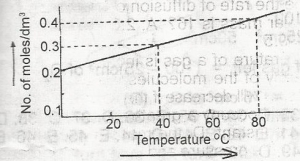
The solubility curve of a solid X (molecular mass = 160) is as show above. 1,000 cm3 of a saturated solution of X at 80^\circC is cooled to 40^\circC . The weight of X crystalized out would be
Attached Figure / Diagram
A
10 g
B
12 g
C
14 g
D
16 g
E
18 g
medium Difficulty
Verified Correct Answer: Option D
Chemical Principles & Mechanism
At 80^\circC, we have \(1000cm^{3} = 0.4mol/cm^{3}\)
40^\circC = \(0.3mol/cm^{3}\)
hence, the loss in concentration = \(0.1mol/cm^{3}\)
= \(0.1 \times 160 = 16g\)
Source: Myschool Past Questions Archive (Record #31314)
Chemistry
UTME / JAMB 1982
Organic Chemistry I: Hydrocarbons & Crude Oil
Diagram
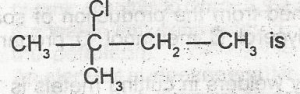
The i.u.p.A.C name for the compound
Attached Figure / Diagram
A
2-chloro-isopentane
B
3-chloro-isopentane
C
2-chloro-2-methylbutane
D
1-chloro-2,2- dimethylpropane
E
2-chloro-2-ethylpropane
medium Difficulty
Verified Correct Answer: Option C
Chemical Principles & Mechanism
No expanded working has been attached for this question yet. The verified answer is Option C.
Source: Myschool Past Questions Archive (Record #31315)