Question Library
Browse, filter, and study verified past examination questions with step-by-step mathematical reasoning.
Searching 18,000+ Questions...
Sifting topics, KaTeX formulas & verified solutions
Showing 271–285 of 29811 verified questions
Sort by:
Physics
WAEC / WASSCE 2025
Simple Machine
Solution
A machine has an efficiency of 60%. If the machine is required to overcome a load of 30N with a force of 20N. Calculate its mechanical advantage.
A
1.5
B
0.9
C
0.7
D
2.5
medium Difficulty
Verified Correct Answer: Option A
Physical Principles & Numerical Solution
E = 60%, L = 30N, E = 20N
M.A = \(\frac{\text{L}}{\text{E}}\) = \(\frac{30}{20}\) = 1.5
Source: WAEC / JAMB / NECO Classroom Archive (Record #76337)
Physics
WAEC / WASSCE 2025
Linear Motion & Kinematics
Solution
A boy cycles continuously through a distance of 1.0km in 5 minutes. Calculate his average speed.
A
0.3m/s
B
16.6m/s
C
20.0m/s
D
3.3m/s
medium Difficulty
Verified Correct Answer: Option D
Physical Principles & Numerical Solution
Average speed = \(\frac{\text{total distance}}{\total time taken}}\)
d = 1. 0km ⇒ 1000m
t = 5minutes ⇒ 5 x 60 = 300 seconds
Average speed = \(\frac{1000}{300}\) = 3.3m/s
Source: WAEC / JAMB / NECO Classroom Archive (Record #76330)
Physics
WAEC / WASSCE 2025
Linear Motion & Kinematics
Solution
A car travelling at a uniform speed of 120km/hr passes two stations in 4minutes. Calculate the distance between the two stations.
A
15km
B
30km
C
8km
D
22km
medium Difficulty
Verified Correct Answer: Option C
Physical Principles & Numerical Solution
Uniform speed = 120km/hr, d =?, t = 4minutes ⇒ \(\frac{4}{60}\) = 0.0667hrs
Distance = speed x time
D = 120 x 0.0667 = 8km.
Source: WAEC / JAMB / NECO Classroom Archive (Record #76336)
Physics
UTME / JAMB 2025
Equilibrium of Forces
Diagram
Solution
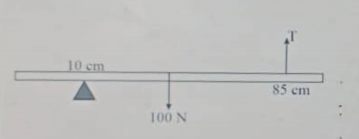
The figure shows a uniform metre rule of weight 100 N balanced by a knife edge at the 10 cm mark and a cord attached at the 85 cm mark. What is the tension in the string?
Attached Figure / Diagram
A
23.62 N
B
53.33 N
C
35.74 N
D
78.68 N
medium Difficulty
Verified Correct Answer: Option B
Physical Principles & Numerical Solution
Answer: B
For equilibrium, clockwise moment = anticlockwise moment about the pivot.
clockwise distance from pivot: 50cm - 10cm = 40cm
anticlockwise distance from pivot: 85cm - 10cm = 75cm
Applying the principle of moments
W x distance(w) = T x distance(T)
100 x 40 = T x 75
T = \(\frac{ 4000}{75}\) ≈ 53.33N
Source: WAEC / JAMB / NECO Classroom Archive (Record #74377)
Physics
UTME / JAMB 2025
Equilibrium of Forces
Diagram
Solution
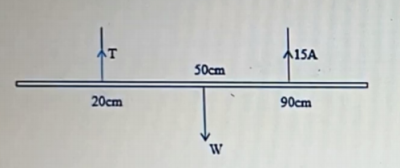
From the above figure, a uniform meter rule is suspended by two cords from a height. Calculate T?
Attached Figure / Diagram
A
11.25N
B
14.8N
C
19.24N
D
16.77N
medium Difficulty
Verified Correct Answer: Option C
Physical Principles & Numerical Solution
T x 80 + 15 x 10 = W x 50
80T + 150 = 50W - - -- - - - - -(1)
T + 15 = W - - - - - - - - - - - (2)
80T + 150 = 50(T + 15)
80T + 150 = 50T + 750
30T = 750 - 150
30T = 600
T = 20N
The closest option is 19.2N
Source: WAEC / JAMB / NECO Classroom Archive (Record #74492)
Physics
WAEC / WASSCE 2025
Projectile Motion
Solution
At what angle to the horizontal must the nozzle of a machine gun be kept when firing to obtain maximum horizontal range of the bullets?
A
0.0º.
B
30.0º.
C
45.0º
D
22.5º
medium Difficulty
Verified Correct Answer: Option C
Physical Principles & Numerical Solution
In a vacuum (where air resistance is ignored), the maximum horizontal range is achieved at an angle of 45º.
From R = \(\frac{u^2sin2\theta}{\text{g}}\)
R\(_{max}\) = \(\frac{u^2sin2(45)}{\text{g}}\) = \(\frac{u^2}{\text{g}}\)
\(\therefore\) \(\theta\) = 45º
Source: WAEC / JAMB / NECO Classroom Archive (Record #76334)
Physics
UTME / JAMB 2025
Momentum Impulse Newtons Law of Motion
Solution
A body is moving initially at 4m/s. If it's impulse after accelerating at 5m/s\(^2\) for 2s is 60Kgms\(^{-1}\). What is its mass?
A
3Kg
B
4Kg
C
6Kg
D
5Kg
medium Difficulty
Verified Correct Answer: Option C
Physical Principles & Numerical Solution
C. 6 kg
Initial velocity \( u = 4 \, \text{m/s} \), Acceleration \( a = 5 \, \text{m/s}^2 \), Time \( t = 2 \, \text{s} \)
Final velocity: \(v = u + at = 4 + 5 \times 2 = 14 \, \text{m/s}\)
Change in momentum (impulse):
\(\Delta p = m(v - u) = 60\)
Substituting for \( v \): \(m(14 - 4) = 60\)
Simplifying: \(m \times 10 = 60\)
Thus, \(m = 6 \, \text{kg}\)
Source: WAEC / JAMB / NECO Classroom Archive (Record #74552)
Physics
UTME / JAMB 2025
Simple Harmonic Motion
Diagram
Solution
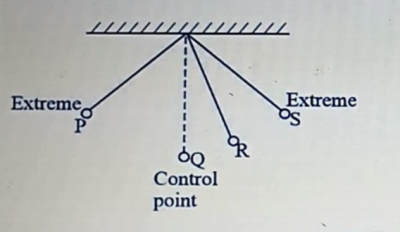
Using the oscillating simple pendulum above, the maximum kinetic energy is obtained at
Attached Figure / Diagram
A
Q
B
S
C
R
D
P
medium Difficulty
Verified Correct Answer: Option A
Physical Principles & Numerical Solution
A. Q
In a simple pendulum, kinetic energy is maximum at the lowest point (equilibrium position) where potential energy is minimum and speed is maximum.Here, Q is the control point (mean/equilibrium position), so maximum kinetic energy occurs at Q. At extremes P and S, kinetic energy is zero (velocity = 0). At R, it is between the extreme and the equilibrium.
Source: WAEC / JAMB / NECO Classroom Archive (Record #74550)
Physics
UTME / JAMB 2025
Simple Harmonic Motion
Solution
If the length of a simple pendulum is 120cm, calculate its frequency [\(\pi\) = \(\frac{22}{7}\) g = 10ms\(^{-2}\)]
A
2.8Hz
B
1.2Hz
C
12Hz
D
0.5Hz
medium Difficulty
Verified Correct Answer: Option D
Physical Principles & Numerical Solution
The frequency \( f \) of a simple pendulum is:
\(f = \frac{1}{2\pi} \sqrt{\frac{g}{L}} \quad \text{where } L = 1.2 \, \text{m}, \, g = 10 \, \text{m/s}^2, \, \pi \approx \frac{22}{7}\)
Calculate:
\(\frac{g}{L} = \frac{10}{1.2} = \frac{25}{3}, \quad \sqrt{\frac{25}{3}} = \frac{5}{\sqrt{3}}\)
\(f = \frac{1}{2 \times \frac{22}{7}} \times \frac{5}{\sqrt{3}} = \frac{35}{44\sqrt{3}}\)
Approximating \( \sqrt{3} \approx 1.732 \):
\(44 \times 1.732 \approx 76.208 \quad \Rightarrow \quad \frac{35}{76.208} \approx 0.459 \, \text{Hz}\)
Thus, the answer is \( D. \, 0.5 \) Hz.
Source: WAEC / JAMB / NECO Classroom Archive (Record #74574)
Physics
WAEC / WASSCE 2025
Simple Harmonic Motion
Solution
A student found out from a simple pendulum experiment that 20 oscillations were completed in 38 seconds.
A
8.0s
B
3.8s
C
1.9s
D
2.0s
medium Difficulty
Verified Correct Answer: Option C
Physical Principles & Numerical Solution
Period of oscillation = \(\frac{\text{ time}}{\text{no. of oscillations}}\) = \(\frac{38}{20}\) = 1.9s
Source: WAEC / JAMB / NECO Classroom Archive (Record #76331)
Physics
WAEC / WASSCE 2025
Simple Harmonic Motion
Solution
The angular speed of an object describes a circle of radius 4m with linear constant speed of 10m/s is
A
2.50 rads\(^{-1}\)
B
1.58 rads\(^{-1}\)
C
14.00 rads\(^{-1}\)
D
40.00 rads\(^{-1}\)
medium Difficulty
Verified Correct Answer: Option A
Physical Principles & Numerical Solution
Linear speed = \(\omega\) r
\(\omega\) = \(\frac{\text{v}}{\text{r}}\)
\(\omega\) = \(\frac{10}{4}\) = 2.5 rads\(^{-1}\)
Source: WAEC / JAMB / NECO Classroom Archive (Record #76333)
Physics
WAEC / WASSCE 2025
Simple Harmonic Motion
Solution
Which of the following will reduce the frequency of oscillation of a simple pendulum?
A
Increasing the mass of the bob
B
Decreasing the length of the string
C
Increasing the length of the string
D
Decreasing the mass of the bob.
medium Difficulty
Verified Correct Answer: Option C
Physical Principles & Numerical Solution
The frequency (f) of a simple pendulum is the number of oscillations it completes per second and is given by the formula: f = \(\frac{1}{2\pi}\)\(\sqrt{\frac{\text{g}}{\text{l}}}\)
where l is the length of the string and g is the acceleration due to gravity. Because the length l is in the denominator, the frequency is inversely proportional to the square root of the length. Therefore, increasing the length results in a slower swing rate, effectively reducing the frequency.
Source: WAEC / JAMB / NECO Classroom Archive (Record #76335)
Physics
UTME / JAMB 2025
Friction
Solution
A Force 18 N pulls a 40 kg mass on a horizontal floor at 0.3 ms\(^{-2}\). Find the coefficient of friction.
A
0.003
B
0.015
C
0.300
D
0.600
medium Difficulty
Verified Correct Answer: Option B
Physical Principles & Numerical Solution
Answer: B. 0.015
(Net F = ma = 40\times0.3 = 12 N;
friction = 18 - 12 = 6 N;
\mu = \(\frac{\text{friction}}{\text{mg}}\) = \(\frac{6}{(40\times10)}\) = 0.015.)
Source: WAEC / JAMB / NECO Classroom Archive (Record #74360)
Physics
UTME / JAMB 2025
Friction
Solution
The tangential force acting on an object that opposes it from sliding freely on the adjacent surface is called
A
Weight
B
Upthrust
C
Frictional force
D
Normal force
medium Difficulty
Verified Correct Answer: Option C
Physical Principles & Numerical Solution
Frictional force is the tangential force opposing an object's free sliding on an adjacent surface. It originates from surface irregularities and intermolecular attractions between materials, resisting relative motion or its initiation.
Source: WAEC / JAMB / NECO Classroom Archive (Record #74476)
Physics
UTME / JAMB 2025
Friction
Solution
A block with an initial speed of 10 m/s slides on a horizontal surface and comes to rest after traveling a distance of 25 m. What is the coefficient of kinetic friction between the block and the surface? (Take g = 9.8 m/s\(^2\)).
A
0.1
B
0.3
C
0.2
D
0.5
medium Difficulty
Verified Correct Answer: Option C
Physical Principles & Numerical Solution
Given: g = 9.8 m/s\(^2\), a = 10 m/s, v = 0( come to rest), s = 25m
v\(^2\) = u\(^2\) + 2as
- 100 = 2 x 25 x a
a = \(\frac{-100}{50}\) = - 2 deceleration is caused by kinetic friction
But, \(\mu\) = \(\frac{\text{f}}{\text{R}}\) = \(\frac{\text{ma}}{\text{mg}}\) = \(\frac{-2}{9.8}\) ≈ 0.2.
Source: WAEC / JAMB / NECO Classroom Archive (Record #75421)