Question Library
Browse, filter, and study verified past examination questions with step-by-step mathematical reasoning.
Searching 18,000+ Questions...
Sifting topics, KaTeX formulas & verified solutions
Showing 28351–28365 of 29811 verified questions
Sort by:
Biology
UTME / JAMB 1983
Supporting Tissues & Skeletal System
Diagram
Solution
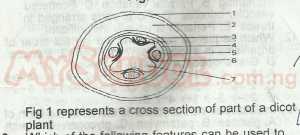
The main function of 4 is to
Attached Figure / Diagram
A
surround inner tissues
B
produce cork
C
produce root hairs
D
produce lateral roots
E
produce more of 3
medium Difficulty
Verified Correct Answer: Option A
Biological Concept & Syllabus Guide
The part labelled 4 is the pericycle (See diagram above).
The major function of the pericycle in the stem is to surround and protect the inner tissues, specifically the vascular bundles (xylem and phloem). The pericycle is part of the vascular system and helps to support and protect these vital tissues.
Source: Myschool Past Questions Archive (Record #15537)
Biology
UTME / JAMB 1983
Reproduction in Plants & Animals
Diagram
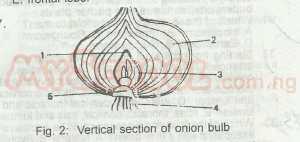
Which of the labelled part in the figure above will develop into new bulb?
Attached Figure / Diagram
A
1
B
4
C
2
D
3
E
5
medium Difficulty
Verified Correct Answer: Option D
Biological Concept & Syllabus Guide
No expanded working has been attached for this question yet. The verified answer is Option D.
Source: Myschool Past Questions Archive (Record #15538)
Biology
UTME / JAMB 1983
Cell & Its Environment (Diffusion, Osmosis & Transport)
Which of the following will not allow osmosis to take place
A
pig's bladder
B
cellophane
C
parchment paper
D
transparent polythene
E
cow's bladder
medium Difficulty
Verified Correct Answer: Option D
Biological Concept & Syllabus Guide
No expanded working has been attached for this question yet. The verified answer is Option D.
Source: Official Exam / Past Question Archive
Biology
UTME / JAMB 1983
Cell & Its Environment (Diffusion, Osmosis & Transport)
If an isolated living cell is left in distilled water for two hours, it is likely to
A
lose some of its water to the surrounding water
B
lose all of its water to the surrounding water
C
reproduce by binary fission
D
become more turgid
E
die due to excess water
medium Difficulty
Verified Correct Answer: Option D
Biological Concept & Syllabus Guide
No expanded working has been attached for this question yet. The verified answer is Option D.
Source: Myschool Past Questions Archive (Record #40483)
Biology
UTME / JAMB 1983
Cell & Its Environment (Diffusion, Osmosis & Transport)
Which of the following will not allow osmosis to take place
A
pig's bladder
B
cellophane
C
parchment paper
D
transparent polythene
E
cow's bladder
medium Difficulty
Verified Correct Answer: Option D
Biological Concept & Syllabus Guide
No expanded working has been attached for this question yet. The verified answer is Option D.
Source: Myschool Past Questions Archive (Record #40484)
Mathematics
UTME / JAMB 1982
Fractions, Decimals, Percentages & Approximations
Diagram
Solution
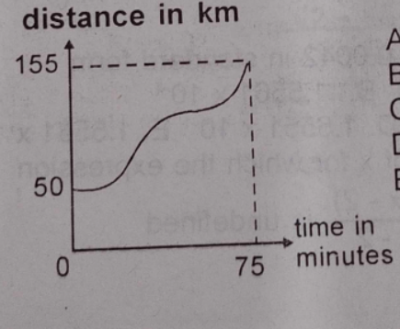
The diagram is the distance time graph of a vehicle. Find its average speed in kilometers per hour during the journey
Attached Figure / Diagram
A
155km/hr
B
50km/hr
C
40km/hr
D
124km/hr
E
84km/hr
medium Difficulty
Verified Correct Answer: Option E
Step-by-Step Mathematical Solution
Distance = 155 - 50 = 105km
Time = 75mins
= \(\frac{75}{60}\)hr = \(\frac{5}{4}\)hr
Average speed = \(\frac{Distance}{time}\) = \(\frac{105}{\frac{5}{4}}\)
= \(\frac{105 \times 4}{5}\)
= 84km\h
Source: WAEC / JAMB / NECO Classroom Archive (Record #32759)
Physics
UTME / JAMB 1982
Calorimetry, Latent Heat & Change of State
Solution
A hot metal ball is suspended in the open air. As it cools it loses heat by?
A
conduction only
B
convection only
C
radiation only
D
conduction and convection
E
convection and evaporation
medium Difficulty
Verified Correct Answer: Option B
Physical Principles & Numerical Solution
Convection occurs when heat is carried away from your body via moving air. If the surrounding air is cooler, the air will absorb heat and rise.
As the warmed air rises, cooler air moves in to take its place and absorb more warmth.
Source: WAEC / JAMB / NECO Classroom Archive (Record #28936)
Physics
UTME / JAMB 1982
Temperature, Thermometry & Thermal Expansion
Diagram
Solution
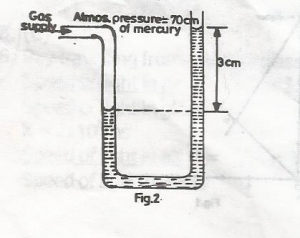
The water manometer above is measuring the pressure of gas supply. if the specific gravity of mercury is 13.6 and the atmospheric pressure is 70cm of mercury what is the total pressure of the gas supply in cm of water
Attached Figure / Diagram
A
67cm
B
73cm
C
949cm
D
952cm
E
955cm
medium Difficulty
Verified Correct Answer: Option E
Physical Principles & Numerical Solution
Atmospheric pressure = 70cmHg (which is the height of mecury)
pressure = pgh = pwghw
Where
Pw = density of water
hw = height of water
ph = pwhw
13.6*70 = 1*hw
hw = 952cm
Pressure of gas in cm of water = 952 + 3 = 955cm
Source: WAEC / JAMB / NECO Classroom Archive (Record #41620)
Physics
UTME / JAMB 1982
Reflection, Refraction & Dispersion of Light
Diagram
Solution
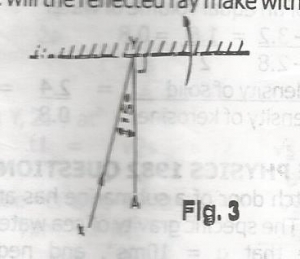
in the image above, an incident ray XY makes an angle of 15\( ^{\circ} \) with a fixed line AY, which is normal to surface of a plane mirror if the mirror is turned as indicated by the arrow through \( 40^{\circ} \), what angle will the reflected ray make with AY
Attached Figure / Diagram
A
\( 25^{\circ} \)
B
\( 40^{\circ} \)
C
\( 15^{\circ} \)
D
\( 55^{\circ} \)
E
\( 95^{\circ} \)
medium Difficulty
Verified Correct Answer: Option E
Physical Principles & Numerical Solution
incident ray = XY
incidence angle i = 15\( ^{\circ} \)
rotation angle \theta = 40º
angle that the reflected ray make with AY = i + 2\theta
= 15 + [2 * 40] = 15 + 80 = 95º
Source: WAEC / JAMB / NECO Classroom Archive (Record #41621)
Physics
UTME / JAMB 1982
Reflection, Refraction & Dispersion of Light
Diagram
Solution
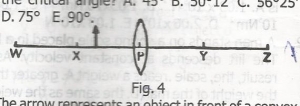
the arrow represents an object in front of a convex mirror whose focal points are X and Y. The image formed is
Attached Figure / Diagram
A
between X and P
B
Between P and Y
C
Between Y and Z
D
Outside W
E
Outside Z
medium Difficulty
Verified Correct Answer: Option B
Physical Principles & Numerical Solution
The image produced by a convex mirror is always virtual, and located behind the mirror.
When the object is far away from the mirror the image is upright and located at the focal point.
Source: WAEC / JAMB / NECO Classroom Archive (Record #41622)
Chemistry
UTME / JAMB 1982
Particulate Nature of Matter, Laws & Formulae
Solution
An element X has two isotopes, \(^{20} _{10}X\) and \(^{22} _{10}X\),
present in the ratio 1:3. The relative atomic mass of X would be?
A
20.5
B
21.0
C
21.5
D
22.0
E
22.5
medium Difficulty
Verified Correct Answer: Option C
Chemical Principles & Mechanism
The relative atomic mass will be [(20 * 1) + (3 * 22)] / (4)
(86)/(4) = (43)/(2) = 21.5
Source: WAEC / JAMB / NECO Classroom Archive (Record #14067)
Chemistry
UTME / JAMB 1982
Reaction Rates & Chemical Equilibrium
Solution
In the reaction N2(g) + O(g)
↔ 2NO(g) produced i an increase in the total pressure will?
A
cause less nitrogen to be produced in the equilibrium mixture
B
cause less nitric oxide to be produced in the equilibrium mixture
C
cause more nitric oxide to be produced in the equilibrium mixture
D
cause more oxygen to be produced in the equilibrium mixture
E
have no effect
medium Difficulty
Verified Correct Answer: Option E
Chemical Principles & Mechanism
If the pressure is increased, the position of equilibrium. moves in the direction of the fewest moles. of gas
However, because there is an equal number of particles on both sides, change in pressure will have no effect on the system.
Source: WAEC / JAMB / NECO Classroom Archive (Record #13984)
Chemistry
UTME / JAMB 1982
Organic Chemistry II: Functional Groups, Polymers & Biomolecules
Solution
Which of the following types of reactions takes place between C2H6 and the halogens?
A
Substitution
B
Polymerization
C
Addition
D
Saponification
E
Oxidation
medium Difficulty
Verified Correct Answer: Option A
Chemical Principles & Mechanism
Alkanes undergo a substitution reaction with halogens in the presence of light.
For instance, in ultraviolet light , methane reacts with halogen molecules such as chlorine and bromine.
Source: WAEC / JAMB / NECO Classroom Archive (Record #13978)
Mathematics
UTME / JAMB 1982
Indices, Logarithms & Surds
Solution
Rationalize the expression \(\frac{1}{\sqrt{2} + \sqrt{5}}\)
A
\(\frac{1}{3}\)(\(\sqrt{5} - \sqrt{2}\)
B
\(\frac{\sqrt{2}}{3}\) + \(\frac{\sqrt{5}}{5}\)
C
\(\sqrt{2} - \sqrt{5}\)
D
5(\(\sqrt{2} - \sqrt{5}\)
E
\(\frac{1}{3}\)(\(\sqrt{2} - \sqrt{5}\)
medium Difficulty
Verified Correct Answer: Option A
Step-by-Step Mathematical Solution
\(\frac{1}{\sqrt{2} + \sqrt{5}}\)
\(\frac{1}{\sqrt{2} + \sqrt{5}} \times \frac{(\sqrt{2} - \sqrt{5})}{(\sqrt{2} - \sqrt{5})}\)
= \(\frac{\sqrt{2} - \sqrt{5}}{2 - 5}\)
= \(\frac{\sqrt{2} - \sqrt{5}}{-3}\)
= \(\frac{1}{3} (\sqrt{5} - \sqrt{2})\)
Source: Myschool Past Questions Archive (Record #32481)
Mathematics
UTME / JAMB 1982
Plane Geometry, Polygons & Circle Theorems
Solution
Simplify 3 - 2 \(\div\) \(\frac{4}{5}\) + \(\frac{1}{2}\)
A
1\(\frac{3}{4}\)
B
-1
C
1\(\frac{3}{10}\)
D
1
E
1\(\frac{9}{10}\)
medium Difficulty
Verified Correct Answer: Option D
Step-by-Step Mathematical Solution
3 - 2 \(\div\) (\(\frac{4}{5}\)) + \(\frac{1}{2}\)
3 - (2 x \(\frac{5}{4}\)) + \(\frac{1}{2}\) = 3 - \(\frac{10}{4}\) + \(\frac{1}{2}\)
= 3 - \(\frac{5}{2}\) + \(\frac{1}{2}\)
= \(\frac{6 - 5 + 1}{2}\)
= \(\frac{2}{2}\)
= 1
Source: Myschool Past Questions Archive (Record #32482)