Question Library

Browse, filter, and study verified past examination questions with step-by-step mathematical reasoning.

Launch Interactive Practice
Searching 18,000+ Questions... Sifting topics, KaTeX formulas & verified solutions
Showing 28261–28275 of 29811 verified questions
Sort by:
Chemistry UTME / JAMB 1983 Stoichiometry, Mole Concept & Volumetric Analysis
An unknown organic compound X has a relative molecular mass of 180. It is a colourless crystaline solid, readily soluble in water. X contains the elements C, H and O in the atomic ratio 1: 2:1. The compound has a sweet teste and melts on heating. In the presence of yeast and in the absence of air, X is converted to compound Y and a colourless gas. Compound Y reacts with sodium metal to produce a gas Z which gives a 'pop' sound with a glowing splint. Y also reacts with ethanoic acid to give a sweet smelling compound W. The molecular formula of X is
A
C12H22O11
B
C6H12O6
C
C3H6O 3
D
C7H14O7
E
C12H6O4
medium Difficulty
Chemistry UTME / JAMB 1983 Organic Chemistry II: Functional Groups, Polymers & Biomolecules
An unknown organic compound X has a relative molecular mass of 180. It is a colourless crystaline solid, readily soluble in water. X contains the elements C, H and O in the atomic ratio 1: 2:1. The compound has a sweet teste and melts on heating. In the presence of yeast and in the absence of air, X is converted to compound Y and a colourless gas. Compound Y reacts with sodium metal to produce a gas Z which gives a 'pop' sound with a glowing splint. Y also reacts with ethanoic acid to give a sweet smelling compound W. Reaction of X with yeast forms the basis of the
A
plastic industry
B
textile industry
C
brewing industry
D
soap industry
E
dyeing industry
medium Difficulty
Chemistry UTME / JAMB 1983 Nature of Matter & Separation Techniques
A mixture of common salt, ammonium chloride and barium sulphate can best be separated by
A
addition of water followed by filtration then sublimation
B
addition of water followed by sublimation then filtration
C
sublimation followed by addition of water then filtration
D
fractional distillation
E
fractional crystallization
medium Difficulty
Chemistry UTME / JAMB 1983 Kinetic Theory of Matter & Gas Laws
Which of the following relationships between the pressure P, the volume V and the temperature T, represents an ideal gas behaviour?
A
P \(\alpha\) VT
B
P \(\alpha\) T/V
C
PT \(\alpha\) V
D
PV \(\alpha\) I/T
E
P \(\alpha\) V/T
medium Difficulty
Chemistry UTME / JAMB 1983 Metals, Transition Elements & Extraction
The colour imparted to a flame by calcuium ion is
A
green
B
blue
C
brick-red
D
yellow
E
lilac
medium Difficulty
Chemistry UTME / JAMB 1983 Stoichiometry, Mole Concept & Volumetric Analysis
In the reaction M + N P;∆H = + QKJ. Which of the following would increase the concentration of the product?
A
Decreaseing the concentration of N
B
Increasing the concentration of P
C
Adding a suitable catalyst
D
Decreasing the temperature
E
Increasing the temperature
medium Difficulty
Chemistry UTME / JAMB 1983 Stoichiometry, Mole Concept & Volumetric Analysis
In which of the following processes is iron being oxidized? 1 Fe + H2SO4 → FeSO4 +H2 2 FeSO4 + H2S → FeS + H2SO4 3 2FeCI2 + Cl2 → 2FeCl3 4 2FeCl3 + SnCl2 + → 2FeCl2 + SnCl4
A
1 only
B
2 only
C
3 only
D
1 and 3
E
2 and 4
medium Difficulty
Chemistry UTME / JAMB 1983 Electrolysis & Electrochemical Cells
In the reaction Fe + Cu2+ \(\to\) Fe2+ + Cu,iron displaces copper ions to from copper. This is due to the fact that
A
irn is in the metallic from while the copper is in the ionic from
B
the atomic weight of copper is greater than that of iron
C
copper is greater than iron
D
copper metal has more electrons than iron metal
E
iron is higher in the electrochemical series than copper
medium Difficulty
Chemistry UTME / JAMB 1983 Organic Chemistry I: Hydrocarbons & Crude Oil
Crude petroleum pollutant usually seen on some Nigerian creeks and waterways can be dispersed or removed by
A
heating the affected parts in order to boil off the petroleum
B
mechanically stirring to dissolve the petroleum in water
C
pouring organic solvents to dissolve the petroleum
D
spraying the water with detergents
E
cooling to freeze out the petroleum
medium Difficulty
Chemistry UTME / JAMB 1983 Chemical Bonding & Intermolecular Forces
An element is electronegative if
A
it has a tendency to exist in the gaseous from
B
its ions dissolve readily in water
C
it has a tendency to lose electrons
D
it has a tendency to gain electrons
E
it readily froms covalent bonds
medium Difficulty
Chemistry UTME / JAMB 1983 Stoichiometry, Mole Concept & Volumetric Analysis
Solutions X, Y, and Z have PH values 3.0. 5. 0 and 9. 0 respectively. Which of the following statements is correct?
A
All the solutions are acidic
B
All the solutions are basic
C
Y and Z are more acidic than water
D
Y is more acidic than X
E
Z is the least acidic
medium Difficulty
Chemistry UTME / JAMB 1983 Stoichiometry, Mole Concept & Volumetric Analysis
In the reactions (I) H2 (g) + 1/2O2(g) → H2O(l); ∆H = -286 KJ (II) C(s) + O2g) → CO2 (g); ∆H = -406 KJ the equations imply that
A
more heat is absorbed in (l)
B
more heat is absorbed in (ll)
C
less heat is evolved in (l)
D
reaction (ll) proceeds faster than (l)
E
reaction (l) proceeds faster than (ll)
medium Difficulty
Chemistry UTME / JAMB 1983 Stoichiometry, Mole Concept & Volumetric Analysis
Which of these metals, Mg, Fe, Pb and Cu will dissolve in dilute HCI?
A
All the metals
B
Mg ,Fe and Cu
C
Mg, Fe and Pb
D
Mg and Fe only
E
Mg only
medium Difficulty
Chemistry UTME / JAMB 1983 Organic Chemistry I: Hydrocarbons & Crude Oil
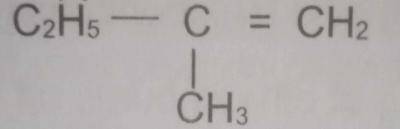
The correct name of the compound with the above structural formula is
Attached Figure / Diagram
Question diagram
A
2-methylbut -1-ene
B
2-methylbut -2-ene
C
2-methylbutane
D
2-ethylprop-1 -ene
E
2-ethylprop-2-ene
medium Difficulty
Chemistry UTME / JAMB 1983 Stoichiometry, Mole Concept & Volumetric Analysis
How many isomeric forms are there for the molecular formula C3H6Br2?
A
1
B
2
C
3
D
4
E
5
medium Difficulty
Page 1885 of 1988