Question Library
Browse, filter, and study verified past examination questions with step-by-step mathematical reasoning.
Searching 18,000+ Questions...
Sifting topics, KaTeX formulas & verified solutions
Showing 27766–27780 of 29811 verified questions
Sort by:
Biology
UTME / JAMB 1985
Growth, Micro-organisms & Public Health
Solution
The primary and secondary hosts respectively of bilharzia are
A
fish and man
B
man and dog
C
man and snail
D
fish and snail
medium Difficulty
Verified Correct Answer: Option C
Biological Concept & Syllabus Guide
The intermediate hosts of Schistosoma spp. (Bilharziasis) are various species of freshwater snails. Eggs are shed from the human host in feces or urine. Under optimal conditions in the environment, the eggs hatch and release miracidia, which swim and penetrate specific snail intermediate hosts.
Source: Myschool Past Questions Archive (Record #3336)
Biology
UTME / JAMB 1985
Growth, Micro-organisms & Public Health
Solution
Which of the following is NOT caused by bacteria?
A
Cholera
B
Gonorrhoea
C
Tuberculosis
D
Onchoceriasis
E
Typhoid
medium Difficulty
Verified Correct Answer: Option D
Biological Concept & Syllabus Guide
Onchocerciasis is another name for river blindness. It is caused by the NEMATODE, Onchocerca volvulus.
Source: Myschool Past Questions Archive (Record #3340)
Biology
UTME / JAMB 1985
Growth, Micro-organisms & Public Health
Tsetse fly is harmful to man because it is associated with the spread of
A
river blindness
B
malaria
C
sleeping sickness
D
leprosy
E
dysentry
medium Difficulty
Verified Correct Answer: Option C
Biological Concept & Syllabus Guide
No expanded working has been attached for this question yet. The verified answer is Option C.
Source: Myschool Past Questions Archive (Record #3343)
Biology
UTME / JAMB 1985
Population Ecology, Habitats & Conservation
Soil erosion CANNOT be controlled by
A
planting cover crops
B
contouring of sloping ground
C
terracing of slopes
D
laying of mulch
E
burning of bush
medium Difficulty
Verified Correct Answer: Option E
Biological Concept & Syllabus Guide
No expanded working has been attached for this question yet. The verified answer is Option E.
Source: Myschool Past Questions Archive (Record #3344)
Biology
UTME / JAMB 1985
Basic Ecological Concepts, Ecosystems & Biomes
Solution
Water retention is highest in soils which are rich in
A
sand, poor in humus and devoid of clay
B
clay and sand, but poor in humus
C
clay and humus, but poor in sand
D
clay, poor in humus and devoid of sand
E
sand and humus, but poor in clay
medium Difficulty
Verified Correct Answer: Option C
Biological Concept & Syllabus Guide
Clay Soil can hold more total water than most other soil types
Source: Myschool Past Questions Archive (Record #3346)
Biology
UTME / JAMB 1985
Basic Ecological Concepts, Ecosystems & Biomes
Solution
The origin of mineral particles in the soil is
A
humus
B
water
C
micro-organisms
D
weathered rock
E
organic matter
medium Difficulty
Verified Correct Answer: Option D
Biological Concept & Syllabus Guide
Weathering is the process by which rocks are broken down and decomposed into smaller particles over time due to physical, chemical, and biological processes. As rocks undergo weathering, they gradually break apart into smaller fragments and minerals. These mineral particles, along with other organic matter such as decaying plant and animal material (humus) and living organisms, make up the soil matrix. so the primary source of mineral particles in the soil is from the weathering of parent rock materials.
Source: Myschool Past Questions Archive (Record #3347)
Biology
UTME / JAMB 1985
Basic Ecological Concepts, Ecosystems & Biomes
Solution
Atmospheric nitrogen is directly replenished in nature through
A
the activities of denitrifying bacteria
B
the breakdown of ammonium salts in the soil
C
the activities of nitrifying bacteria
D
the activities of nitrogen-fixing bacteria in root nodules
E
egestion, death and decay
medium Difficulty
Verified Correct Answer: Option A
Biological Concept & Syllabus Guide
The nitrogen in the soil is converted to atmospheric nitrogen by the process of DENITRIFICATION. This is done by the action of denitrifying bacterias eg several species of Pseudomonas.
Source: Myschool Past Questions Archive (Record #3348)
Biology
UTME / JAMB 1985
Variety of Organisms & Classification of Living Things
Solution
The initial volume of water poured into 60g bag of dry soil was 50ml and the amount that drained through was 35ml. The percentage water content of the fully soaked soil is therefore
A
46.7
B
25.0
C
20.0
D
30.0
E
58.3
medium Difficulty
Verified Correct Answer: Option D
Biological Concept & Syllabus Guide
% water content of fully soaked sand = \(\frac{ 50 - 35}{50} \times 100\)
= \(\frac{ 15}{50} \times 100\) = 30.0.
Source: Myschool Past Questions Archive (Record #3350)
Biology
UTME / JAMB 1985
Excretion & Homeostasis
Diagram
Solution
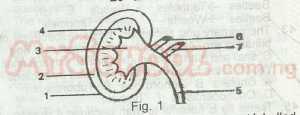
Bowman's capsule are located in the part labelled
Attached Figure / Diagram
A
1
B
2
C
3
D
4
E
5
medium Difficulty
Verified Correct Answer: Option B
Biological Concept & Syllabus Guide
The Bowman’s capsule is found in the cortex region of the kidney. i.e. the part labeled 2.
Source: Myschool Past Questions Archive (Record #15542)
Biology
UTME / JAMB 1985
Variety of Organisms & Classification of Living Things
Diagram
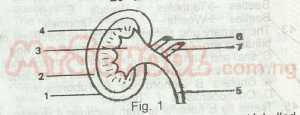
Reabsorption of useful materials takes place in the part labelled
Attached Figure / Diagram
A
1 and 3
B
3 and 5
C
5 and 6
D
6 and 7
E
2 and 4
medium Difficulty
Verified Correct Answer: Option E
Biological Concept & Syllabus Guide
No expanded working has been attached for this question yet. The verified answer is Option E.
Source: Myschool Past Questions Archive (Record #15543)
Biology
UTME / JAMB 1985
Variety of Organisms & Classification of Living Things
Reabsorption of useful materials takes place in the part labelled
A
1 and 3
B
3 and 5
C
5 and 6
D
6 and 7
E
2 and 4
medium Difficulty
Verified Correct Answer: Option E
Biological Concept & Syllabus Guide
No expanded working has been attached for this question yet. The verified answer is Option E.
Source: Official Exam / Past Question Archive
Mathematics
UTME / JAMB 1984
Linear, Simultaneous & Quadratic Equations
Solution
The quadratic equation whose roots are 1 - \(\sqrt{13}\) and 1 + \(\sqrt{13}\) is?
A
x2 + (1 - \(\sqrt{13}\)x + 1 + \(\sqrt{13}\) = 0
B
x2 - 2x - 12 = 0
C
x2 - 2x + 12 = 0
D
x2 + 12 + 2x2 = 0
medium Difficulty
Verified Correct Answer: Option B
Step-by-Step Mathematical Solution
1 - \(\sqrt{13}\) and 1 + \(\sqrt{13}\)
sum of roots - \(1 + \sqrt{13} + 1 - \sqrt{13} = 2\)
Product of roots = (1 - \(\sqrt{13}\)) (1 + \(\sqrt{13}\)) = -12
x2 - (sum of roots) x + (product of roots) = 0
x2 - 2x - 12 = 0
Source: WAEC / JAMB / NECO Classroom Archive (Record #32425)
Mathematics
UTME / JAMB 1984
Plane Geometry, Polygons & Circle Theorems
Diagram
Solution
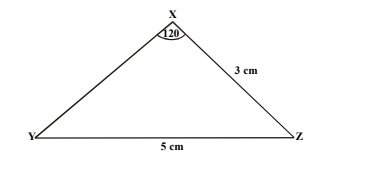
Using \(\bigtriangleup\)XYZ in the figure, find XYZ
Attached Figure / Diagram
A
29o
B
31o
C
31o 20'
D
31o 18'
medium Difficulty
Verified Correct Answer: Option D
Step-by-Step Mathematical Solution
\(\frac{\sin y}{3} = \frac{\sin 120^o}{5}\)
sin 120o = sin 60o
5 sin y = 3 sin 60o
sin y = \(\frac{3 \sin 60^o}{5}\)
\(\frac{3 \times 0.866}{5}\)
= \(\frac{2.598}{5}\)
y = sin-1 0.5196 = 30o 18'
Source: WAEC / JAMB / NECO Classroom Archive (Record #32777)
Physics
UTME / JAMB 1984
Work, Energy, Power & Simple Machines
Solution
A device that converts sound energy into electrical energy is?
A
the horn of a motor car
B
an A.C. generator
C
a microphone
D
the telephone
E
radio waves
medium Difficulty
Verified Correct Answer: Option C
Physical Principles & Numerical Solution
The dynamic microphone is constructed with a small magnet that oscillates inside a coil attached to the diaphragm.
When a sound wave causes the diaphragm of the microphone to vibrate, the relative motion of the magnet and coil creates an electrical signal by magnetic induction.
Source: WAEC / JAMB / NECO Classroom Archive (Record #28735)
Physics
UTME / JAMB 1984
Work, Energy, Power & Simple Machines
Solution
A galvanometer of resistance 5.0Ω has full-scale deflection for a current of 100mA. How would its range be extended to 1.0A? By placing a resistance of
A
\(\frac{5}{9}\)\(\Omega\) in parallel
B
\(\frac{9}{5}\)\(\Omega\) in series
C
45\(\Omega\) in parallel
D
45\(\Omega\) in series
E
\(\frac{9}{5}\)\(\Omega\) in parallel
medium Difficulty
Verified Correct Answer: Option A
Physical Principles & Numerical Solution
Given Data:
I\(_g\) = 100ma = 0.1A
R\(_g\)=5
where I\(_s\) = I - I\(_g\) → 1 - 0.1
I\(_s\) = 0.9
I\(_g\)R\(_g\) = I\(_s\)R\(_s\)
0.1 * 5 = 0.9 * R\(_s\)
R\(_s\) = \(\frac{0.1 * 5}{0.9}\)
R\(_s\) = \(\frac{5}{9}\)
Source: WAEC / JAMB / NECO Classroom Archive (Record #28741)