Question Library
Browse, filter, and study verified past examination questions with step-by-step mathematical reasoning.
Searching 18,000+ Questions...
Sifting topics, KaTeX formulas & verified solutions
Showing 27691–27705 of 29811 verified questions
Sort by:
Chemistry
UTME / JAMB 1985
Stoichiometry, Mole Concept & Volumetric Analysis
Solution
Which of the following compounds is NOT the correct product formed when the parent metals is heated in air?
A
Calcium oxide (CaO)
B
Sodium oxide (Na2O)
C
Copper (ll) oxide (CuO)
D
Tri-iron tetroxide (Fe3O4)
E
Aluminium oxide (Al2O3)
medium Difficulty
Verified Correct Answer: Option B
Chemical Principles & Mechanism
When metals are heated in air, they react with oxygen to form specific oxides. Sodium oxide is not the primary product when sodium metal is heated in air; instead, sodium burns with an intense orange flame to primarily form sodium peroxide. Na\(_2\)O is typically only formed when there is a limited supply of oxygen.
Source: Myschool Past Questions Archive (Record #14129)
Chemistry
UTME / JAMB 1985
Atomic Structure, Orbitals & Nuclear Chemistry
Solution
The atomic number of an element whose cation, X2+, has the ground state electronic configuration 1s22s22p63s22p6 is?
A
16
B
18
C
20
D
22
E
24
medium Difficulty
Verified Correct Answer: Option C
Chemical Principles & Mechanism
-The main difference between ground state and excited state is that ground state is a state where electrons in a system are in the lowest possible energy levels whereas excited state is any state of the system that has a higher energy than the ground state.
-Calcium atoms have 20 electrons and the shell structure is 2.8. 8.2. The ground state electron configuration of ground state gaseous neutral calcium is [Ar]
Source: Myschool Past Questions Archive (Record #14130)
Chemistry
UTME / JAMB 1985
Stoichiometry, Mole Concept & Volumetric Analysis
When marble is heated to about 1473 K, another white solid is obtained which reacts vigorously with water to give an alkaline solution. The solution contains?
A
NaOH
B
KOH
C
Mg(OH)2
D
Zn(OH)2
E
Ca(OH)2
medium Difficulty
Verified Correct Answer: Option E
Chemical Principles & Mechanism
No expanded working has been attached for this question yet. The verified answer is Option E.
Source: Myschool Past Questions Archive (Record #14131)
Chemistry
UTME / JAMB 1985
Oxidation, Reduction & Redox Reactions
Addition of dilute hydrochloride acid to an aqueous solution of a crystalline salt yield a yellow precipitate and a gas which turned dichromate paper green. The crystalline salt was probably?
A
Na2SO4
B
Na2S
C
Na2S2O3.5H2O
D
Na2CO3
E
NaHCO3
medium Difficulty
Verified Correct Answer: Option C
Chemical Principles & Mechanism
No expanded working has been attached for this question yet. The verified answer is Option C.
Source: Myschool Past Questions Archive (Record #14132)
Chemistry
UTME / JAMB 1985
Organic Chemistry II: Functional Groups, Polymers & Biomolecules
Solution
The process involved in the conversion of an oil into margarine is known as?
A
hydrogenation
B
condensation
C
pyrolysis
D
dehydration
E
cracking
medium Difficulty
Verified Correct Answer: Option A
Chemical Principles & Mechanism
Margarine is an inexpensive alternate to butter, made from oil or a combination of oils through the process of hydrogenation.
Source: Myschool Past Questions Archive (Record #14133)
Chemistry
UTME / JAMB 1985
Stoichiometry, Mole Concept & Volumetric Analysis
Solution
An aqueous solution of an inorganic salt gave white precipitate (i) soluble in excess aqueous NaOH (ii) insoluble in excess aqueous NH\(_3\) (iii) with dilute HCl. The cation present in the inorganic salt is?
A
Na+
B
Ca++
C
Zn++
D
Al+++
E
Pb++
medium Difficulty
Verified Correct Answer: Option E
Chemical Principles & Mechanism
Ca\(^{2+}\) (calcium ions) do not form a precipitate that is soluble in excess NaOH, or in dilute HCl, but they do form a white precipitate with NaOH that is insoluble in excess NaOH and in NH\(_3\).
Zn\(^{2+}\) ions form a white precipitate (Zn(OH)₂) with sodium hydroxide (NaOH) that is soluble in excess NaOH and also soluble in excess ammonia (NH₃), forming a complex ion, but insoluble in dilute HCl.
Adding NaOH to Al\(^{3+}\) solution initially forms a white precipitate of Al(OH)₃, which is then soluble in excess NaOH, but the precipitate remains insoluble in NH₃ and dilute HCl.
Pb\(^{2+}\) ions form a white precipitate (lead(II) hydroxide, Pb(OH)\(_2\)) with both sodium hydroxide (NaOH) and aqueous ammonia (NH\(_3\)), but the precipitate is soluble in excess NaOH, but insoluble in excess NH\(_3\). It's also insoluble in dilute HCl.
Both Pb\(^{2+}\) and Al\(^{3+}\) form white precipitates soluble in excess NaOH and insoluble in NH\(_3\) and dilute HCl. However, lead(II) chloride, PbCl\(_2\) is slightly soluble in cold HCl and more soluble in hot HCl while AlCl\(_3\) is soluble in HCl.
Since the precipitate is described as insoluble in dilute HCl, Pb\(^{2+}\) is the more likely candidate.
Source: Myschool Past Questions Archive (Record #14134)
Chemistry
UTME / JAMB 1985
Organic Chemistry II: Functional Groups, Polymers & Biomolecules
Which of the following roles does sodium chloride play in soap preparation? It
A
reacts with glycerol
B
purifies the soap
C
accelerates the decomposition of the fat or oil
D
separates the soap from the glycerol
E
converts the fatty acid to its sodium salt
medium Difficulty
Verified Correct Answer: Option D
Chemical Principles & Mechanism
No expanded working has been attached for this question yet. The verified answer is Option D.
Source: Myschool Past Questions Archive (Record #14135)
Chemistry
UTME / JAMB 1985
Organic Chemistry II: Functional Groups, Polymers & Biomolecules
The function of sulphur during vulcanization rubber is to?
A
act as catalyst for the polymerization of rubber molecules
B
convert rubber from thermosetting to thermo plastics polymer
C
from chains which bind rubber molecules together
D
break down rubber polyer
E
shorten the chain length of rubber polyer
medium Difficulty
Verified Correct Answer: Option C
Chemical Principles & Mechanism
No expanded working has been attached for this question yet. The verified answer is Option C.
Source: Myschool Past Questions Archive (Record #14136)
Chemistry
UTME / JAMB 1985
Periodic Table & Periodicity
Diagram
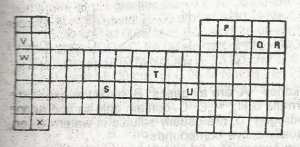
Figure 1 above shows part of the periodic Table which of the elements belongs to the p-block?
Attached Figure / Diagram
A
S, T and U
B
V, W and X
C
S and T only
D
P, Q and R
E
V, W, X and S
medium Difficulty
Verified Correct Answer: Option D
Chemical Principles & Mechanism
No expanded working has been attached for this question yet. The verified answer is Option D.
Source: Myschool Past Questions Archive (Record #31336)
Chemistry
UTME / JAMB 1985
Water, Solutions & Solubility
Diagram
Solution
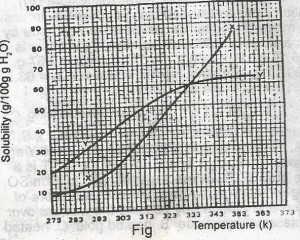
The diagram shown above represents the solubility curves of two salts, X and Y, in water, use this diagram to answer the question. At room temperature (300 K)
Attached Figure / Diagram
A
Y is twice as soluble as X
B
X is twice as soluble as Y
C
X and Y are soluble to the same extent
D
X is three times as soluble as Y
E
Y is three times as soluble as X
medium Difficulty
Verified Correct Answer: Option A
Chemical Principles & Mechanism
From the given graph, when properly traced At room temperature (300 K) Y is twice as soluble as X
Source: Myschool Past Questions Archive (Record #31340)
Chemistry
UTME / JAMB 1985
Water, Solutions & Solubility
Diagram
Solution
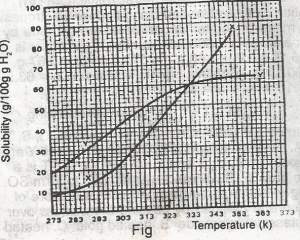
The diagram shown above represents the solubility curves of two salts, X and Y, in water, use this diagram to answer the question. If 80 g each of X and Y are taken up in 100 g of water at 353 K we shall have
Attached Figure / Diagram
A
only 10g of X undissolved
B
only 16 g of Y undissolved
C
10 g of X and 16 g of Y undissolved
D
all X and Y dissolved
E
all X and Y undissolved
medium Difficulty
Verified Correct Answer: Option B
Chemical Principles & Mechanism
For salt X, from the graph, 80g of X dissolves by 349K, so by 353K, all 80g of X is dissolved totally in 100g of water.
For salt Y, from the graph, 64g of Y dissolves by 353K, so (80-64)g of Y is left undissolved. This is 16g of Y left undissolved at that temperature.
Source: Myschool Past Questions Archive (Record #31343)
Chemistry
UTME / JAMB 1985
Stoichiometry, Mole Concept & Volumetric Analysis
Diagram
Solution
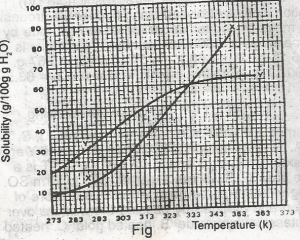
The diagram shown above represents the solubility curves of two salts, X and Y, in water, use this diagram to answer the question. If the molar mass of X is 36 g, the number of moles of X dissolved at 343 K is
Attached Figure / Diagram
A
0.2 moles
B
0.7 moles
C
1.5 moles
D
2.0 moles
E
3.0 moles
medium Difficulty
Verified Correct Answer: Option D
Chemical Principles & Mechanism
The molar mass of x = 36g. At 343k, 72g of x dissolved
Molarity of x = \(\frac{72}{36}\) = 2.00moles.
Source: Myschool Past Questions Archive (Record #31344)
Chemistry
UTME / JAMB 1985
Stoichiometry, Mole Concept & Volumetric Analysis
Diagram
Use the above options to the question. The products formed on hydrolysis of
Attached Figure / Diagram
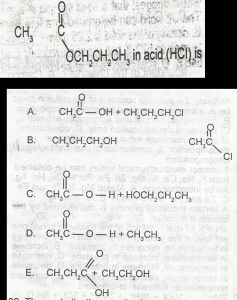
A
A
B
B
C
C
D
D
E
E
medium Difficulty
Verified Correct Answer: Option C
Chemical Principles & Mechanism
No expanded working has been attached for this question yet. The verified answer is Option C.
Source: Myschool Past Questions Archive (Record #31345)
Chemistry
UTME / JAMB 1985
Oxidation, Reduction & Redox Reactions
Diagram
Solution
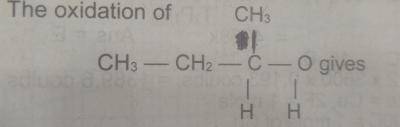
The oxidation of
Attached Figure / Diagram
A
2-butanone
B
2-butanal
C
butane
D
butanoic acid
E
3-butanal
medium Difficulty
Verified Correct Answer: Option A
Chemical Principles & Mechanism
Generally, oxidation of secondary alcohol yields Alkanone or Ketone. The structural formula of the compound above is 2-butanol.
Oxidation of 2-butanol, a secondary alcohol, yields 2-butanone (also known as methyl ethyl ketone), a ketone. This reaction typically occurs using oxidizing agents like sodium dichromate (Na\(_2\)Cr\(_2\)O\(_7\)) and sulphuric acid, or other oxidizing agents such as potassium permanganate (KMnO\(_4\)).
Source: Myschool Past Questions Archive (Record #31346)
Chemistry
UTME / JAMB 1985
Organic Chemistry I: Hydrocarbons & Crude Oil
Diagram
Solution
The I.U.P.A.C name for the compound
Attached Figure / Diagram

A
2-methyl-3-pentene
B
4-methyl-2-pentane
C
2-methyl-2-pentene
D
4-methylpent-2-ene
E
2-methyl-3-pentane
medium Difficulty
Verified Correct Answer: Option D
Chemical Principles & Mechanism
the IUPAC name of the given compound is 4 - methyl pent- 2- ene.
Source: Myschool Past Questions Archive (Record #31348)