Question Library
Browse, filter, and study verified past examination questions with step-by-step mathematical reasoning.
Searching 18,000+ Questions...
Sifting topics, KaTeX formulas & verified solutions
Showing 27121–27135 of 29811 verified questions
Sort by:
Chemistry
UTME / JAMB 1987
Acids, Bases, pH & Salts
In the purification of town water supply, alum is used principally to?
A
kill bacteria
B
control the pH of water
C
improve the taste of the water
D
coagulate small pasrticles of mud
medium Difficulty
Verified Correct Answer: Option D
Chemical Principles & Mechanism
No expanded working has been attached for this question yet. The verified answer is Option D.
Source: Myschool Past Questions Archive (Record #14586)
Chemistry
UTME / JAMB 1987
Water, Solutions & Solubility
Which of the following water samples will have the highest titre value when titrated for the Ca2+ ions using soap solution?
A
Permanently hard water after boiling
B
emporarily hard water after boiling
C
Rain water stored in a glass jar for two years
D
Permanent hard water passed through permuitit
medium Difficulty
Verified Correct Answer: Option A
Chemical Principles & Mechanism
No expanded working has been attached for this question yet. The verified answer is Option A.
Source: Myschool Past Questions Archive (Record #14588)
Chemistry
UTME / JAMB 1987
Air & Environmental Chemistry
Oil spillage in ponds and creeks can be cleaned up by?
A
burning off the oil layer
B
spraying with detergent
C
dispersal with compressed air
D
spraying with hot water
medium Difficulty
Verified Correct Answer: Option B
Chemical Principles & Mechanism
No expanded working has been attached for this question yet. The verified answer is Option B.
Source: Myschool Past Questions Archive (Record #14590)
Chemistry
UTME / JAMB 1987
Water, Solutions & Solubility
Solution
The solubility of Na3AsO4(H2O)12 is 38.9g per 100g H2O. What is the mass percentage of Na3AsO4 in the saturated solution?
(As = 75, Na = 23, O = 16, H = 1)
A
87.27%
B
38.9%
C
19.1%
D
13.7%
medium Difficulty
Verified Correct Answer: Option D
Chemical Principles & Mechanism
Given:
Mass of hydrated salt (Na\(_3\)AsO\(_4\)(H\(_2\)O)\(_{12}\)) = 38.9g
Mass of hydrated salt (Na\(_3\)AsO\(_4\)) = X
Molar mass of hydrated salt (Na\(_3\)AsO\(_4\)(H\(_2\)O)\(_{12}\)) = (23 x 3) + 75 + (16 x 4) + (18 x 12) = 424g/mol
Molar mass of hydrated salt (Na\(_3\)AsO\(_4\)) = (23 x 3) + 75 + (16 x 4) = 208g/mol
Using the formula,
\(\frac{mass of hydrated salt}{mass of anhydrous salt}\) = \(\frac{Molar mass of hydrated salt}{Molar mass of anhydrous salt}\)
\(\frac{38.9}{X}\) = \(\frac{424}{208}\)
X = 19.083 = 19.1%
The mass of anhydrous salt is obtained to be 19.1%
However, we need to get the total mass of the solution, and this we can get by first solving for the total mass of water that make up the solution.
Mass of water in hydrated salt = mass of hydrated salt - mass of anhydrous salt
= 38.9 - 19.1 = 19.8g
Also, recall that 38.9g salt was dissolved in 100g of water ⇒ total mass of water = 100 + 19.8 = 119.8g
Total mass of solution = mass of Na\(_3\)AsO\(_4\) + mass of H\(_2\)O
= 19.1 + 119.8 = 138.9g
Therefore, %Mass of Na\(_3\)AsO\(_4\) in the saturation solution = \(\frac{mass of anhydrous salt}{Total mass of solution}\times 100\)
= \(\frac{19.1}{138.9}\times 100\)
= 13.75%
Source: Myschool Past Questions Archive (Record #14593)
Chemistry
UTME / JAMB 1987
Organic Chemistry II: Functional Groups, Polymers & Biomolecules
In which of the following are the aqueous solutions of each of the substances correctly arranged in order to decreasing acidity?
A
Ethanoic acid, milk or magnesia, sodium chloride, hydrochloric acid and sodium hydroxide
B
Ethanoic acid, hydrochloric acid, milk of magnesia, sodium chloride and sodium chloride and sodium hydroxide
C
Hydrochloride acid, ethanol acid, sodium chloride, milk of magnesia and sodium hydroxide
D
Hydrochloride acid, sodium hydroxide sodium chloride, ethanol acid, and milk of magnesia
medium Difficulty
Verified Correct Answer: Option C
Chemical Principles & Mechanism
No expanded working has been attached for this question yet. The verified answer is Option C.
Source: Myschool Past Questions Archive (Record #14595)
Chemistry
UTME / JAMB 1987
Stoichiometry, Mole Concept & Volumetric Analysis
Solution
If 24.83 cm3 of 0.15 M NaOH is titrated to its end point with 39.45 cm3
of HCl, what is the molarity of the HCl?
A
0.094 M
B
0.150 M
C
0.940 M
D
1.500 M
medium Difficulty
Verified Correct Answer: Option A
Chemical Principles & Mechanism
NaOH + HCl → NaCl + H2O moles ratio = 1/1
↔ (MaVa) / Mb x 39.45 = 0.094
Source: Myschool Past Questions Archive (Record #14598)
Chemistry
UTME / JAMB 1987
Chemical Bonding & Intermolecular Forces
Solution
The atomic numbers of two elements X and Y are 12 and 19 respectively. The bond of these two elements is?
A
ionic
B
covalent
C
Metallic
D
co-ordinate
medium Difficulty
Verified Correct Answer: Option C
Chemical Principles & Mechanism
- Both elements are Magnesium and Potassium respectively
- In general, covalent bonds form between nonmetals, ionic bonds form between metals and nonmetals, and metallic bonds form between metals.
Source: Myschool Past Questions Archive (Record #14600)
Chemistry
UTME / JAMB 1987
Stoichiometry, Mole Concept & Volumetric Analysis
Solution
If d represents the density of a gas and K is a constant, the rate of gaseous diffusion r is related to d by the equation?
A
r = k/√d
B
r = kd
C
r =k/d
D
r = k √d
medium Difficulty
Verified Correct Answer: Option A
Chemical Principles & Mechanism
r = k /√d
Source: Myschool Past Questions Archive (Record #14603)
Chemistry
UTME / JAMB 1987
Atomic Structure, Orbitals & Nuclear Chemistry
Solution
An isotope has an atomic number of 17 and a mass number of 36. Which of the following gives the correct number of neutrons and protons in an atom of the isotope?
A
Neutrons 53, Protons 17
B
Neutrons 17, Protons 36
C
Neutrons 19, Protons 17
D
Neutrons 36, Protons 17
medium Difficulty
Verified Correct Answer: Option C
Chemical Principles & Mechanism
Mass number = number of protons + number of neutrons
36 = 17 + X; X = 36 -17 = 19
19 neutrons and 17 protons
Source: Myschool Past Questions Archive (Record #14605)
Chemistry
UTME / JAMB 1987
Particulate Nature of Matter, Laws & Formulae
Solution
An element Z, contained 90% of 168Z and 10% of Z1818 its relative atomic mass is?
A
16.0
B
16.2
C
17.0
D
17.8
medium Difficulty
Verified Correct Answer: Option B
Chemical Principles & Mechanism
Mass number of Z = 16 while that of Z is 18
90 x 16 = 14.4 10 x 18 = 1.8
100 1 100 1
it relative atomic mass = 14.4 + 1.8 = 162
Source: Myschool Past Questions Archive (Record #14607)
Chemistry
UTME / JAMB 1987
Organic Chemistry II: Functional Groups, Polymers & Biomolecules
Diagram
Solution
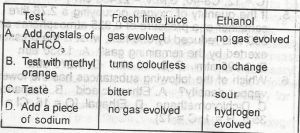
Use the option above to answer this question. Which is the correct set of results for tests conducted respectively on fresh lime juice and ethanol.
Attached Figure / Diagram
A
A
B
B
C
C
D
D
medium Difficulty
Verified Correct Answer: Option A
Chemical Principles & Mechanism
lime juice reacts with NaCO3 with the evolution of CO2 because it is an acid while NaCO3 with ethanol does not result in a significant chemical reaction.
Source: Myschool Past Questions Archive (Record #31379)
Chemistry
UTME / JAMB 1987
Organic Chemistry II: Functional Groups, Polymers & Biomolecules
Diagram
Solution
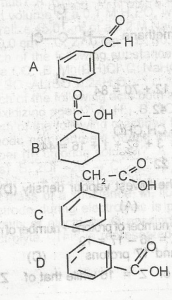
Use the option above to answer this question. The structure of benzoic acid is
Attached Figure / Diagram
A
A
B
B
C
C
D
D
medium Difficulty
Verified Correct Answer: Option D
Chemical Principles & Mechanism
Benzoic acid is a simple aromatic carboxylic acid with the chemical formula C\(_6\)H\(_5\)COOH. Its structure consists of a benzene ring (C\(_6\)H\(_6\)) with a carboxyl group (COOH) attached to it. This carboxyl group is what gives benzoic acid its acidic properties.
(See diagram above)
Source: Myschool Past Questions Archive (Record #31381)
Chemistry
UTME / JAMB 1987
Organic Chemistry II: Functional Groups, Polymers & Biomolecules
Solution
Use the option above to answer this question. The structure of benzoic acid is
A
A
B
B
C
C
D
D
medium Difficulty
Verified Correct Answer: Option D
Chemical Principles & Mechanism
Benzoic acid is a simple aromatic carboxylic acid with the chemical formula C\(_6\)H\(_5\)COOH. Its structure consists of a benzene ring (C\(_6\)H\(_6\)) with a carboxyl group (COOH) attached to it. This carboxyl group is what gives benzoic acid its acidic properties.
(See diagram above)
Source: Official Exam / Past Question Archive
English Language
UTME / JAMB 1987
Reading Comprehension, Summary & Composition
Which one of the following is NOT true of the passage?
A
the lady was beautiful
B
the marriage cost a lot of money
C
the marriage was according to native law and custom
D
Fatmata never had an issue
E
the author wanted another wife
medium Difficulty
Verified Correct Answer: Option D
Grammar & Contextual Explanation
No expanded working has been attached for this question yet. The verified answer is Option D.
Source: Official Exam / Past Question Archive
Biology
UTME / JAMB 1987
Cell Structure, Organization & Cell Division
The functions of endoplasmic reticulum is
A
protein synthesis
B
intracellular transport of materials
C
digestion and destruction of foreign bodies
D
production of energy from glucose
medium Difficulty
Verified Correct Answer: Option B
Biological Concept & Syllabus Guide
No expanded working has been attached for this question yet. The verified answer is Option B.
Source: Myschool Past Questions Archive (Record #3667)