Question Library
Browse, filter, and study verified past examination questions with step-by-step mathematical reasoning.
Searching 18,000+ Questions...
Sifting topics, KaTeX formulas & verified solutions
Showing 26881–26895 of 29821 verified questions
Sort by:
Biology
WAEC / WASSCE 1988
Nutrition in Plants & Animals (Photosynthesis & Food Substances)
Solution
(a) State four modes of nutrition in plants.
(b) Outline the process involved in the light and dark reactions of photosynthesis.
(c) Describe briefly the modifications and the mechanisms associated with the following feeding habits:
(i) filter feeding in mosquito larva; (ii) parasitic feeding in tapeworm.
medium Difficulty
Verified Correct Answer: Option
Biological Concept & Syllabus Guide
(a)Modes of nutrition in plants are:
(i) Autotrophic or holophytic nutrition — It is a process by which green leaves or plants manufacture their food using atmospheric carbon dioxide and soil water as raw materials with sunlight as the source of energy. This type of aytotrophic nutrition is the photosynthetic nutrition. The other type is the chemosynthetic nutrition where energy is derived from the breakdown of inorganic compounds.
(ii) Parasitic nutrition — It is a process by which some plants depend on other plants (as the host) for food and protection. A parasite harms its host by causing some set back during the relationship.
(iii)Mutualism (symbiosis) — This involves two organisms living together for the mutual benefit of each other. It may be between organisms which belong to the same group or different groups, e.g. nitrogen fixing bacteria, rhizobium and leguminous plants and fungi and algae in lichens.
(iv) Epihytic nutrition — This happens when plants attach themselves to other plants for support. They obtain minerals and water from the point of attachment to the host plants but manufacture their food through photosynthesis because they possess green leaves.
(b) (i) Light reaction occurs in the grana of the chloroplast which contains chlorophyll, a light absorbing pigment. The absorption of light energy by chlorophyll helps to split water molecule into hydrogen and hydroxyl ions: 4H\(_2\)O Light energy 4H\(^{+}/) \(_H\)OH — 4OH\(^{-}/)
→
The hydroxyl components react further to form water and oxygen: 2OH + 20H > 2H20 + 02 .
Summary of reactions: 4H\(_2\)O radiant energy 4H\(^{+}/) + 2H\(_2\)O + O\(_2\) + 4e-
In the process, electrons are transferred to photo system I, two molecules of ATP are synthesized from ADP and inorganic phosphate. ADP + P1→ ATP (photophosphory— lotion) electrons move further to another photosystem 1. NADP is reduced to NADPH and two molecules of NADPH are produced.
(ii) Dark reaction takes place in the stoma of the chloroplast in the presence of NADPH and ATP. The Hydrogen (H) formed in the light reaction undergoes series of reactions in which they reduce carbon dioxide to form sugar (glucose): Co\(_2\) + 4H → CH\(_2\)O + H\(_2\)O. The reactions are catalysed by enzymes.
(c) (i) Filter feeding in mosquito: The head possesses brushes, mandible and maxillae. Ventral surface of the head is upward and this enables the pair of brushes at the sides of the mouth to sweep through water and entangle small food particles which are combed into the mouth by the maxillae and mandibles.
(ii) Parasitic feeding in tape worm: The head (scolex) possesses hooks, rostellum and suckers. The hooks and the suckers enable the organism to attach itself to the walls of the intestine of its host. The entire body is used to absorb digested food from its host.
Source: Myschool Past Questions Archive (Record #53114)
Biology
WAEC / WASSCE 1988
Basic Ecological Concepts, Ecosystems & Biomes
Solution
(a) (i) Define the term population. (ii) List two biotic and abiotic factors each that affect population growth.
(b) What are the effects of food shortage on a population?
(c) Describe two methods each for:
(i) improving crop yield (ii) preserving and storing food. Explain the principle involved in each of the methods described.
medium Difficulty
Verified Correct Answer: Option
Biological Concept & Syllabus Guide
(a)(1) Population is defined as the number of a particular species of organisms in a given habitat.
(ii) Biotic factors that affect population growth are:
(1) Animals
(2) Microbes.
(iii) Abiotic factors that affect population growth are:
(1) Rainfall
(2) Wind.
(3) Temperature
(4) Humidity
(5) Soil acidity or alkality
(6) Attitude.
(b) Effects of food shortage on a population are:
(1) Cannibalism — It is the eating of one another in the habitat in order to survive. This reduces population.
(2) Competition — It is the tendency to struggle for the little available food. This is survival of, the fittest.
(3) Loss of weight — There is loss of weight by individuals which brings about low energy out put
(4) Diseases — There is malnutrition due to shortage of food which results in deficiency, diseases and reduction in the resistance of organisms to infection etc.
(5) Death — Organisms may die of starvation due to long period of food shortage.
(6) Famine — Little food is available to go round the population thereby resulting in severe famine.
(c)(i)Methods of improving crop yield:
(1) Use of fertilizer - Fertilizer should be applied before or after planting to increase the fertility of the soil and this will in turn increase yield. During application of fertilizer, you may broadcast, ring or use the side placement or folia method. Example of fertilizer is NPK. Ensure that fertilizer does not come in direct contact with growing crops.
(2) Crop rotation — This is a system of cropping whereby crops are planted on the same piece of land with each crop following the other in a definite sequence during the same farming season. The piece of land may be divided into five plots and different crops planted on these plots every year in a definite order. Ensure that crops of the same family are not allowed to follow each other in the sequence. Deep rooted crops should follow shallow rooted crops and leguminous crops should be planted on the fallow plot in the sequence.
(ii) Methods of preserving and storing food:
(1) Canning — Foods are preserved in cans or sealed containers. Before storage, heat treatment is applied to prevent spoilage.
(2) Refrigeration — Low temperature inhibits the growth and spread of micro organisms.
(3) Drying and salting
(4) Pasteurisation
(5) Additives
(6) Smoking
(7) Irradiation.
Source: Myschool Past Questions Archive (Record #53116)
Biology
WAEC / WASSCE 1988
Population Ecology, Habitats & Conservation
Solution
(a) What is conservation of natural resources?
(b) List various natural resources that need to be conserved. State briefly the benefits of conservation in each case.
(c) List the problems often encountered in ensuring conservation of natural resources.
(d) What are the efforts being employed in your country to ensure conservation of natural resources?
medium Difficulty
Verified Correct Answer: Option
Biological Concept & Syllabus Guide
(a) Conservation of natural resources is defined as the art of planning and management of natural resources to ensure their wise utilisation and continuity of supply over a long period of time while maintaining and enhancing their quality, diversity and values.
(b)(i) Various natural resources to be conserved are: — Water, soil, Wild life and Minerals.
(ii) The benefits of conservation of each of them are:
(1) Water — It is conserved in order to make it available for domestic and commercial use, longevity of aquatic organisms, etc.
(2) Soil — It is conserved in order to enhance fertility and prevent erosion.
(3) Wild life — It is conserved in order to avoid the extinction of certain plants and animal species, e.g. elephants.
(4) Minerals — It is conserved to prevent unrestricted exploitation and exhaustion of minerals like petroleum, gold, tin ore, iron, platinum, etc.
(5) Forest — It is conserved for constant or regular supply of forest products, e.g. timber, fruits, ropes and to avoid desertification, etc.
(c) Problem encountered in conservation are: Farming, soil erosion, hunting, lumbering, fishing, mining, construction, industrialization, bush burning, over cropping, etc
(d) Efforts employed in ensuring conservation are:
(1) Zoological and botanical gardens are established.
(2) Promulgation of law prohibiting lumbering and indiscriminate hunting in our forest reserve.
(3) Prohibiting the use of chemicals for fishing.
(4) Reforestation programme by the Government through tree planting campaign.
(5) Establishment of Federal Environmental Protection Agency (FEPA).
(6) Forest or game reserves are established, e.g. Yankari Game reserve in Bauchi State.
Source: Myschool Past Questions Archive (Record #53117)
Biology
WAEC / WASSCE 1988
Respiration & Gaseous Exchange
Diagram
Solution
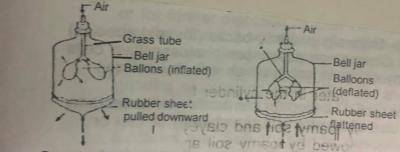
The set-up in diagrams I and II illustrate breathing mechanisms in mammals
(a) Name the structures in mammals that are equivalent in function to the parts labelled (i) glass tube (ii) bell jar (iii) balloons (iv) rubber sheets (v)A (vi) B.
(b) Name the processes illustrated by diagrams (i) I (i)
(c) In which of the bell jars is the pressure lower?
Attached Figure / Diagram
medium Difficulty
Verified Correct Answer: Option
Biological Concept & Syllabus Guide
(a) (i) Trachea (ii) Rib cage (ii) Lungs (iv) Diaphragm (v) Bronchus (vi) Pleural cavity
(b) (i) Inhalation (inspiration or breathing in) (ii) Exhalation: (expiration or breathing out)
(c) In1
Source: Myschool Past Questions Archive (Record #59767)
Biology
WAEC / WASSCE 1988
Variety of Organisms & Classification of Living Things
Diagram
Solution
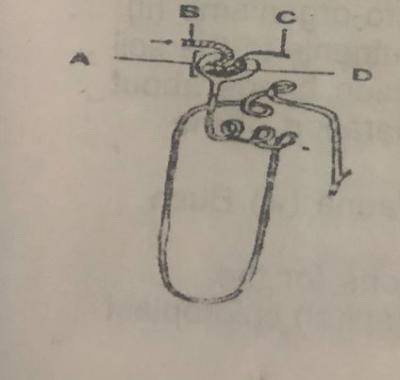
(a) Name the parts labelled A, B, C and D
(b) What is the significance of the relative size of B and C?
(c) Name the structures in: (i) Amoeba (ii) earthworm. Which are equivalent in function to the structure illustrated in the diagram
Attached Figure / Diagram
medium Difficulty
Verified Correct Answer: Option
Biological Concept & Syllabus Guide
2. (a) A = Bowman's capsule B=Afferent capillary C= Efferent capillary This D = Glomerulus
(b) Blood pressure from renal artery is high. pressure is further increased by convuluted nature of the glomerulus.: coupled with difference in diameter between the afferent and efferent capillaries (i.e the afferent being bigger in size) This creates room for thorough filtration or near so, of waste products in the glomerulus (c) (0) Contractile vacuole (i) Nephridium
Source: Myschool Past Questions Archive (Record #59768)
Biology
WAEC / WASSCE 1988
Reproduction in Plants & Animals
Diagram
Solution
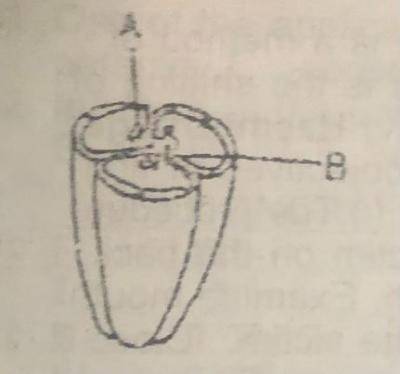
The diagram below represents the transverse section of a fruit (a) State the kind of placentation found in the fruit (b) Name one fruit that has this kind of placentation
Attached Figure / Diagram
medium Difficulty
Verified Correct Answer: Option
Biological Concept & Syllabus Guide
3. (a) Axile placentation (i) Orange. Other fruits are guava, tomatoes, etc
À = Ovule (seed) B = placenta
Source: Myschool Past Questions Archive (Record #59769)
Biology
WAEC / WASSCE 1988
Adaptation & Evolution
Solution
Give one example each of (a) protective colouration (b) structural adaptation in animals for temperature regulation 4.
medium Difficulty
Verified Correct Answer: Option
Biological Concept & Syllabus Guide
4. (a) Fish bears a protective colouration. The darker upper part camouflages it against fishermen, while the silvery lower part protects it against predators (bigger sea animals), since looking from below the water blends it with the sky. The different colours in fish are referred to as countershading. Other forms of adaptive colouration are (i) green colours of grasshopper which camouflages it from predators like lizards, birds and mammals (ii) the colour. of lizards (ranging from brown to grey) make it to blend with the soil walls and tree-backs (for wild species) and as such are protected from predators such as snakes (iii) Chameleon possesses photosensitive cells on its skin and is able to change or blend with the colour of any environment in which it finds itself (iv) Bright colours to ward off enemies e.g ladybirds
Source: Myschool Past Questions Archive (Record #59770)
Biology
WAEC / WASSCE 1988
Respiration & Gaseous Exchange
Solution
List three methods of birth control.
medium Difficulty
Verified Correct Answer: Option
Biological Concept & Syllabus Guide
Three methods of birth control are (i) use of intra-uterine device (IUD) or loop (ii) sterilization or vesectomy or tubal ligation (ii) Use of contraceptive pills or injection (iv) Use of condom (Durox sheeth) or cap or diaphragm (v) Use of ovulation method or abstinence.
Source: Myschool Past Questions Archive (Record #59771)
Biology
WAEC / WASSCE 1988
Population Ecology, Habitats & Conservation
Solution
State two ways in which agricultural practices can affect an ecological system.
medium Difficulty
Verified Correct Answer: Option
Biological Concept & Syllabus Guide
Two ways in which agricultural practices can affect ecological system are: (i) Bush burning affects or reduces organic content of the soil. It increases inorganic content of the soil and kills the soil micro-organisms (ii) Fertilizer application changes the soil pH, alters chemical composition of the soil and adds nutrients to the so Other ways include: (iii) Tillage leads to erosion, aeration and leaching of soil (iv) Irrigation brings about high humidity and increased moisture content of the soil. It decreases air content and aeration of the environment. (v) Herbicides and pesticides pollute water and land. They also alter the vegetation or fauna (vi) Bush clearing destroys vegetation
Source: Myschool Past Questions Archive (Record #59772)
Biology
WAEC / WASSCE 1988
Cell Structure, Organization & Cell Division
Diagram
Solution
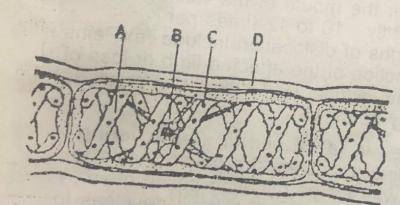
Study the diagram below (a) (i) ldentify the organism illustrated in the diagram (i) Give two reasons for your answer
(b) (i) Name the parts labelled A to D (ii) State the function of one of the labelled parts
Attached Figure / Diagram
medium Difficulty
Verified Correct Answer: Option
Biological Concept & Syllabus Guide
(a) (i) The organism illustrated in the diagram is Spirogyra or Filamentous Alga (ii) Reasons for the identification (1) It is made up of more than one cell joined end to end (filament) (2) It has (spiral) chloroplast (3) It has pyrenoid in the chloroplast (b) (i) The parts labelled A to D are A = (spiral) chloroplast B= Nucieus C= Pyrenoid D= Mucilage (b) () The functions of the labelled parts are A = Photosynthesis or food manufacture B = Controls the activity of the organism C= Storage of food or starch or carbohydrate D = Prevention of desiccation or drying.
Source: Myschool Past Questions Archive (Record #59773)
Biology
WAEC / WASSCE 1988
Excretion & Homeostasis
Solution
State two adaptations necessary for aquatic organisms
medium Difficulty
Verified Correct Answer: Option
Biological Concept & Syllabus Guide
Adaptations necessary for aquatic organisms are: (i) Fins for support and movement (ii) Streamlined shape (iii) Cilia and flagella for movement (iv) Air bladder for buoyancy (v) Gills or air trumpets for respiration (vi) Contractile vacuole for water regulation or osmoregulation.
Source: Myschool Past Questions Archive (Record #59774)
Biology
WAEC / WASSCE 1988
Respiration & Gaseous Exchange
Solution
(a) identify specimens A and B (b) (i) Name the group or class of animals to which each specimen belongs (ii) State the location of specimen B in the organism (c) State two characteristic features common to specimens A and Band which adapt them to their functions (d) What is the function of specimen A in the organism? (e) Suggest the habitats of the animals to which each of the specimens belongs (f) Make a labelled drawing 6 to 7cm long of specimen B to illustrate its essential features.
medium Difficulty
Verified Correct Answer: Option
Biological Concept & Syllabus Guide
(a) Specimen A is a piece of mammalian lung. Specimen B is the gill of a fish (b) (i) The class of specimen A is mammal. The class of specimen B is fishes or pisces (ii) Specimen B is found below the operculum (c) Characteristic features of specimens A and B which adapt them to their functions are: (i) They are highly vascularized or have a lot of blood vessels (ii) They have thin surfaces (ii) They are soft and moist (iv) They have irregular surfaces to create large surface area (d) The function of specimen A in the organisms is for gaseous exchange (e) The habitats of the animals to which each of the specimens belongs are specimen A terrestrial habitat; specimen B aquatic habitat
Source: Myschool Past Questions Archive (Record #59787)
Biology
WAEC / WASSCE 1988
Digestive System & Feeding Mechanisms
Diagram
Solution
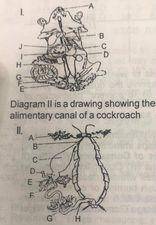
Diagram 1 is a drawing showing the alimentary canal of a mammal. Study the diagram carefully (a) Name the structure labelled A to J (b) What are the functions of the parts labelled A, C and H?
(C) Name the parts labelled A to H (d) State the functions of the parts labelled D and E (e) State two features common diagram I and D in diagram II (f) identify and name the parts in diagrams I and ll that perform similar functions
Attached Figure / Diagram
medium Difficulty
Verified Correct Answer: Option
Biological Concept & Syllabus Guide
(a) The names of the structures labelled A to J are A = Teeth (tooth) or incisors (incisor), B = Oesophagus or gullet C = Stomach D = Duodenum E = Rectum, F =Appendix, G = Large intestine or caecum., H= Smal intestine, I = Bile duct or gall bladder, J=Liver.
(b) The functions of the part labelled A, C and H are: (i) A = for biting or piercing or gnawing or cutting food into small pieces (ii) C= for (temporary) storage or for further digestion of food H= for digestion or absorption of food (c) The parts labelled A to H in diagram ii are: A= Salivary gland, B = Oesophagus or gullet C= Crop D= Gizzard E= Hepatic caeca or digestive gland or enteric caeca or mesenteric caeca F = Mid-gut or middle gut or mesenteron, G= small intestine or Hind gut H = Rectum (d) The functions of the parts labelled D and E are: D = for grinding or crushing food Common to the parts labelled C in diagram I and D in diagram II are: Both are (i) muscular and (ii) have sac-like or convoluted or rough interior (f) The parts in diagrams I and l that perform similar Functions are: Salivary glands, oesophagus, crop or stomach, pancreas or hepatic caeca, ileum or small intestine, large intestine or colon or rectum and anus.
Source: Myschool Past Questions Archive (Record #59789)
Mathematics
UTME / JAMB 1987
Fractions, Decimals, Percentages & Approximations
Solution
Simplify \(\frac{x^2 - y^2}{2x^2 + xy - y^2}\)
A
\(\frac{x + y}{2x + y}\)
B
\(\frac{x + y}{2x - y}\)
C
\(\frac{x - y}{2x - y}\)
D
\(\frac{x - y}{2x + y}\)
medium Difficulty
Verified Correct Answer: Option C
Step-by-Step Mathematical Solution
\(\frac{x^{2} - y^{2}}{2x^{2} + xy - y^{2}}\)
\(2x^{2} + xy - y^{2} = 2x^{2} - xy + 2xy - y^{2}\)
= \(x(2x - y) + y(2x - y) \)
= \((x + y)(2x - y)\)
\(\frac{x^{2} - y^{2}}{2x^{2} + xy - y^{2}} = \frac{(x + y)(x - y)}{(x + y)(2x - y)}\)
= \(\frac{x - y}{2x - y}\)
Source: WAEC / JAMB / NECO Classroom Archive (Record #31911)
Mathematics
UTME / JAMB 1987
Mensuration (Areas, Perimeters & Volumes)
Diagram
Solution
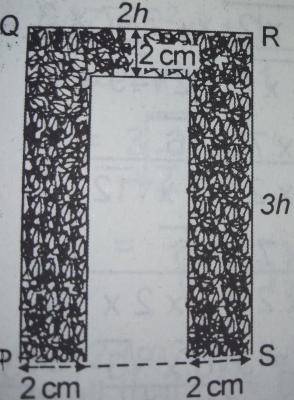
In the figure, PQRS is a rectangle. If the shaded area is 72 sq. cm, find h.
Attached Figure / Diagram
A
12cm
B
10cm
C
8cm
D
5cm
medium Difficulty
Verified Correct Answer: Option D
Step-by-Step Mathematical Solution
From the diagram, PQRS is a rectangle
Area of shaded part = 72sq.cm
But 72 = 3h - 4 + 6h - 4 + 4h
= 72 - 16h - 8
= 16h - 72 + 8
=16h = 80
h = \(\frac{80}{16}\)
= 5cm
Source: WAEC / JAMB / NECO Classroom Archive (Record #54911)