Question Library
Browse, filter, and study verified past examination questions with step-by-step mathematical reasoning.
Searching 18,000+ Questions...
Sifting topics, KaTeX formulas & verified solutions
Showing 26251–26265 of 29821 verified questions
Sort by:
Biology
WAEC / WASSCE 1989
Cell Structure, Organization & Cell Division
Which of the following organelles are likely to be present in cells that are actively respiring and
hotosynthesizing?
A
Nucleoli and centrioles
B
Lysosomers and ribosomes
C
Endoplasmic reticulum and Golgi bodies
D
Chloroplasts and mitochondria
E
Food vacuoles and contractile vacuoles
medium Difficulty
Verified Correct Answer: Option D
Biological Concept & Syllabus Guide
No expanded working has been attached for this question yet. The verified answer is Option D.
Source: Myschool Past Questions Archive (Record #17048)
Biology
WAEC / WASSCE 1989
Growth, Micro-organisms & Public Health
Which of the following is not true about a bacterial colony growing on an agar plate?
A
They are visible without the aid of the microscope
B
Bacterial cells found in one colony often belong to one species
C
Different colonies have different colours
D
Only one species of bacterial colony can grow on a culture at any time
E
Colonies growing on an agar plate under the same conditions must belong to one species
medium Difficulty
Verified Correct Answer: Option C
Biological Concept & Syllabus Guide
No expanded working has been attached for this question yet. The verified answer is Option C.
Source: Myschool Past Questions Archive (Record #17049)
Biology
WAEC / WASSCE 1989
Adaptation & Evolution
The theory that new organs or characteristics develop in organisms when there is a need for them was
postulated by
A
Charles Darwin
B
Jean Lamarck
C
Gregor Mendel
D
Wallace
E
Louis Pasteur
medium Difficulty
Verified Correct Answer: Option B
Biological Concept & Syllabus Guide
No expanded working has been attached for this question yet. The verified answer is Option B.
Source: Myschool Past Questions Archive (Record #17050)
Biology
WAEC / WASSCE 1989
Adaptation & Evolution
Which of the following is an example of reproductive adaptation?
A
Succulent stems of cactus plant
B
Changing colour of chameleon
C
Possession of spines by desert plants
D
Neck colouration in Agama lizard
E
Leaf-shedding in trees
medium Difficulty
Verified Correct Answer: Option D
Biological Concept & Syllabus Guide
No expanded working has been attached for this question yet. The verified answer is Option D.
Source: Myschool Past Questions Archive (Record #17051)
Biology
WAEC / WASSCE 1989
Nervous, Hormonal Coordination & Sense Organs
The large intercellular air spaces which penetrate the tissues of most hyrophytes provide a pathway through
which
A
carbondioxide absorbed by leaves can diffuse to the roots
B
oxygen produced in the leaves can diffuse to the submerged parts
C
salts absorbed by roots can reach other parts of the plant
D
plant hormones are transported to various parts
E
manufactured food is translocated
medium Difficulty
Verified Correct Answer: Option B
Biological Concept & Syllabus Guide
No expanded working has been attached for this question yet. The verified answer is Option B.
Source: Myschool Past Questions Archive (Record #17052)
Biology
WAEC / WASSCE 1989
Basic Ecological Concepts, Ecosystems & Biomes
Which of the following processes will not introduce carbondioxide into the atmosphere?
A
Breathing
B
Photosynthesis
C
Respiration
D
Putrefaction
E
Burning
medium Difficulty
Verified Correct Answer: Option B
Biological Concept & Syllabus Guide
No expanded working has been attached for this question yet. The verified answer is Option B.
Source: Myschool Past Questions Archive (Record #17053)
Biology
UTME / JAMB 1989
Basic Ecological Concepts, Ecosystems & Biomes
Solution
Which ecological factor exerts the greatest influence on the structure of the profiles?
A
Topographic
B
Edaphic
C
Biotic
D
Climatic
medium Difficulty
Verified Correct Answer: Option D
Biological Concept & Syllabus Guide
Climate i.e. option D is correct, by climate(climatic factors) such as rainfall and temperature as we move from forest biome to grassland.
Source: Official Exam / Past Question Archive
Biology
WAEC / WASSCE 1989
Nutrition in Plants & Animals (Photosynthesis & Food Substances)
Diagram
Solution
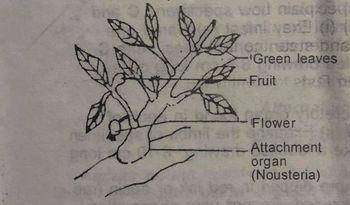
(a) identify specimen D without giving reason (b) (i) State two observable features of specimen D which indicate its mode of nutrition (b) (ii) What is the mode of nutrition cf specimen D? (c) Make a labelled drawing to show features of biological importance of the specimen (d) (i) Examine and identify without reasons specimens E and F
Attached Figure / Diagram
medium Difficulty
Verified Correct Answer: Option
Biological Concept & Syllabus Guide
(a) Specimen D is a parasitic plant (Cassythafiliformis) or dodder. In some schools, it could be a semiparasitic plant-like mistletoe
Organism
Mode of Nutrition
Observable features
Dodder (Cassythafiliformis)
Completely parasitic or heterotrophic
(i) Yellow in colour. It has no leaves. It has no chlorophyll
(ii) Presence of haustoria or Presence of haustoria or leaves. sucker or attachment organ
Mistletoe
Parasitic or semi-parastic or heterotrophic or autotrophic
(i) It has green leaves or chlorophy Il
(ii) Presence of haustoria or sucker or attachment organ
(d)(i) Specimen E is a soldier termite. Specimen F is a grasshopper (ii) Structural adaptations and their significance. Soldier termites have enlarged heads for bearing strong mouth parts of mandibles adapted for offence and defence. The mouth parts are also adapted to vegetable diet. Grasshoppers have biting or chewing mouth parts adapted for chewing vegetable diet. They also have strong hind limbs for jumping away from their enemies. In addition, they have wings for flight
Source: Official Exam / Past Question Archive
Biology
WAEC / WASSCE 1989
Basic Ecological Concepts, Ecosystems & Biomes
Solution
(a) List five morphological features that are characteristic of plant found in each of the following habitats:-(i) tropical rainforest. (ii) savanna. In each case, state function of the features listed in (a) to the plant.
(b) Explain the term: ecological succession
(c) By means of a diagram only, outline the carbon cycle to show the relative importance of the cycle to life in general.
medium Difficulty
Verified Correct Answer: Option
Biological Concept & Syllabus Guide
(a)(i) Morphological features of Tropical rainforest plants:
They are tall trees with unbranched trunks which taper very little.
Usually their barks are thin and they have buttresses.
The leaf buds lack protective covering while the matured leaves are oval in shape, having entire margins and an acumen or drip tip.
Functions of features listed:
Tall unbranched trunks enable the plants to receive adequate sunlight .
Thin bark allows the plant to lose water by transpiration and makes the trees a good source of timber.
Buttress roots provide mechanical support against wind.
Buds lack protective covering and this encourages easy breakage for the buds.
Drip tip type of leaves allows water to drain easily from the leaves, hence transpiration is facilitated.
(ii) Morphological features of plants in the Savanna:
They have long twisted roots and thick bark.
Trunks are gnarled (covered with hard lumps) and twisted.
Because of the underground stems, grasses are tuff and perennial.
Functions of features listed:
Long twisted roots facilitate the absorption of water and mineral salts and also facilitate quick regeneration after fire attack.
Thick bark enables the plants to withstand harsh conditions, e.g. fire.
Gnarled and twisted trunk reduce excessive loss of water as well as resistance to fire attack .
Underground stems enable the plants to survive during dry season and fire attack.
Tuffs and perennial Grasses have inner parts which are highly protected by the outer tuffness against fire outbreak.
(b) Ecological succession can be referred to as a gradual, cumulative and predictable progressive change in the ecological communities in an area with a definite movement toward a position of equilibrium known as climax. It can be classified into primary and secondary succession. Primary succession is the colonization of borne vegetation or bare ground or rocks which have not previously been colonized, e.g. surfaces of fresh hardened molten magma and sand dunes. Secondary succession is the colonization of an area following the destruction or removal of the original vegetation. Barren habitat is gradually colonized by a series of plant and animal inhabitants until a final stable community is achieved.
Source: Myschool Past Questions Archive (Record #53071)
Biology
WAEC / WASSCE 1989
Nervous, Hormonal Coordination & Sense Organs
Solution
(a) Describe an experiment to demonstrate the influence of auxins on the growth of plant shoot.
(b) List three uses of auxins in agriculture.
(c) Describe briefly the mechanism of transmission of impulses through a nerve fibre.
medium Difficulty
Verified Correct Answer: Option
Biological Concept & Syllabus Guide
(a) Experiment to demonstrate the influence of auxins:
Aim —To demonstrate the influence of auxins on the growth of plant shoot .
Apparatus: Young millet seedlings, agar block, blade, indole acetic acid (IAA), red light.
Method: Use young millet seedlings grown in the dark whose coleoptiles is up to I cm long. Label the seedlings A, B and C. Cut off the growing tips of the coleoptiles in a dark room in the presence of red light. Prepare three small agar blocks: (A) Agar block containing auxin, (B) Agar block containing indole acetic acid (IAA), (C) Agar block which is not treated as control experiment. Agar block which contains auxin is placed on cut coleoptile tip A to allow auxin in the tip to diffuse into the agar block. Agar block which contains indole acetic acid (IAA) is put on the tip of the coleoptile B.The untreated agar block is put on the tip of cut coleoptile C as control. Then leave the three coleoptiles in a unilateral source of light for few hours.
Observation: The seedlings in experiment A and B show accelerated growth curvature on the sides the agar blocks were placed. Experiment C which is the control shows no growth curvature. Conclusion: This shows that auxins promote growth in coleoptile or shoot.
(b) Uses of auxins in agriculture :
(1)Auxin spray prevents leaf fall.
(2) It enhances the formation of roots.
(3) It stimulates the formation of female flowers.
(4) It promotes the development of fruits
(5) It induces cells to differentiate into xylem to increase water and mineral transport and to provide support.
(c) Mechanism of transmission of impulses through a nerve fibre: This can be categorised into three phases:
(1) The resting potential
(2) The action potential
(3) Repolarisation phase. At the resting phase, the outer surface of a nerve fibre is positively charged and the inner surface is negatively charged. Stimulus from outside is detected by the receptor organs and this is transmitted along the nerve fibres as an electrical impulse. The change in electrical potential brings about transmission. Any part of the nerve fibre along which the impulse passes is negatively charged relative to other parts of the nerve fibre as a result of the flow of sodium and potassium ions via the membranes of the nerve fibre. Or At the resting stage of the axon, the outside and the inside are positively and negatively charged respectively. Membrane surrounding the axon is polarised, as a result of which it can maintain different electric charge on its two sides. Sodium ions are concentrated outside and potassium ions inside the fibre. Stimulation of the fibre results in change in permeability of the cell membrane. The sodium ions move in while potassium ions move out of the nerve, hence we have sudden reversal of the resting potential. The inner part of the axon becomes positive while the outer part is negative, which is the action potential. Change in the ionic charge along the fibre results in the movement of electrical current along the fibre, hence impulse is transmitted. As soon as the impulse passes on, the resting potential is restored
Source: Myschool Past Questions Archive (Record #53073)
Biology
WAEC / WASSCE 1989
Adaptation & Evolution
Solution
(a) Describe how the floral parts of a named flower are adapted to wind-pollination.
(b) Explain how each of the following behaviours in animals affects the reproduction process: (i) territoriality. (ii) display; (iii) seasonal migration.
medium Difficulty
Verified Correct Answer: Option
Biological Concept & Syllabus Guide
(a) Adaptation of the floral parts of named flower Maize (Zea mays) to wind pollination:
Flowers produce a large number of light, smooth and powdery pollen grains.
They are borne in large inflorescence but are small and inconspicuous.
Stigma are large and feathery and they hang outside the flower.
This ensures a large surface area for pollination and increases the chances of trapping pollen grains in the air.
They possess long style which makes the feathery stigma conspicuous.
Anthers are large and loosely attached to long filaments.
They hang out of the flower, exposing themselves to the wind.
These characteristics facilitate the dispersal of pollen grains.
The flower is usually dull in colour.
(b)(i)Territoriality; is defined as the ability of various species of animals to display a well developed social hierarchy in which the most senior or powerful or the largest in number occupies a dominant position. In this dispensation, some males that are weak may not be able to mate, hence there is reduction in population and the offsprings within a particular territory are able to have enough food to eat. When mating is controlled, the animals may go into extinction and there will be increase in the chances of having mates among the animals.
(ii) Display; is a situation where animals use certain behaviour in order to attract the opposite sex. This includes all sorts of movements ranging from flashing of colour, dancing, nodding, strutting, plumage display, etc. These behaviours lead to courtship which precedes mating.
(iii) Seasonal migration; is the movement of animals carried out at certain time of the year or regularly for some reasons, e.g. breeding, in search of food, avoiding dry sphere, etc. Fishes migrate upstream into their territories for breeding. This prevents the bigger fishes from eating the young ones. Migration leads to population control because many birds may meet adverse environmental condition and die before returning to their place of origin. It also leads to reduction in the number of predators due to migration when their prey are no longer there. The preys multiply fast in number when they return due to the absence of their predators or enemies.
Source: Myschool Past Questions Archive (Record #53074)
Biology
WAEC / WASSCE 1989
Excretion & Homeostasis
Solution
(a) List three functions of the kidney.
(b) Make a labelled diagram of the mammalian kidney tubule (nephron)
(c) Describe how the kidney carries out two of the functions listed in (a).
medium Difficulty
Verified Correct Answer: Option
Biological Concept & Syllabus Guide
(a)Functions of the kidney:
(1) Serves as excretory organ, e.g. urine
(2) As osmoregulatory organ
(3) Homeostasis
(4) Formation of urine
(5) Elimination of toxins, drugs and.harmful substances
(6) Heat production
(7) Water level regulator.
(c)(i) Osmo regulation: Kidney keeps the composition of the body plasma constant by means of osmosis, e.g. if there is too much water in the plasma, the kidneys excrete more water and thus reduce the amount in the plasma. In this way, the osmotic pressure of the plasma is kept constant by the kidney and this is important because, in this way, the balance of osmotic pressure between the blood and cells through the intermediate lymph is maintained. Normally the composition of the plasma is controlled or varied as a result of the amount of water and soluble substances absorbed from the alimentary canal or lost through sweating. The variation is corrected by the kidney.The osmotic pressure of the blood may rise due to too much water loss or excess salt intake. This is detected by sensitive cells in the hypothalamus of the brain which stimulate the production and release of antidiuretic hormone (ADH) by the pituitary gland. As soon as the hormone reaches the kidney, it induces the kidney tubules to reabsorb more water from the glomerular filtrate into the blood, making the urine Cortex more concentrated and thus, reducing more loss of water from the blood. This state helps to maintain the osmotic pressure of the blood.
(C)(ii) Excretion of urine: The unit of excretion is the nephron. Waste products are transported from the.renal artery to the kidney. Inside the Bowman's capsule is the glomerulus which serves as the ultrafilteration of the waste products. The filterate is transported down the kidney tubules. In the loop shaded position of the tubule, more salts are added to the fluid while water is removed from it, resulting in the formation of urine. The urine moves to the bladder by peristatsis and is stored until it is ready to be expelled.
Source: Myschool Past Questions Archive (Record #53097)
Biology
WAEC / WASSCE 1989
Reproduction in Plants & Animals
Solution
(a) What would you observe if a filament of spirogyra is immersed in 0. 1 m sodium chloride solution for about one hour?
(b) Name the process which occurred during the immersion of the spirogyra filament in 0.1 m sodium chloride solution.
medium Difficulty
Verified Correct Answer: Option
Biological Concept & Syllabus Guide
(a) The protoplasm would shrink from the cell wall and become smaller (b) Plasmolysis
Source: Myschool Past Questions Archive (Record #59793)
Biology
WAEC / WASSCE 1989
Reproduction in Plants & Animals
Solution
What is meant by the term endospermous seed?
medium Difficulty
Verified Correct Answer: Option
Biological Concept & Syllabus Guide
The meaning of endospermous seed: Is a seed that stores its food reserve in the endosperm, instead of the cotyledon
Source: Myschool Past Questions Archive (Record #59794)
Biology
WAEC / WASSCE 1989
Basic Ecological Concepts, Ecosystems & Biomes
Solution
State three advantages of vegetation to the soil
medium Difficulty
Verified Correct Answer: Option
Biological Concept & Syllabus Guide
it saves the soil from erosion (ii) Protects the soil from being baked (or leached) (iii) The soil derives its 3 nutrients in form of manure from vegetation (iv) It increases the humus content of the soil through decayed vegetation thereby increasing the fertility of the soil.
Source: Myschool Past Questions Archive (Record #59795)