Question Library
Browse, filter, and study verified past examination questions with step-by-step mathematical reasoning.
Searching 18,000+ Questions...
Sifting topics, KaTeX formulas & verified solutions
Showing 25696–25710 of 29821 verified questions
Sort by:
Mathematics
WAEC / WASSCE 1989
Plane Geometry, Polygons & Circle Theorems
Diagram
Solution
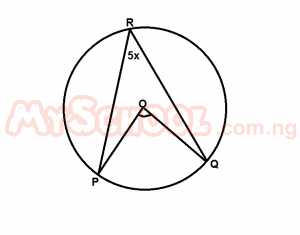
In the diagram, O is the center of the circle, If ∠POQ = 80o and ∠PRQ = 5x, find the value of x.
Attached Figure / Diagram
A
4o
B
8o
C
16o
D
20o
E
32o
medium Difficulty
Verified Correct Answer: Option B
Step-by-Step Mathematical Solution
80o = 2 x 5x(angle at the center)
=80o = 10x; x = 80o/10
= 8o
Source: Myschool Past Questions Archive (Record #22420)
Mathematics
WAEC / WASSCE 1989
Sequences & Series (AP & GP)
Solution
In an A.P. the first term is 2, and the sum of the 1st and the 6th term is 16\(\frac{1}{2}\). What is the 4th term
A
12
B
91/2
C
8
D
7
E
51/2
medium Difficulty
Verified Correct Answer: Option B
Step-by-Step Mathematical Solution
1st term a = 2; 6th term = a + (6 - 1)d = 2 + 5d
2 + (2 + 5d) = 16\(\frac{1}{2}\); 4 + 5d = 16\(\frac{1}{2}\)
5d = 12.5 ∴ = 2.5
the 4th term is 2 + (4 - 1)2.5= 9\(\frac{1}{2}\)
Source: Myschool Past Questions Archive (Record #22421)
Mathematics
UTME / JAMB 1989
Plane Geometry, Polygons & Circle Theorems
Solution
Which of the following is in descending order?
A
\(\frac{9}{10} \frac{4}{5} \frac{3}{4} \frac{17}{20}\)
B
\(\frac{4}{5} \frac{9}{10} \frac{3}{4} \frac{17}{20}\)
C
\(\frac{9}{10} \frac{17}{20} \frac{4}{5} \frac{3}{4}\)
D
\(\frac{4}{5} \frac{9}{10} \frac{17}{20} \frac{3}{4}\)
medium Difficulty
Verified Correct Answer: Option C
Step-by-Step Mathematical Solution
\(\frac{9}{10} \frac{4}{5} \frac{3}{4} \frac{17}{20}\) = \(\frac{18, 16, 15, 17}{20}\)
\(\frac{4}{5} \frac{9}{10} \frac{3}{4} \frac{17}{20}\) = \(\frac{16, 18, 15, 17}{20}\)
\(\frac{9}{10} \frac{17}{20} \frac{4}{5} \frac{3}{4}\) = \(\frac{18, 17, 16, 15}{20}\)
∴ \(\frac{9}{10}; \frac{17}{20}; \frac{4}{5}; \frac{3}{4}\) is in descending order.
Source: Myschool Past Questions Archive (Record #31492)
Mathematics
UTME / JAMB 1989
Plane Geometry, Polygons & Circle Theorems
Solution
Evaluate 2700 000 x 0.03 \div 18 000
A
4.5 x 100
B
4.5 x 101
C
4.5 x 10²
D
4.5 x 10³
medium Difficulty
Verified Correct Answer: Option A
Step-by-Step Mathematical Solution
\(2700000 \times 0.03 \div 18000\)
= \(\frac{2700000 \times 0.03}{18000}\)
= \(\frac{81000}{18000} = 4.5 \times 10^{0}\)
Source: Myschool Past Questions Archive (Record #31493)
Mathematics
UTME / JAMB 1989
Plane Geometry, Polygons & Circle Theorems
Solution
The prime factors of 2520 are
A
2, 9, 5
B
2, 9, 7
C
2, 3, 5, 7
D
2, 3, 7, 9
medium Difficulty
Verified Correct Answer: Option C
Step-by-Step Mathematical Solution
\(2520 = 2 \times 2 \times 2 \times 3 \times 3 \times 5 \times 7\) in terms of its prime factors. Hence, the prime factors of 2520 are 2, 3, 5, 7.
Source: Myschool Past Questions Archive (Record #31494)
Mathematics
UTME / JAMB 1989
Plane Geometry, Polygons & Circle Theorems
Solution
If \(12_{e} = X_{7}\), where e = 12, find X.
A
20
B
15
C
14
D
12
medium Difficulty
Verified Correct Answer: Option A
Step-by-Step Mathematical Solution
\(12_{12} = 1 \times 12^{1} + 2 \times 12^{0} = 12 + 2 = 14_{10}\)
7
14
7
2 rm 0
0 rm 2
\(\therefore 12_{e} = 20_{7}\)
Source: Myschool Past Questions Archive (Record #31495)
Mathematics
UTME / JAMB 1989
Plane Geometry, Polygons & Circle Theorems
Solution
Simplify \(\sqrt[3]{(64r^{-6})^{\frac{1}{2}}}\)
A
\(\frac{r}{2}\)
B
2r
C
\(\frac{1}{2r}\)
D
\(\frac{2}{r}\)
medium Difficulty
Verified Correct Answer: Option D
Step-by-Step Mathematical Solution
\(\sqrt[3]{(64r^{-6})^{\frac{1}{2}}}\)
= \(((64r^{-6})^{1/_2})^{1/_3}\)
=\((64r^{-6})^{1/_6}\)
= (\(64)^{1/_6}(r^{-6})^{1/_6}\)
=\(\frac{2}{\text{r}}\)
Source: Myschool Past Questions Archive (Record #31496)
Mathematics
UTME / JAMB 1989
Fractions, Decimals, Percentages & Approximations
Solution
What is the different between 0.007685 correct to three significant figures and 0.007685 correct to four places of decimal?
A
10-5
B
7 x 10⁻⁴
C
8 x 10⁻⁵
D
10-6
medium Difficulty
Verified Correct Answer: Option A
Step-by-Step Mathematical Solution
0.007685 = 0.00769 (three significant figures)
0.007685 = 0.0077(4d.p)
the difference = 0.0077 - 0.00769
= 0.00001
= 1.0 x 10⁻⁵
Source: Myschool Past Questions Archive (Record #31497)
Mathematics
UTME / JAMB 1989
Plane Geometry, Polygons & Circle Theorems
Solution
If a : b = 5 : 8, x : y = 25 : 16; evaluate \(\frac{a}{x}\) : \(\frac{b}{y}\)
A
125 : 128
B
3 : 5
C
3 : 4
D
2 : 5
medium Difficulty
Verified Correct Answer: Option D
Step-by-Step Mathematical Solution
a : b = 5 : 8 = 2.5 : 40
x : y = 25 : 16
\(\frac{a}{x}\) : \(\frac{b}{y}\) = \(\frac{25}{25}\) : \(\frac{40}{16}\)
= 1 : \(\frac{40}{16}\)
= 16 : 40
= 2 : 5
Source: Myschool Past Questions Archive (Record #31498)
Mathematics
UTME / JAMB 1989
Fractions, Decimals, Percentages & Approximations
Solution
Oke deposited N800.00 in the bank at the rate of 12\(\frac{1}{2}\)% simple interest. After some time the total amount was one and half times the principal. For how many years was the money left in the bank?
A
2\(\frac{2}{3}\)
B
4
C
5\(\frac{1}{3}\)
D
8
medium Difficulty
Verified Correct Answer: Option B
Step-by-Step Mathematical Solution
P = N800 (Principal), r = 12\(\frac{1}{2}\)% or 0.125
After sometimes, A = 1.5 x 800 = N1,200
A = P(1 + Tr) = 1200
= 800(1 + 0.125T)
= 1200
= 800(1 + 0.125T)
1200 = 800(1 + 0.125T)
0.125T = 0.5
T = \(\frac{0.5}{0.125}\)
= 4
Source: Myschool Past Questions Archive (Record #31499)
Mathematics
UTME / JAMB 1989
Mensuration (Areas, Perimeters & Volumes)
Solution
If the surface area of a sphere increased by 44%, find the percentage increase in diameter
A
44
B
30
C
22
D
20
medium Difficulty
Verified Correct Answer: Option D
Step-by-Step Mathematical Solution
Surface Area of Sphere A = 4\(\pi r^2\)
∴ A = 4\(\pi\)\(\frac{(D)^2}{2}\)
= \(\frac{(D)^2}{2}\)
= \(\pi\)D2
When increased by 44% A = \(\frac{144 \pi D^2}{100}\)
\(\pi\)\(\frac{(12D)^2}{10}\) = \(\pi\)\(\frac{(6D)^2}{5}\)
Increase in diameter = \(\frac{6D}{5}\) - D = \(\frac{1}{5}\)D
Percentage increase = \(\frac{1}{5}\) x \(\frac{1}{100}\)%
= 20%
Source: Myschool Past Questions Archive (Record #31500)
Mathematics
UTME / JAMB 1989
Indices, Logarithms & Surds
Solution
Simplify \(4 - \frac{1}{2 - \sqrt{3}}\)
A
2\(\sqrt{3}\)
B
-2 - \(\sqrt{3}\)
C
-2 + \(\sqrt{3}\)
D
2 - \(\sqrt{3}\)
medium Difficulty
Verified Correct Answer: Option D
Step-by-Step Mathematical Solution
\(4 - \frac{1}{2 - \sqrt{3}} = \frac{4(2 - \sqrt{3}) - 1}{2 - \sqrt{3}}\)
= \(\frac{8 - 4\sqrt{3} - 1}{2 - \sqrt{3}}\)
= \(\frac{7 - 4\sqrt{3}}{2 - \sqrt{3}}\)
Rationalizing,
\((\frac{7 - 4\sqrt{3}}{2 - \sqrt{3}}) (\frac{2 + \sqrt{3}}{2 + \sqrt{3}})\)
= \(\frac{14 + 7\sqrt{3} - 8\sqrt{3} - 12}{4 + 2\sqrt{3} - 2\sqrt{3} - 3}\)
= \(\frac{2 - \sqrt{3}}{1} = 2 - \sqrt{3}\)
Source: Myschool Past Questions Archive (Record #31503)
Mathematics
UTME / JAMB 1989
Indices, Logarithms & Surds
Solution
Find p in terms of q if \(\log_{3} p + 3\log_{3} q = 3\)
A
(\(\frac{3}{q}\))3
B
(\(\frac{q}{3}\))\(\frac{1}{3}\)
C
(\(\frac{q}{3}\))3
D
(\(\frac{3}{q}\))\(\frac{1}{3}\)
medium Difficulty
Verified Correct Answer: Option A
Step-by-Step Mathematical Solution
\(\log_{3} p + 3\log_{3} q = 3\)
\(\log_{3} p + \log_{3} q^{3} = 3\)
\(\implies \log_{3} (pq^{3}) = 3\)
\(pq^{3} = 3^{3} = 27\)
\(\therefore p = \frac{27}{q^{3}}\)
= \((\frac{3}{q})^{3}\)
Source: Myschool Past Questions Archive (Record #31504)
Mathematics
UTME / JAMB 1989
Indices, Logarithms & Surds
Solution
What are the values of y which satisfy the equation \(9^{y} - 4 \times 3^{y} + 3 = 0\) ?
A
-1 and 0
B
-1 and 1
C
1 and 3
D
0 and 1
medium Difficulty
Verified Correct Answer: Option D
Step-by-Step Mathematical Solution
\(9^{y} - 4 \times 3^{y} + 3 = 0\)
\(\equiv (3^{2})^{y} - 4 \times 3^{y} + 3 = 0\)
\((3^{y})^{2} - 4 \times 3^{y} + 3 = 0\)
Let \(3^{y}\) be r. Then,
\(r^{2} - 4r + 3 = 0\)
Solving the equation,
\(r^{2} - 3r - r + 3 = 0\)
\(r(r - 3) - 1(r - 3) = 0\)
\((r - 3)(r - 1) = 0\)
\(\therefore \text{r = 3 or 1}\)
Recall, \(3^{y} = r\)
\(3^{y} = 3 = 3^{1} \text{ or } 3^{y} = 1 = 3^{0}\)
\(\implies \text{y = 1 or 0}\)
Source: Myschool Past Questions Archive (Record #31507)
Mathematics
UTME / JAMB 1989
Algebraic Expressions, Polynomials & Factorisation
Solution
Make R the subject of the formula S = \(\sqrt{\frac{2R + T}{2RT}}\)
A
R = \(\frac{T}{(TS^2 + 1)}\)
B
R = \(\frac{T}{2(TS^2 - 1)}\)
C
R = \(\frac{T}{2(TS^2 + 1)}\)
D
R = \(\frac{R}{2(TS^2 + 1)}\)
medium Difficulty
Verified Correct Answer: Option B
Step-by-Step Mathematical Solution
S = \(\sqrt{\frac{2R + T}{2RT}}\)
Squaring both sides,
\(S^{2} = \frac{2R + T}{2RT}\)
\(S^{2} (2RT) = 2R + T\)
\(2S^{2} RT - 2R = T\)
\(R = \frac{T}{2TS^{2} - 2}\)
= \(\frac{T}{2(TS^2 - 1)}\)
Source: Myschool Past Questions Archive (Record #31509)