Question Library
Browse, filter, and study verified past examination questions with step-by-step mathematical reasoning.
Searching 18,000+ Questions...
Sifting topics, KaTeX formulas & verified solutions
Showing 25621–25635 of 29821 verified questions
Sort by:
Mathematics
WAEC / WASSCE 1990
Statistics (Data Representation, Central Tendency & Dispersion)
Solution
The annual salary of Mr. Johnson Mohammed for 1989 was N12,000.00. He spent this on agriculture projects, education of his children, food items, saving , maintenance and miscellaneous items as shown in the pie chart
How much did he spend on food items?
A
N9,700.00
B
N6,700.00
C
N2,000.00
D
N4,000.00
E
N2,300.00
medium Difficulty
Verified Correct Answer: Option E
Step-by-Step Mathematical Solution
Degree for food items = 360^\circ - (120^\circ + 80^\circ + 43^\circ + 30^\circ + 18^\circ)
= 360^\circ - 291^\circ
= 69^\circ
∴∴ Amount spent on food items = \(\frac{69}{360}\)\times12,000.00
= N2300.00
Source: Myschool Past Questions Archive (Record #56104)
Biology
WAEC / WASSCE 1990
Supporting Tissues & Skeletal System
Solution
Specimens I and J are cross-sections of two plants whose cut ends were dipped in red ink or eosin (red dye) for at least 6 hours (a) Observe specimen I with the hand lens provided. Record your observation about the colouring of the tissues by the red ink or eosin.
medium Difficulty
Verified Correct Answer: Option
Biological Concept & Syllabus Guide
(a) Observation after colouring the tissue by the red ink or eosin - The fing-like section is stained red. The remaining sections remain colourless (i.e others are not stained) (b) Observation after flooding with a drop of iodine for about one minute -A layer of ring-like tissue is stained blue-black or dark (c) () In (a) the tissue stained red conducts water and mineral salts (ü) In (b) the tissue stained active blue-black or black stores starch (d) Differences between the arrangements of tissues in specimen I and J
I dicot Stem
(i) Ring like vascular bundles (i) Presence of cambium (iii) Has wide cortex (v) Has distinct endodemis or starch sheath (v) Has distinct pith
J Monocot Stem
(i)Scattered vascular bundles (ii) Absence of cambium (iii) Has narrow or small cortex (iv) Has no endodermis or starch sheath (v)Has no distinct pith or has no pith
Source: Official Exam / Past Question Archive
Biology
WAEC / WASSCE 1990
Nutrition in Plants & Animals (Photosynthesis & Food Substances)
Solution
(a) Describe briefly the process involved in the breakdown of glucose in the cell of living organisms to produce energy (AT P)
(b) State two conditions under which glycogen can be converted to glucose to produce energy.
(c) Describe an experiment to demonstrate that oxygen is released by green plants during photosynthesis.
medium Difficulty
Verified Correct Answer: Option
Biological Concept & Syllabus Guide
(a)The process involved in the breakdown of glucose in living cells occurs in two stages namely anaerobic and aerobic stages
(i) Anaerobic process: In this process, glucose is broken down into pyruvic acid in the presence of enzyme or hexokinase by a process called glycolysis. Oxygen is absent in this process. For each of the glucose respired, two molecules of ATP are released.
(ii) Aerobic process: In the mitochondria, pyruvic acid under the influence of enzymes is oxydised to Acetyl-coenzyme A (AcetylcoA) releasing carbon (iv) oxide. Acetyl COA enters the krebs cycle or citric acid cycle where series of changes take place and oxygen combines with hydrogen to form water. In the process, a large quantity of energy is generated in the form of ATP (Adenosine triphosphate).
The equation for the overall process is as follows:
C\(_6\)H\(_1\)\(_2\)O\(_6\) + 6O\(_2\) → 6H\(_2\)O + 6CO\(_2\) + Energy.
In yeast cells, in the absence of oxygen, glucose is broken down into ethanol, carbon (iv) oxide and energy. C\(_6\)H\(_1\)\(_2\)O\(_6\) → 2C\(_2\)H\(_5\)OH + 2CO\(_2\). Energy. Strenuous exercise results in depletion of oxygen in the muscles. Hence, pyruvic acid is converted to lactic acid which can be oxidized further to yield energy.
(b) Glycogen can be converted to glucose during exercise when the body needs more glucose to produce sufficient energy and when one is anxious, sick, full of fear, fasting or hungry. This results in a fall in the blood sugar level.
Experiment to demonstrate that oxygen is released during Oxygen photosynthesis.
Aim: To show that oxygen is released by green Test tube plant during photosynthesis.
Apparatus: Two beakers, two funnels, two test tubes, water plant (Elodea).
Method — Fill the beakers with Gas bubble water and place the water plant in beaker A and B. Invert a glass funnel in the beaker in order to enclose the water plant. Invert a test tube with water over the stem of the funnel. Experiment A is exposed to sunlight while B is covered with a cardboard paper or placed in the dark. Leave both experiments for sometime. Water containing
Observation: Bubbles of gas appear or are noticed in experiment A. carbon IV oxide (CO2) When tested with a glowing splint, it rekindles, confirming that the Beaker gas is oxygen. This observation in A is absent in B.
Conclusion: What happens in A shows that oxygen is liberated during photosynthesis.
Source: Myschool Past Questions Archive (Record #53067)
Biology
WAEC / WASSCE 1990
Adaptation & Evolution
Solution
(a) (i) Give two reasons why termites are described as social insects.
(ii) Name four castes found in the termite nest, stating one of each castes.
(b) Describe five behavioural adaptations of termites which enable them to survive in their environment.
medium Difficulty
Verified Correct Answer: Option
Biological Concept & Syllabus Guide
(a) (i) Reasons why termites are called social insects:
(1)They live in colonies or communities.
(2)They undergo division of labour.
(ii) Castes found in termites nest are
-king
-queen
-workers
-soldiers.
Role:
king fertilizes the eggs
Queen lays the eggs
workers do all the necessary work, e.g. building of colony, provision of food, feeding of the young ones and the queen
Soldiers defend the colony.
(b) Behavioural adaptation of termites:
(i) Laying of many eggs which hatch into nymphs thereby ensuring survival of many.
(ii) Movement in group enables them to ward off their enemies.
(iii) They build tunnels and burrows into the heart of wood and this protects them from their enemies and harsh weather conditions.
(iv) They feed on their dead members and this helps to maintain a clean and healthy colony.
(v) Presence of inter-connecting tunnels enhances aeration within the termites nest.
Source: Myschool Past Questions Archive (Record #53068)
Biology
WAEC / WASSCE 1990
Population Ecology, Habitats & Conservation
Solution
(a) Describe the process of succession in an abandoned farm land.
(b) List seven ways by which micro-organisms can -be controlled to maintain good health.
medium Difficulty
Verified Correct Answer: Option
Biological Concept & Syllabus Guide
(a)Succession can be defined as a progressive natural development of vegetation towards a climax during which one community is gradually replaced by others. The abandoned farm land is a secondary succession as a result of the fact that it follows a partial destruction of the original vegetation.
The process is as follows:
(i) Decay of plants and animals of the old farm enhances nutrient of the soil.
(ii) The pioneer or initial colonizers are insects' eggs, larvae, worms and seeds of plants carried by animals or by wind. There are also underground stems like rhizomes and stem tubers.
(iii) Next stage includes the hatching of eggs of insects, larvae development, germination and growth of herbaceous plants like grasses and lilies.
(iv) Growth of vegetation attracts rodents to feed on grasses.
(v) Lizards are also attracted to feed on the insects.
(vi) Herbs are displaced by shrubs.
(vii) Shrubs are in turn displaced by trees.
(viii) Trees attract birds, monkeys and tree reptiles.
(ix) Presence of herbivores, carnivores and omnivores (animal community) makes the community to develop or reach a climax. This results in a complex food web.
(b) Ways by which micro-organism can be controlled to maintain good health are:
(i) People should be vaccinated against killer diseases.
(ii) There should be personal hygiene, e.g. regular cleanliness of our body, environment, teeth and clothes.
(iii) Avoid overcrowding to prevent infectious diseases, e.g. tuberculosis.
(iv) Destroy breeding ground for mosquitoes.
(v) Isolate people with highly infectious diseases, e.g. leprosy
(vi) Promote health education
(vii) Cover food to prevent contamination by rats, flies, cockroaches, etc.
(viii) Encourage ventilation of houses.
(ix) Cut bushes around the house and drain stagnant water properly.
Source: Myschool Past Questions Archive (Record #53069)
Biology
WAEC / WASSCE 1990
Variation & Genetics (Heredity)
Solution
(a) Explain briefly how the process of meiotic division contributes to variation in a population
(b) State Mendel's first and second laws of inheritance.
(c) A pure breeding brown coloured rat BB was crossed with a pure breeding white rat bb. By means of diagram only, show the genotypes of the offspring up to the second filial generation.
medium Difficulty
Verified Correct Answer: Option
Biological Concept & Syllabus Guide
(a)Process of meiotic division:
(i) In the prophase of first meiotic division, there is formation of chiasma. Variation occurs from the number and position of chiasmata formed. This determines the different combination that is possible in genes relative to the sequence of genes on the chromosomes.
(ii) In the metaphase of the first meiotic division, segregation of chromosomes occurs. This results in mixing of genes from different individuals carried on different chromosomes which now result in variation between parents and offsprings or among offsprings. Mixing of genes is known as crossing over.
(b)(1)Mendel's first law called law of segregation of genes states that characters of an organism are controlled by genes occurring in pairs which are independently transmitted in gametes from one generation to another without undergoing any alteration.
(ii) The second law known as independent assortment of genes states that character behaves as a separate unit and is inherited independent of another character.
Source: Myschool Past Questions Archive (Record #53070)
Biology
WAEC / WASSCE 1990
Reproduction in Plants & Animals
Solution
1. (a) List three features which are essential for cross-pollination to take place (b) State three characteristics
medium Difficulty
Verified Correct Answer: Option
Biological Concept & Syllabus Guide
(a) The stigma and anthers mature at different times (i) Male and female parts of the flower are located on different plants (ii) Male and female flowers occur separately on the same plant (b) Petals are dull with no nectar of scent. Pollen grains are numerous, light, smooth and powdery so that they can be blown by the wind.
Source: Myschool Past Questions Archive (Record #59805)
Biology
WAEC / WASSCE 1990
Nutrition in Plants & Animals (Photosynthesis & Food Substances)
Solution
2. (a) Name two supporting tissues found in plants (b) Give one function of the Golgi body in the cell.
medium Difficulty
Verified Correct Answer: Option
Biological Concept & Syllabus Guide
2. (a) Sclerenchyma, Collenchyma (b) Synthesis of carbohydrates and proteins. It is a protein collecting and station.
Source: Myschool Past Questions Archive (Record #59806)
Biology
WAEC / WASSCE 1990
Reproduction in Plants & Animals
Diagram
Solution
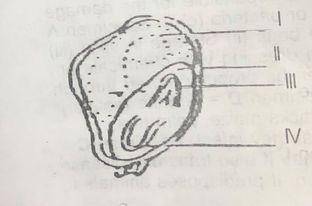
3. (a) Name the parts labelled | - IV (b) In which of the labelled parts is food stored?
Attached Figure / Diagram
medium Difficulty
Verified Correct Answer: Option
Biological Concept & Syllabus Guide
(a) 1- endosperm Il - the cotyledon ll - coleoptile IV - the coleorhiza (b) I and l - endosperm and cotyledon.
Source: Myschool Past Questions Archive (Record #59807)
Biology
WAEC / WASSCE 1990
Reproduction in Plants & Animals
Solution
4. Name two organisms that reproduce by budding
medium Difficulty
Verified Correct Answer: Option
Biological Concept & Syllabus Guide
Yeast, Hydra.
Source: Myschool Past Questions Archive (Record #59808)
Biology
WAEC / WASSCE 1990
Nervous, Hormonal Coordination & Sense Organs
Diagram
Solution
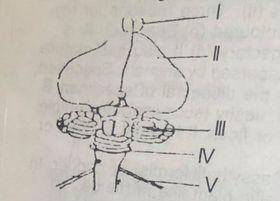
5. (a) Name the parts labelled | - IV (b) Which number indicates a part of the peripheral nervous system?
Attached Figure / Diagram
medium Difficulty
Verified Correct Answer: Option
Biological Concept & Syllabus Guide
(a) I-The olfactory lobe I| - the cerebrum ll - the cerebellum IV - the medulla oblongata V- spinal nerve
(b) V- spinal nerve
Source: Myschool Past Questions Archive (Record #59809)
Biology
WAEC / WASSCE 1990
Basic Ecological Concepts, Ecosystems & Biomes
Solution
6. Mention the process by which food can be synthesized in an ecosystem where tnere is no sunlight.
medium Difficulty
Verified Correct Answer: Option
Biological Concept & Syllabus Guide
The process of chemosynthesis.
Source: Myschool Past Questions Archive (Record #59810)
Biology
WAEC / WASSCE 1990
Variety of Organisms & Classification of Living Things
Solution
List two diseases that may be spread as a result of poor irrigation system.
medium Difficulty
Verified Correct Answer: Option
Biological Concept & Syllabus Guide
(i) Guinea worm disease (ii) Damping off of seedlings.
Source: Myschool Past Questions Archive (Record #59811)
Biology
WAEC / WASSCE 1990
Population Ecology, Habitats & Conservation
Solution
List three factors that can affect population growth.
medium Difficulty
Verified Correct Answer: Option
Biological Concept & Syllabus Guide
(i) Availability of food (ii) Competition (iii) Increased rate of mortality.
Source: Myschool Past Questions Archive (Record #59812)
Biology
WAEC / WASSCE 1990
Nutrition in Plants & Animals (Photosynthesis & Food Substances)
Solution
State two adaptations of Rhizopus to saprophytic mode of nutrition.
medium Difficulty
Verified Correct Answer: Option
Biological Concept & Syllabus Guide
(i) Secretion of enzyme for extracallular digestion of food (ii) Possession of rhzoids for absorption of nutrient
Source: Myschool Past Questions Archive (Record #59813)