Question Library

Browse, filter, and study verified past examination questions with step-by-step mathematical reasoning.

Launch Interactive Practice
Searching 18,000+ Questions... Sifting topics, KaTeX formulas & verified solutions
Showing 25531–25545 of 29821 verified questions
Sort by:
Biology UTME / JAMB 1990 Transport System in Plants & Animals
Transpiration can be measured with a
A
photometer
B
hygrometer
C
potometer
D
barometer
medium Difficulty
Biology UTME / JAMB 1990 Excretion & Homeostasis
Excretory products responsible for the red, purple and blue colours of flowers are called
A
alkaloid
B
tannins
C
anthocyanins
D
resins
medium Difficulty
Biology UTME / JAMB 1990 Variety of Organisms & Classification of Living Things
Etiolation is caused by the influence of
A
minerals salt
B
water
C
carbondioxide
D
light
medium Difficulty
Biology UTME / JAMB 1990 Supporting Tissues & Skeletal System
Muscles are indirectly attached to bones by means of
A
ligaments
B
membranes
C
tendons
D
sutures
medium Difficulty
Biology UTME / JAMB 1990 Nervous, Hormonal Coordination & Sense Organs
During mammalian embryo development, large amounts of oestrogen and progesterone are produced in the
A
umbilical cord
B
amnion
C
placenta
D
amniotic fluid
medium Difficulty
Biology UTME / JAMB 1990 Reproduction in Plants & Animals
Fruits which develop without fertilization are described as
A
simple
B
pathencorpic
C
aggregate
D
compound
medium Difficulty
Biology UTME / JAMB 1990 Reproduction in Plants & Animals
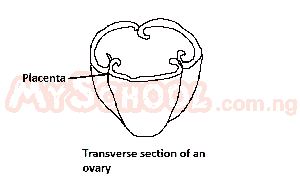
The type of placentation shown in the figure above is a
Attached Figure / Diagram
Question diagram
A
parietal
B
marginal
C
axile
D
free-central
medium Difficulty
Biology UTME / JAMB 1990 Variety of Organisms & Classification of Living Things
The elephant grass is propagated vegetatively by means of
A
corms
B
bubils
C
suckers
D
stolons
medium Difficulty
Biology UTME / JAMB 1990 Nervous, Hormonal Coordination & Sense Organs
The part of the ear that is concerned with balance is the
A
semi-circular canals
B
incus
C
malleus
D
Eustachian tube
medium Difficulty
Biology UTME / JAMB 1990 Variation & Genetics (Heredity)
In organism where the 2nd number of chromosomes is 16, the number of chromosomes in each gamete will be
A
32
B
16
C
8
D
4
medium Difficulty
Biology UTME / JAMB 1990 Variation & Genetics (Heredity)
What will be the result of the first filial generation (F1) and the second filial generation (F2) of a mono-hybrid cross between pure line normal-winged Drosophilia flies and pure line short-winged flies, if the gene for the normal wing is dominant?
A
F1 flies all short-winged and F2 flies all normal-winged
B
F1 flies all normal and F2 flies all short-winged
C
F1 flies all short-winged and three-quarters of F2 flies are short-winged
D
F1 flies all normal-winged and three-quarters of F2 flies are normal-winged
medium Difficulty
Biology UTME / JAMB 1990 Cell Structure, Organization & Cell Division
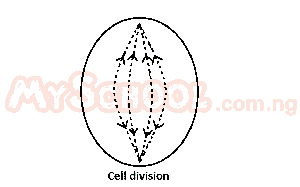
What stage during cell division is represented in the figure above?
Attached Figure / Diagram
Question diagram
A
Prophase
B
Metaphase
C
Anaphase
D
Telophase
medium Difficulty
Biology UTME / JAMB 1990 Growth, Micro-organisms & Public Health
An individual in the AB blood group is a universal recipient for blood donation because
A
all the red blood cells do not carry antigen
B
all the red blood cells carry antigen
C
all the red blood cells carry antigen
D
there are no anti-A and anti-B antibodies in the serum
medium Difficulty
Biology UTME / JAMB 1990 Variation & Genetics (Heredity)
Haemophilia results from the mutation of the genes
A
in the sex chromosome
B
which control skin colour
C
which control the mechanism for blood-clotting
D
which control the formation of haemoglobin
medium Difficulty
Biology UTME / JAMB 1990 Basic Ecological Concepts, Ecosystems & Biomes
In a savanna ecosystem the abiotic factors include
A
legumes, temperature and sandy soil
B
water, temperature and soil
C
minerals, oxygen and reptiles
D
water, soil and grasses
medium Difficulty
Page 1703 of 1989