Question Library
Browse, filter, and study verified past examination questions with step-by-step mathematical reasoning.
Searching 18,000+ Questions...
Sifting topics, KaTeX formulas & verified solutions
Showing 25426–25440 of 29821 verified questions
Sort by:
Chemistry
UTME / JAMB 1990
Kinetic Theory of Matter & Gas Laws
Solution
10.0 dm3 of air containing H2S as an impurity was passed through a solution of Pb(NO3)2 until all the H2S had reacted. The precipitate of PbS was found to weigh 5.02 g. According to the equation:
Pb(NO3)2 + H2S → PbS + 2HNO3 the percentage by volume of hydrogen sulphide in the air is?
(Pb = 207, S = 32, GMV at s.t.p = 22.4dm3)
A
50.2
B
47.0
C
4.70
D
0.47
medium Difficulty
Verified Correct Answer: Option C
Chemical Principles & Mechanism
Pb(NO3)2 + H2S → PbS + 2HNO3
34 g H2S → 239 g pbs
5.02g pbs → (34)/(237g) χ 5.02 g = 0.714 g
34g → 22.4 dm3
=0.714 → (22.4)/34g) χ 100 = 4.70
Source: Myschool Past Questions Archive (Record #12932)
Chemistry
UTME / JAMB 1990
Water, Solutions & Solubility
Solution
A blue solid, T, which weighed 5.0g was placed on a table. After 8 hours, the resulting pink solid was found to weigh 5.5g. It can be inferred that substance T?
A
is deliquescent
B
is hygroscopic
C
has some molecules of water of crystallization
D
is efflorescent
medium Difficulty
Verified Correct Answer: Option B
Chemical Principles & Mechanism
Hygroscopic salts are compounds that readily absorb moisture from the surrounding air, and become sticky and remain solids.
From the question, we were told the solid before exposure to air or placed on the table, weighed 5.0g and then after exposure to air for 8 hours, it was weighing 5.5g which suggests it has absorbed moisture. That accounts for the increase in weight. That substance is said to be a hygroscopic substance because they(hygroscopic substances) often behave in such manner.Unlike the deliquescent salts, they do not turn into solutions.
Source: Myschool Past Questions Archive (Record #12935)
Chemistry
UTME / JAMB 1990
Water, Solutions & Solubility
Solution
The solubility in moles per dm3 of 20g of CuSO4 dissolve in 100 of water at 180°C is?
(Cu = 63.5, S = 32, O = 16)
A
0.13
B
0.25
C
1.25
D
2.00
medium Difficulty
Verified Correct Answer: Option C
Chemical Principles & Mechanism
Solubility in moles per dm3
No of moles = (20)/(159.5) χ 0.125 moles
in 100 g of moles = (0.125)/(100) χ 1000 = 1.25 moles
Source: Myschool Past Questions Archive (Record #12938)
Chemistry
UTME / JAMB 1990
Stoichiometry, Mole Concept & Volumetric Analysis
Smoke consist of?
A
solid particles dispersed in liquid
B
solid or liquid particles dispersed in gas
C
gas or liquid particles dispersed inliquid
D
liquid particles dispersed inliquid
medium Difficulty
Verified Correct Answer: Option B
Chemical Principles & Mechanism
No expanded working has been attached for this question yet. The verified answer is Option B.
Source: Myschool Past Questions Archive (Record #12940)
Chemistry
UTME / JAMB 1990
Stoichiometry, Mole Concept & Volumetric Analysis
Solution
Na2C2O4 + CaCl2 → CaC2O4 + 2NaCl. Given a solution of 1.9g of sodium oxalate in 50g of water at room temperature, calculate the minimum volume of 0.1 M calcium oxalate using the above equation?
A
1.40 χ 102 dm3
B
14.0 χ 102 cm3
C
1.40 χ 10-2 dm-2
D
14.0 χ 10-2 cm3
medium Difficulty
Verified Correct Answer: Option B
Chemical Principles & Mechanism
Na2C2O4 + CaCl2 → CaC2O4 + 2NaCl
molar mass of Na2C2O4 = 134
molarity in 1000g H2O = (1.9)/(134) = 0.014 M
but in 502 g mole = (0.014)/(50) χ 1000 = 0.28 M
M1V1 = M2V2
V2 = (M1V1)/(M2) = (0.28 χ 50)/(0.1) = 140
= 1.40 x 10\(^2\) cm\(^3\)
Source: Myschool Past Questions Archive (Record #12946)
Chemistry
UTME / JAMB 1990
Stoichiometry, Mole Concept & Volumetric Analysis
Solution
2.0g of a monobasic acid was made up to 250 cm3 with distilled water. 25.00 cm3 of this solution required 20.00cm3 of 0.1 M NaOH solution for complete neutralization. The molar mass of the acid is?
A
200 g
B
160 g
C
100 g
D
50 g
medium Difficulty
Verified Correct Answer: Option C
Chemical Principles & Mechanism
Ma = (MbVb)/(Va) = (0.1 m χ 20 cm3)/(25cm) = 0.08 m
M = (concentration in g/dm3)/(m) = (8)/(0.08) = 100 g
Source: Myschool Past Questions Archive (Record #12950)
Chemistry
UTME / JAMB 1990
Stoichiometry, Mole Concept & Volumetric Analysis
Solution
What is the concentration of H+ ions in moles per dm3 of a sodium of pH 4.398?
A
4.0 χ 10-5
B
0.4 χ 10-5
C
4.0 χ 10-3
D
0.4 χ 10-3
medium Difficulty
Verified Correct Answer: Option A
Chemical Principles & Mechanism
PH = -log (H+)
(H+) = 10-4.348 = 4.0 χ 10-5
Source: Myschool Past Questions Archive (Record #12952)
Chemistry
UTME / JAMB 1990
Stoichiometry, Mole Concept & Volumetric Analysis
Solution
What volume of 11.0 M hydrochloric acid must be dilute to obtain 1 dm3 of 0.05 M acid?
A
0.05 dm3
B
0.10 dm3
C
0.55 dm3
D
11.0 dm3
medium Difficulty
Verified Correct Answer: Option A
Chemical Principles & Mechanism
using \(C_1 V_1\) = \(C_2 V_2\)
\(C_1\) = 11.0M, \(V_1\) = ?, \(C_2\) = 0.05M and \(V_2\) = 1\(dm^3\)
\(V_1\) = \(\frac{(C_2 V_2)}{(C_2)}\) = \(\frac{(0.05 \times 1)}{(11)}\) = 0.005\(dm^3\)
OPTION A is the closest value.
Source: Myschool Past Questions Archive (Record #12955)
Chemistry
UTME / JAMB 1990
Stoichiometry, Mole Concept & Volumetric Analysis
Solution
If 10.8 g of silver is deposited in a silver coulometer volume of oxygen liberated is?
A
0.56 dm3
B
5.60 dm3
C
11.20 dm3
D
22.40 dm3
medium Difficulty
Verified Correct Answer: Option A
Chemical Principles & Mechanism
Ag+ + e-
H = 108 g Ag
= 0.11 10.8 Ag
4OH → O2 + 2H2O + 4e
4F ↔ 1mole O2
4F = 22.4 dm3 χ 0.1 = 0.56 dm3
Source: Myschool Past Questions Archive (Record #12959)
Chemistry
UTME / JAMB 1990
Electrolysis & Electrochemical Cells
Solution
0.1 faraday of electricity deposited 2.95 g of nickel during electrolysis of an aqueous solution.
Calculate the number of moles of nickel that will be deposited by 0.4 faraday?
(Ni = 58.7)
A
0.20
B
0.30
C
0.04
D
5.87
medium Difficulty
Verified Correct Answer: Option A
Chemical Principles & Mechanism
0.1F ↔ 2.95 g Ni = 0.4F ↔ 11.8 g Ni
No of moles = (11.8)/(58.2) = 0.20 moles
Source: Myschool Past Questions Archive (Record #12960)
Chemistry
UTME / JAMB 1990
Stoichiometry, Mole Concept & Volumetric Analysis
Solution
The Avogadro number of 24g of magnesium is the same as that of
A
1g of hydrogen molecules
B
16g of oxygen molecules
C
32g of oxygen molecules
D
35.5g of chlorine molecules
medium Difficulty
Verified Correct Answer: Option C
Chemical Principles & Mechanism
24mg = 1 mole of magnesium and
32g of O2 = mole of O2
Source: Official Exam / Past Question Archive
Chemistry
UTME / JAMB 1990
Nature of Matter & Separation Techniques
Diagram
Changes in the physical in the scheme above.The letter X,Y and Z respectively represent
Attached Figure / Diagram
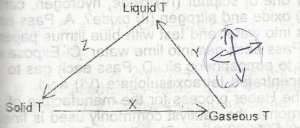
A
sublimation, condensation and freezing
B
sublimation, vapourization and solidification
C
freezing, condensation and sublimation
D
evaporation, liquefaction and solidification
medium Difficulty
Verified Correct Answer: Option A
Chemical Principles & Mechanism
No expanded working has been attached for this question yet. The verified answer is Option A.
Source: Myschool Past Questions Archive (Record #31438)
Chemistry
UTME / JAMB 1990
Stoichiometry, Mole Concept & Volumetric Analysis
Diagram
Use the graph above to answer this question. The structure of cis-2-butene is
Attached Figure / Diagram
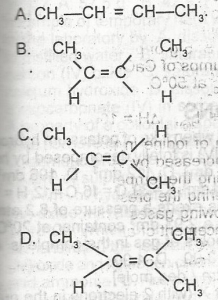
A
A
B
B
C
C
D
D
medium Difficulty
Verified Correct Answer: Option B
Chemical Principles & Mechanism
No expanded working has been attached for this question yet. The verified answer is Option B.
Source: Myschool Past Questions Archive (Record #31439)
Chemistry
UTME / JAMB 1990
Stoichiometry, Mole Concept & Volumetric Analysis
Diagram
Solution
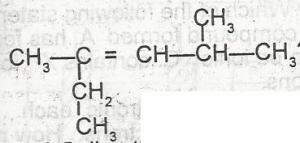
What is the IUPAC name for the hydrocarbon?
Attached Figure / Diagram
A
2-ethyl-4-methylpent-2-ene
B
3,5-dimethylhex-3-ene
C
2,4-dimethylhex 3-ene
D
2-methyl-4-ethylpent-3-ene
medium Difficulty
Verified Correct Answer: Option C
Chemical Principles & Mechanism
The longest chain is not always the straight chain. For this compound, the longest chain is 6, which means hex... with the double bond on Carbon-3, counting from right to left, or from left to right, either way, the double bond is on C3 so the parent name will be hex-3-ene. For the substituents, we have two methyl groups (-CH3), counting from R-L, on C2 & C4. Counting from L-R will be on C3 & C5. However, since C2&C4 tends to be the shorter route, following the rule, the name of the compound is 2,4- dimethylhex-3-ene. The correct answer is option C.
Source: Myschool Past Questions Archive (Record #31440)
Chemistry
UTME / JAMB 1990
Oxidation, Reduction & Redox Reactions
Diagram
Solution
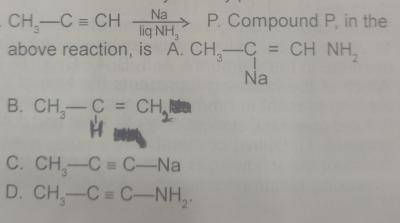
CH3-C = CH \(\frac{Na}{liq NH_3}\)> P, Compound P, in the above reaction, is
Attached Figure / Diagram
A
A
B
B
C
C
D
D
medium Difficulty
Verified Correct Answer: Option B
Chemical Principles & Mechanism
When propyne (methylacetylene) reacts in the presence of sodium (Na) and liquid ammonia (NH₃), it undergoes a reduction reaction.
Propyne (CH₃C≡CH) is reduced to form propene (CH₃CH=CH₂) through the trans addition of hydrogen.
During the reaction, the sodium (Na) dissolves in the liquid ammonia (NH₃) to form a blue-colored solution of solvated electrons, which act as a reducing agent. The sodium is oxidized, releasing electrons that are then used to reduce the propyne. The ammonia acts as a solvent and helps to stabilize the solvated electrons.
So, the sodium is essentially consumed during the reaction, and the ammonia acts as a catalyst or solvent, helping to facilitate the reduction reaction.
The sodium (Na) and ammonia (NH₃) don't interfere with the product formed, which is propene (CH₃CH=CH₂), rather they play a role in facilitating the reaction, but they don't become part of the final product. The sodium is consumed during the reaction, and the ammonia can be recovered or removed, leaving behind the desired product, propene.
Source: Myschool Past Questions Archive (Record #31442)