Question Library
Browse, filter, and study verified past examination questions with step-by-step mathematical reasoning.
Searching 18,000+ Questions...
Sifting topics, KaTeX formulas & verified solutions
Showing 25381–25395 of 29821 verified questions
Sort by:
English Language
WAEC / WASSCE 1990
Lexis, Structure & Register (Cloze & Vocabulary)
Solution
In question number 96 Above, choose the best option from letters A-E that best completes the gap.
A
policy
B
significant
C
particular
D
typical
E
contract
medium Difficulty
Verified Correct Answer: Option A
Grammar & Contextual Explanation
"Policy" fits best because insurance companies assign a policy number to each insured person or business for identification and record-keeping.
Source: Myschool Past Questions Archive (Record #23431)
English Language
WAEC / WASSCE 1990
Lexis, Structure & Register (Cloze & Vocabulary)
Solution
In question number 97 above, choose the best option from letters A-E that best completes the gap.
A
recognition
B
entry
C
identification
D
accounting
E
auditing
medium Difficulty
Verified Correct Answer: Option C
Grammar & Contextual Explanation
"Identification" is the most appropriate choice because policy numbers help in uniquely identifying the insured person or business.
Source: Myschool Past Questions Archive (Record #23432)
English Language
WAEC / WASSCE 1990
Lexis, Structure & Register (Cloze & Vocabulary)
Solution
In question number 98 above, choose the best option from letters A-E that best completes the gap.
A
comprehensive
B
conditional
C
total
D
compact
E
correct
medium Difficulty
Verified Correct Answer: Option A
Grammar & Contextual Explanation
"Comprehensive" fits best because a comprehensive insurance policy provides broad coverage, including damages, theft, and accidents.
Source: Myschool Past Questions Archive (Record #23433)
English Language
WAEC / WASSCE 1990
Lexis, Structure & Register (Cloze & Vocabulary)
Solution
In question number 99 above, choose the best option from letters A-E that best complete the gap.
A
second hand
B
winning party
C
third party
D
subsidiary
E
second party
medium Difficulty
Verified Correct Answer: Option C
Grammar & Contextual Explanation
A comprehensive insurance policy covers more risks than a third-party insurance policy.
Source: Myschool Past Questions Archive (Record #23434)
English Language
WAEC / WASSCE 1990
Lexis, Structure & Register (Cloze & Vocabulary)
Solution
In question number 100 above, choose the best option from letters A-E that best completes the gap.
A
later
B
previous
C
first
D
other
E
latter
medium Difficulty
Verified Correct Answer: Option E
Grammar & Contextual Explanation
"Former" refers to the first-mentioned item (comprehensive policy). "Latter" refers to the second-mentioned item (third-party policy).
Source: Myschool Past Questions Archive (Record #23435)
Physics
UTME / JAMB 1990
Current Electricity & Electric Circuits
Diagram
What is the reading of the vernier scale above
Attached Figure / Diagram
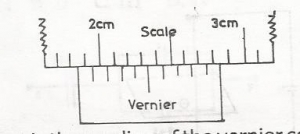
A
1.88cm
B
1.80cm
C
1.28cm
D
1.97cm
medium Difficulty
Verified Correct Answer: Option A
Physical Principles & Numerical Solution
No expanded working has been attached for this question yet. The verified answer is Option A.
Source: Myschool Past Questions Archive (Record #41692)
Physics
UTME / JAMB 1990
Current Electricity & Electric Circuits
Diagram
Two horizontal forces, 10N and 8N and another force F1 inclined at 30 to the vertical acting as shown in the diagram above, keep the body P in equilibrium, The weight of the body is
Attached Figure / Diagram
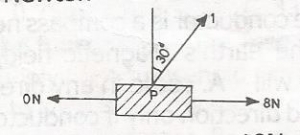
A
2√3/3N
B
√2N
C
4√3/3
D
2V3N
medium Difficulty
Verified Correct Answer: Option D
Physical Principles & Numerical Solution
No expanded working has been attached for this question yet. The verified answer is Option D.
Source: Myschool Past Questions Archive (Record #41693)
Physics
UTME / JAMB 1990
Linear Motion, Projectiles & Kinematics
Diagram
Solution
What is the average velocity of the sprinter whose velocity time graph is as shown above
Attached Figure / Diagram
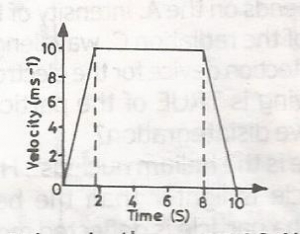
A
85.0ms-1
B
17.0ms-1
C
8.5ms-1
D
1.7ms-1
medium Difficulty
Verified Correct Answer: Option C
Physical Principles & Numerical Solution
Average velocity = \(\frac{total speed}{total time}\)
Total distance = Area under the graph i.e area of trapezium = \(\frac{1}{2}\)(a + b) x h
= 0.5(6 + 10) x 10 = 80m
Total time = 10secs
Average velocity = \(\frac{total speed}{total time}\) = \(\frac{80}{10}\) = 8m/s
so closest answer is 8.5m/s
Source: Myschool Past Questions Archive (Record #41694)
Physics
UTME / JAMB 1990
Current Electricity & Electric Circuits
Diagram
Solution
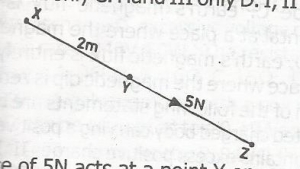
A force of 5N act at a point Y on a rod XYZ as shown in the diagram above, if XY is 2m. What is the moment of the force about point X?
Attached Figure / Diagram
A
0Nm
B
3Nm
C
7Nm
D
10Nm
medium Difficulty
Verified Correct Answer: Option A
Physical Principles & Numerical Solution
X is in the line of action of the force, Therefore moment is equal to zero.
Moment = force x perpendicular distance. ( x is horizontal distance, not perpendicular distance)
Source: Myschool Past Questions Archive (Record #41695)
Physics
WAEC / WASSCE 1990
Linear Motion, Projectiles & Kinematics
Solution
(a) Using a suitable diagram, explain how the following can be obtained from a velocity-time graph (i) acceleration; (ii) retardation; (iii) total distance covered.
(b) Show that the displacement of a body moving with uniform acceleration a is given by \(s = ut + \frac{1}{2} at^{2}\) where u is the velocity of the body at time t = 0.
(c) A particle moving in a straight line with uniform deceleration has a velocity of 40ms\(^{-1}\) at a point P, 20ms\(^{-1}\) at a point Q and comes to rest at a point R where QR = 50m. Calculate the: (i) distance PQ; (ii) time taken to cover PQ; (iii) time taken to cover PR.
medium Difficulty
Verified Correct Answer: Option
Physical Principles & Numerical Solution
(a)
Velocity- time graph:
(i) Acceleration : Gradient of AB in the graph above; (ii) retardation: Gradient of CD in the graph above; (iii) total distance covered is the area under the graph.
(b) S = average velocity x time
\(S = (\frac{u +v}{2}) \times t ... (1)\)
but \(v = u + at ... (2)\), substitute (2) in (1)
\(S = (\frac{u + u + at}{2}) \times t\)
\(S = (\frac{2u + at}{2}) \times t \)
\(S = ut + \frac{1}{2} at^{2}\)
(c) P ----------- Q ----50m------- R
40 ms\(^{-1}\) 20 ms\(^{-1}\)
Since the acceleration is uniform and using equation
\(v^{2} = u^{2} + 2as\) for the motion along QR.
\(0 = 20^{2} - 2a(50)\) (retardation)
\(0 = 400 - 100a \implies 100a = 400\)
\(a = 4 ms^{-2}\) (retardation, hence it is negative)
\(20^{2} = 40^{2} + 2(-4) s\)
\(400 = 1600 - 8s \implies 8s = 1200\)
\(s = 150m\)
(ii) Time taken to cover PQ
Apply the equation
v = u + at
from P to Q:
20 = 40 + (-4)t
4t = 20
t = 5s
Time to cover PQ = 5s
(iii) Time taken to cover PR
PR = PQ + QR = 150 + 50 = 200s
Apply the equation
v = u + at
from P to R (initial velocity \(40\,\text{m s}^{-1}\), final velocity \(0\)):
0 = 40 + (-4)t
4t = 40
t = 10s.
Source: Myschool Past Questions Archive (Record #54764)
Physics
WAEC / WASSCE 1990
Calorimetry, Latent Heat & Change of State
Solution
(a) Define the boiling point of a liquid.
(b) Describe an experiment to determine the boiling point of small quantity of a liquid.
(c) A piece of copper of mass 300 g at a temperature of 950^\circC is quickly transferred to a vessel of negligible thermal capacity containing 250 g of water at 25^\circC. If the final steady temperature of the mixture is 100^\circC, calculate the mass of the water that will boil away.
[Specific heat capacity of copper = \(4.0 \times 10^{2} Jkg^{-1} K^{-1}\); Specific heat capacity of water = \(4.2 \times 10^{3} Jkg^{-1} K^{-1}\); Specific latent heat of vaporization of steam = \(2.26 \times 10^{6} Jkg^{-1}\)
(d) State four other effects of heat on a substance other than expansion.
medium Difficulty
Verified Correct Answer: Option
Physical Principles & Numerical Solution
(a) The boiling point of a liquid is the temperature at which its s.v.p is equal to the external atmospheric pressure.
(b) Experiment to determine the boiling point of a small quantity of a liquid.
Some liquid is introduced into the shorter length of the J - tube above the mercury. The beaker and its contents are heated and stirred continuously. At a stage when the levels of mercury in the two limbs of the J - tube are the same the temperature is read. At this temperature the s.v.p. of the liquid is equal to the atmospheric pressure. This temperature is the boiling point of the liquid.
(c) Heat lost by copper = Heat gained by water
\(mc \theta = m_{1} c_{1} \theta_{1} + ml\)
\(0.3 \times 400 \times (950^\circ - 100^\circ) = 0.25 \times 4200 \times (100^\circ - 25^\circ) + 2.26 \times 10^{6} M\)
\(M = \frac{102000 - 78750}{2.26 \times 10^{6}}\)
\(M = 10.3g\)
Therefore, the mass of water that will boil away is 10.3g.
(d) Four effects of heat other than expansion are:
(1) Change of state (2) Change in temperature (3) Chemical change (4) Change in electrical resistance of conductivity. (5) Melting sublimation.
Source: Myschool Past Questions Archive (Record #54765)
Physics
WAEC / WASSCE 1990
Electrostatics & Capacitors
Solution
(a) Define the capacitance of a capacitor.
(b) State three factors on which the capacitance of a parallel plate capacitor depends.
(c) Derive a formula for the energy W stored in a charged capacitor of capacitance C carrying a charge Q on either plate.
(d) Two capacitors of capacitance 4\(\mu F\) and 6\(\mu F\) are connected in series to a 100V d.c supply. Draw the circuit diagram and calculate the (i) charge on either plate of each capacitor (ii) p.d. across each capacitor; (iii) energy of the combined capacitors.
medium Difficulty
Verified Correct Answer: Option
Physical Principles & Numerical Solution
(a) Capacitance of a capacitor is the ratio of the charge Q on either plate of the capacitor to the p.d in volts between the plates. Mathematically,
\(Capacitance = \frac{Q}{V}\)
Q - Charge ; V - voltage.
(b) Three factors on which the capacitance of a parallel - plate capacitor depends on are: (1) Common area of the plates (2) Dielectric between the plates (3) Separation between the plates.
(c) Work done W = QV
Average work done = \(\frac{1}{2} QV\)
But \(V = \frac{Q}{C}\)
\(\therefore W = \frac{Q}{2} \times \frac{Q}{C} = \frac{Q^{2}}{2C}\)
\(\therefore \text{Energy stored W = } \frac{Q^{2}}{2C}\)
(d)
\(\frac{1}{C} = \frac{1}{C_{1}} + \frac{1}{C_{2}}\)
= \(\frac{1}{6} + \frac{1}{4} = \frac{10}{24}\)
\(C = 2.4 \mu F\)
\(Q = \frac{24}{10} \times 100 \times 10^{-6} = 240 \mu C\)
= \(240 \times 10^{-6} C\)
(ii) p.d across 4\(\mu F, V_{4} = \frac{Q}{C}\)
\(V_{4} = \frac{240 \times 10^{-6}}{4 \times 10^{-6}} = 60V\)
p.d across 6\(\mu F, V_{6} = \frac{Q}{C}\)
= \(\frac{240 \times 10^{-6}}{6 \times 10^{-6}} = 40V\)
(iii) Energy stored = \(\frac{Q^{2}}{2C}\)
= \(\frac{(240 \times 10^{-6})^{2}}{2 \times 2.4 \times 10^{-6}}\)
= \(1.2 \times 10^{-2} J\)
Source: Myschool Past Questions Archive (Record #54766)
Physics
WAEC / WASSCE 1990
Atomic, Quantum, Nuclear Physics & Electronics
Solution
(a) Explain the terms nuclear fission and nuclear fusion.
(b) State two advantages of fusion over fission and explain briefly why, in spite of these advantages, fusion is not normally used for the generation of power.
(c) \(^{238} _{92} U\) is a long half- life alpha emitter and decays to thorium Th which, in turn decays by beta emission with a small decay constant to an isotope of protactinium Pa. The protactinium decay scheme of \(^{238} _{92} U \) as stated above.
(d) State three uses of radioisotopes.
medium Difficulty
Verified Correct Answer: Option
Physical Principles & Numerical Solution
(a) Fission: Nuclear reaction in which a heavy nucleus is bombarded with neutrons and split into approximate equal parts emitting neutrons and releasing large amounts of energy.
Fusion: Nuclear reaction between two light nuclei forming a heavier nucleus with the release of a large amount of energy.
(b) Advantages of Fusion over Fission:
(1)By - products are non-radioactive. (2) Easily achieved with lightest elements so that nuclear repulsion is easily overcome as nuclei approach each other. (3) Raw materials are cheaply available.
Why fusion is not normally used : Very high temperature is required to overcome coulomb repulsive forces between the two light nuclei. It is difficult to get materials that will withstand such high temperature. Mathematically,
\(T^{\frac{1}{2}} = \frac{0.693}{\lambda}\), where \(\lambda\) is the decay constant.
Decay constant = \(\frac{\text{no of atoms disintegrating per sec}}{\text{no of atoms in the source at that instant}}\)
Isotopes: Isotopes of an element are atoms which have the same proton numbers/atoms number but different nucleon numbers/mass number.
Decay scheme: \(^{238} _{92} U \to ^{234} _{90} Th + ^{4} _{2} He + Energy\)
\(^{234} _{90} Th \to ^{234} _{91} Pa + ^{0} _{-1} e + Energy\)
\(^{234} _{91} \to ^{0} _{-1} e + ^{234} _{92} + Energy\)
(d) Uses of radioisotopes:
(1) Radio therapy (2) Radio dating (3) Used as tracers and preservatives in agriculture.
Source: Myschool Past Questions Archive (Record #54767)
Chemistry
UTME / JAMB 1990
Nature of Matter & Separation Techniques
Which of the following is a physical change?
A
The bubbling of chlorine into water
B
The bubbling of chlorine into a jar contanining hydrogen
C
The dissolution of sodium chloride in water
D
The passing of steam over heated iron
medium Difficulty
Verified Correct Answer: Option C
Chemical Principles & Mechanism
No expanded working has been attached for this question yet. The verified answer is Option C.
Source: Myschool Past Questions Archive (Record #12840)
Chemistry
UTME / JAMB 1990
Non-Metals & Their Compounds
Solution
In a reaction: \(SnO_{2} + 2C → Sn + 2CO\) the mass of coke containing 80% carbon required to reduce 0.302 kg of pure tin oxide is?
(Sn - 119, O - 16, C - 12).
A
0.40 kg
B
0.20 kg
C
0.06 kg
D
0.04 kg
medium Difficulty
Verified Correct Answer: Option C
Chemical Principles & Mechanism
In the reaction: \(SnO_{2} + 2CO\)
From the equation above
2(12 g) carbon = 151 g \(SnO_{2}\)
24 g carbon =151 g \(SnO_{2}\)
= 0.302 kg \(SnO_{2}\) = 24/151g χ 0.0302 kg carbon = 0.048 kg carbon
Mass of coke is required not mass of carbon,so it is (0.048\(\times\)100)\(\div\)80 = 0.06
Source: Myschool Past Questions Archive (Record #12848)