Question Library
Browse, filter, and study verified past examination questions with step-by-step mathematical reasoning.
Searching 18,000+ Questions...
Sifting topics, KaTeX formulas & verified solutions
Showing 25066–25080 of 29821 verified questions
Sort by:
Mathematics
UTME / JAMB 1990
Differentiation & Applications
Solution
At what value of x is the function x\(^2\) + x + 1 minimum?
A
-1
B
\(-\frac{1}{2}\)
C
\(\frac{1}{2}\)
D
1
medium Difficulty
Verified Correct Answer: Option B
Step-by-Step Mathematical Solution
x\(^2\) + x + 1
\(\frac{dy}{dx}\) = 2x + 1
At the turning point, \(\frac{dy}{dx}\) = 0
2x + 1 = 0
x = -\(\frac{1}{2}\)
Source: Myschool Past Questions Archive (Record #31474)
Mathematics
UTME / JAMB 1990
Indices, Logarithms & Surds
Solution
If Cos \(\theta\) = \(\frac{12}{13}\). Find 1 + cot\(^2\)\(\theta\)
A
\(\frac{169}{25}\)
B
\(\frac{25}{169}\)
C
\(\frac{169}{144}\)
D
\(\frac{144}{169}\)
medium Difficulty
Verified Correct Answer: Option A
Step-by-Step Mathematical Solution
Cos \(\theta\) = \(\frac{12}{13}\)
x\(^2\) + 12\(^2\) = 13\(^2\)
x\(^2\) = 169- 144 = 25
x = \(\sqrt{25}\) = 5
Hence, tan\(\theta\) = \(\frac{5}{12}\) and cos\(\theta\) = \(\frac{12}{13}\)
If cot\(^2\)\(\theta\) = 1 + \(\frac{1}{tan^2\theta}\)
= 1 + \(\frac{1}{\frac{(5)^2}{12^2}}\)
= 1 + \(\frac{1}{\frac{25}{144}}\)
= 1 + \(\frac{144}{25}\)
= \(\frac{25 + 144}{25}\)
= \(\frac{169}{25}\)
Source: Myschool Past Questions Archive (Record #31478)
Mathematics
UTME / JAMB 1990
Fractions, Decimals, Percentages & Approximations
Solution
If the heights of two circular cylinders are in the ratio 2 : 3 and their base radii are in the ratio 9:8, What is the ratio of their volumes?
A
27 : 32
B
27 : 23
C
23 : 32
D
21 : 27
medium Difficulty
Verified Correct Answer: Option A
Step-by-Step Mathematical Solution
\(\frac{h_1}{h_2}\) = \(\frac{2}{3}\)
h2 = \(\frac{2h_1}{3}\)
\(\frac{r_1}{r_2}\) = \(\frac{9}{8}\)
r2 = \(\frac{9r_1}{8}\)
v1 = \(\pi\)(\(\frac{9r_1}{8}\))2(\(\frac{2h_1}{3}\))
= \(\pi\)r1 2h1 x \(\frac{27}{32}\)
v = \(\frac{\pi r_1 2h_1 \times \frac{27}{32}}{\pi r_1 2h_1}\) = \(\frac{27}{32}\)
v2 : v1 = 27 : 32
Source: Myschool Past Questions Archive (Record #31480)
Mathematics
UTME / JAMB 1990
Plane Geometry, Polygons & Circle Theorems
Solution
Below are the scores of a group of students in a test
\(\begin{array}{c|c} Scores & 1 & 2 & 3 & 4 & 5 & 6 \\ \hline \text{No. of students} & 1 & 4 & 5 & 6 & x & 2\end{array}\)
If the average scores is 3.5, find the value of x
A
1
B
2
C
3
D
4
medium Difficulty
Verified Correct Answer: Option B
Step-by-Step Mathematical Solution
\(\begin{array}{c|c} Scores & 1 & 2 & 3 & 4 & 5 & 6 \\ \hline \text{No. of students} & 1 & 4 & 5 & 6 & x & 2\end{array}\)
Average = 3.5
3.5 = \(\frac{(1 \times 1) + (2 \times 4) + (3 \times 5) + (4 \times 6) + 5x + (6 \times 2)}{1 + 4 + 5 + 6 + x + 2}\)
\(\frac{3.5}{1}\) = \(\frac{1 + 8 + 15 + 24 + 5x + 12}{18 + x}\)
\(\frac{3.5}{1}\) = \(\frac{60 + 5x}{18 + x}\)
60 + 5x = 3.5(18 \(\div\) x)
60 + 5x = = 63 + 1.5x
5x - 1.5x = 63 - 60
1.5x = 3
x = \(\frac{3}{1.5}\)
\(\frac{30}{15}\) = 2
Source: Myschool Past Questions Archive (Record #31488)
Mathematics
UTME / JAMB 1990
Linear, Simultaneous & Quadratic Equations
Diagram
Solution
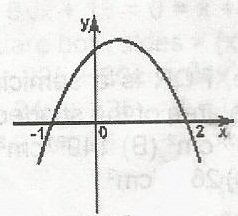
What is the equation of the quadratic function represented by the graph?
Attached Figure / Diagram
A
y = x2 + x - 2
B
y = -x2 - x + 2
C
y = x2 - x - 2
D
y = -x2 - x + 2
medium Difficulty
Verified Correct Answer: Option C
Step-by-Step Mathematical Solution
The required equation is y = x2 - x - 2
i.e. B where the graph touches the graph touches the x-axis y = 0
x2 - x - 2 = 0 = (x + 1)(x - 2) = 0
Hence roots of the equation are -1 and 2 as shown in the graph
Source: Myschool Past Questions Archive (Record #32874)
Mathematics
UTME / JAMB 1990
Plane Geometry, Polygons & Circle Theorems
Diagram
Solution
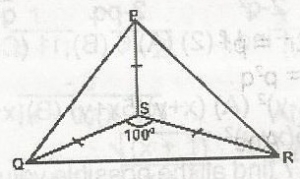
In the figure, PS = QS = RS and QSR - 100o, find QPR
Attached Figure / Diagram
A
40o
B
50o
C
80o
D
100o
medium Difficulty
Verified Correct Answer: Option B
Step-by-Step Mathematical Solution
Since PS = QS = RS
S is the centre of circle passing through P, Q, R /PS/ = /RS/ = radius
QPR \(\pm\) \(\frac{100^o}{2}\) = 50o
Source: Myschool Past Questions Archive (Record #32942)
Mathematics
UTME / JAMB 1990
Plane Geometry, Polygons & Circle Theorems
Diagram
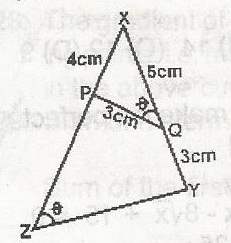
In triangles XYZ and XQP, XP = 4cm, XQ = 5cm and PQ = QY = 3cm. Find ZY
Attached Figure / Diagram
A
8cm
B
6cm
C
4cm
D
3cm
medium Difficulty
Verified Correct Answer: Option B
Step-by-Step Mathematical Solution
No expanded working has been attached for this question yet. The verified answer is Option B.
Source: Myschool Past Questions Archive (Record #32945)
Mathematics
UTME / JAMB 1990
Indices, Logarithms & Surds
Diagram
Solution
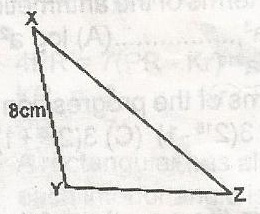
In the figure, YXZ = 30o, XYZ = 105o and XY = 8cm. Calculate YZ
Attached Figure / Diagram
A
16\(\sqrt{2}\)cm
B
8\(\sqrt{2}\)cm
C
4\(\sqrt{2}\)cm
D
22cm
medium Difficulty
Verified Correct Answer: Option C
Step-by-Step Mathematical Solution
yzx + 105o + 30o = 180o
yzx = 180 - 155 = 45o
\(\frac{yz}{sin 30^o} = \frac{8}{sin 45^o}\)
yz = \(\frac{8 \sin 30}{sin 45}\)
= 8(\(\frac{1}{2}) = \frac{8}{1} \times \frac{1}{2} \times \frac{\sqrt{2}}{1}\)
= 4 \(\div\) \(\frac{1}{\sqrt{2}}\)
= 4\(\sqrt{2}\)cm
Source: Myschool Past Questions Archive (Record #32950)
Mathematics
UTME / JAMB 1990
Inequalities & Linear Programming
Diagram
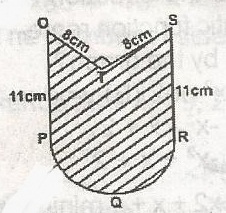
In the figure, PQR is a semicircle. Calculate the area of the shaded region
Attached Figure / Diagram
A
125\(\frac{2}{7}\)2
B
149\(\frac{2}{7}\)cm2
C
234\(\frac{1}{7}\)cm2
D
267\(\frac{1}{2}\)cm2
medium Difficulty
Verified Correct Answer: Option A
Step-by-Step Mathematical Solution
No expanded working has been attached for this question yet. The verified answer is Option A.
Source: Myschool Past Questions Archive (Record #32951)
Mathematics
UTME / JAMB 1990
Indices, Logarithms & Surds
Diagram
Solution
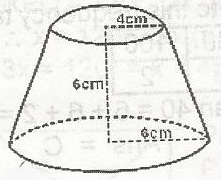
Find the curved surface area of the frustrum in the figure
Attached Figure / Diagram
A
16\(\pi \sqrt{10}\)cm2
B
20\(\pi \sqrt{10}\)cm2
C
24\(\pi \sqrt{10}\)cm2
D
36\(\pi \sqrt{10}\)cm2
medium Difficulty
Verified Correct Answer: Option B
Step-by-Step Mathematical Solution
\(\frac{x}{4} = \frac{6 + x}{6}\)
6x = 4(6 + x) = 24 + 4x
x = 12cm
CSA = \(\pi RL - \pi rl\)
= \(\pi (6) \sqrt{{18^2} + 6^2} - \pi \times 4 \times \sqrt{{12^2} + 4^2}\)
= 6\(\pi \sqrt{360} - 4 \pi \sqrt{160}\)
= 36\(\pi \sqrt{10} - 16 \pi \sqrt{10}\)
= 20\(\pi \sqrt{10}\)cm2
Source: Myschool Past Questions Archive (Record #32962)
Mathematics
WAEC / WASSCE 1990
Sequences & Series (AP & GP)
Solution
(a) Simplify \(\frac{0.016 \times 0.084}{0.48}\) [Leave your answer in standard form].
(b) Eight wooden poles are to be used for pillars and the lengths of the poles form an Arithmetic Progression (A.P). If the second pole is 2m and the sixth is 5m, give the lengths of the poles, in order.
medium Difficulty
Verified Correct Answer: Option
Step-by-Step Mathematical Solution
(a) \(\frac{0.016 \times 0.084}{0.48}\)
= \(\frac{16 \times 10^{-3} \times 84 \times 10^{-3}}{48 \times 10^{-2}}\)
= \(28 \times 10^{-3 - 3 - (-2)}\)
= \(28 \times 10^{-4} = 2.8 \times 10^{-3}\)
(b) \(T_{n} = a + (n - 1)d\) (Terms of an A.P)
\(T_{2} = a + d = 2 ... (1)\)
\(T_{6} = a + 5d = 5 ... (2)\)
\((2) - (1) : 4d = 3 \implies d = \frac{3}{4} = 0.75\)
Put the value of d in (1), so we have
\(a + 0.75 = 2 \implies a = 1.25\)
Therefore, the length of the poles in metres = \(1.25, 2, 2.75, 3.5, 4.25, 5, 5.75, 6.5\)
Source: Myschool Past Questions Archive (Record #54630)
Mathematics
WAEC / WASSCE 1990
Inequalities & Linear Programming
Show on a graph, the area which gives the solution set of the inequalities: \(y - 2x \leq 4 ; 3y + x \geq 6 ; y \geq 7x - 9\).
medium Difficulty
Verified Correct Answer: Option
Step-by-Step Mathematical Solution
No expanded working has been attached for this question yet. The verified answer is Option .
Source: Myschool Past Questions Archive (Record #54632)
Mathematics
WAEC / WASSCE 1990
Plane Geometry, Polygons & Circle Theorems
Solution
(a) Prove that the sum of the angles in a triangle is 2 right angles.
(b) The side AB of a triangle ABC is produced to a point D. The bisector of ACB cuts AB at E. Prove that < CAE + < CBD = 2 < CEB.
medium Difficulty
Verified Correct Answer: Option
Step-by-Step Mathematical Solution
(a) Given any triangle ABC
To prove that < A + < B + < C = 180^\circ
Construction: Produce BC to X and draw CP // BA.
Proof: with the lettering \(a_{1} = a_{2}\) (alternate angles);
\(b_{1} = b_{2}\) (corresponding angles)
\(< BCA + < A + < B = 180^\circ ; < ACB + < A + < B = 180^\circ\)
\(\therefore < A + < B + < C = 180^\circ\)
(b)
From the given triangle and with reference to letterings;
\(\hat{a} + \hat{c} + \hat{c} = \hat{b}\) (exterior opposite angles of a triangle)
\(a + c = e\) (exterior opposite angles of a triangle)
\(a + b = a + a + c + c \implies a + b = 2(a + c)\)
= \(2e \text{where e = a + c}\)
i.e \(< CAE + < CBD = 2 < CED\) (Proved)
Source: Myschool Past Questions Archive (Record #54633)
Mathematics
WAEC / WASSCE 1990
Fractions, Decimals, Percentages & Approximations
Solution
A carpenter was told to make a rectangular desk with top of dimension 50cm by 40cm. The carpenter actually made the desk 60cm by 35cm.
(a) Calculate the percentage error in the (i) length and the breadth ; (ii) area of the table top.
(b) Find the product of the two errors in a(i).
medium Difficulty
Verified Correct Answer: Option
Step-by-Step Mathematical Solution
Error in length = 60cm - 50cm = 10cm
Error in breadth = 40cm - 35cm = 5cm
(i) % error in length = \(\frac{10}{50} \times 100% = 20%\)
% error in breadth = \(\frac{5}{40} \times 100% = 12.5%\)
(ii) Area of the actual table = \(50cm \times 40cm = 2000cm^{2}\)
Area of the table in error = \(60cm \times 35cm = 2100cm^{2}\)
Error in area = \(2100cm^{2} - 2000cm^{2} = 100cm^{2}\)
% error in area = \(\frac{100}{2000} \times 100% = 5%\)
(b) Product of the error in length and in breadth = \(20 \times 12.5 = 250%\)
Source: Myschool Past Questions Archive (Record #54634)
Mathematics
WAEC / WASSCE 1990
Trigonometry, Elevation & Bearings
Solution
The feet of two vertical poles of height 3m and 7m are in line with a point P on the ground, the smaller pole being between the taller pole and P and at a distance of 20m from P. The angle of elevation of the top (T) of the taller pole from the top (R) of the smaller pole is 30^\circ. Calculate the :
(i) distance RT ; (ii) distance of the foot of the taller pole from P, correct to three significant figures ; (iii) angle of elevation of T from P, correct to one decimal place.
medium Difficulty
Verified Correct Answer: Option
Step-by-Step Mathematical Solution
(i) From the figure,
\(\sin 30^\circ = \frac{4}{RT} \implies RT = \frac{4}{\sin 30^\circ}\)
= \(\frac{4}{0.5} = 8m\)
(ii) |RQ| = |XY|
\(\therefore |XY|^{2} = 8^{2} - 4^{2} = 64 - 16 = 48\)
\(|XY| = \sqrt{48} = 4\sqrt{3} m = 6.928m\)
But |PY| = |PX| + |XY|
= 20 + 6.928 = 26.928m \(\approxeq\) 26.9m.
(iii) Let the angle of elevation = \(\theta\)
\(\tan \theta = \frac{TY}{PY} = \frac{7}{26.928}\)
\(\tan \theta = 0.26 \implies \theta = \tan^{-1} (0.26)\)
\(\theta = 14.57^\circ \approxeq 14.6^\circ\) (to 1 decimal place)
Source: Myschool Past Questions Archive (Record #54635)