Question Library
Browse, filter, and study verified past examination questions with step-by-step mathematical reasoning.
Searching 18,000+ Questions...
Sifting topics, KaTeX formulas & verified solutions
Showing 24436–24450 of 29821 verified questions
Sort by:
Mathematics
UTME / JAMB 1991
Indices, Logarithms & Surds
Diagram
Solution
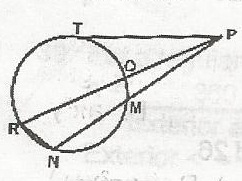
PMN and PQR are two secants of the circle MQTRN and PT is a tangent. If PM = 5cm, PN = 12cm and PQ = 4.8cm, calculate the respective lengths of PR and PT in centimeters
Attached Figure / Diagram
A
7.3, 5.9
B
7.7, 12.5
C
12.5, 7.7
D
5.9, 7.3
medium Difficulty
Verified Correct Answer: Option C
Step-by-Step Mathematical Solution
\(\frac{PQ}{PN} = \frac{PM}{PR} = \frac{QM}{NR}\)
\(\frac{4.8}{12} = \frac{5}{PR}\)
PR = \(\frac{5 \times 12}{4.8} = \frac{50}{4}\)
= 12.5
\(\frac{PQ}{PN} = \frac{PM}{PT} = \frac{TM}{NT}\)
\(\frac{PT}{12} = \frac{5}{PR}\)
PT2 = 60
PT = \(\sqrt{60}\)
= 7.746
= 7.7
Source: Myschool Past Questions Archive (Record #32972)
Mathematics
UTME / JAMB 1991
Plane Geometry, Polygons & Circle Theorems
Diagram
Solution
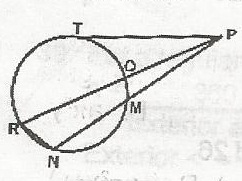
PMN and PQR are two secants of the circle MQTRN and PT is a tangent. If PNR = 110o and PMQ = 55o, find MPQ
Attached Figure / Diagram
A
40o
B
30o
C
25o
D
15o
medium Difficulty
Verified Correct Answer: Option D
Step-by-Step Mathematical Solution
PQM = 110o(Ext. o - (110 + 55)
= 180o - 165o
= 15o
Source: Myschool Past Questions Archive (Record #32975)
Mathematics
UTME / JAMB 1991
Plane Geometry, Polygons & Circle Theorems
Diagram
Solution
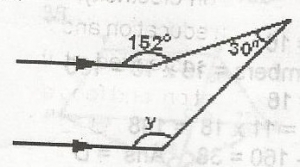
In the figure above, find the value of y
Attached Figure / Diagram
A
28o
B
122o
C
150o
D
152o
medium Difficulty
Verified Correct Answer: Option B
Step-by-Step Mathematical Solution
ADB = 180o - 152o = 28o
28o + y + 30o = 180o
y = 180o - 58o
= 122o
Source: Myschool Past Questions Archive (Record #32978)
Mathematics
UTME / JAMB 1991
Plane Geometry, Polygons & Circle Theorems
Diagram
Solution
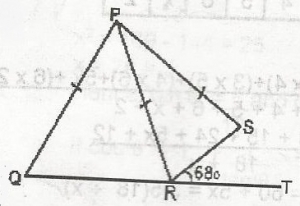
In this figure, PQ = PR = PS and SRT = 68o. Find QPS
Attached Figure / Diagram
A
136o
B
124o
C
12o
D
68o
medium Difficulty
Verified Correct Answer: Option A
Step-by-Step Mathematical Solution
Since PQRS is quadrilateral 2y + 2x = QPS = 360o
i.e. 2(y + x) + QPS = 360o
QPS = 360o - 2(y + x)
But x + y + 68o = 180o
x + y = 180o - 68o = 180o
x + y = 180o - 68o
= 112o
QPS = 360o - 2(112o)
360o - 224o = 136o
Source: Myschool Past Questions Archive (Record #32980)
Mathematics
UTME / JAMB 1991
Indices, Logarithms & Surds
Diagram
Solution
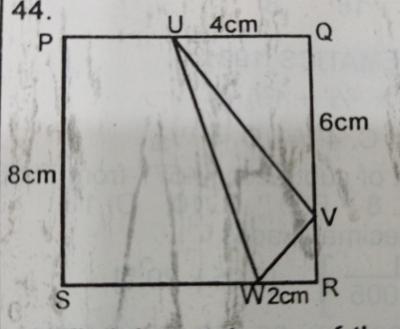
In the figure, PQRS is a square of sides 8cm. What is the area of \(\bigtriangleup\)UVW?
Attached Figure / Diagram
A
64 sq. cm
B
40 sq.cm
C
50 sq.cm
D
10 sq.cm
medium Difficulty
Verified Correct Answer: Option D
Step-by-Step Mathematical Solution
In △ UQV
|UV|\(^2\) = 6\(^2\) + 4\(^2\) (Pythagora's theorem)
|UV| = \(\sqrt{52}\) = 7.21cm
Also, in △ WVR
|WV|\(^2\) = 2\(^2\) + 2\(^2\) = 4 + 4 = 8 (same reason as above)
|WV| = \(\sqrt{8}\) = 2.83
Therefore, the area of △ UVW = \(\frac{1}{2}\) x 2.83 x 7.21 = 10.21 ≈ 10cm\(^2\)
Source: Myschool Past Questions Archive (Record #32981)
Mathematics
UTME / JAMB 1991
Mensuration (Areas, Perimeters & Volumes)
Diagram
Solution
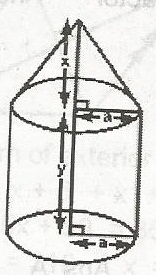
Find the volume of the figure
Attached Figure / Diagram
A
\(\frac{a \pi^2}{3} (x + 3y) \)
B
a\(\pi ^2\)y
C
\(\frac{a \pi ^2}{3}\)(y + x)
D
(\(\frac{1}{3} a \pi ^2 x + y\))
medium Difficulty
Verified Correct Answer: Option A
Step-by-Step Mathematical Solution
Volume of cylinder = \(\pi\)r\(^2\)h = \(\pi\)a\(^2\)y
Volume of cone = \(\frac{1}{3}\) \(\pi\)r\(^2\)h = \(\frac{1}{3}\) \(\pi\)a\(^2\)x
Total Volume = \(\pi\)a\(^2\)y + \(\frac{1}{3}\) \(\pi\)a\(^2\)x = \(\frac{3\pi a^2y + \pi a^2x}{3}\)
= \(\frac{\pi a^2}{3}(x + 3y)\)
Source: Myschool Past Questions Archive (Record #32982)
Mathematics
WAEC / WASSCE 1991
Plane Geometry, Polygons & Circle Theorems
Solution
Simplify :
(i) \(2\frac{2}{3} - (2\frac{1}{2} - 1\frac{4}{5})\)
(ii) \(\frac{3.25 - 1.64}{2.47 - 2.01}\)
medium Difficulty
Verified Correct Answer: Option
Step-by-Step Mathematical Solution
(i) \(2\frac{2}{3} - (2\frac{1}{2} - 1\frac{4}{5})\)
= \(2\frac{2}{3} - (\frac{5}{2} - \frac{9}{5})\)
= \(\frac{8}{3} - (\frac{25 - 18}{10})\)
= \(\frac{8}{3} - \frac{7}{10}\)
= \(\frac{80 - 21}{30}\)
= \(\frac{59}{30}\)
(ii) \(\frac{3.25 - 1.64}{2.47 - 2.01}\)
= \(\frac{1.61}{0.46}\)
= \(\frac{7}{2}\)
= \(3\frac{1}{2}\)
Source: Myschool Past Questions Archive (Record #54606)
Mathematics
WAEC / WASSCE 1991
Indices, Logarithms & Surds
Solution
(a) Using logarithm table, evaluate \(\frac{\sqrt[3]{1.376}}{\sqrt[4]{0.007}}\) correct to three significant figure.
(b) Without using Mathematical tables, find the value of \(\frac{\log 81}{\log \frac{1}{3}}\).
medium Difficulty
Verified Correct Answer: Option
Step-by-Step Mathematical Solution
(a)
No
Log
\(\sqrt[3]{1.376}\)
\(0.1386 \div 3 \) = \(0.0462\)
\(\sqrt[4]{0.007}\)
\(\bar{3}.8451 \div 4\) = \(\bar{1}.4613\)
\(\frac{\sqrt[3]{1.376}}{\sqrt[4]{0.007}}\) =
\(0.5849\)
Antilog = 3.845
\(\therefore \frac{\sqrt[3]{1.376}}{\sqrt[4]{0.007}} \approxeq 3.85\) (to 3 s.f)
(b) \(\frac{\log 81}{\log \frac{1}{3}}\)
= \(\frac{\log 3^{4}}{\log 3^{-1}}\)
= \(\frac{4 \log 3}{-1 \log 3}\)
= \(-4\)
Source: Myschool Past Questions Archive (Record #54607)
Mathematics
WAEC / WASSCE 1991
Sets, Logic & Venn Diagrams
Solution
In a certain class, 22 pupils take one or more of Chemistry, Economics and Government. 12 take Economics (E), 8 take Government (G) and 7 take Chemistry (C). Nobody takes Economics and Chemistry and 4 pupils take Economics and Government.
(a)(i) Using set notation and the letters indicated above, write down the two statements in the last sentence; (ii) Draw a Venn diagram to illustrate the information.
(b) How many pupils take (i) both Chemistry and Government ? (ii) Government only?
medium Difficulty
Verified Correct Answer: Option
Step-by-Step Mathematical Solution
(a)
(i) Nobody takes Economics and Chemistry \(n(E \cap C) = \null \).
(ii) 4 pupils take Economics and Government; \(n(E \cap G) = 4\)
(b) (i) Suppose \(n(C \cap G) = x\)
\(22 = 8 + 4 + 8 - 4 - x + x + 7 - x\)
\(22 = 23 - x \implies x = 1\)
Only 1 person does Chemistry and Government.
(ii) Number taking only Government = \(8 - (4 + x)\)
\(8 - (4 + 1) = 3\)
Source: Myschool Past Questions Archive (Record #54608)
Mathematics
WAEC / WASSCE 1991
Permutations, Combinations & Probability
Solution
A man has 9 identical balls in a bag. Out of these, 3 are black, 2 are blue and the remaining are red.
(a) If a ball is drawn at random, what is the probability that it is (i) not blue? (ii) not red?
(b) If 2 balls are drawn at random, one after the other, what is the probability that both of them will be (i) black, if there is no replacement? (ii) blue, if there is a replacement?
medium Difficulty
Verified Correct Answer: Option
Step-by-Step Mathematical Solution
Total number of balls = 9, No of blue = 2, No of black = 3
\(\therefore\) No of red = 4.
(a)(i) P(not blue) = \( 1 - P(blue)\)
= \(1 - \frac{2}{9} = \frac{7}{9}\)
(ii) P(not red) = \(1 - P(red)\)
= \(1 - \frac{4}{9} = \frac{5}{9}\)
(b) Picking two balls;
(i) P(black) with no replacement = \(\frac{3}{9} \times \frac{2}{8} = \frac{1}{12}\)
(ii) P(blue) with replacement = \(\frac{2}{9} \times \frac{2}{9} = \frac{4}{81}\)
Source: Myschool Past Questions Archive (Record #54609)
Mathematics
WAEC / WASSCE 1991
Plane Geometry, Polygons & Circle Theorems
Solution
ABCDE is a regular pentagon and a rectangle AXYE is drawn on the side AE such that the vertices X and Y lie on the sides BC and CD respectively. Calculate the size of
(i) an interior angle of the pentagon ;
(ii) < BXA.
medium Difficulty
Verified Correct Answer: Option
Step-by-Step Mathematical Solution
(i) Sum of interior angles of a regular polygon = \((2n - 4) \times 90^\circ\)
For a pentagon, \((2(5) - 4) \times 90^\circ = 6 \times 90^\circ = 540^\circ\)
Interior angle = \(\frac{540^\circ}{5} = 108^\circ\)
(ii) < BXA = 108^\circ - 90^\circ = 18^\circ
< ABX = 108^\circ (as shown above)
\(\therefore < BXA = 180^\circ - (108^\circ + 18^\circ) = 54^\circ\)
Source: Myschool Past Questions Archive (Record #54610)
Mathematics
WAEC / WASSCE 1991
Linear, Simultaneous & Quadratic Equations
Solution
(a) Solve the equation, correct to two decimal places \(2x^{2} + 7x - 11 = 0\)
(b) Using the substitution \(P = \frac{1}{x}; Q = \frac{1}{y}\), solve the simultaneous equations : \(\frac{2}{x} + \frac{1}{y} = 3 ; \frac{1}{x} - \frac{5}{y} = 7\)
medium Difficulty
Verified Correct Answer: Option
Step-by-Step Mathematical Solution
(a) \(2x^{2} + 7x - 11 = 0\)
Using the quadratic formula,
\(a = 2, b = 7, c = -11\)
\(x = \frac{-b \pm \sqrt{b^{2} - 4ac}}{2a}\)
\(x = \frac{-7 \pm \sqrt{7^{2} - 4(2)(-11)}}{2(2)}\)
\(x = \frac{-7 \pm \sqrt{49 + 88}}{4}\)
\(x = \frac{-7 \pm 11.705}{4}\)
\(x = \frac{-7 + 11.705}{4} ; \frac{-7 - 11.705}{4}\)
\(x = \frac{4.705}{4} = 1.17625\) or \(x = \frac{-18.705}{4} = -4.67625\)
\(x \approxeq 1.18\) or \(x \approxeq -4.68\)
(b) \(\frac{2}{x} + \frac{1}{y} = 3\)
\(\frac{1}{x} - \frac{5}{y} = 7\)
Substituting using \(P = \frac{1}{x}; Q = \frac{1}{y}\), we have
\(2P + Q = 3 ... (i)\)
\(P - 5Q = 7 ... (ii)\)
Multiply (ii) by 2, we have \(2P - 10Q = 14 ... (iii)\)
(iii) - (i) : \(-10Q - Q = 14 - 3 \implies -11Q = 11\)
\(Q = -1\)
Substitute Q = -1 in (i),
\(2P - 1 = 3 \implies 2P = 3 + 1 = 4\)
\(\implies P = 2\)
P = 2; Q = -1
But \(P = \frac{1}{x} \implies 2 = \frac{1}{x}\)
\(\therefore x = \frac{1}{2}\)
Also, \(Q = \frac{1}{y} \implies -1 = \frac{1}{y}\)
\(y = -1\)
\(\therefore x = \frac{1}{2} ; y = -1\)
Source: Myschool Past Questions Archive (Record #54611)
Mathematics
WAEC / WASSCE 1991
Fractions, Decimals, Percentages & Approximations
Solution
A man bought 5 reams of duplicating paper, each of which are supposed to contain 480 sheets. The actual number of sheets in the packets were : 435, 420, 405, 415 and 440.
(a) Calculate, correct to the nearest whole number, the percentage error for the packets of paper;
(b) If the agreed price for a full ream was N35.00, find, correct to the nearest naira, the amount by which the buyer was cheated.
medium Difficulty
Verified Correct Answer: Option
Step-by-Step Mathematical Solution
(a) Sheets expected from 5 packets = \(480 \times 5 = 2400\)
Actual sheet contained in the packets = \(435 + 420 + 405 + 415 + 440 = 2115\)
Error in supply = 2400 - 2115 = 285 sheets.
\(\therefore\) Percentage error = \(\frac{285}{2400} \times 100% = 11.875%\)
\(\approxeq 12%\)
(b) If 1 packet = 480 sheets cost N35.00
\(\therefore \text{2400 sheets cost } \frac{2400}{480} \times N35.00 = N175.00\)
Amount of buyer was cheated = \(\frac{Error \times N175}{\text{Expected no of sheets}}\)
\(\frac{N285 \times 175}{2400} = N20.78\)
The buyer was cheated by N21 to the nearest naira.
Source: Myschool Past Questions Archive (Record #54613)
Mathematics
WAEC / WASSCE 1991
Inequalities & Linear Programming
Solution
Using a scale of 2cm to 1 unit on the x- axis and 1cm to 1 unit on the y- axis, draw on the same axes the graphs of \(y = 3 + 2x - x^{2}; y = 2x - 3\) for \(-3 \leq x \leq 4\). Using your graph:
(i) solve the equation \(6 - x^{2} = 0\);
(ii) find the maximum value of \(3 + 2x - x^{2}\);
(iii) find the range of x for which \(3 + 2x - x^{2} \leq 1\), expressing all your answers correct to one decimal place.
medium Difficulty
Verified Correct Answer: Option
Step-by-Step Mathematical Solution
\(y = 3 + 2x - x^{2}\) and \(y = 2x - 3\)
Table of values for the equation for \(-3 \leq x \leq 4\)
x
-3
-2
-1
0
1
2
3
4
\(y = 3 + 2x - x^{2}\)
-12
-5
0
3
4
3
0
5
\(y = 2x - 3\)
-9
-7
-5
-3
-1
1
3
5
(i) \(6 - x^{2} = 0\)
\(6 - 3 + 2x - x^{2} = 2x - 3\)
\(3 + 2x - x^{2} = 2x - 3\)
\(\therefore y = 2x - 3\)
Read the point where the two equations intersect on the graph.
x = -2.6 and x = 2.5.
(ii) Maximum value of \(3 + 2x - x^{2}\) is at y = 4.
(iii) Range for which \(3 + 2x - x^{2} \leq 1\) is represented by the shaded portion in the graph.
Source: Myschool Past Questions Archive (Record #54615)
Mathematics
WAEC / WASSCE 1991
Plane Geometry, Polygons & Circle Theorems
Solution
(a) Prove that the angle which an arc of a circle subtends at the centre is twice that which it subtends at any point on the remaining part of the circumference.
(b)
In the diagram, O is the centre of the circle, < OQR = 32^\circ and < MPQ = 15^\circ. Calculate (i) < QPR ; (ii) < MQO.
medium Difficulty
Verified Correct Answer: Option
Step-by-Step Mathematical Solution
(a)
Given: Circle ABC with centre O
To prove : < AOB = 2 < ACB
Construction: Join CO produced to P.
Proof: With lettering as in the figure,
OA = OB (radii) ; \(x_{1} = x_{2}\) (base angles of an isosceles triangle)
\(\therefore < AOP = x_{1} + x_{2}\) (exterior angle of triangle AOC)
\(\therefore < AOP = 2x_{2} (x_{1} = x_{2})\)
Also, \(< BOP = 2y_{2}\) (similar proof as the earlier done ones)
\(\therefore < AOB = 2x_{2} + 2y_{2} = 2(x_{2} + y_{2})\)
\(< AOB = 2 \times < ABC\) (proven)
(b) From the diagram, < OQR = 32^\circ and < MPQ = 15^\circ.
(i) \(\therefore < ORQ = 32^\circ\) (base angles of an isosceles triangle)
\(< OQR = 180^\circ - (32^\circ + 32^\circ) = 180^\circ - 64^\circ = 116^\circ\)
\(\therefore < QPR = \frac{116^\circ}{2} = 58^\circ\) (angle subtended at the centre)
(ii) Join MO and MQ,
Since < MPQ = 15^\circ
then < MOQ = 2 < MPQ (angle at the centre)
\(\therefore < MOQ = 2 \times 15^\circ = 30^\circ\)
\(\therefore < OMQ = < MQO \) (base angles of an isosceles triangle)
\(\therefore < MQO = \frac{180^\circ - 30^\circ}{2} = 75^\circ\)
Source: Myschool Past Questions Archive (Record #54625)