Question Library
Browse, filter, and study verified past examination questions with step-by-step mathematical reasoning.
Searching 18,000+ Questions...
Sifting topics, KaTeX formulas & verified solutions
Showing 24331–24345 of 29821 verified questions
Sort by:
Biology
WAEC / WASSCE 1992
Reproduction in Plants & Animals
(a) (i) identify specimens A. B, C, D and E (ii) To which class of fruits does each specimen belong? (iii) Give two reasons each for your answers (b) Examine specimen C carefully (i) State the agent of dispersal of specimen C (ii) Give one structural feature of specimen C carefully (iii) State the agent of dispersal of specimen C (iv) Give one structural feature of specimen C to support your answer (c) State two advantages of dispersal of fruit and seeds
medium Difficulty
Verified Correct Answer: Option
Biological Concept & Syllabus Guide
No expanded working has been attached for this question yet. The verified answer is Option .
Source: Myschool Past Questions Archive (Record #59935)
Biology
WAEC / WASSCE 1992
Reproduction in Plants & Animals
Diagram
Solution
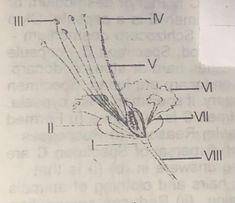
Which of the labellled parts represent the (a) female reproductive system (b) petal?
Attached Figure / Diagram
medium Difficulty
Verified Correct Answer: Option
Biological Concept & Syllabus Guide
. (a) IV, V and VIl (b) VI
Source: Myschool Past Questions Archive (Record #59818)
Biology
WAEC / WASSCE 1992
Reproduction in Plants & Animals
Diagram
Solution
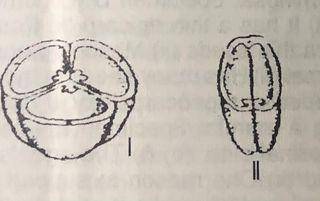
What types of placentation are represented by diagrams I and II
Attached Figure / Diagram
medium Difficulty
Verified Correct Answer: Option
Biological Concept & Syllabus Guide
. (i) Axile placentation (ii) Marginal placentation
Source: Myschool Past Questions Archive (Record #59819)
Biology
WAEC / WASSCE 1992
Cell Structure, Organization & Cell Division
Diagram
Solution
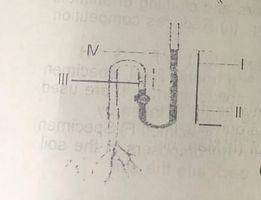
Study the diagram below and use it to answer questions (a)-(d)
(a) Name the set-up illustrated in the diagram (b) What is the apparatus used for? (c) What is contained in the part of the apparatus labelled IV? (d) From which part(s) of the apparatus would the reading(s) be taken after the experiment?
Attached Figure / Diagram
medium Difficulty
Verified Correct Answer: Option
Biological Concept & Syllabus Guide
(a) Monometer (b) It is used to measure chloroplast which is the main centre for photosynthesis (c) Mercury (d) From 1
Source: Myschool Past Questions Archive (Record #59820)
Biology
WAEC / WASSCE 1992
Nutrition in Plants & Animals (Photosynthesis & Food Substances)
Solution
(a) State two ways in which the mesophyll layer of the leaf is adapted for photosynthesis (b) In the test for starch in a leaf, why is the leaf boiled in warm alcohol?
medium Difficulty
Verified Correct Answer: Option
Biological Concept & Syllabus Guide
(a) (i) It posses chloroplast which is the main centre for photosynthesis (ii) it has air spaces in which carbon (iv) oxide accumulates and is used to carry out photosynthesis (b) in order to remove the chlorophyll
Source: Myschool Past Questions Archive (Record #59821)
Biology
WAEC / WASSCE 1992
Variety of Organisms & Classification of Living Things
Solution
List three uses of fibres to plants.
medium Difficulty
Verified Correct Answer: Option
Biological Concept & Syllabus Guide
(i) Mechanical support (ii) rigidity to plant (iii) flexibility to plant
Source: Myschool Past Questions Archive (Record #59822)
Mathematics
UTME / JAMB 1991
Linear, Simultaneous & Quadratic Equations
Solution
A car travels from calabar to Enugu, a distance of P km with an average speed of U km per hour and continues to benin, a distance of Q km, with an average speed of Wkm per hour. Find its average speed from Calabar to Benin
A
\(\frac{(p + q)}{pw + qu}\)
B
\(\frac{uw(p + q)}{pw + qu}\)
C
\(\frac{uw(p + q)}{pw}\)
D
\(\frac{uw}{pw + qu}\)
medium Difficulty
Verified Correct Answer: Option B
Step-by-Step Mathematical Solution
Average speed = \(\frac{total Distance}{Total Time}\)
from Calabar to Enugu in time t1, hence
t1 = \(\frac{P}{U}\) also from Enugu to Benin
t2 \(\frac{q}{w}\)
Av. speed = \(\frac{p + q}{t_1 + t_2}
= p + q * \frac{p}{u} + \frac{q}{w}\)
= p + q x \(\frac{uw}{pw + qu}\)
= \(\frac{uw(p + q)}{pw + qu}\)
Source: WAEC / JAMB / NECO Classroom Archive (Record #31395)
Mathematics
WAEC / WASSCE 1991
Mensuration (Areas, Perimeters & Volumes)
Diagram
Solution
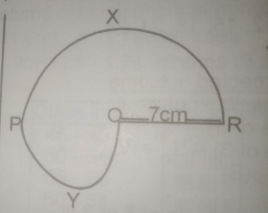
In the diagram above, PXR and PYO are two semicircles with diameters 14cm and 7cm respectively. Find the perimeter of the region (take \(\pi\) = \(\frac{22}{7}\) )
Attached Figure / Diagram
A
22cm
B
33cm
C
40cm
D
47cm
E
66cm
medium Difficulty
Verified Correct Answer: Option C
Step-by-Step Mathematical Solution
P = \(\pi\)r + \(\pi\)r + R = \(\frac{22}{7}\) x 7 + \(\frac{22}{7}\) x \(\frac{7}{2}\) + 7
P = 22 + 11 + 7 = 40cm
Source: WAEC / JAMB / NECO Classroom Archive (Record #22912)
Mathematics
UTME / JAMB 1991
Fractions, Decimals, Percentages & Approximations
Solution
What is the product of \(\frac{27}{5^1}\)(3)-3 and \(\frac{(1)^{-1}}{5}\)?
A
5
B
3
C
1
D
\(\frac{1}{25}\)
medium Difficulty
Verified Correct Answer: Option D
Step-by-Step Mathematical Solution
\(\frac{27}{5^1}\)(3)-3 x \(\frac{(1)^{-1}}{5}\) = \(\frac{27}{5}\) x \(\frac{1}{3^3}\) x \(\frac{1}{\frac{1}{5}}\)
= \(\frac{27}{5}\) x \(\frac{1}{27}\) x \(\frac{1}{5}\)
= \(\frac{1}{25}\)
Source: WAEC / JAMB / NECO Classroom Archive (Record #31376)
Mathematics
UTME / JAMB 1991
Fractions, Decimals, Percentages & Approximations
Solution
Musa borrows N10.00 at 2% per month simple interest and repays N8.00 after 4 months. How much does he still owe?
A
N10.80
B
N10.67
C
N2.80
D
N2.67
medium Difficulty
Verified Correct Answer: Option C
Step-by-Step Mathematical Solution
I = \(\frac{PRT}{100}\)
= \(\frac{10 \times 2 \times 4}{100}\)
= \(\frac{4}{5}\)
= 0.8
Total amount = N10.80
He pays N8.00
Remainder = 10.80 - 8.00
= N2.80
Source: WAEC / JAMB / NECO Classroom Archive (Record #31374)
Mathematics
UTME / JAMB 1991
Variations
Solution
If w varies inversely as \(\frac{uv}{u + v}\) and is equal to 8 when
u = 2 and v = 6, find a relationship between u, v, w.
A
uvw = 16(u + v)
B
16ur = 3w(u + v)
C
uvw = 12(u + v)
D
12uvw = u + v
medium Difficulty
Verified Correct Answer: Option C
Step-by-Step Mathematical Solution
W \(\alpha\) \(\frac{\frac{1}{uv}}{u + v}\)
∴ w = \(\frac{\frac{k}{uv}}{u + v}\)
= \(\frac{k(u + v)}{uv}\)
w = \(\frac{k(u + v)}{uv}\)
w = 8, u = 2 and v = 6
8 = \(\frac{k(2 + 6)}{2(6)}\)
= \(\frac{k(8)}{12}\)
k = 12
i.e 12 ( u + v) = uwv
Source: WAEC / JAMB / NECO Classroom Archive (Record #31398)
Mathematics
WAEC / WASSCE 1991
Inequalities & Linear Programming
Diagram
Solution
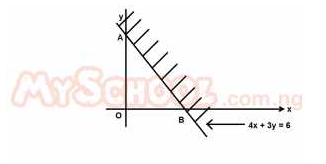
The shaded portion shows the outer boundary
of the half plane defined by the inequality
Attached Figure / Diagram
A
4x + 3y \(\geq\) 6
B
4x + 3y = 6
C
4x + 3y < 6
D
3y >6
E
4x < 6
medium Difficulty
Verified Correct Answer: Option A
Step-by-Step Mathematical Solution
The region is denoted by 4x + 3y \(\geq\) 6
Source: WAEC / JAMB / NECO Classroom Archive (Record #22913)
Physics
WAEC / WASSCE 1991
Calorimetry, Latent Heat & Change of State
Solution
A water fall is 420m high. Calculate the difference in temperature of the water between the top and bottom of the water fall. Neglect heat loses(g = 10.0m-2 specific heat capacity of water = 4.20 x 10\(^3\) JKg-1 K-1)
A
0.1oC
B
1.0oC
C
42oC
D
100oC
E
4.20oC
medium Difficulty
Verified Correct Answer: Option B
Physical Principles & Numerical Solution
Potential Energy = Heat Energy
mgh = Mc\(\Delta \theta = \frac{gh}{c} = \frac{10 \times 240}{4.20 \times 10^3}\)
= 1.0oC
Source: WAEC / JAMB / NECO Classroom Archive (Record #33286)
Physics
WAEC / WASSCE 1991
Linear Motion, Projectiles & Kinematics
Solution
(a) Explain the terms:- uniform acceleration and average speed.
(b) A body at rest is given an initial uniform acceleration of 8.0ms\(^{-2}\) for 30s after which the acceleration is reduced to 5.0ms\(^{-2}\) for the next 20s. The body maintains the speed attained for 60s after which it is brought to rest in 20s. Draw the velocity-time graph of the motion using the information given above.
(c) Using the graph, calculate the: (i) maximum speed attained during the motion; (ii) average retardation as the body is being brought to rest; (iii) total distance travelled during the first 50s; (iv) average speed during the same interval as in (ii).
medium Difficulty
Verified Correct Answer: Option
Physical Principles & Numerical Solution
(a) Uniform acceleration occurs when the change in velocity per unit time is constant. The S.I. unit is ms\(^{-2}\).
\(a = \frac{v - u}{t}\); a - uniform acceleration, v - final velocity, u - initial velocity, t - time.
Graphically,
acceleration is the same acceleration at x is different every point from that at Y.
Note - acceleration is given by slope in both graphs.
(b) SEE DIAGRAM ABOVE.
V\(_1\) = u + at = 0 + 8 x 30 = 240m/s
V\(_2\) = V\(_1\) + at = 240 + 50 x 20 = 340m/s
(i) Maximum speed = 340 m/s.
(ii) \(a = \frac{v - u}{t} = \frac{0 - 340}{20} = -17 ms^{-2}\)
(iii) Area of A = \(\frac{1}{2} \times 30 \times 240 = 3600m\)
Area of B = \(\frac{1}{2}\) x ( 240 + 340) x 20 = 5600m
Total distance in the first 50s: 3600 + 5800 = 9400m
(iv) Average speed during the first 50s = \(\frac{9400m}{50s} = 188 ms^{-1}\)
Source: WAEC / JAMB / NECO Classroom Archive (Record #54773)
Physics
WAEC / WASSCE 1991
Magnetism, Electromagnetism & AC Circuits
Solution
An induction coil is generally used to?
A
rectify an alternating current
B
produce a large input voltage
C
smoothen a pulsating direct current
D
modulate an incoming signal
E
produce a large output voltage
medium Difficulty
Verified Correct Answer: Option E
Physical Principles & Numerical Solution
An induction coil is a device used to produce high emf from a low-voltage direct current (DC) supply.
Source: WAEC / JAMB / NECO Classroom Archive (Record #33443)