Question Library

Browse, filter, and study verified past examination questions with step-by-step mathematical reasoning.
Launch Interactive Practice
Searching 18,000+ Questions... Sifting topics, KaTeX formulas & verified solutions
Showing 24271–24285 of 29821 verified questions
Sort by:
Biology UTME / JAMB 1992 Variety of Organisms & Classification of Living Things
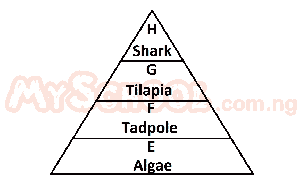
Which level of the pyramid has the least total stored energy?
Attached Figure / Diagram
Question diagram
A
E
B
F
C
G
D
H
medium Difficulty
Biology UTME / JAMB 1992 Basic Ecological Concepts, Ecosystems & Biomes
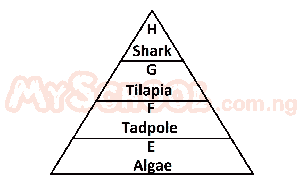
Which organism in the pyramid functions as a tertiary consumer?
Attached Figure / Diagram
Question diagram
A
Algea
B
Shark
C
Tadpole
D
Tilapia
medium Difficulty
Biology UTME / JAMB 1992 Basic Ecological Concepts, Ecosystems & Biomes
Mangrove swamp can be found
A
on a seashore with flat terrains
B
where a river meets the sea
C
on a mud flat near the sea
D
where two rivers meet
medium Difficulty
Biology UTME / JAMB 1992 Variety of Organisms & Classification of Living Things
Soil with the finest particles is called
A
silt
B
clay
C
sand
D
gravel
medium Difficulty
Biology UTME / JAMB 1992 Adaptation & Evolution
The theory of natural selection was developed by
A
Lamarck and Darwin
B
Darwin and Wallace
C
Wallace and Mendel
D
Mendel and Larmack
medium Difficulty
Biology UTME / JAMB 1992 Adaptation & Evolution
Fossil records found in sedimentary rocks offer some explanation for the theory of evolution because
A
the deposit have remains of organisms characteristic of when they were formed
B
different strata have remains of organisms of the same kind
C
only organisms with strong parts are fossilized
D
most animal and plant fossils bear little resemblance to present day living specimens
medium Difficulty
Biology WAEC / WASSCE 1992 Cell Structure, Organization & Cell Division
The organ which is sensitive to light in Euglena is the
A
gullet
B
chloroplast
C
eye spot
D
contractile vacuole
E
flagellum
medium Difficulty
Biology WAEC / WASSCE 1992 Cell Structure, Organization & Cell Division
Which of the following is a similarity between a typical animal cell and a typical plant cell?presence of
A
cellulose cell wall
B
chlorophyll
C
centrally-placed nucleus
D
cell membrane
E
large vacuole
medium Difficulty
Biology WAEC / WASSCE 1992 Cell Structure, Organization & Cell Division
The first scientist to describe the cell was
A
Theodor Schwann
B
Felix Dujardin
C
Robert Hooke
D
Charles Darwin
E
Matthias Schleiden
medium Difficulty
Biology WAEC / WASSCE 1992 Cell Structure, Organization & Cell Division
In which of the following parts of a cell is the chromosome fund?
A
Nucleus
B
Golgi body
C
Cytoplasm
D
Cell membrane
E
Cell wall
medium Difficulty
Biology WAEC / WASSCE 1992 Nervous, Hormonal Coordination & Sense Organs
Which of the following diseases is caused by deficiency of insulin in the body?
A
Malaria
B
Diabetes mellitus
C
Hepatitis
D
Gonorrhoea
E
Cholera
medium Difficulty
Biology WAEC / WASSCE 1992 Transport System in Plants & Animals
Which of the following is the medium of transportation of nutrients with unicellular organisms?
A
Blood
B
Serum
C
Protoplasm
D
Plasma
E
lymph
medium Difficulty
Biology WAEC / WASSCE 1992 Transport System in Plants & Animals
Which of the following blood vessels carries oxygenated blood into the heart?
A
Pulmonary vein
B
Anterior vena cava
C
Pulmonary artery
D
Aorta
E
Posterior vena cava
medium Difficulty
Biology WAEC / WASSCE 1992 Variety of Organisms & Classification of Living Things
The conditions that ensure successful exchange of gases in multicellular organisms include the following except
A
concentration gradient across the respiratory surface
B
presence of thin membrane as the respiratory surface
C
last transportation of absorbed gases
D
presence of larg surface area of the respiratory organ
E
presence of small, dry surface area of the respiratory organ
medium Difficulty
Page 1619 of 1989