Question Library
Browse, filter, and study verified past examination questions with step-by-step mathematical reasoning.
Searching 18,000+ Questions...
Sifting topics, KaTeX formulas & verified solutions
Showing 23896–23910 of 29821 verified questions
Sort by:
Physics
WAEC / WASSCE 1992
Equilibrium of Forces, Moments & Flotation
Solution
Solid weighs 0.040 N in air and 0.024 N when fully immersed in a liquid of density 800 kg m-3. What is the volume of the solid? (g = 1Oms2)
A
2.0 x 10⁻⁶m3
B
2.5x10⁻⁶m3
C
3.0x10⁻⁶m3
D
2.0x 10⁻⁵m3
E
3.0 x 10⁻⁵m3
medium Difficulty
Verified Correct Answer: Option A
Physical Principles & Numerical Solution
Upthrust = weight fluid displacement 0.040 - 0.024 = PVg
0.016 = 800 x V x 10
V = 2.0 x 10⁶
Source: Myschool Past Questions Archive (Record #24249)
Physics
WAEC / WASSCE 1992
Circular Motion, Gravitation & Simple Harmonic Motion
Solution
Which of the following will reduce the frequency of oscillation of a simple pendulum?
A
Increasing the mass of the bob
B
Decreasing the mass of the bob
C
Increasing the length of the string
D
Decreasing the length of the string
E
Increasing the amplitude of oscillation
medium Difficulty
Verified Correct Answer: Option C
Physical Principles & Numerical Solution
The swing rate of a pendulum is determined by its length. The longer the pendulum, the slower the pendulum swings and vice-versa.
Source: Myschool Past Questions Archive (Record #24250)
Physics
WAEC / WASSCE 1992
Scalars, Vectors & Relative Motion
Which of the following is a scalar quantity?
A
Momentum
B
Acceleration
C
Displacement
D
Distance
E
Force
medium Difficulty
Verified Correct Answer: Option D
Physical Principles & Numerical Solution
No expanded working has been attached for this question yet. The verified answer is Option D.
Source: Myschool Past Questions Archive (Record #24202)
Physics
WAEC / WASSCE 1992
Linear Motion, Projectiles & Kinematics
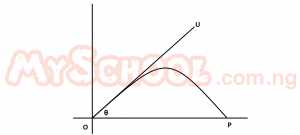
Diagram
The diagram above represents the trajectory of a projectile with an initial velocity U. Calculate the time taken to reach the maximum height. (Take g as acceleration due to gravity)
Attached Figure / Diagram
A
Usinθ/2g
B
2Usinθ/g
C
Ucosθ/g
D
2Ucosθ/g
E
Usinθ/g
medium Difficulty
Verified Correct Answer: Option E
Physical Principles & Numerical Solution
No expanded working has been attached for this question yet. The verified answer is Option E.
Source: Myschool Past Questions Archive (Record #24206)
Physics
WAEC / WASSCE 1992
Current Electricity & Electric Circuits
Solution
What change in velocity would be produced on a body of mass 4kg if a constant force of 16 N acts on it for2 s?
A
0.5 ms-1
B
2.0ms-1
C
8.0 ms-1
D
32.0 ms-1
E
128.0 ms-1
medium Difficulty
Verified Correct Answer: Option C
Physical Principles & Numerical Solution
F = m(v - u)/t; (v - u) = Ft/m = 8.0
Source: Myschool Past Questions Archive (Record #24245)
Physics
WAEC / WASSCE 1992
Newton's Laws, Momentum & Collisions
Solution
A force of 20 N applied parallel to the surface of a horizontal table, is just sufficient to make a block of mass 4kg move on the table. Calculate the coefficient of friction between the block and the table. (g = 10ms2)
A
0.05
B
0.20
C
0.50
D
0.80
E
2.00
medium Difficulty
Verified Correct Answer: Option C
Physical Principles & Numerical Solution
μ= F/mg = 20/40 = 0.5
Source: Myschool Past Questions Archive (Record #24251)
Physics
WAEC / WASSCE 1992
Elasticity, Density, Pressure & Fluids
A barometer can be used in determining the I. height of a mountain II. depth of a mine III. dew point. Which of the following is/are correct?
A
I, II and III
B
II and III only
C
I and III only
D
I and II only
E
III only
medium Difficulty
Verified Correct Answer: Option D
Physical Principles & Numerical Solution
No expanded working has been attached for this question yet. The verified answer is Option D.
Source: Myschool Past Questions Archive (Record #24252)
Physics
WAEC / WASSCE 1992
Work, Energy, Power & Simple Machines
Solution
A body of mass 5kg falls from a height of 10m above the ground. What is the kinetic energy of the body just before it strikes the ground? (Neglect energy losses and take gravity as 10ms^2)
A
5J
B
25J
C
250J
D
500J
E
625J
medium Difficulty
Verified Correct Answer: Option D
Physical Principles & Numerical Solution
v2 = u2 + 2gh = 0 + 2 x 10 x 10
v2 = 200; K.E = 1/2mv2 = 1/2 x 5 x 200 = 500J
Source: Myschool Past Questions Archive (Record #24253)
Physics
WAEC / WASSCE 1992
Temperature, Thermometry & Thermal Expansion
Solution
Steel bars, each of length 3.0 m at 28°C, are to be used for constructing a rail line. If the linear expansivity of steel is 1.0 x 10⁻⁵°C, what is the safety gap that must be left between successive bars if the highest temperature expected is 40oC?
A
1.2 x 10⁻¹cm
B
8.4 x 10⁻²cm
C
7.2 x10⁻²cm
D
3.6 x 10⁻²cm
E
1.8 x 10⁻²cm
medium Difficulty
Verified Correct Answer: Option D
Physical Principles & Numerical Solution
Gap ΔL = αL1Δθ = 1.0 x 10-5 x 3 x (40 - 28)
= 3.6 x 10⁻²
Source: Myschool Past Questions Archive (Record #24254)
Physics
WAEC / WASSCE 1992
Elasticity, Density, Pressure & Fluids
Solution
Which of the following statements is/are correct? I. Pure water freezes at 0ºC under normal pressure ll. Water has its highest density at 4ºC. III. The volume is highest at 4ºC,
A
I only
B
II only
C
I and II only
D
I and III only
E
II and III only
medium Difficulty
Verified Correct Answer: Option C
Physical Principles & Numerical Solution
Under standard atmospheric pressure, pure water freezes at 0ºC. Water is most dense at around 4ºC. As it cools below this temperature, it begins to expand.
Source: Myschool Past Questions Archive (Record #24255)
Physics
WAEC / WASSCE 1992
Current Electricity & Electric Circuits
Solution
A given mass of gas at a temperature of 30^\circC is trapped in a tube of volume V. Calculate the temperature of the gas when the volume is reduced to two-third of its original value by applying a pressure twice the original value.
A
71oC
B
40oC
C
131oC
D
313oC
E
404oC
medium Difficulty
Verified Correct Answer: Option C
Physical Principles & Numerical Solution
Using the genaral gas law: \(\frac{P_1 V_1}{T_1} = \frac{P_2 V_2}{T_2}\)
T\(_1\) = 30º = 273 + 30 = 303k
T\(_2\) = ?
let V\(_1\) = V, V\(_2\) = \(\frac{2}{3}\)V, P\(_1\) = P, P\(_2\) = 2P
From, \(\frac{P_1 V_1}{T_1} = \frac{P_2 V_2}{T_2}\)
T\(_2\) = \(\frac{P_2 V_2 T_1}{P_1 V_1}\) = \(\frac{2P \times \frac{2}{3}V \times 303}{P \times V}\) = 404k(the Ps and Vs cancel out)
404k → ºC = 404 - 273 = 131ºC
Source: Myschool Past Questions Archive (Record #24256)
Physics
WAEC / WASSCE 1992
Current Electricity & Electric Circuits
Which of the following colours of surfaces will radiate heat energy best?
A
Red
B
White
C
Black
D
Yellow
E
Blue
medium Difficulty
Verified Correct Answer: Option C
Physical Principles & Numerical Solution
No expanded working has been attached for this question yet. The verified answer is Option C.
Source: Myschool Past Questions Archive (Record #24257)
Physics
WAEC / WASSCE 1992
Gas Laws & Heat Transfer
Solution
A gas which obeys Charles’ law exactly has a volume of 283cm3 at 10oC. What is its volume at 30oC?
A
142cm3
B
293cm3
C
303cm3
D
566cm3
E
849cm3
medium Difficulty
Verified Correct Answer: Option C
Physical Principles & Numerical Solution
Using Charles law:
V1/T1 = V2/T2;
(283 * 303) / 283
V2= 303
Source: Myschool Past Questions Archive (Record #24258)
Physics
WAEC / WASSCE 1992
Calorimetry, Latent Heat & Change of State
Which of the following best explains why a person suffers a more severe burn when his skin is exposed to steam than when boiling water pours on his skin?
A
Steam is at a higher temperature than boiling water
B
Steam possesses greater heat energy per unit mass than boiling water
C
Steam spreads more easily over a wider area of the skin man boiling water
D
Steam penetrates more deeply into the skin than boiling water
E
the specific latent heat of vaporization is released in changing from boiling water to steam
medium Difficulty
Verified Correct Answer: Option B
Physical Principles & Numerical Solution
No expanded working has been attached for this question yet. The verified answer is Option B.
Source: Myschool Past Questions Archive (Record #24259)
Physics
WAEC / WASSCE 1992
Elasticity, Density, Pressure & Fluids
Solution
A small circular membrane is 10cm below the surface of a pool of mercury when the barometric height is 76 cm of mercury. If the density of mercury is 13600\(kgm^{-3}\), what is the pressure on the membrane in \(Nm^{-2}\)? \((g =10ms^{-2})\)
A
1.17 x 10⁷ Nm-2
B
6.80 x 10⁵Nm-2
C
1.17x10⁵Nm-2
D
1.03 x 10⁵Nm-2
E
1.36 x10⁴ Nm-2
medium Difficulty
Verified Correct Answer: Option C
Physical Principles & Numerical Solution
Pressure at a depth for fluid with constant density such as mercury is given as
\(p = p_{0} + \rho hg\)
where \(p_{0}\) = atmospheric pressure.
\(p_{0} = \rho hg =13600 \times \frac{76}{100} \times 10\)
= \(103,360 Nm^{-2}\)
\(p = 103,360 + (13600 \times \frac{10}{100} \times 10)\)
\(p = 103,360 + 13,600\)
\(p = 116,960 Nm^{-2} \approxeq 1.17 \times 10^{5} Nm^{-2}\)
Source: Myschool Past Questions Archive (Record #24260)