Question Library
Browse, filter, and study verified past examination questions with step-by-step mathematical reasoning.
Searching 18,000+ Questions...
Sifting topics, KaTeX formulas & verified solutions
Showing 23176–23190 of 29821 verified questions
Sort by:
Mathematics
UTME / JAMB 1993
Coordinate Geometry
Diagram
Solution
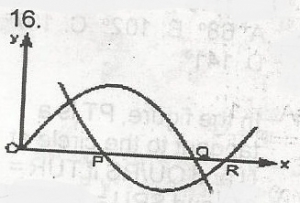
The figure represents the graphs of y = x(2 - x) and y = (x - 1)(x - 3). What are the x-coordinates of P, Q and F respectively?
Attached Figure / Diagram
A
1, 3, 2
B
0, 0, 0
C
0, 2, 3
D
1, 2, 3
medium Difficulty
Verified Correct Answer: Option D
Step-by-Step Mathematical Solution
The two equations are y = x(2 - x) and y = (x - 1)(x - 3)
The root of these equations are points where the graph of the equations cuts the x axis; but at these points = 0
put y = 0; 0 = x(2 - x)
0 = (x - 1)(x - 3)
x = 0 or x = 2; x = 1 or x = 3
The values of x at P, Q, R are increasing towards the positive direction of x-axis
at P, x = 1 at Q, x = 2 at R, x = 3
P, Q, R are respectively (1, 2, 3)
Source: Myschool Past Questions Archive (Record #32992)
Mathematics
UTME / JAMB 1993
Plane Geometry, Polygons & Circle Theorems
Diagram
Solution
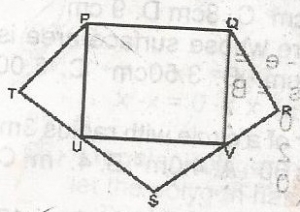
PQRST is a regular pentagon and PQVU is a rectangle with U and V lying on TS and SR respectively as shown in the diagram. Calculate TUP
Attached Figure / Diagram
A
18o
B
54o
C
90o
D
108o
medium Difficulty
Verified Correct Answer: Option B
Step-by-Step Mathematical Solution
The total angle in a regular pentagon = \((2(5) - 4) \times 90\)
= \(6 \times 90 = 540^\circ\)
Each interior angle = \(\frac{540}{5} = 108^\circ\)
While the interior of a quadrilateral = \(\frac{360}{4} = 90^\circ\)
\(PTU + TPU + TUP = 180^\circ\)
\(108^\circ + (180^\circ - 90^\circ) + TUP = 180^\circ\)
\(TUP = 180^\circ - (108^\circ + 18^\circ) = 54^\circ\)
Source: Myschool Past Questions Archive (Record #32993)
Mathematics
UTME / JAMB 1993
Plane Geometry, Polygons & Circle Theorems
Diagram
Solution
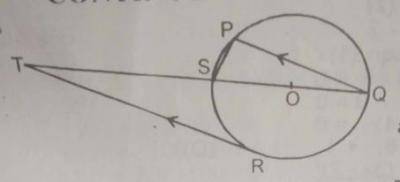
In the diagram, PQRS is a circle with O as centre and PQ||RT. If RTS = 32^\circ. Find PSQ
Attached Figure / Diagram
A
32o
B
45o
C
58o
D
90o
medium Difficulty
Verified Correct Answer: Option C
Step-by-Step Mathematical Solution
< PSO = \(\frac{1}{2}\) < SOQ = \(\frac{1}{2}\)(180) = 90^\circ
< RTS = < PQS = 32^\circ (Alternative angle)
< PSQ = 90 - < PSQ = 90^\circ - 32^\circ
= 58^\circ
Source: Myschool Past Questions Archive (Record #32994)
Mathematics
UTME / JAMB 1993
Plane Geometry, Polygons & Circle Theorems
Diagram
Solution
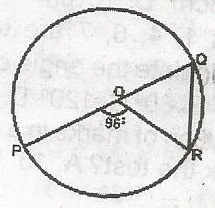
In the diagram, O is the centre of the circle and POQ a diameter. If POR = 96o, find the value of ORQ.
Attached Figure / Diagram
A
84o
B
48o
C
45o
D
42o
medium Difficulty
Verified Correct Answer: Option B
Step-by-Step Mathematical Solution
OQ = OR = radii
< ROQ = 180 - 96 = 84º
\(\bigtriangleup\)OQR = Isosceles
R = Q
R + Q + 84 = 180(angle in a \(\bigtriangleup\))
2R = 96 since R = Q
R = 48º
ORQ = 48º
Source: Myschool Past Questions Archive (Record #32995)
Mathematics
UTME / JAMB 1993
Plane Geometry, Polygons & Circle Theorems
Diagram
Solution
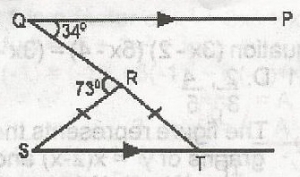
In the diagram, QP//ST:PQR = 34o qrs = 73o and Rs = RT. Find SRT
Attached Figure / Diagram
A
68o
B
102o
C
107o
D
141o
medium Difficulty
Verified Correct Answer: Option B
Step-by-Step Mathematical Solution
Construction joins R to P such that SRP = straight line
R = 180o - 107o
< p = 180o - (107o - 34o)
108 - 141o = 39o
Angle < S = 39o (corr. Ang.) But in \(\bigtriangleup\)SRT
< S = < T = 39o
SRT = 180 - (39o + 39o)
= 180o - 78o
= 102o
Source: Myschool Past Questions Archive (Record #32996)
Mathematics
UTME / JAMB 1993
Plane Geometry, Polygons & Circle Theorems
Diagram
Solution
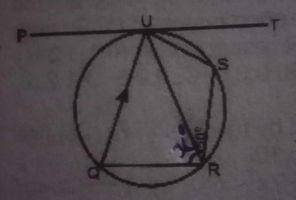
In the figure, PT is tangent to the circle at U and QU/RS if TUR = 35º and SRU = 50º find x
Attached Figure / Diagram
A
95o
B
85o
C
50o
D
35o
medium Difficulty
Verified Correct Answer: Option A
Step-by-Step Mathematical Solution
Since QRU= Xo
RSU = Xo, But RSU = 180o - (50o + 35o)
= 180o - 85o
= 95o
x = 95o
Source: Myschool Past Questions Archive (Record #32997)
Mathematics
UTME / JAMB 1993
Plane Geometry, Polygons & Circle Theorems
Diagram
Solution
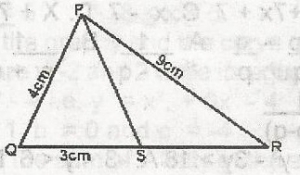
In the diagram, QPS = SPR, PR = 9cm. PQ = 4cm and QS = 3cm, find SR.
Attached Figure / Diagram
A
6\(\frac{3}{4}\)cm
B
3\(\frac{3}{8}\)cm
C
4\(\frac{3}{8}\)cm
D
2\(\frac{3}{8}\)cm
medium Difficulty
Verified Correct Answer: Option A
Step-by-Step Mathematical Solution
Using angle bisector theorem: line PS bisects angle QPR
QS/QP = SR/PR
3/4 = SR/9
4SR = 27
SR = \(\frac{27}{4}\)
= 6\(\frac{3}{4}\)cm
Source: Myschool Past Questions Archive (Record #33005)
Mathematics
UTME / JAMB 1993
Indices, Logarithms & Surds
Diagram
Solution
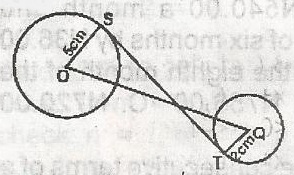
In the figure, the line segment ST is tangent to two circles at S and T. O and Q are the centres of the circles wih OS = 5cm. QT = 2cm and OR = 14cm. Find ST
Attached Figure / Diagram
A
7 \(\sqrt{3}\)cm
B
12.9cm
C
\(\sqrt{87}\)cm
D
7cm
medium Difficulty
Verified Correct Answer: Option B
Step-by-Step Mathematical Solution
SQ2 + OS2 = OQ2 + 52 = 142
SQ2 = 142 - 52
196 - 25 = 171
ST2 + TQ2 = SQ2
ST2 + 22 = 171
ST2 = 171 - 4
= 167
ST = \(\sqrt{167}\)
= 12.92 = 12.9cm
Source: Myschool Past Questions Archive (Record #33007)
Mathematics
UTME / JAMB 1993
Fractions, Decimals, Percentages & Approximations
Diagram
Solution
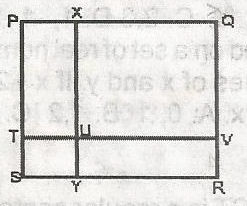
In the figure, the area of the square of the square PQRS is 100cm2. If the ratio of the area of the square TUYS to the area of the area of the square XQVU is 1 : 16, Find YR
Attached Figure / Diagram
A
6cm
B
7cm
C
8cm
D
9cm
medium Difficulty
Verified Correct Answer: Option C
Step-by-Step Mathematical Solution
Since area of square PQRS = 100cm2
each lenght = 10cm
Also TUYS : XQVU = 1 : 16
lengths are in ratio 1 : 4, hence TU : UV = 1: 4
Let TU = x
UV = 1: 4
hence TV = x + 4x = 5x = 10cm
x = 2cm
TU = 2cm
UV = 8cm
But TU = SY and UV = YR
YR = 8cm
Source: Myschool Past Questions Archive (Record #33014)
Mathematics
UTME / JAMB 1993
Statistics (Data Representation, Central Tendency & Dispersion)
Diagram
Solution
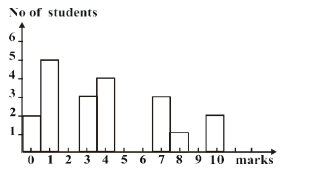
The bar chart shows the distribution of marks in a class test. How many students took the test?
Attached Figure / Diagram
A
15
B
20
C
25
D
30
medium Difficulty
Verified Correct Answer: Option B
Step-by-Step Mathematical Solution
Number f students that took the test = \(\sum f\). Where f is the frequencies
= 2 + 5 + 0 + 3 + 4 + 0 + 0 + 2 + 3 + 1 + 2 = 20
Source: Myschool Past Questions Archive (Record #33021)
Mathematics
WAEC / WASSCE 1993
Indices, Logarithms & Surds
Solution
(a) Simplify, without using Mathematical tables: \(\log_{10} (\frac{30}{16}) - 2 \log_{10} (\frac{5}{9}) + \log_{10} (\frac{400}{243})\)
(b) Without using Mathematical tables, calculate \(\sqrt{\frac{P}{Q}}\) where \(P = 3.6 \times 10^{-3}\) and \(Q = 2.25 \times 10^{6}\), leaving your answer in standard form.
medium Difficulty
Verified Correct Answer: Option
Step-by-Step Mathematical Solution
(a) \(\log_{10} (\frac{30}{16}) - 2 \log_{10} (\frac{5}{9}) + \log_{10} (\frac{400}{243})\)
= \(\log_{10} (\frac{30}{16}) - \log_{10} (\frac{5}{9})^{2} + \log_{10} (\frac{400}{243})\)
= \(\log_{10} (\frac{30}{16} \times \frac{400}{243} \div \frac{25}{81})\)
= \(\log_{10} (\frac{30}{16} \times \frac{400}{243} \times \frac{81}{25})\)
= \(\log_{10} (10) = 1\)
(b) \(\sqrt{\frac{P}{Q}} = \sqrt{\frac{3.6 \times 10^{-3}}{2.25 \times 10^{6}}\)
= \(\sqrt{\frac{36 \times 10^{-4}}{2.25 \times 10^{6}}\)
= \(\frac{6 \times 10^{-2}}{1.5 \times 10^{3}}\)
= \(4 \times 10^{-2 - 3} = 4 \times 10^{-5}\)
Source: Myschool Past Questions Archive (Record #54561)
Mathematics
WAEC / WASSCE 1993
Sets, Logic & Venn Diagrams
Solution
The universal set \(\varepsilon\) is the set of all integers and the subset P, Q, R of \(\varepsilon\) are given by:
\(P = {x : x < 0} ; Q = {... , -5, -3, -1, 1, 3, 5} ; R = {x : -2 \leq x < 7}\)
(a) Find \(Q \cap R\).
(b) Find \(R'\) where R' is the complement of R with respect to \(\varepsilon\).
(c) Find \(P' \cup R'\)
(d) List the members of \((P \cap Q)'\).
medium Difficulty
Verified Correct Answer: Option
Step-by-Step Mathematical Solution
\(P = {..., -5, -4, -3, -2, -1}\)
\(Q = {..., -5, -3, -1, 1, 3, 5, ...}\)
\(R = {-2, -1, 0, 1, 2, 3, 4, 5, 6}\)
(a) \(Q \cap R = {-1, 1, 3, 5}\)
(b) \(R' = {..., -5, -4, -3, 7, 8, ...}\)
(c) \(P' = {0, 1, 2, 3, ...}\)
\(P' \cup R' = {-5, -4, -3, 0, 1, 2, 3, ...}\)
(d) \(Q = {..., -5, -3, -1, 1, 3, 5,...}\)
\(P \cap Q = {..., -7, -5, -3, -1}\)
\((P \cap Q)' = {..., -8, -6, -4, -2, 0, 1, 2, 3, ...}\)
Source: Myschool Past Questions Archive (Record #54566)
Mathematics
WAEC / WASSCE 1993
Trigonometry, Elevation & Bearings
Solution
A simple measuring device is used at points X and Y on the same horizontal level to measure the angles of elevation of the peak P of a certain mountain. If X is known to 5,200m above sea level, /XY/ = 4,000m and the measurements of the angles of elevation of P at X and Y are 15^\circ and 35^\circ respectively, find the height of the mountain. (Take \(\tan 15 = 0.3\) and \(\tan 35 = 0.7\))
medium Difficulty
Verified Correct Answer: Option
Step-by-Step Mathematical Solution
In \(\Delta\) BPY, \(\tan 35^\circ = \frac{h}{x}\)
\(h = x \tan 35 = 0.7 x ... (1)\)
In \(\Delta\) BPX, \(\frac{h}{x + 4000} = \tan 15\)
\(\frac{h}{x + 4000} = 0.3\)
\(h = 0.3 (x + 4000) = 0.3x + 1200 ... (2)\)
Equating (1) and (2) as the values of h, we have
\(0.7x = 0.3x + 1200 \implies 0.7x - 0.3x = 1200\)
\(0.4x = 1200 \times x = \frac{1200}{0.4} = 3000m\)
\(\therefore h = 0.7x = 0.7 (3000) = 2100m\)
\(\text{The total height = } 5200m + 2100m = 7300m\)
Source: Myschool Past Questions Archive (Record #54567)
Mathematics
WAEC / WASSCE 1993
Plane Geometry, Polygons & Circle Theorems
Solution
(a) Simplify \(\frac{3}{m + 2n} - \frac{2}{m - 3n}\)
(b) A number is made up of two digits. The sum of the digits is 11. If the digits are interchanged, the original number is increased by 9. Find the number.
medium Difficulty
Verified Correct Answer: Option
Step-by-Step Mathematical Solution
(a) \(\frac{3}{m + 2n} - \frac{2}{m - 3n}\)
= \(\frac{3(m - 3n) - 2(m + 2n)}{(m + 2n)(m - 3n)}\)
= \(\frac{3m - 9n - 2m - 4n}{(m + 2n)(m - 3n)}\)
= \(\frac{m - 13n}{(m + 2n)(m - 3n)}\)
(b) Let the numbers in the digit be x and z.
Hence the number is \(10x + z\).
When it is interchanged, we have \(10z + x\).
\(10z + x = 10x + z + 9\)
\(10z - z + x - 10x = 9\)
\(9z - 9x = 9 \implies z - x = 1 ... (1)\)
\(x + z = 11 ... (2)\)
From (1), \(z = 1 + x\)
\(\therefore x + 1 + x = 11\)
\(2x + 1 = 11 \implies 2x = 11 - 1 = 10\)
\(\therefore x = 5\)
\(z = 1 + x = 1 + 5 = 6\)
\(\therefore\) The original number = 56.
Source: Myschool Past Questions Archive (Record #54568)
Mathematics
WAEC / WASSCE 1993
Permutations, Combinations & Probability
Solution
A box contains identical balls of which 12 are red, 16 white and 8 blue. Three balls are drawn from the box one after the other without replacement. Find the probability that :
(a) three are red;
(b) the first is blue and the other two are red;
(c) two are white and one is blue.
medium Difficulty
Verified Correct Answer: Option
Step-by-Step Mathematical Solution
n(R) = number of red balls = 12;
n(W) = number of white balls = 16;
n(B) = number of blue balls = 8
Total number of balls = 36
(a) P(three are red) = \(\frac{12}{36} \times \frac{11}{35} \times \frac{10}{34}\)
= \(\frac{11}{357}\)
(b) P(first is blue and other two red) = \(\frac{8}{36} \times \frac{12}{35} \times \frac{11}{34}\)
= \(\frac{44}{1785}\)
(c) P(two are white and one is blue) = \(\frac{16}{36} \times \frac{15}{35} \times \frac{8}{34}\)
= \(\frac{16}{357}\)
Source: Myschool Past Questions Archive (Record #54569)