Question Library
Browse, filter, and study verified past examination questions with step-by-step mathematical reasoning.
Searching 18,000+ Questions...
Sifting topics, KaTeX formulas & verified solutions
Showing 23071–23085 of 29821 verified questions
Sort by:
Biology
WAEC / WASSCE 1994
Growth, Micro-organisms & Public Health
In man, adult schistosoma is found in the
A
blood vessels of the bladder
B
red blood corpuscles
C
lymphatic vessel
D
blood vessels of the lung
E
white blood cells
medium Difficulty
Verified Correct Answer: Option A
Biological Concept & Syllabus Guide
No expanded working has been attached for this question yet. The verified answer is Option A.
Source: Myschool Past Questions Archive (Record #17883)
Biology
WAEC / WASSCE 1994
Supporting Tissues & Skeletal System
Which of the following structures does not function as support in animals?
A
Cuticle in arthropods
B
Scales in' birds
C
Cartilage in mammals
D
Body fluid in earthworms
E
Bones in vertebrates
medium Difficulty
Verified Correct Answer: Option B
Biological Concept & Syllabus Guide
No expanded working has been attached for this question yet. The verified answer is Option B.
Source: Myschool Past Questions Archive (Record #17884)
Biology
UTME / JAMB 1994
Adaptation & Evolution
The mouth part of the insect is adapted for
A
biting and chewing
B
sucking and chewing
C
biting and sucking
D
piercing and sucking
medium Difficulty
Verified Correct Answer: Option A
Biological Concept & Syllabus Guide
No expanded working has been attached for this question yet. The verified answer is Option A.
Source: Official Exam / Past Question Archive
Biology
UTME / JAMB 1994
Variety of Organisms & Classification of Living Things
Diagram
The parts used for feeding is labelled
Attached Figure / Diagram
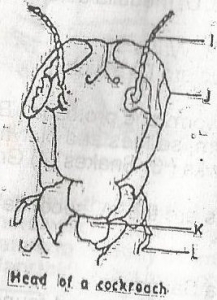
A
I
B
J
C
K
D
L
medium Difficulty
Verified Correct Answer: Option C
Biological Concept & Syllabus Guide
No expanded working has been attached for this question yet. The verified answer is Option C.
Source: Myschool Past Questions Archive (Record #41370)
Biology
UTME / JAMB 1994
Adaptation & Evolution
Diagram
The mouth part of the insect is adapted for
Attached Figure / Diagram
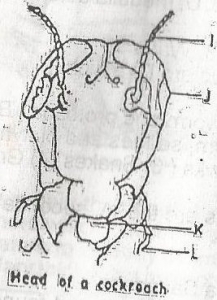
A
biting and chewing
B
sucking and chewing
C
biting and sucking
D
piercing and sucking
medium Difficulty
Verified Correct Answer: Option A
Biological Concept & Syllabus Guide
No expanded working has been attached for this question yet. The verified answer is Option A.
Source: Myschool Past Questions Archive (Record #41372)
Biology
WAEC / WASSCE 1994
Reproduction in Plants & Animals
Solution
SECTION A
Answer all questions in this section
1. In what direction does translocation occur in plants?
2. Name two tissues that are likely to be removed when a stem is removed
3. Name the last blood vessel that will transport glucose to the heart if glucose solution is injected through the arm (b) which chamber of the heart receive the glucose solution.
4 Which part of the brain controls breathing? The Diagram below illustrates two homologous chromosomes during meiosis. Use it to answer question 5
5. Name those points labeled i (b)What is the Importance of those in evolution? (c) what is this stage of melosis called?
Study diagrams i and ii below and use them to answer question 6
6. (a) Identify the organism illustrated in diagrams i and ii
(b) State the levels of organization of i and ii
(c) State a reason for placing i and ii in that level of organization.
Study the diagram below and use it to answer question 7
7. (a) Name the parts labeled i to iv (b) What is the function of the part labeled I?
Study the diagram below and use it to answer questions 8 (a) and (b)
8. (a) What is the set-up used for? (b) Why is the leafy shoot cut under water when setting up the environment? (c) Name the instrument used for measuring water turbidity.
9. (a) Name three methods of preventing food spoilage. Study the diagram below and use it to answer question 10 (a) and (b).
10. (a) Name the parts labeled i to iv (b) State the functions of the parts labeled ii and iv (c) In which organ in the mammalian body is urea formed?
SECTION B
Answer all questions in this section
11. (a) You are provided with specimens A and B (a) (i). Cut a piece of Specimen A, put a drop of iodine on it then record your observation.
(ii) From your observation, what food nutrient does specimen A contain? (ii) Give reasons for your answers
(b) Put a drop of specimen B on the top right hand corner of your question paper using a glass rod. Spread the drop. Clean the glass rod to remove every trace of specimen B. Allow both drops of specimen B and water to dry
(i) Record your observation (ii) From your observation, what food nutrient does specimen B contain? (ii) Give reasons for your answers.
(c) Put 4cm\(^3\) of specimen B in a test tube and add 5cm\(^3\) of water.(i) Record your observation (ii) Shake the content thoroughly and leave it for 3 minutes to settle
Record your observation.
(d) (i) Add 2cm\(^3\) of NaOH to 5cm\(^3\) of specimen B in a clean test tube. Shake thoroughly and observe the mixture. Record your observation.
(ii) What substance in the alimentary canal plays the same role during digestion in mammals as NaOH in this experiment?
12. You are provided with specimens C and D (a) Identify specimen C and D: (i) State the part to which each of the specimens C and D (ii) State two differences specimens C and D.
(b) How can you propagate specimen C? (ii) Give one reason for your answer based on observable feature of specimen C
(c) Make a labeled diagram 10-12cm long of specimen C to show its external features.
13. (a) identify specimens E and F (b) Suggest the agents of pollination of specimen E (c) Give three reasons for your suggestion in (b)
In a tabular form, State three differences specimens E and F. (e) with a sharp blade or scalpel cut a longitudinal section of specimen E to produce two equal parts of specimen E. Make a labeled drawing 10 cm to 12 cm, of one half ofspecimen E
medium Difficulty
Verified Correct Answer: Option
Biological Concept & Syllabus Guide
SECTION A
1.From green leaves to other parts of the plant
2. Epidermis, cortex, cambium and phloem.
3. (a) Superior vena cava (b) Right auricle or right atrium
4. Medulla oblongata
5. (a) Chiasmata (b) Exchange of genetic materials which brings about variation (c) Late prophase
6. (a)- Chlamydomonas Il - Volvox (b) both cellular level of organization (c) They are both unicellular organisms
7. (a) -Sucker or cement gland lI - mouth, III coiled intestine IV- Anus tail fin, VI - tail muscle (b) For attachment of leaves
8. Demonstration of transpiration pull (B) To prevent air bubbles from entering and blocking the xylem vessels (c) Secchi disc
9. (i) Freezing/refrigeration (ii) Drying (ii) Salting
10. (a) 1- cortex, II- Renal artery - pelvis, IV- pyramid V - ureter, VI- medulla (b) transports to the bladder transports oxygenated blood containing urea from the aorta to the kidneys, V Carries urine from the kidney to the bladder for temporary storage (c) The liver.
SECTION B
11. specimen A -A piece of yam (a) (i) The cut surface of specimen A turned blue-black (i) Specimen A containing iodine solution usually turns blue-black when in contact with starch. (b) (i) Specimen B is oil. The piece of paper turned TRANSLUCENT (ii) Specimen B is oil/fat (iii) Paper will turn translucent when rubbed with oil/fat
(c)(i) two separate layers of liquids are formed in the test-tube. The water settled at the bottom layer while Specimen B on top (ii) After the content was shaken thoroughly and left for three minutes, it was observed that specimen B broke into tiny oil droplets and distributed all over the water, later, two separate layers were formed with :Specimen B on top and water below (d) (i) After 2 cm\(^3\) of Sodium hydroxide was added to 5cm\(^3\) of specimen B (oil) observation was as follows. Emulsification occurred (ii) Bile
12. (i) Specimen C Rhizome (Ginger) (ii) Specimen C belongs to stem specimen D Swollen taproot (Carrot) Specimen D - belongs to root.
Specimen C
Specimen D
Presence of terminal buds
No terminal bud
Presence of nodes and internodes
Absence of nodes and internodes
(b) (i) Specimen C - propagation is by stem-cutting i.e vegetative propagation (ii) Due to the presence of Terminal buds.
13. (a) Specimen E Flower of Flame of the Forest or Pride of Barbados. Specimen F- flower of grass or maize plant (b) Agents of pollination are bees, butterfly, any small bird (c) Reasons Presence of nectar, Presence of scent, brightly colored petals.
(d) Differences
Specimen E
Specimen F
Brightly colored petals
Petals are dull
Presence of scent
No scent present
Stigma is present
Absence of stigma
Presence of rough pollen grains
Presence of smooth pollen grains
Source: Official Exam / Past Question Archive
Biology
WAEC / WASSCE 1994
Basic Ecological Concepts, Ecosystems & Biomes
Solution
(a) List three major zones in the marine habitat stating one characteristic feature of each zone.
(b) (i) Give one example each of plants and animals in the marine habitat.
(ii) Explain how each of the plant and animal is adapted to the habitat.
(c) State three bahavioural adaptations of animals to seasonal changes in terrestrial habitat.
(d) State three characteristics each of the plant community in the tropical rain forest and savanna.
medium Difficulty
Verified Correct Answer: Option
Biological Concept & Syllabus Guide
(a)(i)The major zones in the marine habitat are:
(1) Splash or Supral tidal zone
(2) Neritic or Litoral zone/subtidal/ diphotic zone
(3) Neritic/intertidal zone/planktonic/euphotic zone
(4) Hadal/Aphotic zone
(5) Benthic/pelagic/abyssal zone/Aphotic/Oceanic zone.
(ii) Characteristics of each zone are:
(1) Splash/Supratidal is exposed and has occasional moisture.
(2) Litoral zone is always under water and abundant light and enough nutrient.
(3) Intertidal zone is exposed at low tide and covered by water at high tide. Also, it has high photosynthetic activity, primary production, abundant light and fluctuation of water temperature.
(4) Hadal/Aphotic zone has no light penetration and no photosynthetic activities.
(5) Benthic zone has low light penetration and intensity.
(b)(i)(1) Plants in marine habitat are: Sea weed or diatom, algae and sesevium.
(2) Animals in marine habitat are; bony fish, crabs, starfish, barnacles, shrimps, cartilageneous fishes and periwinkle
(ii) Sea weed is adapted to the habitat by:
(1) possession of mucilagenous cover to prevent dessication.
(2) divided leaves, floating devices and air bladder for bouyancy.
(3) point of attachment that makes it hold fast to water.
(4) ability of animals e.g. cartilageneous fishes to retain little urea in the body to cope with water salinity.
(c) Behavioural adaptations of animals to seasonal changes in terrestial habitat are:
(i) Hibernation in cold weather
(ii) Migration to warmer regions in winter
(iii) Aestivation in unfavourable weather
(iv) Basking in the sun to raise body temperature
(v) Covering body with warm clothing or material or resting with warm material
(vi) Burrowing habit to avoid harsh weather in rodents.
(d)Characteristics of plant community in the rainforest:
(i) The plants have broad leaves and buttress roots.
(ii) The forest has many tall trees.
(iii) There is presence of epiphytes. The plants have regularly stratified canopies and possess thin barked trees.
(vi) The ground is generally littered with a lot of leaves.
Characteristics of plant community in the savanna:
(1) The plant has no stratified canopies.
(2) The area is predominantly grassland.
(3) It has plants with underground stem.
(4) The plants possess fewer trees that are scattered
(5) Deep rooted plants.
(6) They are generally fire resistant trees with thick bark.
(7) The trees are resistant to draught.
Source: Myschool Past Questions Archive (Record #53012)
Biology
WAEC / WASSCE 1994
Variety of Organisms & Classification of Living Things
Solution
(a) Describe the general arrangement of the viscera of a named mammal.
(b) Describe the process of feeding in (i) Hydra; (ii) Amoeba.
medium Difficulty
Verified Correct Answer: Option
Biological Concept & Syllabus Guide
(a) The general arrangement of the viscera of man or rabbit shows that the diaphragm divides the trunk into two unequal parts namely, the upper chest cavity and the lower abdominal cavity. The chest cavity is enclosed or encircled by the ribs in which the lungs and the heart lie. The gullet runs down behind the mouth or buccal cavity through the whole length of the thoracic cavity, through the diaphragm. The liver lies below the diaphragm which over-laps a large portion of the stomach. The stomach leads to the small intestine which itself leads to the large intestine. The large intestine forms the caecum at one end and continues to form the rectum at the other end which finally terminates at the anus which lies at the posterior end of the trunk. Very close to the stomach are the pancreas and spleen. At the back of the abdominal cavity, we have a pair of kidneys. In male, the male part of the vasa diferensia are seen at the posterior region in close position with the bladder and ureter. In female, ovaries lie near the kidney, and the oviducts lead to the uterus or womb which is in the lower part of the abdominal cavity or behind the urinary bladder.
(b)(i)Hydra feeds mainly on small aquatic organisms.
-Food is captured by the help of nematocysts, borne on the tentacles.
-The food is then taken into the wide mouth by the tentacle.
-Here enzymes are secreted by the gland cells.
-digested extra cellularly and partially absorbed into endodermal cells.
-Here digestion is completed intra-cellularly.
(ii) Amoeba feeds on micro-organisms, e.g. diaton or organic particles. During feeding, it engulfs the food particles by forming cup shape. When the two ends of the pseudopodia touch, they fuse and enclose the food with little amount or drop of water and these form a food vacuole. The food is digested and absorbed here.
Source: Myschool Past Questions Archive (Record #53013)
Biology
WAEC / WASSCE 1994
Nervous, Hormonal Coordination & Sense Organs
Solution
(a) Describe an experiment to demonstrate the effect of auxin on growth of a plant shoot.
(b) List three uses of auxin in agriculture.
(c) Describe the mechanism of transmission of impulses through a nerve fibre.
medium Difficulty
Verified Correct Answer: Option
Biological Concept & Syllabus Guide
(a)To demonstrate the effect of auxin on growth of a plant shoot, cut off the growing tip of coleoptile or shoot of three potted maize seedlings A,B, and C. Get three agar blocks A.B.C. Place one of the cut tips on an agar block A, so that the auxins in the tip can diffuse into the agar block. Then put three drops of IAA or Synthetic auxin on agar blockB. Put agar blocks A and B on one side or on top of the cut tip of the coleoptile or shoot A and B respectively. Then place the untreated agar block C on the side or tip of third cut coleoptile or shoot tip C as control experiment. Leave the three coleoptiles or shoots in unilateral light for 12 to 36 hours. The Coleoptiles or Shoots carrying agar block A and B show growth curvature while C shows no growth curvature. This shows that auxin promotes growth
(b)The use of auxin in agriculture are:
(i) Auxin helps to induce ripening of fruits.
(ii) It also helps to produce lateral bud development in stem
(iii) It helps in controlling weeds as well as controlling flowering and fruiting in plants.
(v) It assists in breaking seed dormancy.
(vi) It helps to initiate adventitious roots in stem cuttings and for parthenocarpic fruiting.
(c) Mechanism of transmission of impulses through a nerve fibre is characterised by change in electrical, potential and ionic charge. When at rest, the outside of the nerve is positively charged while the inside is negatively charged. Chemically, the nerve fibres possess potassium ions which are concentrated inside the fibre, while sodium ions are concentrated more on the outside. The change in permeability of the cell membrane is brought about when the fibre is stimulated and sodium ions enter the nerve while potassium ions move to the outside. The change in permeability along the nerve or change in electrical potential and ionic change along the fibre cause the movement of the electrical current along the fibre. In this way, the impulse is propagated or transmitted while the original resting stage of the nerve is restored as soon as the impulse passes.
Source: Myschool Past Questions Archive (Record #53014)
Biology
WAEC / WASSCE 1994
Reproduction in Plants & Animals
Solution
(a)(i) Explain the term courtship behaviour in animals.
(ii) How does courtship aid reproduction in animals?
(b) Describe the process of fertilization in flowering plants.
medium Difficulty
Verified Correct Answer: Option
Biological Concept & Syllabus Guide
(a)(i) Courtship behaviour in animals consists of instinctive behaviours in response to certain external stimuli. The behaviour is usually carried out in sequence and alternately performed by male and femal organisms. Each step acts as a stimulus for the next step. It may involve territorial defence, display and pairing. Examples are found in some birds, fishes and mammals.
(ii) When courtship behaviour coincides with ovulation or reproduction period, mating occurs, leading to release of gametes and, therefore, increase in the chances of fertilization or reproduction.
(b) The flower possesses pollen grains which contain the male gametes and the ovules have the female gamete. The pollen grains are transferred from the pollen sac or anther to the stigma during pollination. On the stigma, the pollen grain absorbs sugary fluid and swells until the extine bursts and intine grows into a pollen tube along the style. The nucleus divides into tube and generative nuclei. The generative nucleus divides into two male gametes. One male gamete fuses with the egg cell or Ovum to form Zygote while the other male gamete fuses with pollar nuclei to form the endosperm nucleus which matures to form the nutritive endosperm. The Zygote forms the embryo after several divisions. The whole ovule becomes the seed and the ovary becomes fruit.
Source: Myschool Past Questions Archive (Record #53015)
Chemistry
WAEC / WASSCE 1993
Stoichiometry, Mole Concept & Volumetric Analysis
Solution
Copper metal will react with concentrated trioxonitrate (V) acid to give?
A
Cu(NO3)3 + NO + N2O4 + H2O
B
Cu(NO3)2 + NO + H2O
C
CuO + NO2 + H2O
D
Cu(NO3)2 + 2NO2 + 2H2O
medium Difficulty
Verified Correct Answer: Option D
Chemical Principles & Mechanism
Generally, when metals react with acids, Hydrogen gas is usually liberated, with an exception of dilute Trioxonitrate(V) acids. However, in this case, it is not the usual Acid- metal reaction, as Copper metal is reacting with concentrated nitric acid. Thus, Copper is oxidized by the concentrated nitric acid, HNO3, to produce Cu2+ ions while the nitric acid is reduced to nitrogen dioxide, NO2 and water is also formed. Therefore, the correct answer is option D.
Source: Myschool Past Questions Archive (Record #13447)
Mathematics
UTME / JAMB 1993
Indices, Logarithms & Surds
Diagram
Solution
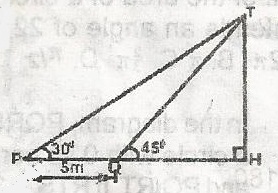
From the figure, calculate TH in centimeters
Attached Figure / Diagram
A
\(\frac{5}{\sqrt{3} + 1}\)
B
\(\frac{5}{\sqrt{3} - 1}\)
C
\(\frac{5}{\sqrt{3}}\)
D
\(\frac{\sqrt{3}}{5}\)
medium Difficulty
Verified Correct Answer: Option B
Step-by-Step Mathematical Solution
TH = tan 45o, TH = QH
\(\frac{TH}{5 + QH}\) = tan 30o
TH = (b + QH) tan 30o
QH = 56 (5 + QH) \(\frac{1}{\sqrt{3}}\)
QH(1 - \(\frac{1}{\sqrt{3}}\)) = \(\frac{5}{\sqrt{3}}\)
QH = \(\frac{5\sqrt{3}}{\sqrt{3}} - \frac{1}{\sqrt{3}}\)
= \(\frac{5}{\sqrt{3} - 1}\)
Source: WAEC / JAMB / NECO Classroom Archive (Record #33020)
Mathematics
UTME / JAMB 1993
Sets, Logic & Venn Diagrams
Diagram
Solution
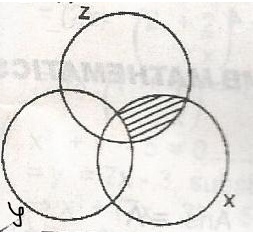
The shaded portion in the venn diagram is
Attached Figure / Diagram
A
x \(\cap\) z
B
xo \(\cap\) y \(\cap\) z
C
x \(\cap\) yo \(\cap\) z
D
x \(\cap\) y \(\cap\) zo
medium Difficulty
Verified Correct Answer: Option C
Step-by-Step Mathematical Solution
The shaded part exists on x \(\cap\) z but not in y
Source: WAEC / JAMB / NECO Classroom Archive (Record #32991)
Mathematics
WAEC / WASSCE 1993
Sequences & Series (AP & GP)
Solution
The nth term of a sequence is given by (-1)\(^{n-2}\) x 2\(^{n-1}\). Find the sum of the second and third terms.
A
-2
B
1
C
2
D
6
E
12
medium Difficulty
Verified Correct Answer: Option A
Step-by-Step Mathematical Solution
when n = 2
(-1)\(^{n-2}\) x 2\(^{n -1}\) = 2
When n = 3
(-1)\(^{n-2}\) x 2\(^{n - 1}\) = -4
Sum = 2 - 4 = - 2
Source: WAEC / JAMB / NECO Classroom Archive (Record #23192)
Mathematics
WAEC / WASSCE 1993
Statistics (Data Representation, Central Tendency & Dispersion)
Solution
Score
1
2
3
4
5
6
7
8
9
Frequency
2
3
6
7
9
6
2
2
3
The table above shows the scores of a group of 40 students in a physics test
What is the mean of the distribution?
A
4.2
B
4.5
C
4.8
D
5.0
E
5.2
medium Difficulty
Verified Correct Answer: Option C
Step-by-Step Mathematical Solution
x
1
2
3
4
5
6
7
8
9
Total
f
2
3
6
7
9
6
2
2
3
40
fx
2
6
18
28
45
36
14
16
27
192
Mean = \(\frac{\sum fx}{\sum f}\)
= \(\frac{192}{40}\)
= 4.8
Source: WAEC / JAMB / NECO Classroom Archive (Record #23225)