Question Library
Browse, filter, and study verified past examination questions with step-by-step mathematical reasoning.
Searching 18,000+ Questions...
Sifting topics, KaTeX formulas & verified solutions
Showing 22561–22575 of 29821 verified questions
Sort by:
Mathematics
WAEC / WASSCE 1994
Trigonometry, Elevation & Bearings
Solution
(a) A tower and a building stand on the same horizontal level. From the point P at the bottom of the building, the angle of elevation of the top, T of the tower is 65^\circ. From the top Q of the building, the angle of elevation of the point T is 25^\circ. If the building is 20m high, calculate the distance PT.
(b) Hence or otherwise, calculate the height of the tower. [Give your answers correct to 3 significant figures].
medium Difficulty
Verified Correct Answer: Option
Step-by-Step Mathematical Solution
(a)
\(< QPB = 90^\circ - 65^\circ = 25^\circ\)
Also, \(< TQP = 90^\circ + 25^\circ = 115^\circ\)
\(\therefore < QTP = 180^\circ - (25^\circ + 115^\circ) = 40^\circ\)
Using sine rule, \(\frac{PQ}{\sin 40^\circ} = \frac{PT}{\sin 115^\circ}\)
\(PT = \frac{20 \sin 115^\circ}{\sin 40^\circ} = \frac{20 \sin 65^\circ}{\sin 40^\circ}\)
= \(28.199m \approxeq 28.2m\) (to 3 sig. fig)
(b) Height of the tower = ST
\(\sin 65 = \frac{ST}{PT} = \frac{ST}{28.199}\)
\(ST = 28.199 \times \sin 65^\circ = 25.557m\)
\(\approxeq 25.6m\) (to 3 sig. figs)
Source: Myschool Past Questions Archive (Record #54551)
Mathematics
WAEC / WASSCE 1994
Indices, Logarithms & Surds
Solution
(a) Divide \(11111111_{two}\) by \(101_{two}\)
(b) A sector of radius 6 cm has an angle of 105^\circ at the centre. Calculate its:
(i) perimeter ; (ii) area . [Take \(\pi = \frac{22}{7}\)]
medium Difficulty
Verified Correct Answer: Option
Step-by-Step Mathematical Solution
(a) This can either be done using the long division method (easier) or convert everything to base ten and divide, then re-convert to base two.
I'll be using the latter method.
\(11111111_{two} = 1 \times 2^{7} + 1 \times 2^{6} + 1 \times 2^{5} + 1 \times 2^{4} + 1 \times 2^{3} + 1 \times 2^{2} + 1 \times 2^{1} + 1 \times 2^{0}\)
= \(128 + 64 + 32 + 16 + 8 + 4 + 2 + 1 = 255_{ten}\)
\(101_{two} = 1 \times 2^{2} + 0 \times 2^{1} + 1 \times 2^{0} \)
= \(4 + 0 + 1 = 5_{ten}\)
\(\frac{255}{5} = 51_{ten}\)
2
51
2
25 r 1
2
12 r 1
2
6 r 0
2
3 r 0
2
1 r 1
0 r 1
= \(110011_{two}\)
(b)
(i) Length of arc AXB = \(\frac{105}{360} \times 2 \times \frac{22}{7} \times 6cm\)
= \(11cm\)
\(\therefore Perimeter = 6cm + 11cm + 6cm = 23cm\)
(ii) Area of sector = \(\frac{105}{360} \times \frac{22}{7} \times 6cm \times 6cm\)
= \(33 cm^{2}\)
Source: Myschool Past Questions Archive (Record #54552)
Mathematics
WAEC / WASSCE 1994
Statistics (Data Representation, Central Tendency & Dispersion)
Solution
The table below gives the frequency distribution of the marks obtained by some students in a scholarship examination.
Scores (x)
15
25
35
45
55
65
75
Freq (f)
1
4
12
24
18
8
3
(a) Calculate, correct to 3 significant figures, the mean mark.
(b) Find the : (i) mode ; (ii) range of the distribution.
medium Difficulty
Verified Correct Answer: Option
Step-by-Step Mathematical Solution
(a)
x
f
fx
15
1
15
25
4
100
35
12
420
45
24
1080
55
18
990
65
8
520
75
3
225
70
3350
\(Mean = \frac{\sum fx}{\sum f} = \frac{3350}{70} = 47.8571\)
\(\approxeq 47.9\) (to 3 sig. figs)
(b)(i) Mode = 45 (score with the highest frequency)
(ii) Range = Highest mark - Lowest mark
= 75 - 15 = 60.
Source: Myschool Past Questions Archive (Record #54553)
Mathematics
WAEC / WASSCE 1994
Indices, Logarithms & Surds
Solution
(a) If \(\log_{10} (3x - 1) - \log_{10} 2 = 3\), find the value of x.
(b) Use logarithm tables to evaluate \(\sqrt{\frac{0.897 \times 3.536}{0.00249}}\), correct to 3 significant figures.
medium Difficulty
Verified Correct Answer: Option
Step-by-Step Mathematical Solution
(a) \(\log_{10} (3x - 1) - \log_{10} 2 = 3\)
\(\log_{10} (\frac{3x - 1}{2}) = 3\)
\(\implies \frac{3x - 1}{2} = 10^{3} = 1000\)
\(\implies 3x - 1 = 2000\)
\(3x = 2000 + 1 = 2001\)
\(x = \frac{2001}{3} = 667\)
(b)
No
Log
0.8972
\(\bar{1}.9528\) +
3.536
\(0.5485\)
= 0.5013 -
0.00249
\(\bar{3}.3962\)
Antilog - 35.70
\(3.1051 \div 2 = 1.5526\)
\(\therefore \sqrt{\frac{0.8972 \times 3.536}{0.00249}} = 35.70\)
Source: Myschool Past Questions Archive (Record #54554)
Mathematics
WAEC / WASSCE 1994
Permutations, Combinations & Probability
Solution
A bag contains 12 white balls and 8 black balls, another contains 10 white balls and 15 black balls. If two balls are drawn, without replacement from each bag, find the probability that :
(a) all four balls are black ;
(b) exactly one of the four balls is white.
medium Difficulty
Verified Correct Answer: Option
Step-by-Step Mathematical Solution
(a) 1st bag contains 12 white (W) balls and 8 black (B) balls; 2nd bag contains 10 white (W) balls and 15 black (B) balls.
P(two black balls from the 1st bag and two black balls from 2nd bag)
= \((\frac{8}{20} \times \frac{7}{19}) \times (\frac{15}{25} \times \frac{14}{24})\)
= \(\frac{14}{95} \times \frac{7}{20}\)
= \(\frac{49}{950}\)
(b) P(picking exactly one white ball) = P(WB from 1st bag and BB from 2nd bag) + P(BW from 1st bag and BB from 2nd bag) + P(BB from 1st bag and WB from 2nd bag) + P(BB from 1st bag and BW from 2nd bag)
= \(\frac{12}{20} \times \frac{8}{19} \times \frac{15}{25} \times \frac{14}{24} + \frac{8}{20} \times \frac{12}{19} \times \frac{15}{25} \times \frac{14}{24} + \frac{8}{20} \times \frac{7}{19} \times \frac{10}{25} \times \frac{15}{24} + \frac{8}{20} \times \frac{7}{19} \times \frac{15}{25} \times \frac{10}{24}\)
= \(\frac{42}{475} + \frac{42}{475} + \frac{7}{190} + \frac{7}{190}\)
= \(\frac{238}{950}\)
Source: Myschool Past Questions Archive (Record #54555)
Mathematics
WAEC / WASSCE 1994
Plane Geometry, Polygons & Circle Theorems
Diagram
Solution
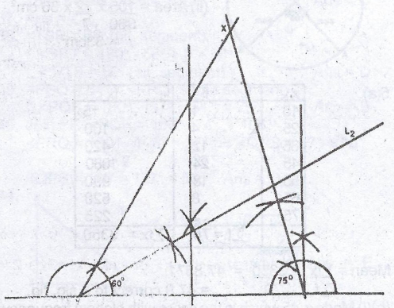
(a) Using a ruler and a pair of compasses only, construct (i) a triangle XYZ in which /YZ/ = 8cm, < XYZ = 60^\circ and < XZY = 75^\circ. Measure /XY/; (ii) the locus \(l_{1}\) of points equidistant from Y and Z ; (iii) the locus \(l_{2}\) of points equidistant from XY and YZ.
(b) Measure QY where Q is the point of intersection of \(l_{1}\) and \(l_{2}\).
Attached Figure / Diagram
medium Difficulty
Verified Correct Answer: Option
Step-by-Step Mathematical Solution
(a)
(b) /QY/ = 4.8 cm
Source: Myschool Past Questions Archive (Record #54556)
Mathematics
WAEC / WASSCE 1994
Statistics (Data Representation, Central Tendency & Dispersion)
Solution
The table below gives the ages, to the nearest 5 years of 50 people.
Age in years
10
15
20
25
30
No of people
8
19
10
7
6
(a) Construct a cumulative frequency table for the distribution.
(b) Draw a cumulative frequency curve (Ogive)
(c) From your Ogive, find the : (i) median age ; (ii) number of people who are at most 15 years of age ; (iii) number of people who are between 20 and 25 years of age.
medium Difficulty
Verified Correct Answer: Option
Step-by-Step Mathematical Solution
(a)
Age in years
No of people
Cum Freq
10
8
8
15
19
27
20
10
37
25
7
44
30
6
50
(b)
(c)(i) Median age = 14.5 years
(ii) Number of people who are at most 15 years of age = 27 people
(iii) Number of people who are between 20 and 25 years = people who are 25 years - people who are 20 years
= 44 - 37 = 7 people
Source: Myschool Past Questions Archive (Record #54557)
Mathematics
WAEC / WASSCE 1994
Differentiation & Applications
Solution
(a) Copy and complete the following table of values for \(y = 2x^{2} - 9x - 1\).
x
-1
0
1
2
3
4
5
6
y
-1
-8
-11
17
(b) Using a scale of 2cm to represent 1 unit on the x- axis and 2cm to represent 5 units on the y- axis, draw the graph of \(y = 2x^{2} - 9x - 1\).
(c) Use your graph to find the : (i) roots of the equation \(2x^{2} - 9x = 4\), correct to one decimal place ; (ii) gradient of the curve \(y = 2x^{2} - 9x - 1\) at x = 3.
medium Difficulty
Verified Correct Answer: Option
Step-by-Step Mathematical Solution
(a)
x
-1
0
1
2
3
4
5
6
y
10
-1
-8
-11
-10
-5
4
17
(b)
(c)(i) \(2x^{2} - 9x = 4\)
\(2x^{2} - 9x - 1 = 4 - 1 = 3\)
At y = 3, x = 0.2 and 4.3.
(ii) Gradient of \(y = 2x^{2} - 9x - 1\) at x = 3
= \(\frac{BC}{AB} = \frac{9.5}{4.3}\)
= \(2.2\)
Source: Myschool Past Questions Archive (Record #54558)
Mathematics
WAEC / WASSCE 1994
Sets, Logic & Venn Diagrams
Solution
(a) The fourth term of an A.P is 37 and 6th term is 12 more than the fourth term . Find the first and seventh terms.
(b) If \(P = {1, 2, 3, 4}\) and \(Q = {3, 5, 6}\), find (i) \(P \cap Q\) ; (ii) \(P \cup Q\) ; (iii) \((P \cap Q) \cup Q\) ; (iv) \((P \cap Q) \cup P\).
medium Difficulty
Verified Correct Answer: Option
Step-by-Step Mathematical Solution
(a) \(T_{n} = a + (n - 1)d\) (nth term of an A.P)
\(T_{4} = a + 3d = 37 ... (1)\)
\(T_{6} = a + 5d = 12 + 37 = 49 ... (2)\)
(2) - (1) : \(2d = 12 \implies d = 6\)
\(a + 3d = 37 \implies a + 3(6) = 37\)
\(a + 18 = 37 \implies a = 37 - 18 = 19\)
\(T_{7} = a + 6d = 19 + 6(6) = 19 + 36 = 55\)
(b) \(P = {1, 2, 3, 4} ; Q = {3, 5, 6}\)
(i) \(P \cap Q = {3}\)
(ii) \(P \cup Q = {1, 2, 3, 4, 5, 6}\)
(iii) \((P \cap Q) \cup Q = {3, 5, 6}\)
(iv) \((P \cap Q) \cup P = {1, 2, 3, 4}\)
Source: Myschool Past Questions Archive (Record #54559)
Mathematics
WAEC / WASSCE 1994
Plane Geometry, Polygons & Circle Theorems
Solution
(a) Two points X(32^\circN, 47^\circW) and Y(32^\circN, 25^\circE) are on the earth's surface. If it takes an aeroplane 11 hours to fly from X to Y along the parallel of latitude, calculate its speed, correct to the nearest kilometre per hour. [Radius of the earth = 6400km; \(\pi = \frac{22}{7}\)]
(b) Two observers P and Q, 15metres apart observe a kite (K) in the same vertical plane and from the same side of the kite. The angles of elevation of the kite from P and Q are 35^\circ and 45^\circ respectively. Find the height of the kite to the nearest metre.
medium Difficulty
Verified Correct Answer: Option
Step-by-Step Mathematical Solution
(a)
Difference in longitude = 47^\circ + 25^\circ = 72^\circ
Distance /XY/ = \(\frac{\theta}{360^\circ} \times 2\pi r\)
Where \(r = R \cos 32^\circ\)
\(\therefore /XY/ = \frac{72}{360} \times 2 \times \frac{22}{7} \times 6400 \times \cos 32\)
= \(2 \times \frac{22}{7} \times 1280 \times 0.8480\)
= \(6822.765km\)
\(Speed = \frac{Distance}{Time}\)
= \(\frac{6822.766}{11} = 620.25 km/h\)
(b) \
\(
Source: Myschool Past Questions Archive (Record #54560)
English Language
UTME / JAMB 1994
Tenses, Aspect & Conditionals
In the question below, fill the gap with the most appropriate option:
Had he come that day, the problem would still not have been solved
A
He came that day, but the problem was not solved
B
He did not come that day, but the problem was solved
C
He did not come that day, and the problem was not solved
D
He did not come that day, but his presence would not have solved the problem
medium Difficulty
Verified Correct Answer: Option D
Grammar & Contextual Explanation
No expanded working has been attached for this question yet. The verified answer is Option D.
Source: Myschool Past Questions Archive (Record #7178)
English Language
UTME / JAMB 1994
Lexis, Structure & Register (Cloze & Vocabulary)
In the question below, fill the gap with the most appropriate option:
He is now the megaphone of the people's oppressors
A
He now speaks on behalf of the oppressors
B
He now carries the megaphone when the oppressors speaks
C
He is now the oppressor with loudest voice
D
He is the oppressor who no speaks with megaphone
medium Difficulty
Verified Correct Answer: Option A
Grammar & Contextual Explanation
No expanded working has been attached for this question yet. The verified answer is Option A.
Source: Myschool Past Questions Archive (Record #7179)
English Language
UTME / JAMB 1994
Concord (Subject-Verb Agreement)
Solution
In the question below, select the option that best explains the information conveyed in the sentence:
Here is Mr Pam the tailor
A
He is the only person known as Mr Pam, and he is a tailor
B
He is one of those known as Mr Pam, and he is a tailor
C
He is the only tailor, and he is Mr Pam
D
He is one of many tailors, and he is Mr Pam
medium Difficulty
Verified Correct Answer: Option D
Grammar & Contextual Explanation
The sentence introduces Mr. Pam and specifies that he is a tailor. It implies he is not the only tailor but one among others who may also be tailors. The sentence is neutral and does not suggest exclusivity either to his name or profession.
Source: Myschool Past Questions Archive (Record #7180)
English Language
UTME / JAMB 1994
Lexis, Structure & Register (Cloze & Vocabulary)
Solution
In the question below, fill the gap with the most appropriate option:
One of the guarantors shall sign here
A
It is desirable that on e of the guarantor signs here
B
It is reasonable that one of the guarantors signs here
C
It is obligatory that one of the guarantors signs here
D
It is advisable that one of the guarantors sign here
medium Difficulty
Verified Correct Answer: Option C
Grammar & Contextual Explanation
The word “shall” expresses obligation or requirement, especially in formal or legal English. When we rewrite sentences expressing obligation using expressions like:
It is obligatory that…
It is essential that…
It is necessary that…
We use the subjunctive form of the verb.
Source: Myschool Past Questions Archive (Record #7181)
English Language
UTME / JAMB 1994
Antonyms (Opposite in Meaning)
Solution
In the question below choose the most appropriate option opposite in meaning to the word(s) underlined:
The paper carries many humorous cartoon on Saturdays
A
amorous
B
grievous
C
hilarious
D
grave
medium Difficulty
Verified Correct Answer: Option D
Grammar & Contextual Explanation
A. amorous: This term refers to feelings of love or affection, which is not the opposite of "humorous." It's unrelated to the context of cartoons.
B. grievous: This term means causing great pain or sorrow, and it is not the opposite of "humorous." It represents a serious and somber tone.
C. hilarious: This term is similar in meaning to "humorous." It does not convey an opposite meaning; rather, it reinforces the idea of something being funny.
D. grave: This term is the most appropriate opposite in meaning to "humorous." "Grave" refers to something serious, solemn, or dignified, contrasting with the light and amusing nature of "humorous."
So, the correct answer is D. grave, as it provides the opposite meaning to "humorous" in the context of cartoons.
Source: Myschool Past Questions Archive (Record #7182)