Question Library
Browse, filter, and study verified past examination questions with step-by-step mathematical reasoning.
Searching 18,000+ Questions...
Sifting topics, KaTeX formulas & verified solutions
Showing 22441–22455 of 29821 verified questions
Sort by:
Biology
WAEC / WASSCE 1995
Variation & Genetics (Heredity)
Which of the following is not a reason why an offspring looks different from its parents?
A
Random reorganisation of chromosome during gamete formation
B
Existence of multiple alleles in organisms
C
Formation of chasmata in chromatids during meiosis
D
Mutation which gives rise to new combination of gene
E
Mitosis of the zygote produces new combination of chromosomes
medium Difficulty
Verified Correct Answer: Option D
Biological Concept & Syllabus Guide
No expanded working has been attached for this question yet. The verified answer is Option D.
Source: Myschool Past Questions Archive (Record #18246)
Biology
WAEC / WASSCE 1995
Variation & Genetics (Heredity)
The pair of genes expressed in a heterozygous individual is described as
A
allele
B
chromatid
C
dominant gene
D
centrosome
E
chromomere
medium Difficulty
Verified Correct Answer: Option C
Biological Concept & Syllabus Guide
No expanded working has been attached for this question yet. The verified answer is Option C.
Source: Myschool Past Questions Archive (Record #18247)
Biology
WAEC / WASSCE 1995
Respiration & Gaseous Exchange
Solution
The following structures are adaptation for water conservation except
A
sunken stomata
B
scales in animals
C
lenticels in stems
D
spines in plants
E
thick leaves
medium Difficulty
Verified Correct Answer: Option C
Biological Concept & Syllabus Guide
Lenticel permits the exchange of gases between the environment and the internal tissue spaces of the organs (stems and some fruits) . They permit the entrance of oxygen and simultaneously the output of carbon dioxide and water vapor.
Source: Myschool Past Questions Archive (Record #18249)
Biology
WAEC / WASSCE 1995
Population Ecology, Habitats & Conservation
Which of the following ecological factors causes food shortage?
A
Low rate of reproduction
B
Emigration
C
Drought
D
Topography
E
wind direction
medium Difficulty
Verified Correct Answer: Option C
Biological Concept & Syllabus Guide
No expanded working has been attached for this question yet. The verified answer is Option C.
Source: Myschool Past Questions Archive (Record #18266)
Biology
WAEC / WASSCE 1995
Basic Ecological Concepts, Ecosystems & Biomes
Density, mortality rate, birth rate are the factors that affect
A
population
B
dominance
C
cover
D
habitat
E
abiotic community
medium Difficulty
Verified Correct Answer: Option A
Biological Concept & Syllabus Guide
No expanded working has been attached for this question yet. The verified answer is Option A.
Source: Myschool Past Questions Archive (Record #18267)
Biology
WAEC / WASSCE 1995
Excretion & Homeostasis
Ultra-filtration process at the Bowman’s capsule is facilitated by
A
the volume of water in the blood
B
the high concentration of urea in the blood of the Bowman’s capsule
C
the differential blood pressure between the glomerulus and the Bowman’s capsule
D
the differential blood volume between the glomerulus and the Bowman’s capsule
E
heavy weight of the urea, water, glucose and amino acids in the Bowman’s capsule.
medium Difficulty
Verified Correct Answer: Option C
Biological Concept & Syllabus Guide
No expanded working has been attached for this question yet. The verified answer is Option C.
Source: Myschool Past Questions Archive (Record #18271)
Biology
UTME / JAMB 1995
Nervous, Hormonal Coordination & Sense Organs
Solution
The part labelled X is the
A
axon
B
cell body
C
terminal dendrites
D
synapse
medium Difficulty
Verified Correct Answer: Option B
Biological Concept & Syllabus Guide
The part labeled X is the Cell body also known as SOMA.
Source: Official Exam / Past Question Archive
Biology
UTME / JAMB 1995
Nervous, Hormonal Coordination & Sense Organs
Diagram
Solution
The diagram represents
Attached Figure / Diagram
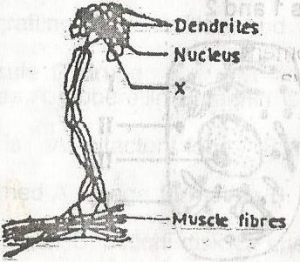
A
sensory neurone
B
relay neurone
C
afferent neurone
D
motor neurone
medium Difficulty
Verified Correct Answer: Option D
Biological Concept & Syllabus Guide
The image is a diagram of a motor(efferent) neurone. it transmits impulses away from the central nervous system to the effector organ,e.g. muscles and glands.
Source: Myschool Past Questions Archive (Record #41365)
Biology
UTME / JAMB 1995
Nervous, Hormonal Coordination & Sense Organs
Diagram
Solution
The part labelled X is the
Attached Figure / Diagram
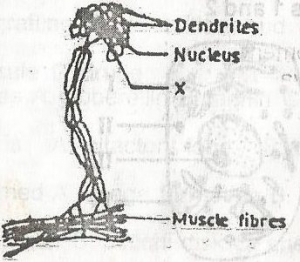
A
axon
B
cell body
C
terminal dendrites
D
synapse
medium Difficulty
Verified Correct Answer: Option B
Biological Concept & Syllabus Guide
The part labeled X is the Cell body also known as SOMA.
Source: Myschool Past Questions Archive (Record #41367)
Biology
WAEC / WASSCE 1995
Supporting Tissues & Skeletal System
Solution
1. Name the blood vessel which carries blood away from the kidney.
2.What part of the brain controls temperature regulation in the body?
3.Name the process in mammal during which Urea is formed.
4. In the test for starch why is the green leaf boiled in (a) water; (b) alcohol?
5. Name four parts of the mammalian alimentary canal.
6 State two features which are peculiar to the atlas vertebra
7. Name three diseases which can affect the kidney of man
8 Use the diagram below to answer questions (a) to (c) (a) (i)Name the structure illustrated above (ii) State the organ in which it is food
(b) Name the parts labeled HV (c) Name the fluid that is found within the parts of the structure labeled I - V
10. List the media of transportation of nutrients in: (a) Paramecium (c) invertebrates, (d) mammals
11. State two features which classify the rhizome as an underground stem.
SECTION B
Answer all the questions
12. You are provided with 10cm\(^3\) of water and a few crystals of potassium permanganate. Take two crystals with a spatula, bring the spatula close to the surface of tho water and gently drop that crystals into the water Do not stir the water or shake the test tube. (a) Carefully observe the set- up and record your observations as follows () Immediately after dropping the crystals into the water (i) after 5 minutes (ii) after 10 minutes (iv) after 15 minutes.
Copy the table below into your answer booklet and use it in recording your observations.
Time
Observation
Immediately after dropping the crystals
After 5 minutes
After 1O minutes
After 15 minutes
(b) What physical process must have given rise to the observations made? (c) State three physiological processes in organisms in which this phenomenon occurs
(ii) Why is it not advisable to stir the water or shake the beaker in this experiment?
13. (a) identify specimen. A and B (b) What type of skeleton has specimen A? (c) What is this skeleton made of? (d) From what group of animals can specimen B be collected? (e) From what part of the animal is it found? (f)(i) Make a labeled drawing 8 to 12 cm long of the anterior view of specimen B (ii) Give one function each of any three of the labeled parts.
14. Specimen C is a plant immersed in ink solution. Cut a thin cross section of the stem from at least 1 cm away from the ink mark upwards. Place the cut section in a Petri dish or transparent piece of glass or watch glass. Observe the cut section with a hand lens (a) Make a labeled drawing 8-10 cm in diameter of the cut surface to show with a distribution of tissues in the specimen (b), Shade all the stained tissues with horizontal strokes (c) Name two materials that are transported by the shaded tissues (d) Name three physical processes which help the transportation of materials from the soil to the leaf of the plant.
medium Difficulty
Verified Correct Answer: Option
Biological Concept & Syllabus Guide
1. Renal vein
2. Hypothalamus
3. Deamination.
4. (a) In the test for starch, the green leaf is boiled in water (i) to kill the protoplasm (il) to soften the leaf (ii) to burst open the starch granules (b) Boiled in alcohol to remove the chlorophyll
5. (a)The mouth (b) The gullet or oesophagus (C) The stomach (d) The small intestine
6. (i) Possession of large neural canal (i) Possession of two large facets for articulation with the skull (in) Possession of reduced or no centrum
7. Alkaloid, tannin, gums.
8. Kidney stones, diuresis, nephritis.
9. (a) (i) The inner ear of mammal (ii) The structure can be found in the mammalian ear (b) Semi-circular canals (ii) Ampullae (ii) Utriculus (iv) Sacculus.
10. (a) Paramecium cytoplasm (b) Plants-cell sap (c) Invertebrates-body fluid (d) Mammals -blood and lymph al buds.
11. (i) Possession of nodes and internodes (ii) Possession of adventitious roots (iii) Possession of terminal buds.
SECTION B
TIME
OBSERVATION
Immediately after dropping the crystals
Streak of purple colour going down to the bottom of the beaker
After 5 minutes
The crystals have started to dissolve with deep colour at the bottorn
After 10 minutes
Thick purple at bottom, light purple in the middle and very light purple on top
After 15 minutes
Whole water is purple
(b) The physical process is diffusion (c) (i) Exchange of gases in organisms (i) Absorption of digested food through the villi of small intestine (ii) Absorption of carbon (iv) oxide during photosynthesis (d) Stirring will interfere with the rate of diffusion and therefore the various stages cannot be observed.
13. (a) Specimen A - Grasshopper, Specimen B Mammalian thoracic vertebra (b) Exoskeleton (c) Chitin (d) Vertebrates (e) Thoracic cavity in the vertebral column (1) Neural canal for passage of spinal cord. The transverse process for the articulation With the ribs. The neural spine for attachment of muscles.
(c) (i) Water (ii) Mineral sats (d) (i) Transpiration pull (i) Dffusion (ii) The root pressure
Source: Official Exam / Past Question Archive
Biology
WAEC / WASSCE 1995
Digestive System & Feeding Mechanisms
Solution
(a) Make a labelled diagram of the vertical section of the mammalian tooth.
(b) Describe the role of the following in mammalian nutrition: (i) teeth; (ii) tongue ; (iii) saliva; (iv) stomach .
(c) Describe how to test for protein in a food sample
medium Difficulty
Verified Correct Answer: Option
Biological Concept & Syllabus Guide
(a)
(b)(i) The role of teeth in nutrition are:
(1) For chewing, mastication, cutting, grinding and biting of foods
(2) For tearing and breaking Enamel food into particles
(3) Exposing large surface area for functioning or action of the enzymes.
(ii) Role of tongue in nutrition are:
(1) movement of food in the Neck buccal cavity or mouth
(2) it allows the mixing of food with Cement saliva or enzyme
(3) It assists in swallowing or pushing of bolus into the gullet
(4) enables the formation of food into bolus.
(iii) Role of saliva in nutrition are:
(1) For lubrication of food
(2) it allows for easy chewing or movement of food in the mouth, for swallowing.
(3) Acts as a solvent for food
(4) Contains ptyalim or enzyme for digesting cooked starch
(5) It is slightly alkaline.
(iv) The role of stomach in nutrition are:
(1) production of gastric juice which contains pepsin for protein digestion
(2) The juice contains Renin for coagulation of liquid protein or milk. The stomach also has hydrochloric acid to form acid medium which kills bacteria. It helps in storing or temporal storage of undigested food.
(3) It produces churning movement which aids mixing of food with digestive juice.
(c) Test for protein can be carried out through million's test or biuret test.
Million test: Prepare an aqueous suspension of food sample, add a few drops of million's reagent. White precipitate is formed. Then, heat the mixture. Red or pin red precipitate is formed, which shows the presence of protein.
Biuret Test:- Make an aqueous suspension of food sample, add 2cm3 of 2% of sodium hydroxide solution, mix or shake it. Add a few drops of 1% dilute copper sulphate solution. Violet or purple colour will be formed which shows the presence of protein.
Source: Myschool Past Questions Archive (Record #53003)
Biology
WAEC / WASSCE 1995
Basic Ecological Concepts, Ecosystems & Biomes
Solution
(a) With reference to the food chain, explain the role of the followings; (i) green plants; (ii) herbivores; (iii) carnivores; (iv) decomposers
(b) With the aid of diagram, describe the carbon cycle.
medium Difficulty
Verified Correct Answer: Option
Biological Concept & Syllabus Guide
(a)(i) Role of green plants are:
(1) They are called producers and are usually most abundant
(2) They mark the beginning of food chain
(3) Green plants can produce carbohydrates during photosynthesis
(4) They use carbon dioxide and water
(5) They harness, utilize or store light energy in the presence of light.
(ii) Role of herbivores:
(1) Herbivores are the primary consumers.
(2) They normally feed or depend directly on plant materials for food.
(3) They build up energy or food for herbivores.
(iii) Role of carnivores:
(1) They are the secondary consumers and are fewer in number
(2) They feed on herbivores or other animals for energy
(3) They are referred to as flesh eating animals
(iv) Role of Decomposers:
(1) They are also called tertiary consumers. They depend or feed on dead organic materials or saprophytes for energy.
(2) They help in the recycling of nutrients.
(b) Description of carbon cycle:
(1) Plants and animal respiration release carbon (iv) oxide to the atmosphere
(2)Plants are eaten by herbivores
(3) Herbivores are eaten by carnivores
(4) Dead organisms decay to release carbon (iv) oxide into the atmosphere
(5) Bacteria respire on some materials they absorb and release carbon (iv) oxide to the atmosphere
(6) Burning of plant or fossils or fuel release carbon (iv) oxide to the air
(7) Carbon (iv) oxide is found in ocean or large body of water, due to respiration which is released when required to maintain the balance.
(8) Green plants absorb atmospheric carbon (iv) oxide to produce food eaten by animals.
(9) Carbon (iv) oxide from the atmosphere dissolves in the ocean or large body of water.
Carbon cycle
Source: Myschool Past Questions Archive (Record #53005)
Biology
WAEC / WASSCE 1995
Cell Structure, Organization & Cell Division
Solution
(a) What is a cell?
(b) Describe briefly the structure of DNA.
(c) Describe the process of mitosis
(d) What is the importance of mitosis to living organisms?
medium Difficulty
Verified Correct Answer: Option
Biological Concept & Syllabus Guide
(a) A Cell can be defined as the basic structural and eg. Cool, Wood functional unit of a living organism. Or it could be Volcanoes referred to as the smallest unit of living organism or Diffusion basic unit of life
(b) Structure of DNA: DNA consist Carbon dioxide In of two chains of nucleotides, twisted into each other the atmosphere p n to form a double helix. Each nucleotide is made up Putrefaction of a phosphate group alternating with sugar molecule or deoxyribose, a nitrogenous base or (cytosine, Dead /4 Respiration and deca adenine, guanine, thymine) or purines and y/ Photosynthesis Green manure and plant residue pyrimidines. The nitrogenous base from one chain link up with a compatible base of the opposite chain Dead and or adenine with thymine, guanine with cytosine. The DNA is like a rung of a ladder through a hydrogen teal decay of plants Plants bond. Absorption through roots
(c) Description of the process of mitosis: Mitosis occurs. in somatic cells or body cells or meristematic cells. Inorganic salts of carbonates In soil At the beginning of mitosis or prophase nuclear membrane and nucleolus disappear. Chromosomes Losses in form of carbonates become more visible, the chromosomes replicate. of metals like calcium and potassium They are normally made up of two strands or chomatids, spindles are formed. Chromosomes are then arranged at the equator or middle of the cell or ) metaphase. The chromosomes attach themselves at the centromere to the spindle and chromatids separate at the centromere. Each member of the pair move to the opposite pole of the cell or anaphase. The two sets of chromatid grouped together at the opposite pole and become less visible or Telophase . The nuclear membrane reappears including the nucleolus. The cytoplasm constrict in animals cells to form daughter cells. In plant cells, wall is formed between two sets of chromatids. Then two daughter cells are formed.
(d) Importance of mitosis to living organisms:
(1) Mitosis helps in the growth or development.
(2) It assist in Repair of cells
(3) It also ensures exact copy of DNA or sum total of inherited factors or transmission of genes to the daughter cells or ensures consistency of DNA. )
Source: Myschool Past Questions Archive (Record #53007)
Biology
WAEC / WASSCE 1995
Nervous, Hormonal Coordination & Sense Organs
Solution
(a) What is a sensory cell?
(b) State one function each for the following parts of mammalian eye: (i) lens; (ii) vitreous humour; (iii) optic nerve.
(c) (i) List four structures which protect the eye from injury.
(ii)Explain briefly how each of these structures performs its function.
(d) Explain why a person in a dark room is dazzled for some seconds when he is suddenly exposed to bright sunlight.
medium Difficulty
Verified Correct Answer: Option
Biological Concept & Syllabus Guide
(a) Sensory cells are specialised cells which receive a particular stimulus. Normally they convert stimuli into impulses and transmit such impulses or sensation to the brain or spinal cord or central nervous system.
(b) (i) The function of lens is that it reflects rays or makes fine adjustment to focus object on the retina
(ii) Vitreous humour reflects light rays onto the retina or helps maintain spherical shape of the eye
(iii) Optic nerve transmits sensory impulses to the brain or transmits sensory impulses from the brain
(c )(i) The four structures which protect the eye against injury are
(1) Eye lids
(2) Eye lashes
(3) Eye socket or bonying socket
(4) conjunctive.
The eye lid is closed to protect the eye from foreign particles or mechanical injury. During blinking it carries water from the tear glands to moisten or irrigate the eye with tear or water to keep it moist. Eye lashes also acts as a hood and protects the eye from glare or excessive light. It also shields the eye against sweat, water or dust. Conjunctiva provides protective shield to the inner most delicate structure and gets inflamed during infection instead of the entire eye. Eye socket houses or encloses the eye balls. It shields or gives protection from mechanical injury, e.g. from a blow.
(d) In a dark room, the iris contracts while the pupil dilates or opens widely to allow in more light. On sudden exposure to bright sun-light, the pupil which is still wide open allows in too much light which bleaches pigment in the rod cells and this causes the dazzling sensation experienced. The iris muscle gradually relaxes within a few seconds. The pupil constricts gradually to regulate the entry of the required amount of light for the vision to return to normal.
Source: Myschool Past Questions Archive (Record #53008)
Mathematics
WAEC / WASSCE 1994
Sequences & Series (AP & GP)
Solution
If the 2nd and 5th terms of a G.P are 6 and 48 respectively, find the sum of the first four for term
A
-45
B
-15
C
15
D
33
E
45
medium Difficulty
Verified Correct Answer: Option E
Step-by-Step Mathematical Solution
\(T_2\) = ar = 6
\(T_5\) = ar\(^{4}\) = 48
\(\frac{T_5}{T_2}\) = \(\frac{ar^{4}}{ar}\) = \(\frac{48}{6}\)
= r\(^{3}\) = 8
=> r = 2
\(S_n\) = \(\frac{a((r^n) - 1)}{r - 1}\)
\(S_4\) = \(\frac{a((r^4) - 1)}{r - 1}\)
\(S_4\) = \(\frac{3((2^4) - 1)}{2 - 1}\)
= 3(16 -1)
= 45
Source: Myschool Past Questions Archive (Record #21978)