Question Library

Browse, filter, and study verified past examination questions with step-by-step mathematical reasoning.

Launch Interactive Practice
Searching 18,000+ Questions... Sifting topics, KaTeX formulas & verified solutions
Showing 22396–22410 of 29821 verified questions
Sort by:
Biology WAEC / WASSCE 1995 Supporting Tissues & Skeletal System
Which of the following is not a tissue found in plants?
A
Epidermis
B
Phloem
C
Xylem
D
Dermis
E
Mesophyll
medium Difficulty
Biology WAEC / WASSCE 1995 Cell & Its Environment (Diffusion, Osmosis & Transport)
Higher organisms use a transport system and not diffusion only to distribute nutrients because
A
the ratio of their surface area to volume is small
B
metabolic waste products diffuse to the surface of the organisms
C
the rate at which nutrients and other substances diffuse increases
D
substances to be transported move shorter distances to reach the numerous cells
E
the internal structures of the organisms are in direct contact with the environment.
medium Difficulty
Biology WAEC / WASSCE 1995 Variety of Organisms & Classification of Living Things
In complex food relationships in a community, the primary, secondary and tertiary consumers are referred to as
A
symbionts
B
omnivores
C
heterotrophs
D
autotrophs
E
carnivores
medium Difficulty
Biology WAEC / WASSCE 1995 Cell & Its Environment (Diffusion, Osmosis & Transport)
The cell membrane of a cell is said to be semi-permeable because
A
it allows only large molecular substances to pass through it into the cell
B
it is actively involved in energy production in the cell
C
it actively allows all substances to pass through it by diffusion
D
it is actively selective in allowing substances pass through it
E
fatty acids are only the building blocks of the membrane
medium Difficulty
Biology WAEC / WASSCE 1995 Cell & Its Environment (Diffusion, Osmosis & Transport)
Hormones are transported around the mammalian body by
A
water
B
nerves
C
blood
D
osmosis
E
diffusion
medium Difficulty
Biology WAEC / WASSCE 1995 Nervous, Hormonal Coordination & Sense Organs
Which of the following is not a function of insulin?
A
Accelerates the rate at which glucose is converted to glycogen
B
Promotes the uptake of glucose by tissues
C
Regulates the amount of glucose in the blood
D
Accelerates the absorption of glucose at the glomerulus
E
Stimulates muscles to oxidize glucose.
medium Difficulty
Biology WAEC / WASSCE 1995 Nervous, Hormonal Coordination & Sense Organs
Which of the following is the correct route of transmission of impulses along a reflex arc?
A
Receptor → sensory neurone → synapse → intermediate neurone → synapse → motor neurone → effector
B
Receptor → motor neutron e synapse → intermediate neurone → synapse → sensory neurone effector
C
Receptor → synapse → sensory neurone → intermediate neurone → synapse → effector → motor neurone
D
Effector → motor neurone → synapse → sensory neurone → synapse → intermediate neurone → receptor
E
Effector → intermediate neurone → synapse → motor neurone → synapse → sensory neurone → receptor.
medium Difficulty
Biology WAEC / WASSCE 1995 Nervous, Hormonal Coordination & Sense Organs
Which of the following statements is false?
A
Human sense of smell is easily fatigued
B
The skin can perceive the sensations of touch, pain, pressure and temperature
C
Taste buds and olfactory cells are active when wet as well as when dry
D
Sensory nerve endings receive stimuli and send to the central nervous system
E
Senses of smell and taste can be weakened by catarrh or blocked nose.
medium Difficulty
Biology WAEC / WASSCE 1995 Nervous, Hormonal Coordination & Sense Organs
The following are directly involved in transmission of sound waves to the brain except
A
eardrum
B
auditory meatus
C
auditory ossicles
D
eustachian tube
E
cochlea
medium Difficulty
Biology WAEC / WASSCE 1995 Reproduction in Plants & Animals
The term syncarpous is used to describe a flower when the carpels are
A
many and fused
B
two only
C
two and separate
D
many and free
E
lying at different parts of a flower
medium Difficulty
Biology WAEC / WASSCE 1995 Reproduction in Plants & Animals
Which of the following structures are characteristics of insect pollinated flowers?
A
Dull coloured flowers with no nectar
B
Very light numerous and pendulous stamen
C
Brightly coloured petals, scent nectar
D
Flowers are usually small and inconspicuous
E
Stigma are large, feathery and hang outside the flower
medium Difficulty
Biology WAEC / WASSCE 1995 Population Ecology, Habitats & Conservation
Which of the following statements is not correct?
A
Shortage of food may be caused by pestilence, rinderpest and neglect of farming
B
Shortage of food may lead to competition, emigration, death and decline in the rate of reproduction
C
Over-crowding may lead to scarcity of food
D
Dispersal of seeds and fruits prevents overcrowding
E
Territorial defence encourages food scarcity in a habitat
medium Difficulty
Biology WAEC / WASSCE 1995 Reproduction in Plants & Animals
Which of the following is an advantage of dispersal of fruits and seeds? It allows
A
fair distribution of source of food for animals
B
growth in close association with parent plant
C
even distribution of plants and reduction of intraspecific competition
D
keen competition for food
E
the seeds to evolve new species
medium Difficulty
Biology WAEC / WASSCE 1995 Reproduction in Plants & Animals
The series of changes that occur in a seed by which the embryo develops into a seedling is known as
A
fertilization
B
gametogenesis
C
pollination
D
germination
E
regeneration
medium Difficulty
Biology WAEC / WASSCE 1995 Variety of Organisms & Classification of Living Things
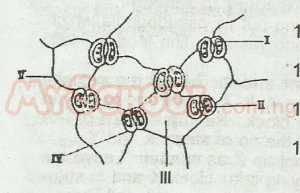
The function of the part labelled I is
Attached Figure / Diagram
Question diagram
A
controlling water loss
B
trapping solar energy
C
absorbing water
D
storing sugar
E
transporting sugar
medium Difficulty
Page 1494 of 1989