Question Library
Browse, filter, and study verified past examination questions with step-by-step mathematical reasoning.
Searching 18,000+ Questions...
Sifting topics, KaTeX formulas & verified solutions
Showing 21931–21945 of 29821 verified questions
Sort by:
Mathematics
UTME / JAMB 1995
Plane Geometry, Polygons & Circle Theorems
Solution
Two perpendicular lines PQ and QR intersect at (1, -1). If the equation of PQ is x - 2y + 4 = 0, find the equation of QR
A
x + 2y - 1= -0
B
2x + y - 3 = 0
C
x - 2y - 3 = 0
D
2x + y - 1 = 0
medium Difficulty
Verified Correct Answer: Option D
Step-by-Step Mathematical Solution
Line PQ : x - 2y + 4 = 0
2y = x + 4 \(\implies y = \frac{x}{2} + 2 \)
Slope = \(\frac{1}{2}\)
Slope of the perpendicular line QR: \(\frac{-1}{\frac{1}{2}} = -2\)
Line QR: \(y = mx + b\)
\(y = -2x + b\)
Point of intersection: (1, -1)
\(-1 = -2(1) + b \implies b = -1 + 2 = 1\)
\(y = -2x + 1 \implies y + 2x - 1 = 0\)
\(QR: 2x + y - 1 = 0\)
Source: Myschool Past Questions Archive (Record #30933)
Mathematics
UTME / JAMB 1995
Plane Geometry, Polygons & Circle Theorems
Solution
P is on the locus of points equidiatant from two given points X and Y. UV is a straight line throuh Y parallel to the locus. If < PYU is 40^\circ, find < XPY.
A
100o
B
80 o
C
50 o
D
40 o
medium Difficulty
Verified Correct Answer: Option B
Step-by-Step Mathematical Solution
< PYU = < YPQ = 40^\circ(Alternative) = PQ\(\parallel\)UV
< XPQ = < YPQ = 40^\circ, Since QX = QY
therefore < XPY = 80^\circ
Source: Myschool Past Questions Archive (Record #30935)
Mathematics
UTME / JAMB 1995
Trigonometry, Elevation & Bearings
Solution
A school boy lying on the ground 30m away from the foot of a water tank tower observes that the angle of elevation of the top of the tank 60o. Calculate the height of the water tank.
A
60m
B
30 \(\sqrt{3}\)m
C
20 \(\sqrt{3}\)m
D
10 \(\sqrt{3}\)m
medium Difficulty
Verified Correct Answer: Option B
Step-by-Step Mathematical Solution
h = 30 tan 60o
= 30\(\sqrt{3}\)
Source: Myschool Past Questions Archive (Record #30939)
Mathematics
UTME / JAMB 1995
Trigonometry, Elevation & Bearings
Solution
The derivative of cosec x is
A
tan x cosec x
B
-cot x cosec x
C
tan x sec x
D
-cot x sec x
medium Difficulty
Verified Correct Answer: Option B
Step-by-Step Mathematical Solution
\(\csc x = \frac{1}{\sin x}\)
Using the quotient rule,
\(\frac{\mathrm d y}{\mathrm d x} = \frac{vdu - udv}{v^{2}}\)
= \(\frac{\sin x (0) - 1 (\cos x)}{(\sin x)^{2}}\)
= \(\frac{- \cos x}{\sin^{2} x}\)
= \((\frac{- \cos x}{\sin x}) (\frac{1}{\sin x})\)
= \(- \cot x \csc x\)
Source: Myschool Past Questions Archive (Record #30940)
Mathematics
UTME / JAMB 1995
Plane Geometry, Polygons & Circle Theorems
Solution
For what value of x is the tangent to the curve y = x\(^2\) - 4x + 3 parallel to the x-axis?
A
3
B
2
C
1
D
6
medium Difficulty
Verified Correct Answer: Option B
Step-by-Step Mathematical Solution
At the point where the tangent is parallel to the x- axis, the slope of the curve = 0.
Given: \(y = x^{2} - 4x + 3\)
\(\frac{\mathrm d y}{\mathrm d x} = 2x - 4\)
\(2x - 4 = 0 \implies 2x = 4 \)
\(x = 2\)
When x = 2, the tangent of the curve is parallel to the x- axis.
Source: Myschool Past Questions Archive (Record #30941)
Mathematics
UTME / JAMB 1995
Linear, Simultaneous & Quadratic Equations
Solution
Two variables x and y are such that \(\frac{dy}{dx}\) = 4x - 3 and y = 5 when x = 2. Find y in terms of x
A
2x2 - 3x + 5
B
2x2 - 3x + 3
C
2x2 - 3x
D
4
medium Difficulty
Verified Correct Answer: Option B
Step-by-Step Mathematical Solution
∫dy = ∫(4x - 3)dx, y = 2x2 - 3x + C
when y = 5, x = 2, C = 3
y = 2x2 - 3x + 3
Source: Myschool Past Questions Archive (Record #30942)
Mathematics
UTME / JAMB 1995
Integration & Applications
Solution
Find the area bounded by the curve y = 3x\(^2\) - 2x + 1, the ordinates x = 1 and x = 3 and the x-axis.
A
24
B
22
C
21
D
20
medium Difficulty
Verified Correct Answer: Option D
Step-by-Step Mathematical Solution
\(\frac{\mathrm d y}{\mathrm d x} = 3x^{2} - 2x + 1\)
\(y = \int_{1} ^{3} (3x^{2} - 2x + 1) \mathrm d x\)
\(y = [x^{3} - x^{2} + x]_{1} ^{3}\)
= \([3^{3} - 3^{2} + 3] - [1^{3} - 1^{2} + 1]\)
= \(21 - 1 = 20\)
Source: Myschool Past Questions Archive (Record #30943)
Mathematics
UTME / JAMB 1995
Statistics (Data Representation, Central Tendency & Dispersion)
Solution
\(\begin{array}{c|c} \text{Age in years} & 13 & 14 & 15 & 16 & 17 \\ \hline \text{No. of students} & 3 & 10 & 30 & 42 & 15\end{array}\)
The frequency distribution above shows the ages of students in a secondary school. In a pie chart constructed to represent the data, the angles corresponding to the 15 years old is
A
27o
B
30o
C
54o
D
108o
medium Difficulty
Verified Correct Answer: Option D
Step-by-Step Mathematical Solution
Number of 15- year old pupils = 30.
Total number of students: 3 + 10 + 30 + 42 + 15 = 100.
Angle = \(\frac{30}{100} \times 360^\circ\)
= \(108^\circ\)
Source: Myschool Past Questions Archive (Record #30944)
Mathematics
UTME / JAMB 1995
Statistics (Data Representation, Central Tendency & Dispersion)
Solution
The variance of the scores 1, 2, 3, 4, 5 is
A
1, 2
B
1, 4
C
2.0
D
3.0
medium Difficulty
Verified Correct Answer: Option C
Step-by-Step Mathematical Solution
\(x\)
1
2
3
4
5
sum =15
\(x - \bar{x}\)
-2
-1
0
1
2
\((x - \bar{x})^{2}\)
4
1
0
1
4
10
Mean = \(\frac{15}{5} = 3\)
\(Variance = \frac{\sum (x - \bar{x})^{2}}{n}\)
= \(\frac{10}{5}\)
= \(2.0\)
Source: Myschool Past Questions Archive (Record #30947)
Mathematics
UTME / JAMB 1995
Statistics (Data Representation, Central Tendency & Dispersion)
Solution
\(\begin{array}{c|c} \text{Class Interval} & Frequency & \text{Class boundaries} & Class Mid-point \\ \hline 1.5 - 1.9 & 2 & 1.45 - 1.95 & 1.7\\ 2.0 - 2.4 & 1 & 1.95 - 2.45 & 2.2\\ 2.5 - 2.9 & 4 & 2.45 - 2.95 & 2.7 \\ 3.0 - 2.9 & 15 & 2.95 - 3.45 & 3.2\\ 3.5 - 3.9 & 10 & 3.45 - 3.95 & 3.7\\ 4.0 - 4.4 & 5 & 3.95 - 4.45 & 4.2\\ 4.5 - 4.9 & 3 & 4.45 - 4.95 & 4.7\end{array}\)
Find the mode of the distribution.
A
3.2
B
3.3
C
3.7
D
4.2
medium Difficulty
Verified Correct Answer: Option B
Step-by-Step Mathematical Solution
Mode = a + \(\frac{ (b - a)(fm - Fb)}{2Fm - Fa - Fb}\)
= 3.0 + \(\frac{(3.45 - 2.95)(15 - 4)}{2(15) - 4 - 10}\)
= 3 + \(\frac{(0.5)(11)}{30 - 14}\)
= 3 + \(\frac{5.5}{16}\)
= 3 + 0.34375
= 3.34375
= 3.3cm
Source: Myschool Past Questions Archive (Record #30948)
Mathematics
UTME / JAMB 1995
Statistics (Data Representation, Central Tendency & Dispersion)
Solution
\(\begin{array}{c|c} \text{Class Interval} & Frequency & \text{Class boundaries} & Class Mid-point \\ \hline 1.5 - 1.9 & 2 & 1.45 - 1.95 & 1.7\\ 2.0 - 2.4 & 21 & 1.95 - 2.45 & 2.2\\ 2.5 - 2.9 & 4 & 2.45 - 2.95 & 2.7 \\ 3.0 - 2.9 & 15 & 2.95 - 3.45 & 3.2\\ 3.5 - 3.9 & 10 & 3.45 - 3.95 & 3.7\\ 4.0 - 4.4 & 5 & 3.95 - 4.45 & 4.2\\ 4.5 - 4.9 & 3 & 4.45 - 4.95 & 4.7\end{array}\)
The median of the distribution above is
A
4.0
B
3.4
C
3.2
D
3.0
medium Difficulty
Verified Correct Answer: Option B
Step-by-Step Mathematical Solution
Median = \(\frac{a + b}{fm}\) (\(\frac{1}{2} \sum f - CF_b\))
= 2.95 + \(\frac{0.5}{15}\)(2.-7)
= 2.95 + \(\frac{0.5}{15}\) x 13
= 2.95 + 0. 43
= 3.38
= 3.4
Source: Myschool Past Questions Archive (Record #30949)
Mathematics
UTME / JAMB 1995
Permutations, Combinations & Probability
Let p be a probability function on set S, where S = (a1, a2, a3, a4). Find P(a1) if P(a2) = \(\frac{1}{3}\), p(a3) = \(\frac{1}{6}\) and p(a4) = \(\frac{1}{5}\)
A
\(\frac{7}{3}\)
B
\(\frac{2}{3}\)
C
\(\frac{1}{3}\)
D
\(\frac{3}{10}\)
medium Difficulty
Verified Correct Answer: Option D
Step-by-Step Mathematical Solution
No expanded working has been attached for this question yet. The verified answer is Option D.
Source: Myschool Past Questions Archive (Record #30950)
Mathematics
UTME / JAMB 1995
Permutations, Combinations & Probability
Solution
A die has four of it's faces coloured white and the remaining two coloured black. What is the probability that when the die is thrown two consecutive time, the top face will be white in both cases?
A
\(\frac{5}{3}\)
B
\(\frac{1}{9}\)
C
\(\frac{4}{9}\)
D
\(\frac{1}{36}\)
medium Difficulty
Verified Correct Answer: Option C
Step-by-Step Mathematical Solution
\(\begin{array}{c|c} & W & W & W & W & B & B \\ \hline W & WW & WW & WW & WW & WB & WB \\ W & WW & WW & WW & WW & WB & WB\\W & WW & WW & WW & WW & WB & WB\\ W & WW & WW & WW & WW & WB & WB\\ B & BW & BW & BW & BW & BB & BB \\ B & BW & BW & BW & BW & BB & BB\end{array}\)
P(WW) = \(\frac{16}{36}\)
= \(\frac{4}{9}\)
Source: Myschool Past Questions Archive (Record #30951)
Mathematics
UTME / JAMB 1995
Inequalities & Linear Programming
Diagram
Solution
Use the graph of the curve y = f(x)to solve the inequality f(x) \(\leq\) 0
Attached Figure / Diagram
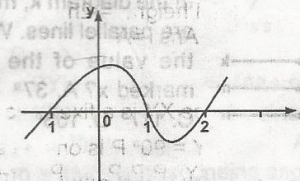
A
-1 \(\geq\) x \(\geq\) 1, x \(\geq\) 2
B
x \(\leq\) -1, 1 \(\geq\) x \(\geq\) 2
C
x \(\geq\) -1, 1 \(\geq\) x \(\geq\) 2
D
x \(\geq\) 2, -1 \(\geq\) x \(\geq\) 1
medium Difficulty
Verified Correct Answer: Option B
Step-by-Step Mathematical Solution
-1 \(\geq\) x \(\geq\) 1, 1 < x \(\geq\) 2
Combining solutions
= x \(\leq\) 1; 1 \(\geq\) x \(\geq\) 2
Source: Myschool Past Questions Archive (Record #33043)
Mathematics
UTME / JAMB 1995
Plane Geometry, Polygons & Circle Theorems
Diagram
Solution
Determine the value of x in the figure
Attached Figure / Diagram
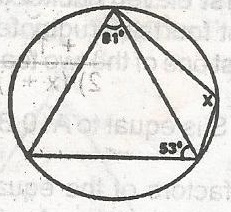
A
134o
B
81o
C
53o
D
46o
medium Difficulty
Verified Correct Answer: Option A
Step-by-Step Mathematical Solution
Within the triangle,
180^\circ - (81^\circ + 53^\circ) = 46^\circ
In a cyclic quadrilateral, the sum of two opposite angles = 180^\circ
\(\therefore\) x = 180^\circ - 46^\circ = 134^\circ
Source: Myschool Past Questions Archive (Record #33044)