Question Library
Browse, filter, and study verified past examination questions with step-by-step mathematical reasoning.
Searching 18,000+ Questions...
Sifting topics, KaTeX formulas & verified solutions
Showing 21886–21900 of 29821 verified questions
Sort by:
Mathematics
WAEC / WASSCE 1995
Mensuration (Areas, Perimeters & Volumes)
Solution
A 120^\circ sector of a circle of radius 21cm is bent to form a cone. What is the base radius of the cone?
A
31/2cm
B
7cm
C
1O1/2cm
D
14cm
E
21cm
medium Difficulty
Verified Correct Answer: Option B
Step-by-Step Mathematical Solution
The length of the arc subtended by the sector of angle 120^\circ = circumference of the base of the cone.
\(\frac{120}{360} \times 2 \times \frac{22}{7} \times 21 = 2\pi r\)
\(44 = 2\pi r\)
\(r = 22 \div \pi\)
\(r = 22 \times \frac{7}{22}\)
r = 7 cm
Source: Myschool Past Questions Archive (Record #23746)
Mathematics
WAEC / WASSCE 1995
Mensuration (Areas, Perimeters & Volumes)
Solution
The angle of a sector of a circle is 108^\circ. If the radius of the circle is 3\(\frac{1}{2}\)cm, find the perimeter of the sector
A
6 \(\frac{3}{5}\)cm
B
6 \(\frac{4}{5}\)cm
C
7 \(\frac{1}{10}\)cm
D
10 \(\frac{2}{5}\)cm
E
13 \(\frac{3}{5}\)cm,
medium Difficulty
Verified Correct Answer: Option E
Step-by-Step Mathematical Solution
Perimeter of sector = \(\frac{\theta}{360^\circ} \times 2\pi r + 2r\)
= \(\frac{108}{360} \times 2 \times \frac{22}{7} \times \frac{7}{2} + 2(\frac{7}{2})\)
= \(6 \frac{3}{5} + 7\)
= \(13 \frac{3}{5} cm\)
Source: Myschool Past Questions Archive (Record #23747)
Mathematics
WAEC / WASSCE 1995
Plane Geometry, Polygons & Circle Theorems
Diagram
Solution
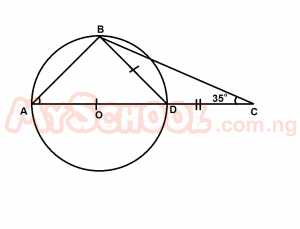
In the diagram above; O is the centre of the circle and |BD| = |DC|. If ∠DCB = 35^\circ, find ∠BAO.
Attached Figure / Diagram
A
20o
B
25o
C
30o
D
35o
E
40o
medium Difficulty
Verified Correct Answer: Option A
Step-by-Step Mathematical Solution
< DBC = 35^\circ (base angles of an isosceles triangle)
< CDB = 180^\circ - (35^\circ + 35^\circ)
= 110^\circ
< ADB = 70^\circ; < ABD = 90^\circ(< in a semi-circle)
\(\therefore\) < BAO = 180^\circ - (70^\circ + 90^\circ)( sum of
Source: Myschool Past Questions Archive (Record #23748)
Mathematics
WAEC / WASSCE 1995
Plane Geometry, Polygons & Circle Theorems
Diagram
Solution
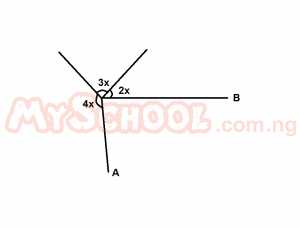
In the diagram above, AO is perpendicular to OB. Find x
Attached Figure / Diagram
A
7.5o
B
15o
C
22.5o
D
30o
E
38.6o
medium Difficulty
Verified Correct Answer: Option D
Step-by-Step Mathematical Solution
4x + 3x + 2x + 90 =360^\circ [angle at a point]
9x + 90 = 360^\circ
9x = 360^\circ - 90^\circ
9x = 270
x = 270/9
x = 30^\circ
Source: Myschool Past Questions Archive (Record #23774)
Mathematics
WAEC / WASSCE 1995
Plane Geometry, Polygons & Circle Theorems
Diagram
Solution
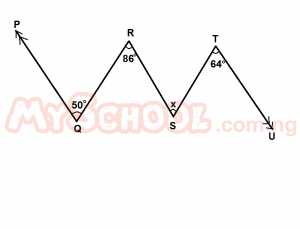
In the diagram above, PQ is parallel to TU, ∠PQR = 50^\circ, ∠QRS = 86^\circ and ∠STU = 64^\circ. Calculate the value of x.
Attached Figure / Diagram
A
136o
B
120o
C
108o
D
100o
E
96o
medium Difficulty
Verified Correct Answer: Option D
Step-by-Step Mathematical Solution
y = 86^\circ - 50^\circ [Alternate ∠s are equal]
y = 86^\circ - 50^\circ = 36^\circ
a = y = 36^\circ [Alternate ∠s]; b = 64^\circ [Alternate ∠s;]
x = a + b = (36^\circ + 64^\circ)
=100^\circ
Source: Myschool Past Questions Archive (Record #23775)
Mathematics
WAEC / WASSCE 1995
Indices, Logarithms & Surds
Solution
If log\(_{10}\) x = \(\bar{2}.3675\) and log\(_{10}\) y = \(\bar{2}.9738\), what is the value of x + y, correct lo three significant figures?
A
O.117
B
0.118
C
0.903
D
O.944
E
0.946
medium Difficulty
Verified Correct Answer: Option A
Step-by-Step Mathematical Solution
log\(_{10}\) x = \(\bar{2}.3675\) => x = 0.023
log\(_{10}\) y = \(\bar{2}.9738\) => y = 0.094
x + y = 0.117
Source: Myschool Past Questions Archive (Record #23776)
Mathematics
WAEC / WASSCE 1995
Plane Geometry, Polygons & Circle Theorems
Diagram
Solution
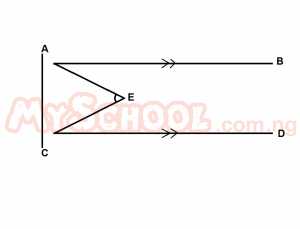
In the diagram above, AB//CD, the bisector of ∠BAC and ∠ACD meet at E. Find the value of ∠AEC
Attached Figure / Diagram
A
30o
B
45o
C
60o
D
75o
E
90o
medium Difficulty
Verified Correct Answer: Option E
Step-by-Step Mathematical Solution
Ae is a bisector of BAC => EAC = 45o
CE is the bisector of ACD => ACE = 45o
AEC = 180o - [EAC + ACE]
= 180o - (45o + 45o) = 180o - 90o = 90o
Source: Myschool Past Questions Archive (Record #23777)
Mathematics
WAEC / WASSCE 1995
Plane Geometry, Polygons & Circle Theorems
Diagram
Solution
In the diagram above, AB//CD. What is the size of the angle marked x?
Attached Figure / Diagram
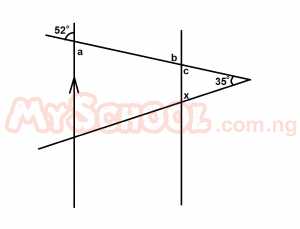
A
103o
B
93o
C
77o
D
62o
E
52o
medium Difficulty
Verified Correct Answer: Option B
Step-by-Step Mathematical Solution
a = 52o [vertical opp. ∠s are equal]
a = b = 52o [Alternate ∠s]
b = c = 52o [vertical opp ∠s]
c + x + 35o = 180o [sum of angles in a triangle]
52o + x + 35o = 180o
x + 87o = 180o
x = 180o - 87o = 93o
Source: Myschool Past Questions Archive (Record #23778)
Mathematics
WAEC / WASSCE 1995
Plane Geometry, Polygons & Circle Theorems
The locus of a point which is equidistant from two given fixed points is the
A
perpendicular bisector of the straight line joining them
B
angle bisector of the straight lines joining the points to the origin
C
perpendiculars to the straight line joining them
D
parallel-line to the straight line joining them
E
a line making an acute angle with the line joining the two points
medium Difficulty
Verified Correct Answer: Option A
Step-by-Step Mathematical Solution
No expanded working has been attached for this question yet. The verified answer is Option A.
Source: Myschool Past Questions Archive (Record #23779)
Mathematics
WAEC / WASSCE 1995
Plane Geometry, Polygons & Circle Theorems
Diagram
Solution
In the diagram above, the value of angles b + c is
Attached Figure / Diagram
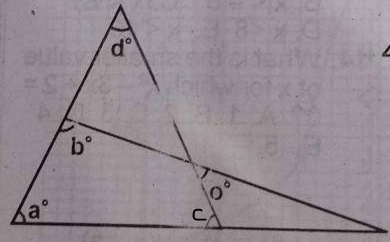
A
180o
B
90o
C
45o
D
ao
E
do
medium Difficulty
Verified Correct Answer: Option A
Step-by-Step Mathematical Solution
a + c + d = 180o[sum of angles in triangle]
x = a[vertical opp. ∠s]
y + x + d = 180o[sum of ∠s in a \Delta]
y + a + d = 180o
y + a + d = a + c + d
y = c
but b + y = 180o [sum of ∠s on a straight line ]
b + c = 180o; Ans = A = 180o
Source: Myschool Past Questions Archive (Record #23780)
Mathematics
WAEC / WASSCE 1995
Plane Geometry, Polygons & Circle Theorems
Solution
Which of the following angles is an exterior angle of a regular polygon?
A
95o
B
85o
C
78o
D
75o
E
72o
medium Difficulty
Verified Correct Answer: Option E
Step-by-Step Mathematical Solution
The formula for the exterior angle of a regular polygon = \(\frac{360}{n}\).
Among the options, only 72^\circ is divisible by 360^\circ to give an integer.
Source: Myschool Past Questions Archive (Record #23781)
Mathematics
WAEC / WASSCE 1995
Plane Geometry, Polygons & Circle Theorems
Diagram
Solution
In ΔABC above, BC is produced to D, /AB/ = /AC/ and ∠BAC = 50o. Find ∠ACD
Attached Figure / Diagram
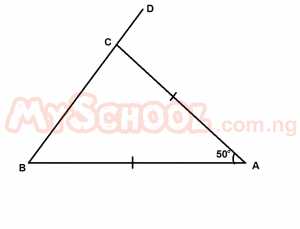
A
50o
B
60o
C
65o
D
100o
E
115o
medium Difficulty
Verified Correct Answer: Option E
Step-by-Step Mathematical Solution
ACB = ABC [Base angles of isoceles triangle]
ACB + ABC + 50o = 180o[sum of angles in a triangle]
ACB + ABC = 180o - 50o = 130o
ACB 130o/2 = 65o
ACD + ACB = 180o[sum of ∠s on a straight line]
ACD + 65o = 180o
ACD = 180o - 65o = 115o
Source: Myschool Past Questions Archive (Record #23782)
Mathematics
WAEC / WASSCE 1995
Trigonometry, Elevation & Bearings
Solution
Without using tables, find the value of \(\frac{\sin 20^\circ}{\cos 70^\circ} + \frac{\cos 25^\circ}{\sin 65^\circ}\)
A
2
B
1
C
o
D
-1
E
-2
medium Difficulty
Verified Correct Answer: Option A
Step-by-Step Mathematical Solution
Note: sin 20^\circ = cos 70^\circ hence
\(\frac{\sin 20}{\cos 70} = 1\)
Also, cos 65^\circ = sin 25^\circ
\(\frac{\cos 65}{\sin 25} = 1\)
\(\therefore \frac{\sin 20}{\cos 70} + \frac{\cos 65}{\sin 25}\)
= 1 + 1
= 2
Source: Myschool Past Questions Archive (Record #23783)
Mathematics
WAEC / WASSCE 1995
Trigonometry, Elevation & Bearings
Diagram
Solution
In the diagram above, ∠PRQ = 90^\circ, ∠QPR = 30^\circ and /PQ/ = 10 cm. Find y.
Attached Figure / Diagram
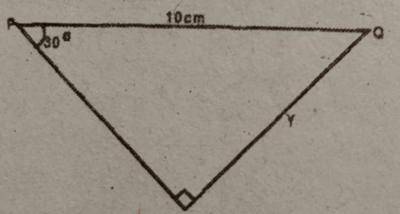
A
6cm
B
5cm
C
4cm
D
3cm
E
2cm
medium Difficulty
Verified Correct Answer: Option B
Step-by-Step Mathematical Solution
\(\sin 30^\circ = \frac{y}{10}\)
\(y = 10 \sin 30^\circ = 10 \times 0.5 = 5 cm\)
Source: Myschool Past Questions Archive (Record #23784)
Mathematics
WAEC / WASSCE 1995
Indices, Logarithms & Surds
Solution
The bearing of two points Q and R from a point P are 030^\circ and 120^\circ respectively, lf /PQ/ = 12 m and /PR/ = 5 m, find the distance QR.
A
13m
B
11m
C
9m
D
7m
E
5m
medium Difficulty
Verified Correct Answer: Option A
Step-by-Step Mathematical Solution
x\(^2\) = 12\(^2\) + 5\(^2\)
x\(^2\) = 144 + 25
x\(^2\) = 169
x = \(\sqrt{169}\) = 13m.
Source: Myschool Past Questions Archive (Record #23785)