Question Library
Browse, filter, and study verified past examination questions with step-by-step mathematical reasoning.
Searching 18,000+ Questions...
Sifting topics, KaTeX formulas & verified solutions
Showing 21841–21855 of 29821 verified questions
Sort by:
Biology
WAEC / WASSCE 1996
Variation & Genetics (Heredity)
The statements below are about evolution of species
I. Members of a species vary ll. Organisms produce many offspring lll. The mechanism of evolution is
inheritance of acquired characters IV. Changes in the phenotype is brought about by the individual itself
Which of the statement(s) is/are related to the Darwin’s theory of evolution?
A
I only
B
II only
C
I, II and IV
D
I and II only
E
II and IV only
medium Difficulty
Verified Correct Answer: Option E
Biological Concept & Syllabus Guide
No expanded working has been attached for this question yet. The verified answer is Option E.
Source: Myschool Past Questions Archive (Record #18637)
Biology
WAEC / WASSCE 1996
Basic Ecological Concepts, Ecosystems & Biomes
Which of the following fields of study may not yield strong evidence of evolution?
A
Fossil
B
Histology
C
Ecology
D
Genetics
E
Cytology
medium Difficulty
Verified Correct Answer: Option C
Biological Concept & Syllabus Guide
No expanded working has been attached for this question yet. The verified answer is Option C.
Source: Myschool Past Questions Archive (Record #18639)
Biology
WAEC / WASSCE 1996
Nutrition in Plants & Animals (Photosynthesis & Food Substances)
Solution
1. (a) Name the organism illustrated in the diagram above (b) Name the structure labelled A.
2. List (a) two air pollutants (b) Three water pollutants. Study the diagram below and use it to answer question 3
3. (a) Name the structure illustrated above (b) Name the parts labelled A- D (c) State the function of the part labelled C (d) in which group of animals is this structure found? 4. State the basic structure of a virus. Study the diagram below and use it to answer question 5 Study the diagram below and use it to answer question 5
5. (a) Name the organism illustrated in the diagram above (b) Name the parts labelled A to D (c) What is the habitat of the organism? What are the functions of A and D? The diagram below represents an instrument used in an ecological study.
Use it to answer question 6
6. (a) VWhat is the name of the instrument? (b) What is the instrument used for? (c) What is the function of the part labelled A? (d) Name the parts labelled B and C.
7. A food substance was put in two test tubes labeilcd I and Il in test tube , Fehling's solutions A and B were added and the mixture warmed. A negative result was obtained. In test tube Il dilute hydrochloric acid was added and the mixture was boiled, after which few drops of sodium hyddroxide were added. Then Fehling's solutions A and B were added. A positive result was obtained in test tube H after warming (a) What colour should indicate a positive result in test tube lI? (b) What food substance must have given the positive result in test tube l1? (c) What role did dilute hydrochloric acid play in the test? (d) Why was sodium hydroxide added to test tube l1? (e) Why was a negative result obtained in test tube 1? (f) Suggest the food substance in the original samples tested
SECTION B
Answer all the questions in this section
8. (a) ldentify specimens A and B without reason (b) State the agricultural classification of each of specimen A and B based on their uses. (c) Name one pest each that is likely to have put the specimens A and B in the condition they are (d) Name two ways of preventing the activity of the named pests during storage (e) Give one possible disadvantage of the named control measure of the pest during storage (f) Describe how you can test for the presence of protein in specimen A (g) Carry out a test to show the presence of starch in specimen B with the reagent provided. Record your procedure and result following the pattern given below
9.Examine specimen C carefully (a) Copy the table below in your answer book. Complete the table using your observations on specimen C
Test
Observation
Inference
(b)
Name of floral parts
Number of floral parts
Colour of floral parts
Sepal
Petal
Filament
Stigma
b) Carefully detach the other petals except the special petal. Make a large labeled drawing (10-12 cm long) of the remaining floral parts. 0. The variation of length of leaves of a certain plant species was studied in order to illustrate the frequency distribution of the lengths. The leaves were sorted out into the following ranges of lengths:
(a) Using the data. draw a histogram to show the frequency of leaves of different lenghts. Place thee range of lengths on the horizontal axis and the number of leaves/frequency on the vertical axis (b) How many leaves were collected during the study? (c) if the leaves were collected from different plants,give two possible causes of the differences in length.
Range of length (in mm)
Number of leaves / frequency
21-24
3
24-27
30
27-30
66
30-33
40
33-36
10
36-39
20
39- 42
38
42-45
58
45-48
33
48-51
16
51-54
2
54-57
1
medium Difficulty
Verified Correct Answer: Option
Biological Concept & Syllabus Guide
1 (a) The yeast (b) The bud of the yeast
2 (a) (i) Carbon monoxide (i) Sulphur dioxide (b) Fertilizers sewage, oil, industrial wastes
3 (a) Flame cell (b) A-The nucleus B-The cell lumen, C -Flagellae D-Intracellular duct (c) The beating of the flagellae or cilia helps to push Wáter and excretory waste towards the intracellular duct (d) The structure can be found in the flatworms.
4. The basic structure of a virus is DNA or RNA, the neclear material and a protein coat
5. (a) Mosquito larva (b) A - siphon or breathing tube B - the hairs C antenna D- mouth brush (c) The habitat of the organism is stagnant water ponds (d) A - IS used for breathing B-is used for sweeping small organisms in water into the mouth.
6. (a) The name of the instrument is Pooter. (b) The instrument is used for collecting small insects on hard surfaces e.g leaves, tree barks (c)The function of A is to prevent dirt from entering the suction tube (d) B collecting tube C - suction tube
7. (a) The colour that will indicate positive result in test tube ll is brick red precipitate (b) The food substance is simple or reducing sugar (c) The dilute hydrochloric acid hydrolised the food substance to reducing sugar (d) The sodium hydroxide iIs to neutralise the acid (e) The negative result was due to absence of reducing or simple sugar in test tube I (f) The food substance in the original sample is complex or non- reducing sugar
SECTION B
8. (a) Specimen A is beans or cowpea (b) Specimen A legume (c) Specimen A - Bean weevil
Sepcimen B is maize grain Specimen B Cereal Specimen B Maize weevil
(d) Ways of preventing activity of the pest during storage (i) The use of pesticide (ii) The use of irradiation (e) (i) It can be transfered along the food chain (i) It can cause food poisoning
8 8. Aim: To test for the presence of protein in specimen A
Apparatus: lestitube,specimen A Millon's reagent bunsen burner and a crucible.
Method: Crush the seed of specimen A in a crucible. Put small quantity in a boiling tube. Add Millon's reagent and heat over a bunsen flame Observation:
White precipitate which later changes to red is formed. Conclusion: The colour indicate the presence of protein.
Test
Observation
Inference
Add a few drops of iodine solution to a crushed Specimen B
It turned black
This indicates the presence of starch
Name of floral parts
Number of floral parts
Colour of floral parts
Sepal
5
red
Petal
5
red
Filament
10
red
Stigma
1
red or pink
Source: Official Exam / Past Question Archive
Biology
WAEC / WASSCE 1996
Adaptation & Evolution
Solution
(a) State two advantages of complex structural organisation in higher organisms.
(b) (i) List two differences between colonial organisms and filamentous organisms.
(ii) Give one example each of a colonial organisms and a eke filamentous
(c) Make a labelled diagram 10 - 12 cm long to show the structure of a named filamentous alga.
.
medium Difficulty
Verified Correct Answer: Option
Biological Concept & Syllabus Guide
(a) The advantages of complex structural organisation in higher animals are:
(i) There is cellular differentiation or group of similar cells differentiate to form tissues that carry out similar functions.
(ii) Differential leads to internal structural specialization or the group of similar cells or tissues becomes specialised to carry out one or more functions.
(iii) It increases adaptation to environment.
(v) It leads to mutual interdependence between component cells or division of labour by component cells which leads to efficiency and increase in size.
(b)(i) Differences between colonial organisms and filamentous organisms are:
Colonial organism
Filamentous organisms
-Intercellular cell-wall is absent
-Identical cells form a mass.
-Cells are linked by cytoplasmic bridges/ connected by cytoplasmic material, i.e., physiologically dependent.
-Inter-cellular cell-wall is present.
-Identical cells form end- to -end arrangement/ threadlike filamentous/ linear structure.
-All cells are physiologically independent.
(ii) Examples of a colonial organisms are:- Pandorina / Volvox while that of filamentous organism is Spirogyra / Zygnema / Oscillateria
Source: Myschool Past Questions Archive (Record #52992)
Biology
WAEC / WASSCE 1996
Cell Structure, Organization & Cell Division
Solution
(a) Describe the process of osmo regulation in (I) a named unicellular organism (ii) man
(b) Describe how the mammalian skin can react to regulate the body temperature in a hot room.
medium Difficulty
Verified Correct Answer: Option
Biological Concept & Syllabus Guide
(a)(i) The process of osmoregulation in a named unicellular organism, e.g. Paramecium /Amoeba is as follows: Contractile vacuole carries osmoregulation in paramecium. The cell content of paramecium is hypertonic to the external medium. Therefore water enters, by osmosis into the cytoplasm and later into the contractile vacuole. To prevent the cell from being over turgid and bursting, the contractile vacuole discharges its content from time to time, thereby maintaining water balance within the organism.
(ii) The process of osmoregulation in man begins with the kidney. The kidneys carry out osmoregulation in
man, when the osmotic concentration of blood is higher than that of the cell content, by means of sugar/ Nucleus mineral salts/amino Acids/other plasma solutes. The kidneys extract these substances from the blood/ body cells and absorb more water. When these substances are present in small amounts in the blood there is higher osmotic pressure in body cells, thus decreasing osmotic concentration of the blood. The kidney extracts more water than usual by the action of ADH/hormones and more concentrated urine is produced, thus keeping the osmotic concentrations of blood and cell fairly constant/avoiding any damage. Water can also be lost through sweating and breathing out moist air.
(b) The mammalian skin can react to regulate the body temperature in a hot room. When there is excess heat in the body, blood flow in the dermal capillaries is stimulated and the blood vessels under the skin epidermic dilates whereby more blood is brought to the surface or the sweat picks up the latent heat of vaporization from the skin, cooling the skin down. Heat is also lost by radiation which allows air to flow through the follicles and through convention. The hair lies inclined / flat.
Source: Myschool Past Questions Archive (Record #52994)
Biology
WAEC / WASSCE 1996
Adaptation & Evolution
Solution
(a) What is meant by competition.
(b) Explain briefly the terms: (i) interspecies competition: (ii) intra species competition.
(c) Explain two ways each by which the toad/frog is structurally adapted to the following: (I) obtaining me food (ii) protection (iii) movement.
medium Difficulty
Verified Correct Answer: Option
Biological Concept & Syllabus Guide
(a) (i) Competition; is the process by which living organisms in a habitat struggle/compete with one another for limited essential needs such as food/light/nutrients/mates/shelter/space in the environment.
(b)(i) Inter-species competition exists between individuals of different species, e.g. Iroko tree and terminalia in a forest competing for light and competition for grazing land between a herd of cattle and a herd of antelopes on a grazing land.
(ii) Infra - species competition is the competition between individuals of the same species / kind, e.g. tomato seedlings in a nursery/ a population of laboratory rats in a cage.
(c)(i) The toad is structurally adapted to obtain food by:
(1) possessing special olfactory organ in the head for smelling/perceiving the odour of its food
(2) the ability to draw eyes in so that they make bulges in the roof of the mouth which helps to prevent their prey from escaping/ help in swallowing,
(3) the tongue being attached at the front of the mouth which can be rapidly extended to capture/trap prey
(4) the tongue being long and sticky to help hold the prey
(5) the tongue being long to help catch prey.
(ii) Special adaptation by toad for protection include:
(1)The skin is slimy with mucous gland which makes the animal difficult to catch by predators.
(2) Slimy fluid keeps the skin moist and prevents the skin from drying up.
(3) Toad has poison glands on the skin which is poisonous/ distasteful to the predators.
(4) Brownish colour/cryptic colouration helps to blend with the colour of the surrounding and this prevents them from being noticed by enemies/ predators (5) The colour can be altered to match the type of background.
(iii) special adaptation by toad for movement are:
(1) A toad has long hind limb with powerful muscles which enables it to hop/jump efficiently away from predators/ on land.
(2) The absence of tail facilitates hopping/jumping movement while webbed hind limb can be used as paddle for efficient swimming in water.
(3) The stout/short nature of fore limb absorbs shock on landing
Source: Myschool Past Questions Archive (Record #52995)
Biology
WAEC / WASSCE 1996
Variation & Genetics (Heredity)
Solution
(a) List three transmittable characters in: (I) human beings (ii) plants
(b) State three ways in which genetics has contributed to improvement of agriculture.
(c) A homozygous tall parent was crossed with a homozygous short parent. The offspring in F\(_1\) generation were all tall. An offspring of F\(_1\) generation was then crossed with another homozygous short individual. (i) Illustrate the crosses with suitable diagrams.(ii) What is the phenotypic ratio of the offspring in the F\(_2\) generation? (iii)What is the genotypic ratio of offspring in the F\(_2\) generation? (iv)What is the probability that an individual that has genotype Tt will produce a gamete withT\(_1\) gene? Briefly explain your answer.
medium Difficulty
Verified Correct Answer: Option
Biological Concept & Syllabus Guide
(a)(i) Transmittable characters in Human beings are:
(1) body stature /posture/shape of body
(2) shape of head/nose/ ear
(3) size of nose/head/ear
(4) colour of skin/hair/eye
(5) characteristic of voice/speech
(6) intelligence
(7) height, blood group, baldness
(8) tongue rolling
(9) sickle cell anaemia.
(ii) Transmittable characters in plants are:
(1) height of plant
(2) size of fruit/ weight of fruit/size of leaf
(3) taste of fruit
(4) colour of leaf/flower/fruits/seeds
(5) resistance to environmental factors/diseases/pests/drought
(6) shape of leaf/seed coat or taste/fruit/flower
(7) leaf texture
(8) life span/habit of growth
(b) Contribution of genetics to improvement in Agriculture are:
(i) It has helped to develop high yielding varieties of plants and animals
(ii) development of early maturing varieties
(iii) improvement of quality of yield
(iv) development of disease resistant varieties through hybridisation/cross breeding.
crossing of F1 generation with homozygous short individuals.
(ii) The phenotypic ratio of offspring in F2 generation is 2:2.
(iii) The genotypic ratio of F2 generation is 2: 2
(d) The probability is 50% or ½. This is because
(i) The genotype of the plants is Tt
(ii) The plants therefore produce gametes of two kinds, T and t in equal number.
(iii) The probability that a gamete will contain T gene is 1 out of 2.
Source: Myschool Past Questions Archive (Record #52997)
Mathematics
UTME / JAMB 1995
Statistics (Data Representation, Central Tendency & Dispersion)
Solution
\(\begin{array}{c|c} class& 1 - 3 & 4 - 6 & 7 - 9\\ \hline Frequency & 5 & 8 & 5\end{array}\)
Find the standard deviation of the data using the table above
A
5
B
\(\sqrt{6}\)
C
\(\frac{5}{3}\)
D
\(\sqrt{5}\)
medium Difficulty
Verified Correct Answer: Option D
Step-by-Step Mathematical Solution
\(\begin{array}{c|c} \text{class intervals} & Fre(F) & \text{class-marks(x)} & Fx & (x - x)& (x - x)^2 & F(x - x)^2 \\ \hline 1 - 3 & 5 & 2 & 10 & -3 & 9 & 45\\ 4 - 6 & 8 & 5 & 40 & 0 & 0 & 0 \\ 7 - 9 & 5 & 8 & 40 & 3 & 9 & 45 \\ \hline & 18 & & 90 & & & 90 \end{array}\)
x = \(\frac{\sum fx}{\sum f}\)
= \(\frac{90}{18}\)
= 5
S.D = \(\frac{\sum f(x - x)^2}{\sum f}\)
= \(\frac{90}{18}\)
= \(\sqrt{5}\)
Source: WAEC / JAMB / NECO Classroom Archive (Record #30946)
Mathematics
UTME / JAMB 1995
Statistics (Data Representation, Central Tendency & Dispersion)
Diagram
Solution
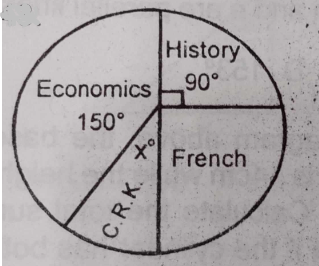
The pie chart shows the distribution of students in a secondary school class. If 30 students offered French, how many offered C.R.K?
Attached Figure / Diagram
A
25
B
15
C
10
D
8
medium Difficulty
Verified Correct Answer: Option C
Step-by-Step Mathematical Solution
Total number of students (y) using the subject French
( 90 / 360 )º x Y = 30
Y = 30 x 4
Y = 120
History- 90º + French- 90º + Economics- 150º + CRK = 360º
CRK = 360º - 330º = 30º
Number that offered CRK:
( 30 / 360 )º x 120 = 10
Source: WAEC / JAMB / NECO Classroom Archive (Record #30945)
Physics
UTME / JAMB 1995
Scalars, Vectors & Relative Motion
Diagram
Solution
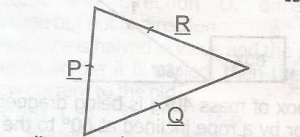
In the above fig, PQ and R are vectors, which of the following options, gives a correct relationship between the vectors?
Attached Figure / Diagram
A
P = Q + R
B
P = Q - R
C
P = R - Q
D
P + Q + R = O
medium Difficulty
Verified Correct Answer: Option A
Physical Principles & Numerical Solution
Addition of vectors:
P = Q + R
Source: WAEC / JAMB / NECO Classroom Archive (Record #41727)
Physics
UTME / JAMB 1995
Electrostatics & Capacitors
Diagram
Solution
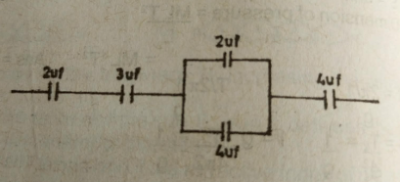
The resultant capacitance in the fig above is
Attached Figure / Diagram
A
15.0µF
B
9.8µF
C
1.3µF
D
0.8µF
medium Difficulty
Verified Correct Answer: Option D
Physical Principles & Numerical Solution
Capacitors in parallel = 4\(\mu\)f + 2 \(\mu\) f = 6\(\mu\) f
Capacitors in series =\(\frac{1}{C_{eff}}\) = \(\frac{1}{C_1} + \frac{1}{C_2} + \frac{1}{C_3} + \frac{1}{C_4}\)
\(\frac{1}{C_{eff}}\) = \(\frac{1}{2} + \frac{1}{3} + \frac{1}{6} + \frac{1}{4}\) = \(\frac{6 + 4 + 2 + 3}{12}\)
\(\frac{1}{C_{eff}}\) = \(\frac{15}{12}\)
C\(_{eff}\) = \(\frac{12}{15}\) = 0.8\(\mu\) f
Source: WAEC / JAMB / NECO Classroom Archive (Record #41732)
Physics
WAEC / WASSCE 1995
Current Electricity & Electric Circuits
Diagram
Solution
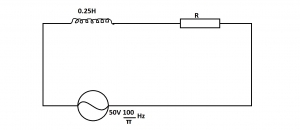
If the current in the resistor R in diagram above is 0.05A, calculate the p.d. across the inductor.
Attached Figure / Diagram
A
2.5V
B
25.0V
C
49.0V
D
50.0V
E
250.0V
medium Difficulty
Verified Correct Answer: Option A
Physical Principles & Numerical Solution
V= i \times \(_l\)
X\(_l\) = inductive reactance → 50
I = current → 0.05A
V = 0.05 \times 50
V = 2.5volt
Source: WAEC / JAMB / NECO Classroom Archive (Record #25093)
Chemistry
UTME / JAMB 1995
Acids, Bases, pH & Salts
Diagram
Solution
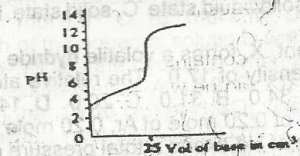
The option above shows the PH changes for the titration of a
Attached Figure / Diagram
A
strong acid versus strong base
B
weak acid versus strong base
C
strong acid versus weak base
D
weak acid versus weak base
medium Difficulty
Verified Correct Answer: Option B
Chemical Principles & Mechanism
Option B is a graph of weak a acid and strong base
Source: WAEC / JAMB / NECO Classroom Archive (Record #31527)
Chemistry
UTME / JAMB 1995
Periodic Table & Periodicity
Solution
A particle that contains 8 proton, 9 neutrons and 7 electrons could be written as?
A
O
B
O+
C
N
D
O-
medium Difficulty
Verified Correct Answer: Option B
Chemical Principles & Mechanism
The atomic number is the number of protons in the nucleus of an atom.
The number of protons define the identity of an element (i.e., an element with 8 protons is a carbon atom, no matter how many neutrons may be present).
If an atom loses or gains electrons, it will become a positively or negatively charged particle, called an ion.
The loss of one or more electrons results in more protons than electrons and an overall positively charged ion, called a cation.
Source: WAEC / JAMB / NECO Classroom Archive (Record #13628)
Chemistry
UTME / JAMB 1995
Water, Solutions & Solubility
In general, an increase in temperature increases the solubility of a solute in water because?
A
more solute molecules collide with each other
B
most solutes dissolve with the evoltion of heat
C
more solute molecules dissociate at hihger temperatures
D
most solutes dissolve with absorption of heat
medium Difficulty
Verified Correct Answer: Option D
Chemical Principles & Mechanism
No expanded working has been attached for this question yet. The verified answer is Option D.
Source: WAEC / JAMB / NECO Classroom Archive (Record #13644)