Question Library
Browse, filter, and study verified past examination questions with step-by-step mathematical reasoning.
Searching 18,000+ Questions...
Sifting topics, KaTeX formulas & verified solutions
Showing 21556–21570 of 29821 verified questions
Sort by:
Mathematics
WAEC / WASSCE 1996
Linear, Simultaneous & Quadratic Equations
Solution
(a) Copy and complete the table for \(y = 3x^{2} - 5x - 7\)
x
-3
-2
-1
0
1
2
3
4
\(y = 3x^{2} - 5x - 7\)
35
-7
-9
5
(b) Using a scale of 2cm = 1 unit along the x- axis and 2cm = 5 units along the y- axis, draw the graph of \(y = 3x^{2} - 5x - 7\).
(c) On the same axis, draw the graph of \(y + 3x + 2 = 0\).
(d) From your graph, find the : (i) range of values of x for which \(3x^{2} - 5x - 7 < 0\) ; (ii) roots of the equation \(3x^{2} - 2x - 5 = 0\).
medium Difficulty
Verified Correct Answer: Option
Step-by-Step Mathematical Solution
(a)
x
-3
-2
-1
0
1
2
3
4
\(y = 3x^{2} - 5x - 7\)
35
15
1
-7
-9
-5
5
21
(b)
(c) \(y + 3x + 2 = 0 \implies y = -3x - 2\)
when x = -2, y = 6 - 2 = 4.
when x = 3, y = -9 - 2 = -11.
(d) \(3x^{2} - 2x - 5 = 0 = 3x^{2} - 5x - 7 = -3x - 2\)
The roots of the equation \(3x^{2} - 2x - 5 = 0\) is when the line \(y = -3x - 2\) cuts the equation i.e. x = 1.0 or 1.7.
Source: Myschool Past Questions Archive (Record #54515)
Mathematics
WAEC / WASSCE 1996
Plane Geometry, Polygons & Circle Theorems
Solution
(a) Make d the subject of the formula \(S = \frac{n}{2}[2a + (n - 1) d]\).
(b) (i)
In the diagram, O is the centre of the circle, A, B and P are points on the circumference. Prove that < AOB = 2 < APB.
(ii)
Find the angles x, v and z in the diagram.
medium Difficulty
Verified Correct Answer: Option
Step-by-Step Mathematical Solution
(a) \(S = \frac{n}{2} [2a + (n - 1)d]\)
\(2S = n[2a + (n - 1) d]\)
\(\frac{2S}{n} = 2a + (n - 1)d\)
\(\frac{2S}{n} - 2a = (n - 1) d\)
\(d = \frac{\frac{2S}{n} - 2a}{(n - 1)}\)
= \(\frac{2S - 2an}{n(n - 1)}\)
(b)
(i) Given: circle ABP
To prove < AOB = 2 < APB
Construction : Join PO produced to Q.
Proof : /OA/ = /OB/ (radii)
\(\therefore x_{1} = x_{2} \) (base angles of isosceles triangle)
\(\therefore < AOQ = x_{1} + x_{2}\) (exterior angle of triangle AOP)
\(\therefore < AOQ = 2x_{2} (x_{1} = x_{2})\)
Similarly, < AOB = < BOQ - < AOQ.
= \(2y_{2} - 2x_{2} = 2(y_{2} - x_{2}) = 2 \times < APB\)
\(\therefore < AOB = 2 < APB.\)
(ii) \(z = 2x \) (angle subtended at the centre)
\(z = 2(126^\circ) = 252^\circ\)
\(\therefore x = 360^\circ - 252^\circ = 108^\circ\)
\(\therefore y = \frac{1}{2} \times 108^\circ = 54^\circ\)
\(x = 108^\circ ; y = 54^\circ ; z = 252^\circ\)
Source: Myschool Past Questions Archive (Record #54517)
Mathematics
WAEC / WASSCE 1996
Permutations, Combinations & Probability
Solution
(a) P and Q are points on the parallel of latitude 68.7^\circS, their longitudes being 124^\circW and 56^\circE respectively. What is their distance apart measured along the parallel of latitude? [Take R = 6400km, \(\pi = 3.142\)]. (Give your answers to 3 significant figures).
(b) A bag contains four red, three white and five green balls. (i) If one ball is picked at random, what is the probability that it is not green? (ii) if two balls are picked at random without replacement, what is the probability that one is red and the other white?
medium Difficulty
Verified Correct Answer: Option
Step-by-Step Mathematical Solution
(a)
Difference in longitudes = 124^\circ + 56^\circ = 180^\circ
Distance PQ = \(\frac{180^\circ}{360^\circ} \times 2\pi r\)
where \(r = R \cos \theta\)
\(/PQ/ = \frac{180}{360} \times 2 \times 3.142 \times R \cos 68.7^\circ\)
\(/PQ/ = 3.142 \times 6400 \times 0.3633\)
= \(7305.53 km\)
\(\approxeq 7300 km\) (3 sig. figs)
(b) Red balls = 4, white = 3 ; green = 5
Total = 4 + 3 + 5 = 12 balls.
(i) P(green) = \(\frac{5}{12}\)
P(not green) = \(1 - \frac{5}{12} = \frac{7}{12}\)
(ii) P(picking red and white) = P( red then white) or P(white then red)
= \(\frac{4}{12} \times \frac{3}{11} + \frac{3}{12} \times \frac{4}{11}\)
= \(\frac{2}{11}\)
Source: Myschool Past Questions Archive (Record #54519)
Mathematics
WAEC / WASSCE 1996
Trigonometry, Elevation & Bearings
Solution
Two men P and Q set off from a base camp R, prospecting for oil. P moves 20km on a bearing of 205^\circ and Q moves 15km on a bearing of 060^\circ. Calculate the:
(a) distance of Q from P ;
(b) bearing of Q from P.
(Give your answer in each case to the nearest whole number)
medium Difficulty
Verified Correct Answer: Option
Step-by-Step Mathematical Solution
(a) By cosine rule, \(/PQ/^{2} = 20^{2} + 15^{2} - 2 \times 20 \times 15 \times \cos 145^\circ\)
= \(400 + 225 - 600 \cos 145^\circ\)
= \(625 + 600 \times 0.8192\)
= \(491.52 + 625\)
\(/PQ/^{2} = 1116.52 \implies /PQ/ = \sqrt{1116.52} = 33.41\)
\(\approxeq 33km\) ( to the nearest whole number)
(b) By sine rule,
\(\frac{\sin < QPR}{15} = \frac{\sin 145}{33.41}\)
\(\sin < QPR = \frac{15 \sin 145}{33.41}\)
\(\sin < QPR = \frac{15 \times 0.5736}{33.41} = 0.2575\)
\(< QPR = 14.92^\circ\)
\(\therefore\) Bearing of Q from P = 25^\circ + 14.92^\circ = 39.92^\circ.
\(\approxeq 40^\circ\) (to nearest whole number)
Source: Myschool Past Questions Archive (Record #54520)
English Language
UTME / JAMB 1996
Concord (Subject-Verb Agreement)
Solution
Select the option that best explains the information conveyed in the sentence.
Imona couldn't have attended lectures yesterday
A
it was impossible that Imona attended lectures yesterday
B
It was possible that Imona didn't attend lectures yesterday
C
It was possible that Imona attended lectures yesterday
D
It was impossible that Imona didn't attend lectures yesterday
medium Difficulty
Verified Correct Answer: Option A
Grammar & Contextual Explanation
The sentence "Imona couldn't have attended lectures yesterday" suggests a situation where it is unlikely or impossible for Imona to have attended lectures on the specified day. The word "couldn't" implies a strong negation or impossibility. Option A, "It was impossible that Imona attended lectures yesterday," is the correct interpretation. It reflects the idea that attending lectures yesterday is not a possible or likely scenario for Imona.
Source: Myschool Past Questions Archive (Record #10743)
Physics
WAEC / WASSCE 1996
Current Electricity & Electric Circuits
The magnitude of the force required to make an object of mass M move with speed V in a circular path of radius R is given by the expression.
A
mr/v
B
(mr) 2/v
C
mv2/r
D
mv/2
E
mv/r
medium Difficulty
Verified Correct Answer: Option C
Physical Principles & Numerical Solution
No expanded working has been attached for this question yet. The verified answer is Option C.
Source: Myschool Past Questions Archive (Record #25205)
Physics
WAEC / WASSCE 1996
Current Electricity & Electric Circuits
Solution
A body of mass 4.2kg moving with velocity 10ms-1 due east, hits a stationary body of mass 2.8kg. If they stick together after collision and move with velocity V due east, calculate the value of V
A
3ms-1
B
6ms-1
C
7ms-1
D
15ms-1
E
17ms-1
medium Difficulty
Verified Correct Answer: Option B
Physical Principles & Numerical Solution
M1U = (M1 + M2)V = 4.2 x 10 = (4.2 = 2.8)V
∴ V = 4.2 x 10/7.0 = 6m/s
Source: Myschool Past Questions Archive (Record #25206)
Physics
WAEC / WASSCE 1996
Current Electricity & Electric Circuits
Solution
A body of mass 2kg is suspended from the ceiling of a lift with a light inextensible string. lf the lift moves upwards with acceleration of 2ms-2, calculate the magnitude of the tension in the string (g = 1Oms-2)
A
24N
B
20N
C
16N
D
4N
E
0N
medium Difficulty
Verified Correct Answer: Option A
Physical Principles & Numerical Solution
T - ma = mg
T = mg + ma = 2 x 10 + 2 x 2 = 24N
Source: Myschool Past Questions Archive (Record #25207)
Physics
WAEC / WASSCE 1996
Current Electricity & Electric Circuits
Solution
A stationary object of mass 4kg is set in motion by a net force of 5ON. If the object attains is speed of 5ms-1 in time. Calculate the value of t.
A
0.20s
B
0.40s
C
0.63s
D
0.80s
E
1.30s
medium Difficulty
Verified Correct Answer: Option B
Physical Principles & Numerical Solution
F = ma = MV/t ∴ t = MV/F = 20/50 = 0.40s
Source: Myschool Past Questions Archive (Record #25208)
Physics
WAEC / WASSCE 1996
Units, Measurements & Dimensional Analysis
Diagram
Solution
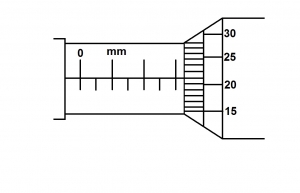
The diagram above represents a portion of a micrometer screw gauge in which the horizontal scale is in millimetres. What is the reading on the instrument?
Attached Figure / Diagram
A
3.72mm
B
3.50mm
C
3.30mm
D
3.28mm
E
3.22mm
medium Difficulty
Verified Correct Answer: Option E
Physical Principles & Numerical Solution
Micrometer screw gauge reading = Main scale reading + vernier scale reading
= 3 + 0.22 = 3.22mm
Source: Myschool Past Questions Archive (Record #25198)
Physics
WAEC / WASSCE 1996
Current Electricity & Electric Circuits
A loaded test-tube which floats upright in water is carefully and slightly depressed and then released. Which of the following best describes the sub-sequent motion of the test-tube?
A
Circular
B
Rotational
C
Random
D
Oscillatory
E
Translational
medium Difficulty
Verified Correct Answer: Option D
Physical Principles & Numerical Solution
No expanded working has been attached for this question yet. The verified answer is Option D.
Source: Myschool Past Questions Archive (Record #25199)
Physics
WAEC / WASSCE 1996
Linear Motion, Projectiles & Kinematics
Diagram
Solution
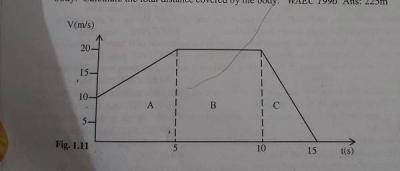
The diagram above illustrates the velocity-time graph of the motion of a body. Calculate the total distance covered by the body
Attached Figure / Diagram
A
50m
B
65m
C
175m
D
225m
E
300m
medium Difficulty
Verified Correct Answer: Option D
Physical Principles & Numerical Solution
Distance of A = 1/2 x (10 + 20) x 5
= 1/2 x 30 x 5 = 75m. Distance of B = 20 x 5 = 100m
Distance of C = 1/2 x 5 x 20 = 50/225
∴ Total distance is 225m
Source: Myschool Past Questions Archive (Record #25200)
Physics
WAEC / WASSCE 1996
Newton's Laws, Momentum & Collisions
Solution
A ball of mass 5.0kg hits a smooth vertical wall normally with a speed of 2ms-1 and rebounds with the same speed. Determine the impulse experienced by the ball
A
20.0kg ms-1
B
10.0kg ms-1
C
5.0kg ms-1
D
1.3kg ms-1
E
0.0kg ms-1.
medium Difficulty
Verified Correct Answer: Option A
Physical Principles & Numerical Solution
Impulse = Ft = mu - (-mu)
= mu + mu = 2mu = 2 x 5 x 2 = 20kgms-1
Source: Myschool Past Questions Archive (Record #25201)
Physics
WAEC / WASSCE 1996
Linear Motion, Projectiles & Kinematics
Solution
A rocket is launched from the surface of the earth. If the radius of the earth is 6.4 x 10⁶m and the acceleration of free fall due to gravity is 1Oms-1 calculate the escape velocity of the rocket.
A
2.53 x 10⁴ms-1
B
1.13 x 10⁴ms
C
8.00 x 10³ms-1
D
4.23 x 10³ms-1
E
6.41 x 10⁴ms-1
medium Difficulty
Verified Correct Answer: Option B
Physical Principles & Numerical Solution
V = √2gR
V = √2 x 10 x 6.4 x 102
1.13 x 10⁴ms
Source: Myschool Past Questions Archive (Record #25202)
Physics
WAEC / WASSCE 1996
Work, Energy, Power & Simple Machines
Solution
The velocity ratio and efficiency of a system of pulleys are 6 and 80% respectively. How much effort is required to lift a load of mass 120kg with this system? (g=10ms-2)
A
25N
B
90N
C
96N
D
250N
E
960N
medium Difficulty
Verified Correct Answer: Option D
Physical Principles & Numerical Solution
Efficiency = M.A/V.R x 100%
= 80/100 = 120 x 10/E
E = 250N
Source: Myschool Past Questions Archive (Record #25203)