Question Library

Browse, filter, and study verified past examination questions with step-by-step mathematical reasoning.
Launch Interactive Practice
Searching 18,000+ Questions... Sifting topics, KaTeX formulas & verified solutions
Showing 20836–20850 of 29821 verified questions
Sort by:
Biology WAEC / WASSCE 1998 Reproduction in Plants & Animals
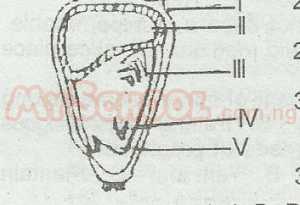
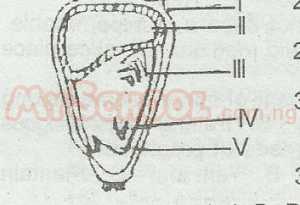
The part labelled II in the diagram is the
Attached Figure / Diagram
Question diagram
A
plumule
B
endosperm
C
radicle
D
coleorhiza
E
pericarp
medium Difficulty
Biology WAEC / WASSCE 1998 Reproduction in Plants & Animals
The part labelled IV in the diagram is the
Attached Figure / Diagram
Question diagram
A
plumule
B
endosperm
C
radicle
D
coleoptile
E
pericarp
medium Difficulty
Biology WAEC / WASSCE 1998 Digestive System & Feeding Mechanisms
Which of the following is not a function of the blood?
A
Maintenance of body temperature
B
Formation of clot
C
Distribution of bile
D
Transportation of excretory materials.
E
Distribution of hormones
medium Difficulty
Biology WAEC / WASSCE 1998 Reproduction in Plants & Animals
Which of the following is a feature of wind pollinated flowers?
A
Large and brightly coloured petals
B
Possession of sweet scent
C
Presence of nectar
D
Presence of pollen guides
E
Smooth, light and numerous pollen grains
medium Difficulty
Biology WAEC / WASSCE 1998 Nutrition in Plants & Animals (Photosynthesis & Food Substances)
In testing for starch in a leaf the function of alcohol is to
A
kill the cells of the leaf
B
soften the veins of the leaf
C
aid iodine to penetrate the cells
D
be a component of the heating bath
E
extract the chlorophyll from the leaf
medium Difficulty
Biology WAEC / WASSCE 1998 Basic Ecological Concepts, Ecosystems & Biomes
Which of the following processes removes CO2 from the atmosphere?
A
Respiration
B
Photosynthesis
C
Transpiration
D
Excretion
E
Combustion
medium Difficulty
Biology WAEC / WASSCE 1998 Basic Ecological Concepts, Ecosystems & Biomes
The role of bacteria in the nitrogen cycle includes the following except
A
fixing atmospheric nitrogen
B
converting ammonia to nitrites
C
converting nitrites to nitrates
D
converting carbohydrates to carbondioxide
E
causing the decay of dead organisms
medium Difficulty
Biology WAEC / WASSCE 1998 Nutrition in Plants & Animals (Photosynthesis & Food Substances)
The mode of nutrition which describes feeding habit in animals is
A
autotrophic
B
holozoic
C
holophytic
D
saprophytic
E
photosynthetic
medium Difficulty
Biology WAEC / WASSCE 1998 Variety of Organisms & Classification of Living Things
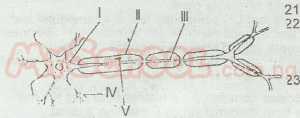
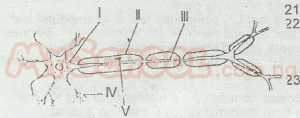
The cell body in the diagram labelled
Attached Figure / Diagram
Question diagram
A
I
B
II
C
III
D
IV
E
V
medium Difficulty
Biology WAEC / WASSCE 1998 Nervous, Hormonal Coordination & Sense Organs
The function of the part labelled II in the diagram is to
Attached Figure / Diagram
Question diagram
A
transmit impulse from one end of the cell to the other
B
manufacture food for the cell
C
protect the axon
D
produce energy for the cell
E
detect electrical impulses
medium Difficulty
Biology WAEC / WASSCE 1998 Nervous, Hormonal Coordination & Sense Organs
The organ responsible for equalising air pressure in the ear is the
A
sacculus
B
utriculus
C
Eustachian tube
D
ampulla
E
air ossicle
medium Difficulty
Biology WAEC / WASSCE 1998 Variety of Organisms & Classification of Living Things
Which of the following organisms lacks a reproductive organ?
A
Chlamydomonas
B
Toad
C
Pride of Barbados
D
Cockroach
E
Man
medium Difficulty
Biology WAEC / WASSCE 1998 Reproduction in Plants & Animals
Which of the following mammalian features acts as a shock-absorber to the developing embryo?
A
Amniotic fluid
B
Umbilical cord
C
Placenta
D
Amnion
E
Chorion
medium Difficulty
Biology WAEC / WASSCE 1998 Reproduction in Plants & Animals
The collective name for the female parts of the flower is
A
gynoecium
B
androecium
C
ovary
D
stigma
E
style
medium Difficulty
Biology WAEC / WASSCE 1998 Reproduction in Plants & Animals
If the petals of a flowering plant are removed. Which of the following processes is likely to be affected?
A
Transpiration
B
Pollination
C
Germination
D
Photosynthesis
E
Dispersal
medium Difficulty
Page 1390 of 1989