Question Library
Browse, filter, and study verified past examination questions with step-by-step mathematical reasoning.
Searching 18,000+ Questions...
Sifting topics, KaTeX formulas & verified solutions
Showing 20566–20580 of 29821 verified questions
Sort by:
Physics
WAEC / WASSCE 1998
Atomic, Quantum, Nuclear Physics & Electronics
It is always not possible to determine exactly and simultaneously the position and momentum of a particle. This statement is known as the
A
De broglie's law
B
Heisenberg's uncertainty principle
C
Compton effect
D
Frank-Hertz experimental law
E
Wave particle paradox
medium Difficulty
Verified Correct Answer: Option B
Physical Principles & Numerical Solution
No expanded working has been attached for this question yet. The verified answer is Option B.
Source: Myschool Past Questions Archive (Record #33701)
Physics
WAEC / WASSCE 1998
Current Electricity & Electric Circuits
Solution
Connect the circuit as shown above. Set the value of R= 30\(\Omega\). Close the key and obtain a balance at point T on the potentiometer wire PQ. Read and record the length TQ = L Evaluate L\(^{-1}\) and R\(^{-1}\), Repeat the experiment for R= 20, 10.5, 3 and 1\(\Omega\) respectively. In each case, determine and record the corresponding values of LL\(^{-1}\) and R\(^{-1}\). Remove the resistance box from the circuit and then determine the length \(L_o\) corresponding to R= 0. Tabulate your readings. Plot a graph at \(R_1\) on the vertical axis, and L\(^{-1}\) on the horizontal axis, starting both axes from the origin (0,0). Determine the slope, s of the graph and its intercept, I on the vertical axis.
Evaluate: (i) k = 1\(^{-1}\)
(ii) \(\frac{Lo}{S}\)
State two precautions taken to ensure accurate result
(b)i. Using your graph, determine the value of L for which R =15\(\Omega\).
ii. if the intercept I = 0.5+ y\(^{-1}\), use your graph to determine the value of y.
iii. Explain what is meant by the e.m.f.of a cell.
A
adhension between water and glass molecules is greater than the sdhension between water molecules
B
cohension between water molecules is greater then the adhension between glass and water molecule
C
molecules of water near the glass move faster than the molecules at the centre of the tube
D
molecules of water at the water-air boundary are often attracted to the centre of the tube
E
weight of the water pulls the centre part of the surface down
medium Difficulty
Verified Correct Answer: Option A
Physical Principles & Numerical Solution
Table of values/observation
S/N
R\(\Omega\)
L(cm)
R\(^{-1}\)(\(\Omega^{-1}\))
L\(^{-1}\)(cm\(^{-1}\))
1
30.00
88.80
0.033
0.01126
2
20.00
84.60
0.050
0.01182
3
10.00
79.80
0.100
0.01253
4
5.00
71.50
0.200
0.01399
5
3.00
69.50
0.333
0.01439
6
1.00
42.40
1.000
0.02358
Slope (s) = \(\frac{\bigtriangleup {R^{-1}(\Omega)}}{\bigtriangleup {L^{-1}(cm^{-1})}} = \frac{1.08-(-0.96)}{0.002175-0.00175}\)
= \(\frac{1.08-(-0.96)}{0.002175-0.00175} = \frac{2.04}{0.00425}\) = 4800cm\(\Omega ^{-1}\)
I = -1.14(\(\Omega ^{-1}\)
(i) K I\(^{-1}\) \(\frac{1}{I} = \frac{-1}{1.14}\) = 0.877\(\Omega\)
(ii) C = \(\frac{L_{o}}{S} = \frac{78.50cm}{4800cm \Omega ^{-1}}\) = 0.01635\(\Omega\)
Precautions:
- The key was opened when readings were not taken.
- I ensured tight connections.
- I avoided parallax error when reading potentiometre.
(b)i. When R = 15\(\Omega\), R\(^{-1}\) = \(\frac{1}{R} = \frac{1}{15}\) = 0.0666\(\Omega ^{-1}\)
From the graph, L\(^{-1}\) = 0.001175, \(\frac{1}{L}\) 0.01175, L = \(\frac{1}{0.01175}\)
= 85.11cm
I = 0.5+y\(^{-1}\), -1.14 = 0.5 + y\(^{-1}\), y\(^{-1}\) = 1.14 - 0.5
= -0.64, \(\frac{1}{y}\) = -0.64
\(\therefore\) y = \(\frac{-1}{0.64}\) = -1.6
(iii) e.m.f. is the p.d between the terminals of a cell when an open circuit or the work done in moving unit charge round a complete circuit.
Source: Official Exam / Past Question Archive
Physics
UTME / JAMB 1998
Current Electricity & Electric Circuits
Diagram
Solution
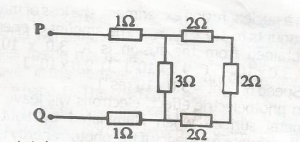
The total resistance measured at PQ in the diagram above is
Attached Figure / Diagram
A
18.0Ω
B
11.0Ω
C
4.0Ω
D
2.0Ω
medium Difficulty
Verified Correct Answer: Option C
Physical Principles & Numerical Solution
The three 2 ohms are in series, therefore the total resistance is
\(R=R_1+R_2+R_3\)
\(R_ {total} =2+2+2= 6\) ohms.
resketching circuit;
6 ohms is used to replace the three 2 ohms which is therefore placed by the 3 ohms resistor.
The 3 ohms and 6 ohms resistors are in parallel, so the combined resistance is
\(R=\frac{R_1xR_2}{R_1+R_2}\)
\(R= \frac{3\times6}{3+6}\)
\(R=\frac{18}{9}=2\) ohms.
Resketching circuit:
The 2 ohms is used to replace the 3 ohms and 6 ohms laying side-by-side.
Therefore, the 3 resistors (1 ohm, 1 ohm, and 2 ohms) are in series.
Thus, the total resistance is
\(R= (R_1+R_2+R_3)\)
\(R_{total} =1+1+2=4\) ohms.
Therefore, the total resistance measured at PQ is 4 ohms.
Source: Myschool Past Questions Archive (Record #41744)
Physics
UTME / JAMB 1998
Magnetism, Electromagnetism & AC Circuits
Diagram
Solution
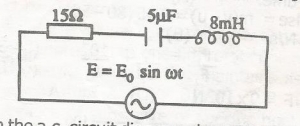
In the AC circuit diagram above, the resonance frequency is
Attached Figure / Diagram
A
5000π Hz
B
2500π Hz
C
5000/π Hz
D
2500/π Hz
medium Difficulty
Verified Correct Answer: Option D
Physical Principles & Numerical Solution
resonance frequency \(f_r\) = \(\frac{ 1}{ 2\pi \sqrt{LC}}\)
\(f_r\) = \(\frac{1}{2\pi \sqrt{5\times10^{-6} \times 8\times 10^{-3}}}\)
\(f_r\) = \(\frac{1}{ \pi 0.0004}\)
\(f_r\) = \(\frac{ 2500}{\pi}\)
Source: Myschool Past Questions Archive (Record #41745)
Physics
UTME / JAMB 1998
Atomic, Quantum, Nuclear Physics & Electronics
In photoelectric effect, electrons will leave the metal surface when illuminated by light of appropriate frequency if the photon energy is
A
greater than the work function
B
less than the work function
C
equal to the work function
D
equal to the maximium kinetic energy of the electron
medium Difficulty
Verified Correct Answer: Option A
Physical Principles & Numerical Solution
No expanded working has been attached for this question yet. The verified answer is Option A.
Source: Myschool Past Questions Archive (Record #27676)
Physics
WAEC / WASSCE 1998
Linear Motion, Projectiles & Kinematics
Solution
(a) Explain the term uniform acceleration
(b)(i) Sketch and describe the velocity-time graph for the motion of a ball from the time it is projected vertically upwards until it returns to the point of projection.
(ii) Neglecting air resistance and using ycur sketch, explain how the acceleration of free fall due to gravity g, and the maximum height attained when the ball is projected vertically upwards can be determined.
(c) A stone is projected vertically upwards with a velocity of 20ms\(^{-1}\). Two seconds later, a second stone is similarly projected with the same velocity. When the two stones meet, the second one is rising at a velocity of 10ms\(^{-1}\). Neglecting air resistance, calculate the:
(i) length of time the second stone is in motion before they meet,
(ii) velocity of the first stone when they meet (Take g as 10ms\(^{-2}\))
medium Difficulty
Verified Correct Answer: Option
Physical Principles & Numerical Solution
(a) A body is said to be moving with uniform acceleration when its time rate of increase of velocity is constant. It is measured in m/s\(^2\). It is a vector quantity.
The above sketch shows the v-t graph of the ball. The velocity decreases uniformly from A to zero (p) at the top of K its flight in a time kp. P , Va It then increases in velocity uniformly as it returns to the point of projection A.
(ii) The magnitude of the slope of the line AP = g or Ap\(^-\) = g, where g = acceleration of free fall due to gravity. The height attained when the ball is thrown up is equal to the area of the triangle AKP. The distance it falls from its maximum height is equal to the area of the triangle A\(^-\)PC which is equal to triangle AKP.
(c)(i) The second stone moves upwards and its acceleration g = 10m/s\(^2\). From equation v = u - gt
10 = 20 - 10t -10 = -10t
t = 1
The second stone has been in air for 1s before they met.
(ii) The first stone has been moving for (1 + 2)s = 3s
From equation v = u + gt
= 2 - (10 x 3) = 20 - 30 = -10m/s
The minus sign means the first stone is moving down and its velocity is 10m/s.
Source: Myschool Past Questions Archive (Record #54709)
Physics
WAEC / WASSCE 1998
Temperature, Thermometry & Thermal Expansion
Solution
(a) Distinguish between heat and temperature.
(b) State two physical properties of substances which may be used to measure temperature.
(c) State two reasons why mercury is preferred to alcohol as a thermometric liquid.
(d)(i) Describe how a mercury-in-glass thermometer is calibrated.
(ii) State two precautions necessary to ensure an accurate result.
(e) Explain how land and sea breezes occur.
medium Difficulty
Verified Correct Answer: Option
Physical Principles & Numerical Solution
(a) Heat is a form of energy due to temperature gradient while temperature is the degree of hot-ness or cold-ness of a body.
(b)(i) The change in volume expansion of a fixed mass of a liquid.
(ii) The change in volume of a gas at constant pressure.
(iii) The change in electrical resistance of a substance.
(iv) The change in e.m.f generated in a thermo-couple. (Note: Any correct two)
(c)(i) It does not wet glass (unlike alcohol) (ii) It is opaque and easily seen (unlike alcohol) (iii) It is a
better conductor of heat. (iv) It measures higher temperature than alcohol. (Note: Any correct two)
(d) Support the thermometer vertically ensuring the bulb is covered with melting pure ice shavings. Allow the mercury thread to fall till its level remains steady. Mark this position on the thermometer as the lower fixed point. Suspend the thermometer in the steam of a hypsometer. Allow the mercury thread to rise until its level remains steady. Mark this position on the thermometer as the steam point. Sub-divide the fundamental interval into a number of equal parts. Precautions
(i) The thermometer bulb should not be placed in the boiling water of the hypsometer.
(ii) The thermometer should be inserted in the hypsometer such that the mercury thread is visible just above the top of the apparatus.
(iii) Some few minutes should be allowed to pass when the mercury thread is steady before making the thermometer.
(iv) One should ensure that the steam is at atmospheric pressure. (Note: Any correct two)
(e) The breezes are due to the fact that the specific heat capacity of water is greater than that of land. During the day the land is hotter than the sea. A low pressure area is created on the land and cooler air from the sea blows into the land. This wind is called sea breeze. At night the sea is warmer than the land. A low pressure area is created over the sea, resulting in cooler air blowing from the land where the pressure is higher into the sea. This is called land breeze.
Source: Myschool Past Questions Archive (Record #54710)
Physics
WAEC / WASSCE 1998
Current Electricity & Electric Circuits
Solution
(a)(i) Describe, with the aid of a circuit diagram, an experiment to measure the resistance of a wire given an ammeter of low resistance, a battery, a key, a rheostat, va high-resistance voltmeter and some connecting wires.
(ii) State two precautions necessary to obtain an accurate result.
(b) Using the experimental result and any necessary measurements, explain how the resistivity of the wire may be determined.
(c) Two cells, each of e.m.f. 2V and internal resistance 0.552, are connected in series. They are made to supply current to a combination of three resistors, one of resistance 20 connected in series to a parallel combination of two other resistors each of resistance 3Q. Draw the circuit diagram and calculate the:
(i) current in the circuit
(ii) potential difference across the parallel combination of the resistors
(iii) lost volts of the battery.
medium Difficulty
Verified Correct Answer: Option
Physical Principles & Numerical Solution
(a)
Description: The circuit is set up as shown above. The key (k) is closed. The rheostat (R) is adjusted so that lowest current is flowing. Ammeter and voltmeter readings (I and V) are recorded. Adjust rheostat to increase current. Ammeter and voltmeter readings are recorded for other positions of the rheostat. Values of (are plotted against values of I. Slope, which is the value of the resistance is determine.
Precautions;
i) Kcy should be removed when readings are not taken
ii) Connections should be tight
(iii) Parallax' error when reading ammeter and voltmeter should be avoided
(iv) Only low current should be used
v) Zero error of the meters should be avoided. Note: Any correct two) Resistance, R = P'/A where = length of wire, A = cross sectional area, p = resistivity )f wire. But slope, S of graph = R. Hence S = P'/A
Measure I with a metre rule. Measure diameter with a micrometer screw gauge and determine A. Substitute p = \(\frac{SA}{I}\)
c) Diagram
i) Total e.m.f. = 4V
Total resistance = 1 + 2 + \(\frac{3 \times 3}{ 2 \times 3}\)
= 3 + 1\(\frac{1}{2}\)
= \(\frac{1}{2} \Omega\)
E = IR\(_T\),
= E/R
:.Current, I = 4/9 x 2/1
= 8/9;
A = 0.9A
(ii) P.d = IR = 8/9 x 3/2 = 4/3 = 1.3V
(iii) Lost volts = Ir = \(\frac{8}{9}\) x 1 = \(\frac{8}{9} = 0.9V\)
Source: Myschool Past Questions Archive (Record #54711)
Physics
WAEC / WASSCE 1998
Atomic, Quantum, Nuclear Physics & Electronics
Solution
(a) Explain the term photoelectric effect.
(b)
The diagram above represents a photocell with its associated electric circuit. Identify each of the physical quantities
represented by the letters A, B, C, D, E and F
(c) What factor determines the: (i) current produced by the photocell
(ii) maximum kinetic energy of the photoelectrons?
(d) State one similarity and one difference between photoemission and evaporation
(e) Name two methods by which a beam of free electrons may be produced other than photoemission
(f) State two applications of photoelectric effect.
(g) A light wavelength 5.0 x 10\(^{-7}\) m is incident on metal resulting in photoemission of electrons. If the work function of the metal is 3.04 x 10\(^{-19}\)J, calculate the:
(i) frequency of the light
(ii) energy of the incident photon,
(iii) maximum kinetic energy of the photoelectrons (Speed of light = 3.00 x 10⁸ms\(^{-1}\); Planck's constant = 6.6 x 10\(^{-34}\)Js).
medium Difficulty
Verified Correct Answer: Option
Physical Principles & Numerical Solution
(a) When EM radiation of appropriate frequency or wavelength is incident on a metal surface, it causes electrons to be emitted from the surface. This phenomenon is called photoelectric effect. It is a surface phenomenon. Emission is instantaneous and K.E. of emitted electrons depend on frequency or wavelength of incident photons.
(b) A = Incident light or EM radiations
B = Cathode
C = Photoelectrons
D = Anode
E = Vacuum (Evacuated space)
F = Glass tube
(c)(i) Intensity of the incident radiation
(ii) Energy or frequency of the incident radiation.
(d) Similarities
(i) In both, particles are emitted
(ii) Both are surface phenomenon
(iii) Both involves energy changes
Difference
(i) Evaporation involves molecules while photoemission involves electrons.
(ii) Evaporation causes cooling while photoemission does not.
(e)(i) Thermionic emission.
(ii) Ionization of gases.
(iii) Field emission
(f) Photocells can be used.
(i) To open or close doors automatically
(ii) In automatic switching device.
(iii) In television cameras
(iv) As a burglar alarm
(v) As safety devices in paper mills and related industries
(vi) To produce sounds of varying intensities on film tracks.
Source: Myschool Past Questions Archive (Record #54713)
Physics
WAEC / WASSCE 1998
Equilibrium of Forces, Moments & Flotation
Solution
You are provided with a uniform metre rule, a knife edge and a body m of mass 50g. Suspend the given body m by means of a thread from 1.0cm mark of the metre rule. Balance the loaded metre rule on the knife-edge as shown in the diagram above. Determine and record the value of x when the metre rule is in horizontal equilibrium. Evaluate \(\frac{1}{x}\). Repeat the experiment for values of m = 70, 90, 110, 130 and 150g respectively. In each case, determine and record the corresponding values of x and \(\frac{1}{x}\). Tabulate your readings. Plot a graph of m on the vertical axis and \(\frac{1}{x}\) on the horizontal axis, starting both axes from the origin (0,0). Determine the slope s, of the graph and the value of m for which /\(\frac{1}{x}\) = 0. State two precautions taken to ensure accurate results.
(b)i. Using your graph, determine the value of x for which m = 0.
(ii) State two conditions necessary to maintain the metre rule in the experiment above, in equilibrium.
(iii) Using your graph, determine the value of x for which m = 100g.
medium Difficulty
Verified Correct Answer: Option
Physical Principles & Numerical Solution
Table of values/Observation
S/N
m(g)
x(cm)
(cm)
1
50.00
49.75
0.0202
2
70.00
39.65
0.0252
3
90.00
35.10
0.0285
4
110.00
30.75
0.0325
5
130.00
27.40
0.0365
6
150.00
25.00
0.0400
Slope (s) = \(\frac{\bigtriangleup {m(g)}}{\bigtriangleup {\frac {1}{x}(cm^{-1})}}\) = \(\frac{130-10}{0.04-0.0145}\)
\(\frac{140}{0.0255}\) = 4705.88(g cm)
Deduction: When \(\frac{1}{x}\) = 0, m = \(\frac{1}{x}\)66.00g
Precaution:
- l avoided draught by switching off the fans.
- I ensure that the suspended mass did not touch the table.
- I avoided error due to parallax when reading the metre rule
- Zero error of the metre rule was noted.
(b)i. From the graph, when m = 0, \(\frac{1}{x}\) = 0.0125
\(\therefore\) \(\frac{1}{x} = \frac{1}{0.0125}\) = 80 cm
(1) Sum of upward forces = sum of downward forces.
(2) Algebraic sum of all the moments about the pivot is Zero.
ii. when m = 100g. X = 0.0305
\(\therefore\) \(\frac{1}{x} = \frac{1}{0.0305}\) = 32.97cm
Source: Myschool Past Questions Archive (Record #60143)
Physics
WAEC / WASSCE 1998
Reflection, Refraction & Dispersion of Light
Solution
Trace the outline PQRS of the glass block on a sheet of paper, as shown in the diagram. Remove the block Mark a position 0 very close to P. Draw the normal NOG From point G, measure and mark out Points \(B_1\) \(B_2\) \(B_3\) \(B_4\) and \(B_5\) along with line GR at distances 1, 2, 3, 4 and 5cm respectively from G. Replace the glass block on the outline PORS Erect a pin at 0 and another at \(B_1\). Now fx a pin at \(T_1\) such that the pins at \(T_1\) and \(B_1\) are in line with the pin at O when viewed through the side SR of the glass block. Remove the glass block. Join the line O\(B_1\) and \(B_1\)\(T_1\). Measure and record the angles x and y. Evaluate sin x and y. Repeat the experiment with the pin at \(B_1\) fixed at \(B_2\), \(B_3\), \(B_4\) and \(B_5\) respectively while the pin at O remains unaltered. In each case, measure and record the values of x, y, sin x, and cos y. Tabulate your readings. Plot a graph of sin x on the vertical axis and cos y on the horizontal.axis, starting both axes from the origin (0,0). Calculate the slope, s of the graph. Evaluate K= \(\frac{1}{s}\). State two precautions taken to ensure accurate results. [Attach your tracings to your answer booklet]
(b)i. State Snell's law of refraction and explain why reaction Occurs at the boundary between two media.
ii. Differentiate refraction from diffraction.
iii. State two conditions necessary for total internal reflection to occur in a medium.
medium Difficulty
Verified Correct Answer: Option
Physical Principles & Numerical Solution
Table of values/observation
S/N
X^\circ(degree)
y^\circ (degree)
Sin x
Cos y
1
10.00
74.00
0.1736
0.2756
2
20.00
61.50
0.3420
0.4772
3
27.50
47.00
0.4617
0.6820
4
34.00
33.5
0.5592
0.8339
5
40.00
26.00
0.6428
0.8988
6
44.00
14.00
0.6947
0.9703
Slope (s) = \(\frac{\bigtriangleup {\text {sin x}}}{\bigtriangleup {\text {cos y}}} = \frac{0.69-0.03}{0.97-0.1}\)
= \(\frac{0.66}{0.87}\) = 0.7586 = 0.76
K = \(\frac{1}{S} = \frac{1}{0.7586}\) = 1.318 \(\approx\) 1.32
Precautions:
I ensured that the optical pins were vertical
l ensured reasonable spacing of pins.
I used a sharp pencil.
l avoided parallax error in reading the protractor.
(b)i. \(\frac{\text {sin i}}{\text {sin r}}\) = constant for a given pair of media where
i = angle sin r of incidence and
r = angle of retraction.
(ii) Retraction is the bending of rays at the interface of two media while diffraction is the spreading out of rays of light around the edges of obstacles or aperture.
(iii)(1) Light must travel from a dense medium to a less dense medium.
(2) The angle of incidence in the dense medium must be greater than the critical angle.
Source: Myschool Past Questions Archive (Record #60144)
Physics
WAEC / WASSCE 1998
Current Electricity & Electric Circuits
Solution
Connect the circuit as shown above. Set the value of R= 30\(\Omega\). Close the key and obtain a balance at point T on the potentiometer wire PQ. Read and record the length TQ = L Evaluate L\(^{-1}\) and R\(^{-1}\), Repeat the experiment for R= 20, 10.5, 3 and 1\(\Omega\) respectively. In each case, determine and record the corresponding values of LL\(^{-1}\) and R\(^{-1}\). Remove the resistance box from the circuit and then determine the length \(L_o\) corresponding to R= 0. Tabulate your readings. Plot a graph at \(R_1\) on the vertical axis, and L\(^{-1}\) on the horizontal axis, starting both axes from the origin (0,0). Determine the slope, s of the graph and its intercept, I on the vertical axis.
Evaluate: (i) k = 1\(^{-1}\)
(ii) \(\frac{Lo}{S}\)
State two precautions taken to ensure accurate result
(b)i. Using your graph, determine the value of L for which R =15\(\Omega\).
ii. if the intercept I = 0.5+ y\(^{-1}\), use your graph to determine the value of y.
iii. Explain what is meant by the e.m.f.of a cell.
medium Difficulty
Verified Correct Answer: Option
Physical Principles & Numerical Solution
Table of values/observation
S/N
R\(\Omega\)
L(cm)
R\(^{-1}\)(\(\Omega^{-1}\))
L\(^{-1}\)(cm\(^{-1}\))
1
30.00
88.80
0.033
0.01126
2
20.00
84.60
0.050
0.01182
3
10.00
79.80
0.100
0.01253
4
5.00
71.50
0.200
0.01399
5
3.00
69.50
0.333
0.01439
6
1.00
42.40
1.000
0.02358
Slope (s) = \(\frac{\bigtriangleup {R^{-1}(\Omega)}}{\bigtriangleup {L^{-1}(cm^{-1})}} = \frac{1.08-(-0.96)}{0.002175-0.00175}\)
= \(\frac{1.08-(-0.96)}{0.002175-0.00175} = \frac{2.04}{0.00425}\) = 4800cm\(\Omega ^{-1}\)
I = -1.14(\(\Omega ^{-1}\)
(i) K I\(^{-1}\) \(\frac{1}{I} = \frac{-1}{1.14}\) = 0.877\(\Omega\)
(ii) C = \(\frac{L_{o}}{S} = \frac{78.50cm}{4800cm \Omega ^{-1}}\) = 0.01635\(\Omega\)
Precautions:
- The key was opened when readings were not taken.
- I ensured tight connections.
- I avoided parallax error when reading potentiometre.
(b)i. When R = 15\(\Omega\), R\(^{-1}\) = \(\frac{1}{R} = \frac{1}{15}\) = 0.0666\(\Omega ^{-1}\)
From the graph, L\(^{-1}\) = 0.001175, \(\frac{1}{L}\) 0.01175, L = \(\frac{1}{0.01175}\)
= 85.11cm
I = 0.5+y\(^{-1}\), -1.14 = 0.5 + y\(^{-1}\), y\(^{-1}\) = 1.14 - 0.5
= -0.64, \(\frac{1}{y}\) = -0.64
\(\therefore\) y = \(\frac{-1}{0.64}\) = -1.6
(iii) e.m.f. is the p.d between the terminals of a cell when an open circuit or the work done in moving unit charge round a complete circuit.
Source: Myschool Past Questions Archive (Record #60145)
English Language
WAEC / WASSCE 1998
Antonyms (Opposite in Meaning)
From the words lettered A to E below each of the following sentences, choose the word that is opposite in meaning to the underlined word.
By nature armed robbers are ruthless I have never seen a ........ one among them
A
humane
B
barbarous
C
forceious
D
mean
E
decent
medium Difficulty
Verified Correct Answer: Option A
Grammar & Contextual Explanation
No expanded working has been attached for this question yet. The verified answer is Option A.
Source: Myschool Past Questions Archive (Record #24499)
English Language
WAEC / WASSCE 1998
Antonyms (Opposite in Meaning)
From the words lettered A to E below each of the following sentences, choose the word that is opposite in meaning to the underlined word.
The taxi driver slowed while overtaking the lorry when the proper thing to do was for him to have.........
A
throttled
B
despatched
C
expedited
D
negotiated
E
accelerated
medium Difficulty
Verified Correct Answer: Option E
Grammar & Contextual Explanation
No expanded working has been attached for this question yet. The verified answer is Option E.
Source: Myschool Past Questions Archive (Record #24500)
English Language
WAEC / WASSCE 1998
Antonyms (Opposite in Meaning)
From the words lettered A to E below each of the following sentences, choose the word that is opposite in meaning to the underlined word.
The probationary workers do not have the same rights as .....staff
A
approved
B
dismissed
C
postponed
D
confirmed
E
provoked
medium Difficulty
Verified Correct Answer: Option A
Grammar & Contextual Explanation
No expanded working has been attached for this question yet. The verified answer is Option A.
Source: Myschool Past Questions Archive (Record #24501)