Question Library

Browse, filter, and study verified past examination questions with step-by-step mathematical reasoning.

Launch Interactive Practice
Searching 18,000+ Questions... Sifting topics, KaTeX formulas & verified solutions
Showing 19906–19920 of 29821 verified questions
Sort by:
Physics WAEC / WASSCE 1999 Magnetism, Electromagnetism & AC Circuits
Magnetic flux density is defined as the
A
total number of magnetic lines of force surrounding a magnet
B
number of magnetic lines of force per unit area normal to the magnetic field
C
strength of the magnetic field surrounding a current-carrying conductor
D
magnetic force exerted on a unit magnetic pole
medium Difficulty
Physics WAEC / WASSCE 1999 Magnetism, Electromagnetism & AC Circuits
The voltage and current in the primary of a transformer are 200V and 2Arespectively. lf the transformer is used to light ten 12 V, 30 W bulbs, calculate its efficiency.
A
100%
B
90%
C
75%
D
50%
medium Difficulty
Physics WAEC / WASSCE 1999 Current Electricity & Electric Circuits
Measure and record the e.m.f of the accumulator provided. Connect the circuit as shown in the diagram. With zero resistance in the resistance box, adjust the rheostat to obtain the maximum possible reading on the ammeter. Do not adjust the rheostat again throughout the experiment. Open the key. With R= 1\(\Omega\), close the key, read and record the reading of the ammeter I. Calculate 1\(^{-1}\) Repeat the experiment for R=2,3,4 and 5\(\Omega\) respectively. In each case, read and record the value of \(1_A\) and calculate the Corresponding value of l\(_{A}^{-1}\). Now connect the resistor Q in series into the circuit and without altering the setting of the rheostat, record the new ammeter readings \(l_B\) for R= 1,2,3, 4, and 5\(\Omega\). Calculate the corresponding value of \(l_B\) in each case. Tabulate all your readings. On the same graph and using the same axes and scales, plot the graphs of: (i) I\(_{A}^{-1}\)' on the vertical axis and R on the horizontal axis; (ii) l\(_{B}^{-1}\) on the vertical axis and R on the horizontal axis. Calculate the slopes \(S_A\) in (i) and \(S_B\) in (ii) above. Determine the difference D between the intercepts of the graphs on the vertical axis. State two precautions taken to ensure accurate results. (b) i. Explain why a battery of eight dry Leclanche cells, each of e.m.f. 1.5v is not normally used in place of a motor-car battery of 12V to start a car. ii. State two sources of e.m.f. other than the chemical cell.
A
Radioactive materials are stored in glass casings
B
Radioactive materials are handled with remote-controlled tongs
C
Technicians in nuclear stations wear radio-sensitive badges which are checked regularly.
D
Radioactive materials are kept in thick-walled lead containers
medium Difficulty
Physics WAEC / WASSCE 1999 Electrostatics & Capacitors
In a uniform electric field, the magnitude of the force on a charge of 0.2 C is 4N. Calculate the electric field intensity
A
20 N C-1
B
8 N C-1
C
5 N C-1
D
2 N C-1
medium Difficulty
Physics WAEC / WASSCE 1999 Calorimetry, Latent Heat & Change of State
A 10 \Omega coil takes 21 s to melt 10g of ice at 0ºC. Assuming no heat losses, determine the current in the coil. (Specific latent heat of fusion of ice = 336 Jg\(^{-1}\))
A
16A
B
5A
C
4A
D
3A
medium Difficulty
Physics WAEC / WASSCE 1999 Work, Energy, Power & Simple Machines
A point charge of magnitude 2μC is moved through a distance of 0.02 m against uniform field of intensity 25 Vm-1 Calculate the work done on the charge
A
5.0 x 10⁶J
B
1.0 x10⁻⁶J
C
5.0 x10⁻⁷J
D
1.0 x 10⁻²J
medium Difficulty
Physics WAEC / WASSCE 1999 Current Electricity & Electric Circuits
Bohr’s atomic model proves most successful for the explanation of the. I. structure of the hydrogen atom; II. line spectra of the hydrogen atom; III. Multi-electron atoms. Which of the statements above is/are correct?
A
I only
B
II only
C
I and II only
D
I and III only
medium Difficulty
Physics WAEC / WASSCE 1999 Waves, Sound & Vibrations
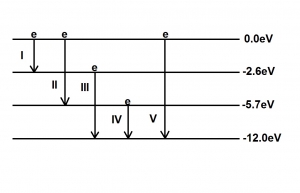
The diagram above illustrates the energy transitions of five electrons of an atom. Which of the transitions will produce the emission of longest wavelength?
Attached Figure / Diagram
Question diagram
A
I
B
II
C
III
D
IV
medium Difficulty
Physics WAEC / WASSCE 1999 Current Electricity & Electric Circuits
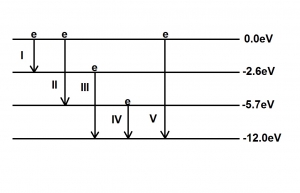
Which of the transitions will produce the emission of highest frequency?
Attached Figure / Diagram
Question diagram
A
V
B
IV
C
III
D
II
medium Difficulty
Physics WAEC / WASSCE 1999 Current Electricity & Electric Circuits
I. All elements emit and absorb characteristic spectra. II. Spectral analysis is an important method of identifying environmental pollutants. III. The chemical composition of stars could be determined using spectral analysis. Which of the statements above are correct?
A
I, II and III
B
II and III only
C
I and III only
D
I and II only
medium Difficulty
Physics WAEC / WASSCE 1999 Atomic, Quantum, Nuclear Physics & Electronics
A metal has work function of 4.375 eV Calculate its threshold frequency. (h = 6.6 x 10⁻³⁴Js; 1eV = 1.6 x 10⁻¹⁹J)
A
2.01 X 10¹⁵Hz
B
1.06x10¹⁵Hz
C
6.30 x 10¹⁴Hz
D
1.60 x 10¹⁴Hz
medium Difficulty
Physics WAEC / WASSCE 1999 Atomic, Quantum, Nuclear Physics & Electronics
The half-life of a radioactive substance is
A
its average life time
B
one-half the value of its decay constant.
C
the length of time needed by the substance to decay completely
D
the length of time during which the activity of the substance reduces by 50%.
medium Difficulty
Physics WAEC / WASSCE 1999 Atomic, Quantum, Nuclear Physics & Electronics
The half-life of a radioactive element is 5 Calculate its decay constant
A
0.113s-1
B
0.436 s-1
C
0.139 s-1
D
0.193 s-1.
medium Difficulty
Physics WAEC / WASSCE 1999 Atomic, Quantum, Nuclear Physics & Electronics
A sheet of paper is placed in the path of the following radiations: I. Alpha particles II. Beta particles III. Gamma rays. Which of the radiations will pass through the sheet of paper?
A
I only
B
II only
C
I and II only
D
II and III only
medium Difficulty
Physics WAEC / WASSCE 1999 Current Electricity & Electric Circuits
Which of the following are the essential parts of an atomic bomb?
A
Uranium and neutrons
B
Radium and polonium
C
Nitrogen and neutrons
D
ranium and α - particles.
medium Difficulty
Page 1328 of 1989