Question Library
Browse, filter, and study verified past examination questions with step-by-step mathematical reasoning.
Searching 18,000+ Questions...
Sifting topics, KaTeX formulas & verified solutions
Showing 121–135 of 1709 verified questions
Sort by:
Physics
WAEC / WASSCE 2020
Mechanics and Properties of Matter
Solution
An elastic material of length 3m is to be stretched to reduce an extension three times its original length. Calculate the force required to produce the extension
medium Difficulty
Verified Correct Answer: Option
Physical Principles & Numerical Solution
Calculation of the force needed to produce extension of material
F = Ke
= 988.3 x 3 x 3
= 8840.74N
Source: Myschool Past Questions Archive (Record #59504)
Physics
WAEC / WASSCE 2020
Mechanics and Properties of Matter
Solution
The velocity v, of a wave in a stretched string, depends on the tension T, in the spring and the mass per unit length of the spring. Obtain an expression for v in terms of T and u, using the method of dimensions.
medium Difficulty
Verified Correct Answer: Option
Physical Principles & Numerical Solution
Expression for v
c = kT\(^a\)U\(^b\), k is dimensionless
[v] = k[T]\(^a\)[\(\mu\)]\(^b\)
Lt\(^{-1}\) = kM\(^{a \div b}\) L\(^{a + b}\) T\(^{-2a}\)
For T, -1 = 2a
a = \(\frac{1}{2}\)
For M,
0 = a + b
b = -a
= \(\frac{1}{2}\)
v = KT\(^{\frac{1}{2}}\)\(\mu^{- \frac{1}{2}}\)
OR
v = k\(\sqrt{\frac{T}{\mu}}\)
Source: Myschool Past Questions Archive (Record #59509)
Physics
WAEC / WASSCE 2020
Mechanics and Properties of Matter
Solution
A satellite launched with velocity V\(_E\) just escapes the earth's gravitational attraction. Given that the radius of the earth is R, show that V\(_E\) = \(\sqrt{20R}\) [g = 10ms\(^{-2}\)
medium Difficulty
Verified Correct Answer: Option
Physical Principles & Numerical Solution
To show that V\(_E\) = \(\sqrt{20R}\)
KE = Gravitational Potential Energy
\(\frac{1}{2}\)MV\(_E^2\) = \(\frac{GmM}{R}\)
V\(_E^2\) = \(\frac{2GM}{R}\)
but GM = gR\(^2\)
V\(_E^2\) = \(\frac{2gR^2}{R}\) = 2gR
V\(_E^2\) = \(\sqrt{2 \times 10 \times R}\)
= \(\sqrt{20R}\)
OR
P.E = K.E
mgR = \(\frac{1}{2}\)mv\(^2\)
v\(^2\) = 2gR
v = \(\sqrt{2gR}\)
= \(\sqrt{20R}\)
Source: Myschool Past Questions Archive (Record #59511)
Physics
WAEC / WASSCE 2020
Mechanics and Properties of Matter
Solution
A bullet is fired from a gun at 30\(^o\) to the horizontal. The bullet remains in flight for 25s before touching the ground. Calculating the velocity of projection. [g = 10ms\(^{-2}\)]
medium Difficulty
Verified Correct Answer: Option
Physical Principles & Numerical Solution
Calculation of velocity of fired bullet
Time of flight T = \(\frac{2u sin \theta}{g}\)
25 = \(\frac{2u sin 30}{g}\)
u = 250ms\(^{-1}\)
Source: Myschool Past Questions Archive (Record #59512)
Physics
WAEC / WASSCE 2020
Mechanics and Properties of Matter
Solution
State three properties of lasers that make them preferable to ordinary light beam.
medium Difficulty
Verified Correct Answer: Option
Physical Principles & Numerical Solution
- Travels a very long distance without losing its intensity
- Has a very narrow optical bandwidth.
- Gives more intense light/power
- Is monochromatic
Source: Myschool Past Questions Archive (Record #59513)
Physics
WAEC / WASSCE 2020
Mechanics and Properties of Matter
Solution
(a)i) Define a torque.
(ii)State three factors that determine a torque
(b)(i) Define free fall.
(ii) A body is thrown vertically upwards from the top of a tower 40.0m high with a velocity of 10.0ms\(^{-1}\). Calculate the time taken for the body to reach the ground. [g.= 10.0ms\(^{-2}\)]
c) A cube of wood of side 8.0cm, floats at the interface between oil and water with 2.0cm of its surface below the interface as shown in the diagram below. Given that the relative densities of oil and water are 0.72 and 1.00 respectively, calculate the mass of the wood
medium Difficulty
Verified Correct Answer: Option
Physical Principles & Numerical Solution
(a)i) Definition of a torque
- The turning effect of force about an axis/pivot
(ii) Factors that determine a torque
- perpendicular distance of the force from the pivot
- direction of the force.
- magnitude of the force
(b)(i) Definition of free fall:
- The vertical motion of a body only under the influence of gravity/its own weight
(ii) Calculation of the time taken by a body thrown vertically upward to reach the ground
S = 10t - \(\frac{1}{2}\)10t\(^2\)
-40 = 10t - \(\frac{1}{2}\)10t\(^2\) x 10 t\(^2\)
(t + 2)(t - 4) = 0
Time to fall to the ground, t = 4s
(c) Calculation of the mass of wood:
- Mass of wood = upthrust due to water displace + upthrust due to oil displaced
= 1000 x 2 x 8 x 8 x 10 + 720 x 6 x 8 x 8 x 10
= 0.404kg
Source: Myschool Past Questions Archive (Record #59520)
Physics
WAEC / WASSCE 2020
Mechanics and Properties of Matter
Solution
(a)Explain resonance frequency as applied in RLC series Circuit.
(ii) Sketch a diagram to illustrate the variation of frequency, f, with the resistance, R, the capacitive reactance, X\(_c\) and the inductive reactance X\(_L\), in RLC series circuit.
(iii) Using the diagram drawn in (a)(ii) state whether the current in the circuit leads, lags or is in phase with the supply voltage when: (\(\alpha\)) f = f\(_o\); (\(\beta\)) f < f\(_o\) ; (\(\gamma\))f\(_o\); when f\(_o\) is the resonant frequency.
b)(i) Define mutual inductance.
(i) The coil of an electric generator has 500 turns and 8.0cm diameter. If it rotates in a magnetic field of density 0.25T, calculate the angular speed when its peak voltage is 480V. [\(\pi\) = 3.142].
medium Difficulty
Verified Correct Answer: Option
Physical Principles & Numerical Solution
(a)i) Explanation of resonance frequency as applied to RLC series circuit
- It is the frequency of oscillation of an RLC series circuit when the capacitive reactance is equal to the inductive reactance. The impedance is equal to the resistance /the impedance is minimum.
(ii) A sketched graph
(iii) \(\alpha\) Relationship between current and voltage when f = f\(_o\);
Current is in phase with the supply voltage (\(\beta\))
- Relationship when current and voltage when f = f\(_o\);
Current lags the Supply voltage (\(\gamma\))
- Relationship between current and voltage when f > f\(_o\);
Current leads the supply voltage.
(b) (i) Definition of mutual inductance:
The ratio of the induced emf in one coil/circuit to the time rate of change of current in the other coil. OR The production of e.m.f in a circuit as a result of the change in the magnetic flux/magnetic circuit in an adjacent circuit linked to it
.
(ii) Calculation of angular speed of the coil of an electric generator: E = \(\omega\)BAN
480 = \(\omega\) x 0.25 x \(\pi\) x (\(\frac{8.0 \times 10^{-2}}{2}\)) x 500 = \(\omega\) = 763.8 rad/s
(c)(i) Explanation of eddy current:
The current is induced and flows within a metal block when there is a change in magnetic flux linking the block.
OR
Loops of electric current induced within a conductor by the changing magnetic flux/field in the conductor.
OR
The localised electric current/loops of electric current
(ii) Practical Uses of eddy current:
- induction furnaces
- induction coils
- speedometers
- induction meters
Source: Myschool Past Questions Archive (Record #59524)
Physics
WAEC / WASSCE 2020
Mechanics and Properties of Matter
Solution
(a) (i) Define Optical angle.
(ii) Explain two conditions necessary for total internal reflection to occur.
(iii) List three practical applications of total internal reflection.
(b) State two effects of refraction.
(c)(i) Define progressive waves.
(ii) A plane progressive wave is represented by the equation y = 0.5 sin(1000\(\pi\)r = \(\frac{100 \pi \lambda}{17}\)) where y is in millimetres, t in seconds and x in metres. Calculate the: (\(\alpha\)) frequency of the wave; (\(\beta\))of the wave; (\(\gamma\)) speed of the wave
medium Difficulty
Verified Correct Answer: Option
Physical Principles & Numerical Solution
(a) (i) The angle of incidence in the optically denser medium for which the angle of refraction in the less dense medium is 90\(^o\)
(ii) Conditions necessary for total internal reflection to occur:
- Light rays must travel from a dense medium to a less dense medium.
- Angle of incidence in the dense medium must be greater than the critical angle.
iii) Practical applications of total internal reflection
- Prism periscopes.
- Prism Binoculars.
- Fibre optics
- Fish eye view.
- Transmission of radio signals
(b) Effects of refraction
- straight objects placed in liquid appear bent (on the interface or boundary)
- mirages.
- dispersion of white light/formation of rainbow.
- apparent displacement of objects placed in liquids/apparent shadows of pools base.
(c)(i) Definition of progressive waves: A disturbance which travels through a medium that enables energy to be transferred from its source to another (without the particles of the medium transferred). OR Transfer of energy and momentum from the source of disturbances.
(ii) (\(\alpha\)) calculation of frequency of wave
y = 0.5 sin (1000) \(\pi\) t - 100 \(\pi \frac{x}{17}\)
= a sin (2\(\pi ft - 2 \pi \frac{x}{\gamma}\))
= 2\(\pi f = 1000 \pi\)
f = 500Hz
(\(\beta\)) calculation of wavelength of wave
\(\frac{2\pi}{\lambda} = \frac{100\pi}{17}\)
\(\lambda\) = \(\frac{2 \times 17}{100}\)
= 0.34m
(\(\gamma\) calculation of speed of wave)
v = f\(\lambda\)
= 500 x 0.34
170ms\(^{-1}\)
Source: Myschool Past Questions Archive (Record #59529)
Physics
WAEC / WASSCE 2020
Mechanics and Properties of Matter
Solution
(a) In an experiment to measure the specific latent heat of vapourisation of water, a student places a heater in a beaker containing water. The beaker stands on an electronic balance so that the mass of the beaker and water could be measured. The heater is switched on and readings were taken every 100s when the water starts boiling.
The table below shows the readings.
Time/s
0
100
200
300
400
Reading on balance/g
203.22
201.62
199.79
198.26
196.50
Mass of water evaporated/g
0
Energy supplied by heated/J
0
(I) Fill in the mass of water evaporated.
(ii) Given that the heater supplies energy at the rate of 38J/s, fill in the values of the energy supplied by the heater in 100s, 200s, 300s, and 400s.
(ii) Plot a graph of energy supplied on the vertical axis and mass of water evaporated on the horizontal axis, starting both axes from the origin(0,0).
(iv) Determine the slope of the graph.
(v) what does the value of the slope mean?
medium Difficulty
Verified Correct Answer: Option
Physical Principles & Numerical Solution
(a)(i)
Time/s
0
100
200
300
400
Reading on balance/g
203.22
201.62
199.79
198.26
196.50
Mass of water evaporated/g
0
1.60 (\(\frac{1}{2}\))
3.43 (\(\frac{1}{2}\))
4.96 (\(\frac{1}{2}\))
6.72 (\(\frac{1}{2}\))
Energy supplied by heated/J
0
3800 (\(\frac{1}{2}\))
7600 (\(\frac{1}{2}\))
11400 (\(\frac{1}{2}\))
15200 (\(\frac{1}{2}\))
(iv)
Determination of slope of graph
Slope = \(\frac{\Delta Q}{\Delta M}\)
= \(\frac{14.0 - 2.0) \times 10^3}{6.1 - 0.8}\)
= 2.26 x 10\(^3\)J/g
(v) Meaning of the value of the slope of graph
2.26 x 10\(^2\)J of heat energy is needed to evaporate 1g of water at constant temperature.
(b)(i) Explanation of saturated vapour pressure;
At any given temperature, some energetic molecules of a liquid in a given system escape from the liquid surface as vapour and at the same time some return to the liquid. Vapour pressure is built up above the liquid in the process. When the rate of escape equals the rate of return, the vapour is said to be saturated and the pressure it exerts is called saturated vapour pressure at that temperature.
(ii) Factor that affects saturated vapour pressure;
- Temperature
Source: Myschool Past Questions Archive (Record #59533)
Physics
WAEC / WASSCE 2020
Mechanics and Properties of Matter
Solution
(a) Define isotopes.
(b) Mention two uses of radioactive tracers in each of the following areas:
(\(\alpha\)) medicine
(\(\beta\)) industry
(\(\gamma\)) agriculture.
(c) State three features of electromagnetic waves.
(d)) Mention four components of the nuclear reactor.
(i) State the functions of each of the components stated in (d)(i).
medium Difficulty
Verified Correct Answer: Option
Physical Principles & Numerical Solution
(a)i) Definition of isotopes;
Atoms of the same element that have the same number of protons but different number of neutron.
OR
Same atomic number but different mass number
(ii) (\(\alpha\)) Uses of Radioactive Tracers in Medicine;
- monitoring the function of the thyroid gland/other organs.
- detection of blood clots in the brain.
- diagnosis and treatment of disease
- sterilization of medical equipment
(\(\beta\)) Uses of tracers in industry
Detection of;
- leakages in underground pipes
- wear and tear of moving parts of machinery:
- environmental pollution
(\(\gamma\) ) Uses of tracers in agriculture
- determination of plants absorption of mineral elements;
- study of the mechanism of photosynthesis;
- seed preservation;
- sterilization of insects;
- food preservation.
(b) Calculation of the minimum frequency of radiation
OR
f\(_o\) = f - \(\frac{E}{b}\)
= 5.4 x 10\(\frac{1}{2}\) - \(\frac{1.2 \times 10^{-19}}{6.6 \times 10^{34}}\)
= 3.6 x 10\(^4\)Hz
(c) Features of electromagnetic waves
- Transverse waves,
- Travel with the speed of light in vacuum;
- Undergo refraction/reflection/diffraction/polarization/interference
- Travel through vacuum.
(d)(i) Components of the nuclear reactor;
- uranium fuel
- graphite moderator;
- (boron) control rod
- coolant;
- heat exchanger;
- shield
(ii) Functions of the component of the nuclear reactor;
- uranium rods
- serves as fuel;
- graphite moderator
- control neutron speed; (boron) control rod
- Controls neutron population; coolant
- reduces the excessive heat produced in the reaction; heat exchanger
- converts the heat energy produced to other forms; shield
- to protect operator and surroundings against extraneous radiation
Source: Myschool Past Questions Archive (Record #59554)
Physics
WAEC / WASSCE 2020
Mechanics and Properties of Matter
Solution
(a)
You are provided with a metre rule, a knife-edge, set of masses, inextensible string, retort support and other necessary apparatus.
i. Place the metre rule on the knife edge. Read and record the point G where the metre rule balances horizontally, as shown in Fig (a).
ii. Suspend the metre rule at G with the aid of the string provided and attach the string to the retort support as shown in Fig 1(b). Keep the string attached to this point throughout the experiment.
iii. Attach the mass \(M_0\) at the 80cm mark of the metre rule. Determine the distance of y from G. Keep \(M_0\) at this
position throughout the experiment.
iv. Suspend a mass M= 40g on the side AG and adjust its position until the metre rule balances horizontally.
v. Measure and record the distance of x of M from G. Evaluate x\(^{-1}\)
vi. Repeat the procedure for four other values of M= 60g, 80g, 100g and 120g. Measure and record x and evaluate x\(^{-1}\) in each case.
vii. Tabulate the readings.
viii. Plot a graph of M on the vertical axis and x on the horizontal axis, starting both axes from the origin (0,0).
ix. Determine the slope s of the graph:
x. Given that s = y\(M_0\), determine \(M_0\).
xi. State two precautions taken to obtain accurate results.
(b) i. Define the moment of a force about a point.
ii. A uniform metre rule is suspended by an inextensible string at its centre of gravity. If a mass of 60g is placed at the 25cm mark, what mass should be placed at the 80cm mark of the metre rule to balance it horizontally?
medium Difficulty
Verified Correct Answer: Option
Physical Principles & Numerical Solution
a(i) Note: G = 50.0cm, (ii) y = 30.0cm
(iii)
S/N
M(g)
x(cm)
x\(^{-1}\)(cm\(^{-1}\)0
x\(^{-1}\)(x10\(^{-3}\))
1
2
3
4
6
40.0
60.0
80.0
100.0
120.0
37.50
25.0
18.75
15.00
12.50
0.027
0.040
0.055
0.067
0.08
27.00
40.00
53.00
67.00
80.00
(iv)
(ix). Slope = \(\frac{\bigtriangleup M}{\bigtriangleup X^{-1}}\) = \(\frac{M_2}{X_2^{-1}} - \frac{M_1}{X_1^{-1}}\)
= \(\frac{120.0 - 40}{80.0 - 27}\) = \(\frac{80}{53}\)
= 1.509 x 10\({^3}\) = 1509
x. S = y\(M_0\)
1509 = 30\(M_0\)
\(M_0\) = \(\frac{1509}{30}\)
\(M_0\) = 50.3
xi. Precautions:
- Avoided parallax error in reading metre rule
- Noted/corrected/Avoided zero error on metre rule
- Avoided draught
- Ensured that support was rigid/firm
- Repeated readings shown on the table
- Ensured mass does not touch or rest on the table.
(b) i. Definition of the moment of a force about a point: It is the product of the force and the perpendicular distance between the line of action of the force and the point.
Sum of clockwise moment = sum of anticlockwise moment
M x 30 = 60 x 25
M = \(\frac{60 \times 25}{30}\) = 50
Source: Myschool Past Questions Archive (Record #59725)
Physics
WAEC / WASSCE 2020
Mechanics and Properties of Matter
Diagram
Solution
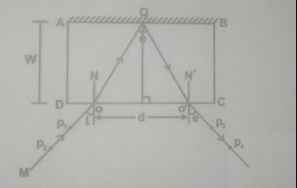
You are provided with a glass block, plane mirror, and optical pins.
(i) Place the glass block on a drawing sheet and trace its outline ABCD as shown in the diagram above.
(ii) Remove the block, measure and record the width W of the block.
(iii) Draw a normal ON to DC at a point about one-quarter the length of DC.
(iv) Draw a line making an angle i = 10^\circ with the normal.
(v) Replace the block on its outline and mount the plane mirror vertically behind the block such that it makes good contact with the face AB.
(vi) Stick two pins \(P_1\) and \(P_2\) on the line MO.
(vii) Looking through the face CD, stick two other pins \(P_3\) and \(P_4\) such that they appear to be in a straight line with the images of pins \(P_1\) and \(P_2\) seen through the block.
(viii) Join \(P_3\) and \(P_4\) with a straight line and extend it to touch the face CD at O\(^{1}\).
(ix)Draw a perpendicular line from the midpoint of OO\(^{1}\) to meet AB at Q.
(x) Draw lines OQ, O\(^{1}\)Q and normal O\(^{1}\)N\(^{1}\) produced.
(xi) Measure and record \cos\theta, e, and d.
(xii) Evaluate m = sin e, and n cos\(\frac{\theta}{2}\)
(xii)Repeat the procedure for i = 20^\circ, 30^\circ, 40^\circ and 50.
(xiv) Tabulate your readings.
(xv) Plot a graph with m on the vertical axis and n on the horizontal axis.
(xvi) Determine the slope, s, of the graph and evaluate \cos\theta = 2Ws.
(xvii) State two precautions are taken to ensure accurate results.
(xviii) Sketch a diagram to show the path of the ray through the glass block when the angle of incidence i = 90^\circ in the experiment above.
(xix) A coin lies at the bottom of a tank containing water to a depth of 130cm. If the refractive index of water is 1.3, calculate the apparent displacement of the coin when viewed vertically from above.
Attached Figure / Diagram
medium Difficulty
Verified Correct Answer: Option
Physical Principles & Numerical Solution
i/^\circ
\theta/^\circ
e/^\circ
d/cm
m = sine/^\circ
n = cos\(\frac{\theta}{2}\)/^\circ
10
20
30
40
50
10.4
19.0
20.0
30.0
30.5
10.0
20.4
30.0
40.0
50.0
3.00
3.90
6.00
7.00
7.50
0.174
0.349
0.500
0.643
0.766
0.996
0.986
0.985
0.966
0.965
Slope = \(\frac{0.766 - 0.174}{0.965 - 0.996}\)
= \(\frac{0.592}{-0.031}\)
= - 19.097^\circ
q = 2ws
q = 2 x 6.5 x -19.097
q = 1248.261
q = -248.3
SEE THE GRAPH ABOVE.
Precautions:- Neat traces, Pins located vertically, Pins reasonably spaced, Avoided parallax error while reading the protractor/ ruler, zero error avoided on the metre rule.
(b) Refractive index is the ratio of the velocity of light in air to the velocity of light in a medium when light waves pass from air to a material medium. Mathematically,
n = \(\lambda_{1}\)
\(\lambda_{2}\). Where;
\(\lambda_{1}\) = wavelength in air
\(\lambda_{2}\) = wavelength in material
n = refractive index of the material
(ii) The light must be traveling from a denser medium to a less dense medium. The angle of incidence in the denser medium must be greater than the critical angle.
Source: Myschool Past Questions Archive (Record #59735)
Physics
WAEC / WASSCE 2020
Mechanics and Properties of Matter
Solution
You are provided with a resistance box R, voltmeter, key, cell of e.m.f. E, constantan wire, standard resistor, RX, an ammeter, and other necessary apparatus.
(i) Measure and record the e.m.f. E of the cell provided.
(ii) Set up the circuit as shown in the diagram above.
(iii) Set R to 1\(\Omega\). Close the key, read and record the current I and the corresponding voltage V.
(iv) Repeat the procedure for four other values of R= 2\(\Omega\), 4\(\Omega, 6\(\Omega\), and 8\(\Omega\).
(v) In each case, read and record I and V.
(vi) Tabulate the reading.
(vii) Plot a graph of V on the vertical axis and I on the horizontal axis.
(viii) Determine the slope s, of the graph.
(ix) State two precautions are taken to ensure accurate results
(b) )State two advantages of connecting identical cells in parallel.
(ii) State two factors to consider in choosing the material for the design of a resistor
medium Difficulty
Verified Correct Answer: Option
Physical Principles & Numerical Solution
R(n)
I(A)
V(v)
1.0
2.0
4.0
6.0
8.0
0.40
0.35
0.28
0.22
0.18
0.65
0.58
0.22
0.45
0.40
E = 3.00v
(x) Precautions:
- Key opened in between readings/key opened when readings were not taken
- Ensuring tight connections Avoid parallax error when taking a reading on voltmeter/ammeter Repeated readings (shown on the table)
- Noted/corrected zero error on voltmetre/ammeter
- Clean terminals ensured
(b)Advantages of connecting identical cells in parallel produce a larger amount of current. supply steady current for a long period - efficiency is high
(ii) Factors to consider in choosing a material for the design of a resistor
- Power rating-Tolerance
- Voltage rating
-Temperature coefficient
- Noise
- Frequency response
- Stability
- Resistivity
Source: Myschool Past Questions Archive (Record #59755)
Physics
UTME / JAMB 2019
Mechanics and Properties of Matter
Solution
The limiting frictional force between two surface depends on
I. the gaseous reaction between the surfaces
II. the nature of the surfaces in contact
III. the relative velocity between the surfaces
A
I only
B
I & IV only
C
II only
D
III only
medium Difficulty
Verified Correct Answer: Option C
Physical Principles & Numerical Solution
- Friction depends on the nature of the surfaces in contact
Source: Myschool Past Questions Archive (Record #54954)
Physics
UTME / JAMB 2019
Mechanics and Properties of Matter
Solution
If a body moves with a constant speed and at the same time undergoes an acceleration, its motion is said to be
A
circular
B
oscillatory
C
rectilinear
D
rotational
medium Difficulty
Verified Correct Answer: Option A
Physical Principles & Numerical Solution
Circular motion has uniform
Source: Myschool Past Questions Archive (Record #54957)