Question Library
Browse, filter, and study verified past examination questions with step-by-step mathematical reasoning.
Searching 18,000+ Questions...
Sifting topics, KaTeX formulas & verified solutions
Showing 121–135 of 5315 verified questions
Sort by:
Physics
UTME / JAMB 2025
Current Electricity
Solution
What is the electrolyte used in wet Leclanche cell
A
Nickle hydroxide
B
Lead dioxide
C
Ammonium chloride
D
Carbon
medium Difficulty
Verified Correct Answer: Option C
Physical Principles & Numerical Solution
C. Ammonium chloride.
It is the electrolyte in the wet Leclanché cell (aqueous solution).Others:
Nickel hydroxide: In Ni-Cd/Ni-MH batteries.
Lead dioxide: Cathode in lead-acid batteries.
Carbon: Conductivity enhancer, not electrolyte.
Source: WAEC / JAMB / NECO Classroom Archive (Record #74558)
Physics
UTME / JAMB 2025
Current Electricity
Diagram
Solution
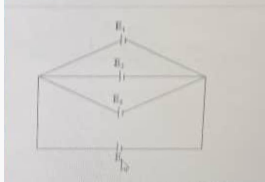
Assuming E\(_1\), E\(_2\), and E\(_3\), are equal, then the total e.m.f of the arrangement will be given by
Attached Figure / Diagram
A
\(\frac{1}{\text{E}}\) = (\(\frac{1}{E_1}\) +\(\frac{1}{E_2}\)) + E\(_3\)
B
E = \(E_1\) + \(E_2\) + \(E_3\)
C
\(\frac{1}{\text{E}}\) = \(\frac{1}{E_1}\) + \(\frac{1}{E_2}\) + \(\frac{1}{E_3}\)
D
E = \(E_1\) = \(E_2\) = \(E_3\)
medium Difficulty
Verified Correct Answer: Option D
Physical Principles & Numerical Solution
Parallel connection does not add the voltages; it only increases the current capacity. Thus, total e.m.f. E = E\(_1\) = E\(_2\) = E\(_3\).
Source: WAEC / JAMB / NECO Classroom Archive (Record #74659)
Physics
WAEC / WASSCE 2025
Current Electricity
Solution
The energy stored in a capacitor of capacitance 5μF is 40 J. Calculate the voltage applied across its terminals.
A
6 V
B
200 V
C
16 V
D
4000 V
medium Difficulty
Verified Correct Answer: Option D
Physical Principles & Numerical Solution
E = \(\frac{1}{2}\)QV;
But, Q = CV
∴ E = \(\frac{1}{2}\)CV\(^2\);
40 = \(\frac{1}{2}\) \times 5 \times 10\(^{-6}\) \times V\(^2\)
V\(^2\) = \(\frac{(2 \times 40)}{5 \times 10^{-6}}\)
V\(^2\) = 16 \times 10\(^6\)
∴ V = \(\sqrt{(16 \times 10^6)}\) = 4000 V
Source: WAEC / JAMB / NECO Classroom Archive (Record #76401)
Physics
WAEC / WASSCE 2025
Current Electricity
Solution
Calculate the quantity of charge flowing through a conductor if a current of 10 A passes through the conductor for 10 s.
A
10 C
B
15 C
C
100 C
D
20 C
medium Difficulty
Verified Correct Answer: Option C
Physical Principles & Numerical Solution
The quantity of charge flowing through a conductor is given by the formula Q = It.
Substituting the given values,
we get Q = 10 \times 10 = 100 C.
Source: WAEC / JAMB / NECO Classroom Archive (Record #76404)
Physics
WAEC / WASSCE 2025
Current Electricity
Diagram
Solution
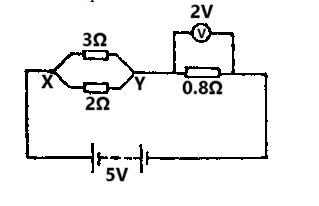
What is the potential difference between X and Y in the diagram above if the battery is of negligible internal resistance?
Attached Figure / Diagram
A
3.0V
B
12.5V
C
5.8V
D
5.0V
medium Difficulty
Verified Correct Answer: Option A
Physical Principles & Numerical Solution
\(\frac{1}{R_{XY}}\) = \(\frac{1}{3} + \frac{1}{2} + \frac{1}{6}\) = \(\frac{5}{6}\)
\(\therefore\) R\(_{XY}\) = \(\frac{5}{6}\)\(\Omega\)
\(\therefore\) R\(_T\) = \(\frac{5}{6}\) + 0.8 = \(\frac{5}{6}\) + \(\frac{4}{5}\) = \(\frac{10}{5}\) = 2\(\Omega\)
But, V = IR\(_T\) where V = 5v and R\(_T\) = 2\(\Omega\)
I = \(\frac{\text{V}}{R_T}\) = \(\frac{5}{2}\)A
\(\therefore\) V\(_{across XY}\) = I R\(_{XY}\) = \(\frac{5}{2}\) x \(\frac{6}{5}\) = 3.0V.
Source: WAEC / JAMB / NECO Classroom Archive (Record #76406)
Physics
WAEC / WASSCE 2025
Current Electricity
Diagram
Solution
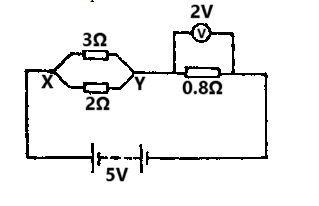
Calculate the current in the 3 Ω resistor in Question 47.
Attached Figure / Diagram
A
0.4 A
B
0.3 A
C
1.5 A
D
1.0 A
medium Difficulty
Verified Correct Answer: Option D
Physical Principles & Numerical Solution
V = IR Voltage across XY = 3V
V = 3I = 3V
I = \(\frac{3}{3}\) = 1.0 A
Source: WAEC / JAMB / NECO Classroom Archive (Record #76408)
Physics
WAEC / WASSCE 2025
Current Electricity
Solution
A given wire of resistance 10 Ω has a length of 5 m and a cross-sectional area of 4.0 × 10\(^{-3}\) m\(^2\). Calculate the conductivity of the wire.
A
2.50 × 10\(^2\) Ω\(^{-1}\)m\(^{-1}\)
B
2.02 × 10\(^2\) Ω\(^{-1}\)m\(^{-1}\)
C
1.25 × 10\(^2\) Ω\(^{-1}\)m\(^{-1}\)
D
0.80 × 10\(^2\) Ω\(^{-1}\)m\(^{-1}\)
medium Difficulty
Verified Correct Answer: Option C
Physical Principles & Numerical Solution
The resistance \(R\) of a wire is related to its resistivity \(\rho\), length \(L\), and cross-sectional area \(A\) by the formula: \(R = \frac{\rho L}{A}\)
The conductivity \(\sigma\) is the reciprocal of the resistivity:
\(\sigma = \frac{1}{\rho}\)
\(\rho = \frac{R A}{L}\)
\(\sigma = \frac{L}{R A}\)
Substitute the given values (\(L = 5\) m, \(R = 10\) \Omega, \(A = 4.0 \times 10^{-3}\) m²):
\(\sigma = \frac{5}{10 \times 4.0 \times 10^{-3}} = \frac{5}{0.04} = 125\)
The conductivity of the wire is 125 \Omega\(^{-1}\)m\(^{-1}\) = 1.25 x 10\(^2\) \Omega\(^{-1}\)m\(^{-1}\)
Source: WAEC / JAMB / NECO Classroom Archive (Record #76411)
Physics
WAEC / WASSCE 2025
Current Electricity
Diagram
Solution
3a. (i) Measure and record the e.m.f of the accumulator provided.
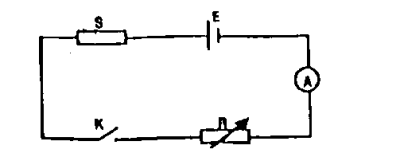
(ii) Connect the circuit as shown in the diagram. S is a standard resistor, and R is a resistance box.
(iii) With R = 0 Ω, close the key K. Read and record the ammeter reading I. Evaluate I\(^{-1}\).
(iv) Repeat the procedure for R = 1, 2, 3, 4, and 5 Ω. Tabulate your readings.
(v) Plot a graph of R on the vertical axis and I\(^{-1}\) on the horizontal axis, starting both axes from the origin (0,0).
(vi) Determine the slope s of the graph and find the intercept c on the vertical axis.
(vii) State two precautions taken to ensure accurate results. [21 marks]
bi. State two advantages of a lead-acid accumulator over a Leclanche cell. [2 marks]
ii. A parallel combination of 3 Ω and 4 Ω resistors is connected in series with a resistor of 4 Ω and a battery of negligible internal resistance. Calculate the effective resistance in the circuit. [2 marks]
Attached Figure / Diagram
medium Difficulty
Verified Correct Answer: Option
Physical Principles & Numerical Solution
3a. The e.m.f of the accumulator = 1.5V
Tables of values
R(\(\Omega\))
I(A)
I\(^{-1}\)((A\(^{-1}\))
0
0.78
1.28
1
0.50
2.00
2
0.38
2.63
3
0.30
3.33
4
0.25
4.00
5
0.22
4.55
S = \(\frac{y_2 - y_1}{x_2 - x_1}\) = \(\frac{4 - 2}{4 - 1}\) = \(\frac{2}{3}\) = 0.67
The intercept on the vertical axis = 1.32\(\Omega\)
Precautions:
(i) I ensured all electrical connections were securely tightened to prevent loose contacts, which could lead to fluctuating or inaccurate readings.
(ii) I avoided parallax error by positioning my eyes directly in line with the scale when reading the ammeter or voltmeter for precise measurements.
(iii) I checked and corrected for any zero error on the ammeter and voltmeter before taking readings to improve accuracy.
(iv) I removed the key from the circuit when not taking measurements to avoid unnecessary heating and potential damage to components.
(v) I took multiple readings at each data point and averaged the values to minimize random errors and ensure more reliable results.
(vi) I ensured the apparatus was properly calibrated and regularly checked for consistency throughout the experiment.
bi. 1. Rechargeability: A lead-acid accumulator is rechargeable, making it more suitable for long-term use, whereas a Leclanché cell is primarily a primary (non-rechargeable) cell.
2. Higher Current Supply: Lead-acid accumulators can deliver higher currents, making them ideal for applications requiring significant power, like in vehicles, while Leclanché cells are suitable for low-current devices.
3. Longer Lifespan: Due to its rechargeable nature, the lead-acid accumulator has a longer operational life compared to a Leclanché cell, which has a limited lifespan and must be replaced after depletion.
4. Stable Voltage: Lead-acid accumulators provide a relatively stable output voltage during discharge, while the voltage of a Leclanché cell drops significantly over time.
bii. Since 3 \Omega and 4 \Omega are connected in parallel,
\(\frac{1}{\text{R}}\) = \(\frac{1}{3}\) + \(\frac{1}{4}\)
\(\frac{1}{\text{R}}\) = \(\frac{4 + 3}{12}\)
\(\frac{1}{\text{R}}\) = \(\frac{7}{12}\)
R = \(\frac{12}{7}\) = 1.71 \Omega
Now, 1.71 \Omega is connected in series with 4 \Omega.
∴ The effective resistance in the circuit = 1.71 \Omega + 4 \Omega = 5.71 \Omega
Source: WAEC / JAMB / NECO Classroom Archive (Record #76605)
Physics
UTME / JAMB 2025
Energy and Power
Solution
A 500W electric oven plugged into a 220 V source will consume an electric current of
A
4.88A
B
2.27A
C
6.43A
D
3.23A
medium Difficulty
Verified Correct Answer: Option B
Physical Principles & Numerical Solution
Answer: B. 2.27A
(I = \(\frac{\text{P}}{\text{V}}\) = \(\frac{500}{220}\) ≈ 2.27 A.)
Source: WAEC / JAMB / NECO Classroom Archive (Record #74361)
Physics
UTME / JAMB 2025
Energy and Power
Solution
A refrigerator uses 150W. If it is kept on for 336 hours nonstop. What is the energy consumed in Kwh?
A
60.20Kwh
B
25.01Kwh
C
50.40Kwh
D
30.20Kwh
medium Difficulty
Verified Correct Answer: Option C
Physical Principles & Numerical Solution
C. 50.40Kwh
Convert power to kW (150 W = 0.15 kW), then multiply by time in hours: energy = 0.15 kW \times 336 h = 50.4 kWh.
Source: WAEC / JAMB / NECO Classroom Archive (Record #74555)
Physics
UTME / JAMB 2025
Energy and Power
Diagram
Solution
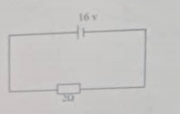
The electrical power developed in the resistor above is
Attached Figure / Diagram
A
8W
B
64W
C
128W
D
256W
medium Difficulty
Verified Correct Answer: Option C
Physical Principles & Numerical Solution
The circuit is a simple series circuit with a 16 V battery (or voltage source) directly connected across a 2 \Omega resistor.
The power (\(P\)) dissipated (developed) in the resistor is given by: \(P = \frac{V^2}{R}\)
where \(V = 16 \, \text{V}\) and \(R = 2 \, \Omega\).
Calculating the power: \(P = \frac{16^2}{2} = \frac{256}{2} = 128 \, \text{W}\)
Source: WAEC / JAMB / NECO Classroom Archive (Record #74679)
Physics
UTME / JAMB 2025
Simple Ac Circuit
Solution
In an A.C circuit, the instantaneous current is 7A. What is the root mean square(r.m.s) value of the current I\(_{r.m.s}\)
A
5A
B
6A
C
3A
D
4A
medium Difficulty
Verified Correct Answer: Option A
Physical Principles & Numerical Solution
For an A.C. current,
\(I_{\text{r.m.s}} = \frac{I_0}{\sqrt{2}}\)
where (I_0) is the maximum (peak) current.
Given (I_0 = 7,\text{A}),
\(I_{\text{r.m.s}} = \frac{7}{\sqrt{2}} \approx 4.95,\text{A}\)
Answer: \(4.95 \text{A}\ \ (\approx 5\ \text{A})\)
Source: WAEC / JAMB / NECO Classroom Archive (Record #74485)
Physics
UTME / JAMB 2025
Simple Ac Circuit
Diagram
Solution
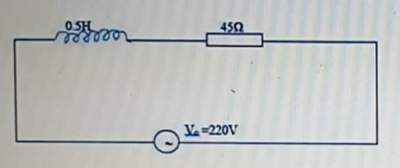
From the above circuit, calculate the impedance ((\(\pi\) = \(\frac{22}{7}\), f = 50Hz)
Attached Figure / Diagram
A
86.7\(\Omega\)
B
163.5\(\Omega\)
C
204.8\(\Omega\)
D
16.3\(\Omega\)
medium Difficulty
Verified Correct Answer: Option B
Physical Principles & Numerical Solution
Given: Inductance: \( L = 0.5 \, \text{H} \), Resistance: \( R = 45 \, \Omega \), Frequency: \( f = 50 \, \text{Hz} \)
inductive reactance \( X_L \): \(X_L = 2 \pi f L = 2 \times \frac{22}{7} \times 50 \times 0.5 = \frac{1100}{7} \approx 157.14 \, \Omega\)
The impedance \( Z \):
\(Z = \sqrt{R^2 + X_L^2} = \sqrt{(45)^2 + (157.14)^2} = \sqrt{2025 + 24642.82} \approx \sqrt{26667.82} \approx 163.5 \, \Omega\).
Source: WAEC / JAMB / NECO Classroom Archive (Record #74489)
Physics
WAEC / WASSCE 2025
Simple Ac Circuit
Solution
An alternating voltage with a frequency of 50 Hz has a period of
A
0.02 s
B
0.20 s
C
0.05 s
D
0.50 s
medium Difficulty
Verified Correct Answer: Option A
Physical Principles & Numerical Solution
The period of a wave is the reciprocal of its frequency.
Therefore, period = \(\frac{1}{\text{frequency}}\)
Substituting the given frequency,
we get period = \(\frac{1}{ 50}\) Hz = 0.02 s.
Source: WAEC / JAMB / NECO Classroom Archive (Record #76384)
Physics
WAEC / WASSCE 2025
Simple Ac Circuit
Diagram
Solution
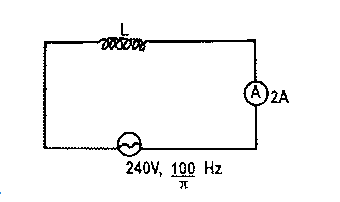
Calculate the inductance L of the COIL in the circuit shown above
Attached Figure / Diagram
A
3.8 H
B
0.4 H
C
0.6 H
D
14.4 H
medium Difficulty
Verified Correct Answer: Option C
Physical Principles & Numerical Solution
V = I X\(_L\)
X\(_L\) = \(\frac{\text{V }}{\text{I}}\) = \(\frac{240}{2}\) = 120 \Omega
But X\(_L\) = 2\(\pi\)fL
120 = 2 x 2\(\pi\) x \(\frac{100}{\pi}\) x L
120 = 2 x 100 x L = 200L
L = \(\frac{120}{200}\) = 0.6H
Source: WAEC / JAMB / NECO Classroom Archive (Record #76389)