Question Library
Browse, filter, and study verified past examination questions with step-by-step mathematical reasoning.
Searching 18,000+ Questions...
Sifting topics, KaTeX formulas & verified solutions
Showing 106–120 of 1709 verified questions
Sort by:
Physics
WAEC / WASSCE 2020
Mechanics and Properties of Matter
The volume of a fixed mass of a gas varies inversely as the pressure on it provided the temperature is constant. This statement is
A
Pressure law
B
Charles law
C
Boyle's law
D
General gas law
medium Difficulty
Verified Correct Answer: Option C
Physical Principles & Numerical Solution
No expanded working has been attached for this question yet. The verified answer is Option C.
Source: Myschool Past Questions Archive (Record #59364)
Physics
WAEC / WASSCE 2020
Mechanics and Properties of Matter
The earpiece of a telephone handset converts energy from
A
electrical to sound
B
sound to electrical
C
sound to electrical
D
sound to radio wave
medium Difficulty
Verified Correct Answer: Option A
Physical Principles & Numerical Solution
No expanded working has been attached for this question yet. The verified answer is Option A.
Source: Myschool Past Questions Archive (Record #59394)
Physics
WAEC / WASSCE 2020
Mechanics and Properties of Matter
Solution
The magnitude of the force experienced by a charge of 1.6 x 10\(^{-8}\)C in a uniform electric field of intensity 5 x 10\(^5\)NC\(^{-1}\) is
A
3.2 x 10\(^{-14}\)N
B
8.0 x 10\(^{-13}\)N
C
8.0 x 10\(^{-3}\)N
D
3.1 x 10\(^{13}\) N
medium Difficulty
Verified Correct Answer: Option C
Physical Principles & Numerical Solution
E = \(\frac{\text{F}}{\text{q}}\)
Force F = E x q
F = 5 x 10\(^5\) x 1.6 x 10\(^{-8}\) = 8.0 x 10\(^{-3}\)N
Source: Myschool Past Questions Archive (Record #59458)
Physics
WAEC / WASSCE 2020
Mechanics and Properties of Matter
Solution
A motorcycle starting from rest is uniformly accelerated such that its velocity in 10s is 72kmhr\(^{-1}\). What is its acceleration?
A
108ms\(^2\)
B
86ms\(^2\)
C
4ms\(^2\)
D
2ms\(^2\)
medium Difficulty
Verified Correct Answer: Option D
Physical Principles & Numerical Solution
where u = o m/s, t = 10s,
v = 72kmhr\(^{-1}\) ---> (72 X 1000) / 3600
: v = 20 m/s
Acceleration (a) = ( v - u ) / t ---> (20 - 0) / 10
: a = 2m/s\(^2\)
Source: Myschool Past Questions Archive (Record #59460)
Physics
WAEC / WASSCE 2020
Mechanics and Properties of Matter
Solution
The velocity of sound in air at 15^\circC is 340ms\(^{-1}\). Calculate the velocity at 47\(^o\)C
A
790ms\(^{-1}\)
B
602ms\(^{-1}\)
C
358ms\(^{-1}\)
D
322ms\(^{-1}\)
medium Difficulty
Verified Correct Answer: Option C
Physical Principles & Numerical Solution
Given the velocity of sound at \( 15^\circ C \):
\(v_0 = 340 \, \text{m/s}\)
The absolute temperatures are:
\(T_0 = 15 + 273.15 = 288.15 \, \text{K}\)
\(T = 47 + 273.15 = 320.15 \, \text{K}\)
We use the formula for the velocity of sound:
\(v = v_0 \sqrt{\frac{T}{T_0}}\)
Substituting the known values:
\(v = 340 \times \sqrt{\frac{320.15}{288.15}}\)
Calculating the ratio of temperatures:
\(\frac{320.15}{288.15} \approx 1.111\)
Taking the square root:
\(\sqrt{1.111} \approx 1.054\)
Finally, calculating the new velocity:
\(v \approx 340 \, \text{m/s} \times 1.054 \approx 358.6 \, \text{m/s}\)
The velocity of sound in air at \( 47^\circ C \) is approximately:
\(v \approx 358.6 \, \text{m/s}\)
Source: Myschool Past Questions Archive (Record #59437)
Physics
WAEC / WASSCE 2020
Mechanics and Properties of Matter
A 500N box rests on a horizontal floor. A constant horizontal force is exerted on the box so that it moves through 8m. If the coefficient of kinetic friction between the floor and the box is 0.22, calculate the workdone on the box
A
880J
B
440J
C
400J
D
110J
medium Difficulty
Verified Correct Answer: Option A
Physical Principles & Numerical Solution
No expanded working has been attached for this question yet. The verified answer is Option A.
Source: Myschool Past Questions Archive (Record #59446)
Physics
WAEC / WASSCE 2020
Mechanics and Properties of Matter
Diagram
Solution
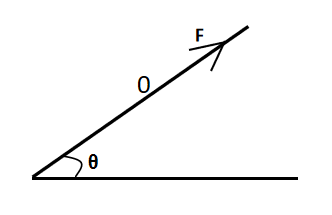
The diagram illustrates a ball of mass m sliding down a plank inclined at an angle of 0 to the horizontal. The kinetic friction between the ball and the plank is F, and the acceleration of free fall is g. The normal force on the ball is?
Attached Figure / Diagram
A
mgsin \(\theta\)
B
mgtan \(\theta\), mgcos \(\theta\)
C
mgcos \(\theta\)
D
mgcot \(\theta\)
medium Difficulty
Verified Correct Answer: Option C
Physical Principles & Numerical Solution
The normal reaction/force on a body on a horizontal surface is R = mg; but that on a body on an inclined surface is R = mgCos\theta.
Source: Myschool Past Questions Archive (Record #59449)
Physics
WAEC / WASSCE 2020
Mechanics and Properties of Matter
Diagram
Solution
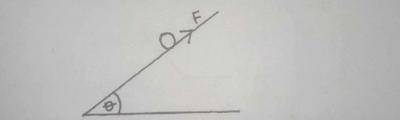
The diagram above illustrates a ball of mass m sliding down a plank inclined at an angle of 0 to the horizontal. The kinetic friction between the ball and the plank is F and the acceleration of free fall is g. The net force on the ball along the plank is?
Attached Figure / Diagram
A
mgsin \(\theta\) + F
B
F - mgcos \(\theta\)
C
mgsin \(\theta\) - F
D
F + mgcos \(\theta\)
medium Difficulty
Verified Correct Answer: Option C
Physical Principles & Numerical Solution
The force causing the ball to roll down the inclined plane is greater than the one pulling it up, resolving the force in its component we have \(mgsin\theta\)
therefore the Net Force acting on the ball = \(mgsin\theta\) - F
Source: Myschool Past Questions Archive (Record #59451)
Physics
WAEC / WASSCE 2020
Mechanics and Properties of Matter
Solution
An electron of mass m and charge e moves in a circular path in a magnetic field of flux density B. How long does it take to complete one orbit?
A
\(\frac{2me}{B\pi}\)
B
\(\frac{2B}{me\pi}\)
C
\(\frac{2\pi m}{Be}\)
D
\(\frac{Be}{2 \pi m}\)
medium Difficulty
Verified Correct Answer: Option C
Physical Principles & Numerical Solution
Motion of charged particles in Magnetic field
qvb = \(\frac{Mv^2}{r}\)
where q = e
Introducing Period (T) as time taken to complete one orbit = \(\frac{2\piM}{qe}\)
Source: Myschool Past Questions Archive (Record #59463)
Physics
WAEC / WASSCE 2020
Mechanics and Properties of Matter
Diagram
Solution
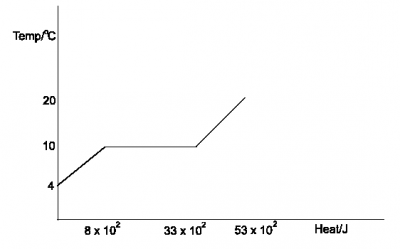
The sketched graph above illustrates the heating curve of a 0.02kg of water. Determine the approximate value of the specific latent heat of vapourization of water
Attached Figure / Diagram
A
2.25 x 10\(^6\) J kg\(^{-1}\)
B
4.17 x 10\(^3\) J kg\(^{-1}\)
C
2.00 x 10\(^3\) J kg\(^{-1}\)
D
1.00 x 10\(^3\) J kg\(^{-1}\)
medium Difficulty
Verified Correct Answer: Option A
Physical Principles & Numerical Solution
specific latent heat of vapourization is the amount of heat energy needed to change 1kg of liquid to vapour without a temperature change. The heat absorbed by the liquid at the beginning of vapourization is \(8 \times 10^3\)J and heat absorbed after the change of stage is \(53 \times 10^3\)J. therefore, the total heat energy needed to change the liquid completely to vapour is Q = \(53 \times 10^3 - 8 \times 10^3 J = 45 \times10^3\)J
Recall, Q = mL
Where, L = specific latent heat of vapourization
Q = mL
L = \(\frac{ Q}{m}\) = \(\frac{ 45 \times 10^3}{0.02}\)
L = \(2.25 \times10^6JKg^{-1}\)
Source: Myschool Past Questions Archive (Record #59465)
Physics
WAEC / WASSCE 2020
Mechanics and Properties of Matter
In the hydraulic press, the force F applied is related to the diameter d of the cylinder by
A
F \(\alpha\) d\(^2\)
B
F \(\alpha\) d
C
F \(\alpha\) d\(^{-1}\)
D
F \(\alpha\) d\(^{-2}\)
medium Difficulty
Verified Correct Answer: Option A
Physical Principles & Numerical Solution
No expanded working has been attached for this question yet. The verified answer is Option A.
Source: Myschool Past Questions Archive (Record #59466)
Physics
WAEC / WASSCE 2020
Mechanics and Properties of Matter
Solution
Water waves have a wavelength of 3.6cm and speed of 18cms\(^{-1 }\) in deep water. If the waves enter shallow water with wavelength of 2.0cm, calculate the speed of the waves in the shallow water.
A
0.4cms\(^{-1}\)
B
2.5cms\(^{-1}\)
C
10.0cms\(^{-1}\)
D
10.8cms\(^{-1}\)
medium Difficulty
Verified Correct Answer: Option C
Physical Principles & Numerical Solution
Velocity = frequency x wavelength
v = 18cm/s, wavelength = 3.6cm, then F = 5hertz
therefore, the speed of the wave in the shallow water = 5 x 2 = 10cm/s
NOTE; as a general rule, the frequency of a wave remains constant while speed and wavelength change as it travels from one medium to another.
Source: Myschool Past Questions Archive (Record #59469)
Physics
WAEC / WASSCE 2020
Mechanics and Properties of Matter
Solution
An electron of mass 9.1x 10\(^{-31}\) kg is travelling at a speed of 2.0 x 10\(^6\)ms\(^{-1}\). Calculate the associate wavelength of the electron. [h = 6.6. x 10\(^{-34}\) Js]
A
3.63 x10\(^{-10}\) m
B
3.63 x 10\(^{-8}\) m
C
3.63 x 10\(^{-7}\) m
D
6.89 x 10\(^{-4}\) m
medium Difficulty
Verified Correct Answer: Option A
Physical Principles & Numerical Solution
Using de Broglie wavelength formula: \(\lambda\) = \(\frac{h}{p}\)
P = momentum = mass x velocity = 9.1x 10\(^{-31}\) x 2.0 x 10\(^6\) = 1.82 \times 10\(^{ −24}\) kg m/s
\(\lambda\) = \(\frac{6.6. \times 10^{-34}}{1.82 \times 10^{ −24}}\) = 3.63 x 10\(^{-10}\) m
Source: Myschool Past Questions Archive (Record #59476)
Physics
WAEC / WASSCE 2020
Mechanics and Properties of Matter
Which of the following actions would increase the electric force between two positively charged particles?
A
Decreasing the mass of the particles
B
Decreasing the distance between the particles
C
Increasing the assistance between the particles
D
Increasing the mass of the particles
medium Difficulty
Verified Correct Answer: Option B
Physical Principles & Numerical Solution
No expanded working has been attached for this question yet. The verified answer is Option B.
Source: Myschool Past Questions Archive (Record #59480)
Physics
WAEC / WASSCE 2020
Mechanics and Properties of Matter
Solution
Which of the following statement about viscosity is not true? it
A
depends on areas of the surfaces in contact
B
occurs in fluids
C
is independent of the relative velocity of the layers
D
depends on the tangential force between the layers
medium Difficulty
Verified Correct Answer: Option C
Physical Principles & Numerical Solution
Is independent of the relative velocity of the layers is not true because:
Viscosity is dependent on the relative velocity of the layers in a fluid; it describes how the fluid flows when layers move relative to each other.
Viscosity depends on the area of the surface in contact
Viscosity is independent of normal reaction
Viscosity depends on the relative velocity between layers
Source: Myschool Past Questions Archive (Record #59502)