Question Library
Browse, filter, and study verified past examination questions with step-by-step mathematical reasoning.
Searching 18,000+ Questions...
Sifting topics, KaTeX formulas & verified solutions
Showing 106–120 of 5315 verified questions
Sort by:
Physics
UTME / JAMB 2025
Gravitational Field
Solution
The gravitational force between two masses, P and Q, is 10N, find the new value of the force if both masses are doubled
A
40.0N
B
20.0N
C
10.0N
D
2.5N
medium Difficulty
Verified Correct Answer: Option A
Physical Principles & Numerical Solution
The gravitational force \( F \) between two masses is given by Newton's law of universal gravitation:
\(F = G \frac{m_1 m_2}{r^2}\)
where \( G \) is the gravitational constant, \( m_1 \) and \( m_2 \) are the masses (P and Q), and \( r \) is the distance between their centers.
Originally, \( F = 10 \, \text{N} \).
If both masses are doubled (\( m_1' = 2P \), \( m_2' = 2Q \)) and \( r \) remains constant, the new force is:
\(F' = G \frac{(2P)(2Q)}{r^2} = G \frac{4PQ}{r^2} = 4 \left( G \frac{PQ}{r^2} \right) = 4 \times 10 = 40 \, \text{N}\)
Source: WAEC / JAMB / NECO Classroom Archive (Record #74573)
Physics
WAEC / WASSCE 2025
Gravitational Field
Solution
What is the escape velocity of a body on the surface of the Earth of radius R if the gravitational constant is G and the mass of the Earth is M? (Neglect energy losses to the surroundings)
A
\(\sqrt{(2GR^2}\)
B
\(\sqrt{(2GR)}\)
C
\(\sqrt{(2GM)}\)
D
\(\sqrt{(\frac{2G}{\text{R}})}\)
medium Difficulty
Verified Correct Answer: Option C
Physical Principles & Numerical Solution
v\(_e\) = \(\sqrt{(2gR)}\)
Since gR = GM
\(\therefore\), v\(_e\) = \(\sqrt{(2GM)}\)
Source: WAEC / JAMB / NECO Classroom Archive (Record #76386)
Physics
WAEC / WASSCE 2025
Gravitational Field
Solution
1a. Explain what is meant by the acceleration of free fall due to gravity, g.
b. State two reasons why g varies on the surface of the Earth.
c. A stone is projected upwards at an angle of 30° to the horizontal from the top of a tower of height 100 m and it hits the ground at a point Q. If the initial velocity of projection is 100 ms\(^{-1}\), calculate the:
i. maximum height of the stone above the ground (neglect air resistance and take g as 10 ms\(^{-2}\))
ii. time it takes to reach this height
iii. time of flight.
iv. horizontal distance from the foot of the tower to the point Q (neglect air resistance and take g as 10 ms\(^{-2}\))
medium Difficulty
Verified Correct Answer: Option
Physical Principles & Numerical Solution
1a. Acceleration of a free fall due to gravity is the force of attraction of the Earth on a unit mass.
b. g varies on the surface of the earth because of the shape of the earth and the rotation of the earth about its polar axis.
ci. \theta = 30^\circ; H = 100 m; u = 100 m/s; h = ?
Total height = H + h
=> h = \(\frac{u^2 sin^2 \theta }{2g}\) = \(\frac{100^2 sin^2 30^\circ}{ 2 \times 10}\)
= \(\frac{10000 \times 0.25}{ 20}\) = \(\frac{2500}{ 20}\) = 125 m
. Height from the ground = height of tower + the maximum height the stone reached = 100 + 125 = 225 m
ii. t = \(\frac{u sin \theta }{\text{g}}\) = \(\frac{100 \times sin 30^\circ}{10}\) = \(\frac{100 \times 0.5 }{10}\) = 10 \times 0.5 = 5 s
iii. Time of flight = time taken for a particle which is projected to return to its original level T = \(\frac{2u sin \theta}{\text{g}}\) = \(\frac{2 \times 100 \times sin 30^\circ}{10}\) = \(\frac{200 \times 0.5}{10}\) = 10 s
Time of flight = 10 s
But the total time taken to land on the ground = T + time used to return from the top of the tower to the ground level. Since it's falling S\(_y\) = 100 m
S\(_y\) = ut sin \theta - \(\frac{1}{2}\) g t\(^2\) => -100
= 100t sin 30^\circ - \(\frac{1}{2}\) (10) t\(^2\) =>
-100 = 100t \times 0.5 - 5 t\(^2\) => -100 = 50t - 5 t\(^2\) => 5 t\(^2\) - 50t - 100 = 0 => t\(^2\) - 10t - 20 = 0
t = \(\frac{10 \pm \sqrt{10^2 - 4 \times -20 \times 1}}{2}\) = \(\frac{10 \pm \sqrt{100 + 80}}{2}\)
t = \(\frac{10 + 13.416}{2}\) = \(\frac{23.416}{2}\) ≈ 11.7s (ignore the -ve part)
t = 11.7 s => Total time = 10 + 11.7 = 21.7 seconds
iv. Horizontal distance = the range = \(\frac{u^2 sin 2\theta}{\text{g}}\) = \(\frac{100^2 sin 60^\circ}{10}\) = \(\frac{10000 \times 0.866}{10}\) = 1000 \times 0.866 = 866 m
Source: WAEC / JAMB / NECO Classroom Archive (Record #76484)
Physics
UTME / JAMB 2025
Electric Field
Diagram
Solution
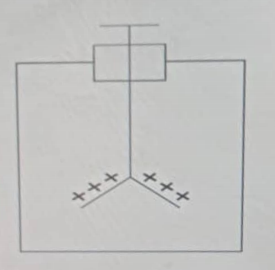
If a positively charged rod is brought close to the cap in the diagram above, the divergence
Attached Figure / Diagram
A
is unchanged
B
Increases
C
decreases
D
Collapses
medium Difficulty
Verified Correct Answer: Option B
Physical Principles & Numerical Solution
B. Increases
When a positively charged rod is brought near the cap of a positively charged gold-leaf electroscope (as indicated by the diverging leaves with + signs in the diagram), electrostatic induction occurs. The rod attracts negative charges toward the cap and repels additional positive charges toward the leaves. This increases the positive charge on the leaves, enhancing their mutual repulsion and thus increasing the divergence.
Source: WAEC / JAMB / NECO Classroom Archive (Record #74569)
Physics
UTME / JAMB 2025
Magnetic Field
Solution
The point where no magnetic effect is felt around a magnet is
A
near point
B
far point
C
Infinite point
D
Neutral point
medium Difficulty
Verified Correct Answer: Option D
Physical Principles & Numerical Solution
The neutral point around a magnet is where the magnetic field strength is zero, meaning no magnetic effects (like deflection of a compass needle) are observed, often due to cancellation by Earth's magnetic field.
Source: WAEC / JAMB / NECO Classroom Archive (Record #74477)
Physics
UTME / JAMB 2025
Magnetic Field
Solution
The commonly used materials for shielding or screening magnetism is
A
Alumumium
B
Brass
C
Soft iron
D
Copper
medium Difficulty
Verified Correct Answer: Option C
Physical Principles & Numerical Solution
Soft iron has high magnetic permeability, so it easily attracts and redirects magnetic field lines, shielding areas from external magnetic fields. Aluminum, brass, and copper do not have this property and are ineffective for magnetic shielding.
Source: WAEC / JAMB / NECO Classroom Archive (Record #74556)
Physics
UTME / JAMB 2025
Magnetic Field
Solution
A method of demagnetization is
A
placing the magnetic bar in a solenoid
B
double-stroking the magnet with soft in n-s direction
C
heating a magnetic bar red hot and allowed to cool e-w direction
D
hammering the magnetic bar repeatedly in n-s direction
medium Difficulty
Verified Correct Answer: Option C
Physical Principles & Numerical Solution
This process disrupts the alignment of magnetic domains, effectively demagnetizing the bar.
Source: WAEC / JAMB / NECO Classroom Archive (Record #74662)
Physics
UTME / JAMB 2025
Electromagnetic Field
Solution
The device that operates using the magnetic effect of electric current is
A
Rheostat
B
Thermostat
C
Electric bell
D
Carbon microphone
medium Difficulty
Verified Correct Answer: Option C
Physical Principles & Numerical Solution
Answer: C
An electric bell works using an electromagnet.
Source: WAEC / JAMB / NECO Classroom Archive (Record #74373)
Physics
WAEC / WASSCE 2025
Electromagnetic Field
Solution
2a. State Faraday's law of electromagnetic induction.
b. Draw a labelled diagram of an induction coil and explain how it works.
c. How is the effect of eddy currents minimized in the coil?
d. State two reasons why a capacitor should be included in the primary circuit of the coil.
e. State three uses of an induction coil.
medium Difficulty
Verified Correct Answer: Option
Physical Principles & Numerical Solution
a. Faraday's law of electromagnetic induction states that the induced e.m.f. in a circuit is directly proportional to the rate of change of the magnetic flux, or field lines, linking the circuit i.e e ∝ \(\frac{dφ}{\text{dt}}\).
b. See diagram above. How it works: it has a primary coil of a few turns and a secondary coil of many turns. When the primary circuit is made, a current flows in P. A is then attracted, so breaking the circuit at the contact point. This makes the large magnetic flux in the secondary fall very quickly. A high voltage is then produced at its terminals X and Y, and a spark appears across the air gap as the circuit is made and broken repeatedly.
c. The eddy current can be minimized by laminating the core to reduce energy losses.
d. The spark which produce across the gap of the make and break device is reduced by the capacitor. Thus, it should be included.
e. (i). It is used in the operation of X-ray tubes. (ii). It is used in the generation of high voltages. (iii). It is used in morse radio transmitter.
Source: WAEC / JAMB / NECO Classroom Archive (Record #76494)
Physics
UTME / JAMB 2025
Electric Field
Solution
A circular parallel plate capacitor with radius 6cm is separated by 0.12cm. Calculate the capacitance of the capacitor [\(\pi\) = 3.142, ε\(_0\) = 8.85 x 10\(^{-12}\)Nm\(^2\)C\(^2\)]
A
4.3 x 10\(^{-11}\)F
B
5.1 x 10\(^{11}\)F
C
8.3 x 10\(^{-11}\)F
D
9.6 x 10\(^{-11}\)F
medium Difficulty
Verified Correct Answer: Option C
Physical Principles & Numerical Solution
The capacitance \( C \) of a parallel-plate capacitor is calculated using the formula:
\(C = \epsilon_0 \frac{A}{d}\)
where: \(\epsilon_0 = 8.85 \times 10^{-12} \, \text{F/m},\)
\(A = \pi r^2 \quad \text{(area of one plate)},\)
and \( d \) is the separation between plates. \(r = 6 \, \text{cm} = 0.06 \, \text{m},\)
\(d = 0.12 \, \text{cm} = 0.0012 \, \text{m}\)
Calculate the area: \(A = \pi r^2 = 3.142 \times (0.06)^2 = 3.142 \times 0.0036 = 0.0113112 \, \text{m}^2\)
Calculate the capacitance: \(C = 8.85 \times 10^{-12} \times \frac{0.0113112}{0.0012} = 8.85 \times 10^{-12} \times 9426 \approx 8.34 \times 10^{-11} \, \text{F}\)
Source: WAEC / JAMB / NECO Classroom Archive (Record #74543)
Physics
UTME / JAMB 2025
Electric Field
Solution
When capacitors are connected in series across a potential difference, there is a loss in their stored energy because:
A
Increase in the internal resistance of the voltage
B
Unequal charges being deposited on the capacitors
C
a charge flows between the capacitors
D
decrease in the overall capacitance of the capacitors
medium Difficulty
Verified Correct Answer: Option D
Physical Principles & Numerical Solution
When capacitors are connected in series across a potential difference, there is a loss in their stored energy primarily due to the decrease in overall capacitance, which limits the amount of energy they can store, rather than due to charge flowing between the capacitors.
Source: WAEC / JAMB / NECO Classroom Archive (Record #74565)
Physics
WAEC / WASSCE 2025
Electric Field
Solution
A charge of 1.6 × 10\(^{-10}\) C is placed in a uniform electric field of intensity 2.0 × 10\(^5\) NC\(^{-1}\). What is the magnitude of the electric force exerted on the charge?
A
3.2 × 10\(^{-5}\) N.
B
3.2 × 10\(^5\) N.
C
1.8 × 10\(^{-5}\) N.
D
1.8 × 10\(^5\) N.
medium Difficulty
Verified Correct Answer: Option A
Physical Principles & Numerical Solution
The force exerted on a charge in an electric field is given by the formula F = qE, where F is the force, q is the charge, and E is the electric field intensity.
Given: the charge q is 1.6 \times 10\(^{-10}\) C, and the electric field intensity E is 2.0 \times 10\(^5\) NC\(^{-1}\).
Substituting these values into the formula gives F = (1.6 \times 10\(^{-10}\) C) \times (2.0 \times 10\(^5\) NC\(^{-1}\)) = 3.2 \times 10\(^{-5}\) N.
Source: WAEC / JAMB / NECO Classroom Archive (Record #76387)
Physics
WAEC / WASSCE 2025
Electric Field
Solution
Calculate the electric potential at a distance of 20.0cm from a point charge of 0.015 C placed in air of permittivity. [ take \(\frac{1}{4\pi ε₀}\) = 9.0 x 10\(^9\)Nm\(^2\)C\(^{-2}\)]
A
6.75 x 10\(^6\)V
B
3.40 x 10\(^5\)V
C
3.40 x 10\(^9\)V
D
6.75 x 10\(^8\)V
medium Difficulty
Verified Correct Answer: Option D
Physical Principles & Numerical Solution
Given: r = 20cm ⇒ 0.20m, K = \(\frac{1}{4\pi ε₀}\) = 9.0 x 10\(^9\)Nm\(^2\)C\(^{-2}\), q = 0.015C
The electrical potential V = \(\frac{\text{kq}}{\text{r}}\)
V = \(\frac{ 9.0 x 10^9 \times 0.015}{0.20}\) = \(\frac{1.35 \times 10^8}{0.20}\) = 6.75 x 10\(^8\)V
Source: WAEC / JAMB / NECO Classroom Archive (Record #76394)
Physics
WAEC / WASSCE 2025
Electric Field
Diagram
Solution
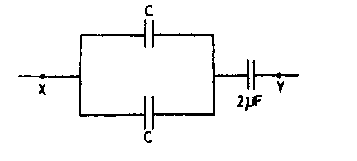
The effective capacitance between points X and Y in the diagram above is 1.0\(\mu\) F. What is the value of the capacitance?
Attached Figure / Diagram
A
5.0 μ
B
4.0 μ
C
3.0 μ
D
1.0 μ
medium Difficulty
Verified Correct Answer: Option D
Physical Principles & Numerical Solution
Effective capacitance across the parallel = C + C = 2C
Effective capacitance across the circuit = \(\frac{1}{2C} + \frac{1}{2}\) = \(\frac{1 + C}{2C}\)
∴ Effective capacitance across the circuit = \(\frac{1 + C }{2C}\) = \(\frac{1}{1}\)
1 + C = 2C;
2C – C = 1
∴ C = 1.0 \mu
Source: WAEC / JAMB / NECO Classroom Archive (Record #76403)
Physics
UTME / JAMB 2025
Current Electricity
Solution
Which of the following is better for measuring a very small resistance?
A
Voltmeter
B
Wheatstone bridge
C
rheostat
D
Potentiometer
medium Difficulty
Verified Correct Answer: Option B
Physical Principles & Numerical Solution
A Wheatstone bridge is specifically designed for the accurate measurement of small and unknown resistances. It operates on the principle of balancing two legs of a bridge circuit, enabling precise determination of resistance values.
Potentiometer: Used to measure potential difference or electromotive force (emf), not to measure resistance directly.
Rheostat: A variable resistor utilized to control current, rather than for measuring resistance.
Wheatstone Bridge: The most effective method for measuring very small resistances.
Source: WAEC / JAMB / NECO Classroom Archive (Record #74484)