Question Library
Browse, filter, and study verified past examination questions with step-by-step mathematical reasoning.
Searching 18,000+ Questions...
Sifting topics, KaTeX formulas & verified solutions
Showing 91–105 of 1709 verified questions
Sort by:
Physics
WAEC / WASSCE 2021
Mechanics and Properties of Matter
Diagram
Solution
c(ii)
(a)(i) Define dew point. (ii) Explain why dew forms more quickly on the metal parts than on the rubber parts of a bicycle placed in the open overnight.
(b)(i) Explain the statement. the specific heat capacity of copper is 400 J/kg/K. (ii) Two metals, P and Q are supplied with the same quantity of heat.
If the ratio of the specific heat capacity of P to Q is 3: 1 and their masses are in the ratio I:2 respectively.
calculate the ratio of the temperature rise of P to Q.
(c)(i) Define coefficient of thermal conductivity of a material.
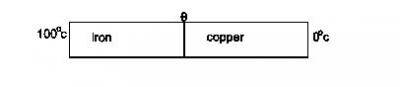
The diagram above c(ii) illustrates a composite bar of iron and copper. The bar is insulated along its sides and it has a diameter of 10 mm. The length and thermal conductivity of the iron are 0.15 m and 40 W/m/K, respectively and those of copper are 0.05 m and 360 W/m/K, respectively. If the free ends of the iron and copper are kept at 100^\circC and 0^\circC respectively. calculate the (i) temperature at the interface between the bars; (ii) rate of heat flow along the bar.
Attached Figure / Diagram
medium Difficulty
Verified Correct Answer: Option
Physical Principles & Numerical Solution
(a)(i) Dew Point: This is the temperature at which the water vapour/miosture present in the atmosphere/air is just sufficient to saturate it.
(a)(ii) Explanation of why dew forms more quickly on metal parts than rub Metal is a better conductor of heat than rubber. At night. metal loses heat faster than rubber and becomes colder.
Warm air gains latent heat of vaporization from the faster than rubber. Dews are thus formed on the metal parts.
9: (b)(i) Explanation of the statement: 400J of heat/energy is required to charge or raise the temperature of lkg of copper by 1k.
(ii) Heat = mc\DeltaΘ
Hence; MpCp\DeltaΘP = MqCq\DeltaΘq
Given that: Cp : Cq = 3:1 and
Mp : Mq = 1:2
\(\frac{\DeltaΘp}{\DeltaΘq}\) = \(\frac{Cp * Mq}{Cp * Mp}\) → \(\frac{1}{3}\) * \(\frac{2}{1}\)
\DeltaΘp : \DeltaΘq = 2:3
Heat = mc\DeltaΘ
Hence; MpCp\DeltaΘP = MqCq\DeltaΘq
1 * 3 * \DeltaΘp = 2 * 1 * \DeltaΘp
\(\frac{ \DeltaΘp }{ \DeltaΘq}\) = \(\frac{2}{3}\)
\DeltaΘp : \DeltaΘq = 2:3
(c) Definition of Coefficient of Thermal Conductivity: The time rate of flow of heat per unit cross sectional area per unit temperature gradient.
(cii) \(\frac{Θ}{t} = \frac{KA\DeltaΘ}{\DeltaL}\)
\(40 \times \pi \frac{(10 \times10^{-3})^2}{4}\times\frac{(100 - Θ)}{0.15}\)
= \(360 \times \pi \frac{(10 \times10^{-3})^2}{4} \times\frac {Θ - 0}{0.05}\) = 3.6^\circC
(c)(iii) \(\frac{Θ}{t} = 40\pi (\frac{10^{-2}}{4})^3 (\frac{100 - 3.6}{0.15}) = 2.02J/S\)
Source: Myschool Past Questions Archive (Record #62325)
Physics
WAEC / WASSCE 2021
Mechanics and Properties of Matter
Diagram
Solution
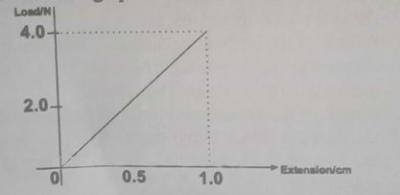
The load-extension graph of an elastic material is illustrated above. Use the graph to determine the work done in stretching the material
Attached Figure / Diagram
medium Difficulty
Verified Correct Answer: Option
Physical Principles & Numerical Solution
Determination of work done from the graph: Work done is the area under the graph
Area = \(\frac{1}{2}\) b * h = \(\frac{1}{2} \times 10^{-2} \times 4\) = \(2 \times10^{-2}\)J
Source: Myschool Past Questions Archive (Record #62318)
Physics
WAEC / WASSCE 2021
Mechanics and Properties of Matter
Solution
Explain the wave-particle duality of light. (b) A particle of wavelength 4.2x 10\(^{-11}\)m travels (a) With a momentum of 1.6 x 10\(^{-23}\) kg m/s,
Determine the value of the Planck's constant, h.
medium Difficulty
Verified Correct Answer: Option
Physical Principles & Numerical Solution
(a) Explanation of wave-particle duality of light: Light can act as a particle (by way of Photon) and also simultaneously).
(b) Determination of Planck's Constant
h = \pi P = 4.2 x 10\(^{-11}\) x 1.6 x 10\(^{-23}\) as waves
= 6.72 x 10\(^{-34}\) JS
Source: Myschool Past Questions Archive (Record #62322)
Physics
WAEC / WASSCE 2021
Mechanics and Properties of Matter
(a)(i) State the principal factor that determines the relative stability of a radioactive nucleus.
(ii) Arrange the following radioactive nucleus in decreasing order of stability. Justify your answer: X,W and Y:
\(^40{X}_20\) \(^920{Y}_36\) and \(^95{Z}_42\)
(b)(i) Explain the term ionization potential.
(ii)
The diagram above illustrates energy levels in the hydrogen atom. E, is the energy of the E\(_0\) ground state.
(i) When an electron makes a transition from level n = 3 to level n = 1, it emits a photon of wavelength 1.02x 10\(^{-7}\)m. Calculate E\(_0\).
(ii) Calculate the ionization potential of the hydrogen atom.
(c)(i) Explain the statement, the work function of sodium is 2.0 eV. (ii) Light of wavelength 160 mm is shone on the surface of a sodium metal of work function 2.0 eV. Determine whether photoelectrons will be emitted. [h = 6.6 x 10\(^{-34}\) Js, e = 3.0 x 10\(^{8}\)m/s, I eV = 1.6 x 10\(^{-19}\) J]
medium Difficulty
Verified Correct Answer: Option
Physical Principles & Numerical Solution
No expanded working has been attached for this question yet. The verified answer is Option .
Source: Myschool Past Questions Archive (Record #62328)
Physics
WAEC / WASSCE 2021
Mechanics and Properties of Matter
Diagram
Solution
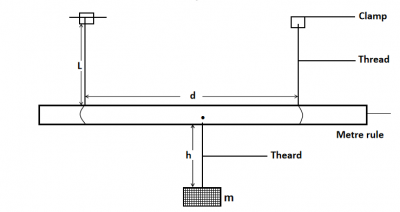
(a) You are provided with a set of masses, a metre rule, a thread, two retort stands and clamps, a stop watch, a knife edge and split corks.
Carry out the following instructions using the diagram above as a guide.
(i) Determine the centre of gravity, C, of the metre rule using the knife edge.
(ii) Read and record the mass, M, of the metre rule written on the reverse side of it.
(iii) Suspend the metre rule by means of two parallel threads of equal length, h =70 cm, with one at the 10 cm mark and the other at 90 cm mark of the metre rule.
(iv) Attach a mass m = 30g firmly to the metre rule at C. Ensure that the graduated face of the metre rule is facing upwards and that d= 80 cm throughout the experiment. (v) Set the metre rule into small angular oscillations about the vertical axis through its centre of gravity by displacing its ends in opposite directions.
(VI) Determine the time,i, for 20 oscillations and evaluate the period T, T\(^2\) and T\(^{-2}\).
(vii) Repeat the procedure for four other values of m =40 g, 50 g, 60 g and 70 g n each case, determine I and evaluate T\(^2\) and T\(^{-2}\).
(viii) Plot a graph of T on the vertical axis and m on the horizontal axis.
(ix) Determine the slope, s, of the graph.
(x) Evaluate Q= 0.68 / s.
(xi) State two precautions taken to ensure accurate results.
(b) (i) Give two examples of simple harmonic motion other than the motion of a simple pendulum.
(ii) Explain the term centre of gravity of a body.
Attached Figure / Diagram
medium Difficulty
Verified Correct Answer: Option
Physical Principles & Numerical Solution
(ai) M = 50.0cm
S\N
m(g)
t(s)
T = \(\frac{t}{20}\)(s)
T\(^2\)(S\(^2\))
T\(^{-2}\)(\(^{-2}\))
1
20.0
30.00
1.50
2.2500
0.4444
2
30.0
32.00
1.60
2.5600
0.3906
3
50.0
35.00
1.75
3.0625
0.3265
4
70.0
37.00
1.85
3.4225
0.2922
5
100.0
40.00
2.00
4.0000
0.2500
Slope, s = \(\frac{\Delta T^2}{\Deltam}\) = \(\frac{0.15 - 0.4}{112 - 34}\) = \(\frac{- 0.25}{78}\) = - 0.0032
(i) Avoid error due to parallax error in the reading my metre rule.
(ii) Ensured that support was rigid
Definition of the period of an oscillatory motion.
(b)(i) The period of an oscillatory motion is the time taken to complete one oscillation.
(ii) Differences between mass and weight
Mass is the measure of the amount of matter in a body. Mass is denoted using m or M.
Weight is the measure of the amount of force acting on a mass due to the acceleration due to gravity. Weight usually is denoted by W.
SEE THE GRAPH ABOVE.
Source: Myschool Past Questions Archive (Record #62349)
Physics
UTME / JAMB 2020
Mechanics and Properties of Matter
Solution
The force required to make an object of mass m, travelling with velocity v, turn in a circle of radius r is
A
\(\frac{mv^2}{r}\)
B
\(\frac{mr^2}{x}\)
C
\(\frac{mr}{v}\)
D
\(\frac{mv}{r^2}\)
medium Difficulty
Verified Correct Answer: Option A
Physical Principles & Numerical Solution
The force required to make an object of mass \( m \), traveling with velocity \( v \), turn in a circle of radius \( r \) is known as the \textbf{centripetal force}. The formula for centripetal force \( F_c \) is given by: \(F_c = \frac{mv^2}{r}\)
where:\( m \) = mass of the object, \( v \) = velocity of the object, \( r \) = radius of the circular path.
Source: Myschool Past Questions Archive (Record #56891)
Physics
UTME / JAMB 2020
Mechanics and Properties of Matter
Solution
A machine gun with a mass of 5kg fires a 50g bullet at a speed of 100 ms\(^{-1}\). The recoil speed of the machine gun is
A
0.5 ms\(^{-1}\)
B
1.5 ms\(^{-1}\)
C
1 ms\(^{-1}\)
D
2ms\(^-1\)
medium Difficulty
Verified Correct Answer: Option C
Physical Principles & Numerical Solution
Gun Momentum = bullet momentum
M\(_a\)V\(_a\) = M\(_b\)V\(_b\)
5 x V\(_a\) = 0.05 x 100
V\(_a\) = 1m\(^{-1}\)
Source: Myschool Past Questions Archive (Record #56892)
Physics
UTME / JAMB 2020
Mechanics and Properties of Matter
Solution
What is the cost of running five 50W lamps and four 100W lamps for 10 hours if electrical energy costs 2 Kobo per KWh?
A
N0.65
B
N0.39
C
N3.90
D
N0.13
medium Difficulty
Verified Correct Answer: Option D
Physical Principles & Numerical Solution
POWER = energy consumed/time
Energy consumed = power x time
energy consumed = \(\frac{(5 \times 50) + (4 \times 100) \times10}{1000}\)
= 6.5KWh.
but 1KWh = 2kobo
then 6.5KWh = 6.5 x 2 = 13kobo →#0.13
Source: Myschool Past Questions Archive (Record #56903)
Physics
UTME / JAMB 2020
Mechanics and Properties of Matter
Solution
A solid weighs 4.8g in air, 2.8g in water and 3.2g in Kerosine. The ratio of density of the solid to that of the kerosine is
A
2
B
\(\frac{3}{2}\)
C
\(\frac{2}{3}\)
D
3
medium Difficulty
Verified Correct Answer: Option D
Physical Principles & Numerical Solution
Relative density of solid
\(\frac{\text{weight of solid}}{\text{weight of an equal volume of water}}\)
= \(\frac{4.8}{4.8 - 2.8}\)
= \(\frac{4.8}{2}\) = 2.4
Relative density of liquid
= \(\frac{\text{Weight of liquid kerosine}}{\text{Weight of an equal volume of water}}\)
= \(\frac{4.8 - 3.2}{4.8 - 2.8}\) = \(\frac{1.6}{2}\) = 0.8
= \(\frac{\text{Ratio of relative density of solid}}{\text{Relative density of Kerosine}}\)
= \(\frac{\text{density of solid}}{\text{density of Kerosine}}\)
= \(\frac{2.4}{0.8}\)
= 3
Source: Myschool Past Questions Archive (Record #56906)
Physics
UTME / JAMB 2020
Mechanics and Properties of Matter
Diagram
Solution
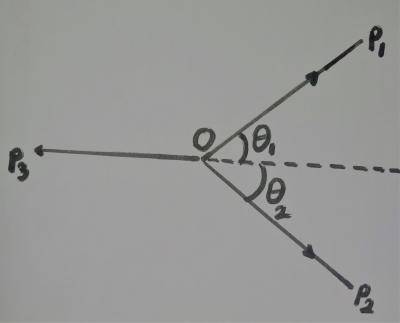
Consider the three forces acting at O and in equilibrium as shown in the figure. Which of the following equations is/are CORRECT?
I. P\(_1\) cos \(\theta_1\) = p\(_1\) cos \(\theta_2\)
II. P\(_3\) = P\(_1\) cos \(\theta_4\) + P\(_2 cos_2\)
III. P\(_1 \sin \theta_1 = P_2 \sin \theta_2\)
Attached Figure / Diagram
A
I only
B
II only
C
III only
D
I, II and III only
medium Difficulty
Verified Correct Answer: Option C
Physical Principles & Numerical Solution
resolving \(P_1\), \(P_2\) and \(P_3\) into x and y component
\(P_x\) = \(P_1 Cos\theta_1\)
\(P_y\) = \(P_1Sin\theta_1\)
\(P_x\) = \(P_2Cos\theta_2\)
\(P_y\) = \(-P_2Sin \theta_2\)
\(P_x\) = \(- P_3Cos \theta0\)
therefore
total \(P_x\) = \(P_1 Cos\theta_1\) + \(P_2Cos \theta_2\) + \(- P_3Cos \theta0\) = 0
total \(P_y\) = \(P_1Sin\theta_1\) + \(-P_2Sin \theta_2\) = 0
so that \(P_1Sin\theta_1\) = \(P_2Sin \theta_2\)
\( P_3Cos \theta0\) = \(P_1 Cos\theta_1\) + \(P_2Cos \theta_2\)
Source: Myschool Past Questions Archive (Record #56913)
Physics
UTME / JAMB 2020
Mechanics and Properties of Matter
Solution
The refractive index of a liquid is 1.5. If the velocity of light in vacuum is 3.0 x 10\(^8ms^{-1}\), the velocity of light in the liquid is
A
1.5 x 10\(^8ms^{-1}\)
B
2.0 x 10\(^8ms^{-1}\)
C
3.0 x 10\(^8ms^{-1}\)
D
4.5 x 10\(^8ms^{-1}\)
medium Difficulty
Verified Correct Answer: Option B
Physical Principles & Numerical Solution
n = \(\frac{\text{speed in air}}{\text{speed in glass}}\)
1.5 = \(\frac{3 \times 10^4}{\text{speed in glass}}\)
Speed in glass = 3 x 10\(^8\)m/s / 1.5
= 2 x 10\(^8\)m/s
Source: Myschool Past Questions Archive (Record #56914)
Physics
UTME / JAMB 2020
Mechanics and Properties of Matter
Solution
Heat is supplied uniformly at the rate of 100W to 1.0 x 10\(^{-2}\)kg of a liquid for 20 seconds. If the temperature of the liquid rises by 5\(^o\)C, then the specific heat capacity of the liquid is
A
2.0 x 10\(^2\)Jkg\(^-1\)K\(^-1\)
B
2.0 x 10\(^2\)Jkg\(^-1\)
C
4.0 x 10\(^4\)Jkg\(^-1\)K\(^-1\)
D
4.0 x 10\(^4\)Jkg\(^-1\)
medium Difficulty
Verified Correct Answer: Option C
Physical Principles & Numerical Solution
Heat energy = Electrical Energy
MC\(\theta\) = power x time
5 x 1 x 10\(^{-2}\) x C = 100 x 20
C = \(\frac{200}{5 \times 10^2}\)
= 4 x 10\(^4\) J/kg/\(^oC\)
Source: Myschool Past Questions Archive (Record #56920)
Physics
UTME / JAMB 2020
Mechanics and Properties of Matter
Diagram
Solution
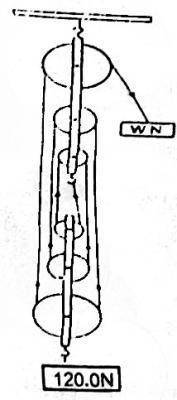
The fiqure above represents a block-and-tackle pulley system on which an effort of W Newtons supports a load of 120.0N. If the efficiency of the machine is 40\(^o\), then the value of W is
Attached Figure / Diagram
A
28.0N
B
48.0N
C
288.0N
D
50.0N
medium Difficulty
Verified Correct Answer: Option D
Physical Principles & Numerical Solution
V.E = 6, load = 120N
Efficiency = M.A x \(\frac{1}{V.R}\) x 100%
40 = \(\frac{120}{effort}\) x \(\frac{1}{6}\) x \(\frac{100}{1}\)
Effort = 50N
Source: Myschool Past Questions Archive (Record #56922)
Physics
WAEC / WASSCE 2020
Mechanics and Properties of Matter
In collision between two objects, kinetic energy is conserved only if
A
one of the objects was initially at rest
B
potential energy is converted to work
C
the collision is inelastic
D
the collision is elastic
medium Difficulty
Verified Correct Answer: Option D
Physical Principles & Numerical Solution
No expanded working has been attached for this question yet. The verified answer is Option D.
Source: Myschool Past Questions Archive (Record #59362)
Physics
WAEC / WASSCE 2020
Mechanics and Properties of Matter
Solution
The quantity of motion of a body is its
A
acceleration
B
displacement
C
mometum
D
velocity
medium Difficulty
Verified Correct Answer: Option C
Physical Principles & Numerical Solution
Momentum is a physical quantity that describes the motion of an object. It is defined as the product of an object's mass and its velocity.
Unlike acceleration, displacement, and velocity, which describe different aspects of motion, momentum specifically quantifies the motion of a body.
Source: Myschool Past Questions Archive (Record #59363)