Question Library
Browse, filter, and study verified past examination questions with step-by-step mathematical reasoning.
Searching 18,000+ Questions...
Sifting topics, KaTeX formulas & verified solutions
Showing 91–105 of 4783 verified questions
Sort by:
Chemistry
UTME / JAMB 2025
Atomic Structure and Periodic Table
Solution
In oxidation reactions, electrons are
A
hydrolysed
B
removed
C
added
D
hydrated
medium Difficulty
Verified Correct Answer: Option B
Chemical Principles & Mechanism
Oxidation is defined as the loss or removal of electrons from a substance. A common mnemonic device used to remember this is "OIL RIG", which stands for "Oxidation Is Loss", "Reduction Is Gain" (of electrons). When a substance is oxidized, its oxidation number increases, indicating a loss of negatively charged electrons.
A. hydrolysed and D. hydrated: Hydrolysis is a chemical process involving the splitting of a molecule by the addition of water, while hydration is the addition of water molecules to a substance. These processes are not the general definition of what happens to electrons during oxidation reactions.
C. added: The addition or gain of electrons is the definition of a reduction reaction, which occurs simultaneously with oxidation in a redox reaction.
The correct answer is option B - removed
Source: Myschool Past Questions Archive (Record #74252)
Chemistry
UTME / JAMB 2025
Organic Chemistry
Solution
(CH\(_3\))\(_2\)CHCH(OH)CH\(_2\)C(CH\(_3\))\(_3\)
The IUPAC name of the compound above is
A
2,5,5-trimethylhexan-3-ol
B
1,1-dimethylisopentanol
C
1,1,4,4-pentamethylbutanol
D
2,5-dimethylhexan-4-ol
medium Difficulty
Verified Correct Answer: Option A
Chemical Principles & Mechanism
To determine the IUPAC name for the compound (CH\(_3\))\(_2\)CHCH(OH)CH\(_2\)C(CH\(_3\))\(_3\), follow these steps:
Identify the longest carbon chain including the hydroxyl (-OH) group: The longest continuous chain containing the hydroxyl group has 6 carbon atoms, so the parent alkane name is hexane, and the compound is a hexanol.
Number the carbon chain: Start numbering from the end closest to the hydroxyl group to give the -OH group the lowest possible number. Numbering from left to right puts the -OH on carbon. The chain is: C1-C2-C3(OH)-C4-C5-C6. The groups are attached as: two methyls on C2, two methyls on C5.
Identify and name the substituents: There are three methyl groups in total. One is on carbon 2, and two are on carbon 5.
Combine the information: The substituents are listed with their positions. There are three methyl groups, so we use the prefix "tri-". The full name is 2,5,5-trimethylhexan-3-ol.
Source: Myschool Past Questions Archive (Record #74255)
Chemistry
UTME / JAMB 2025
Matter & Separation Techniques
Solution
Anti-freeze used in a vehicle radiator is a mixture of water and
A
propanetriol
B
propanol
C
propanone
D
propanal
medium Difficulty
Verified Correct Answer: Option A
Chemical Principles & Mechanism
The primary active ingredient in most modern automotive antifreeze is ethylene glycol (also known as ethanediol or glycol), or the less toxic propylene glycol. However, historically and in some specific formulations, propanetriol, more commonly known as glycerol (or glycerine), has also been used as an antifreeze agent. Propanetriol is effective, non-toxic, and can withstand high temperatures. Given the options provided, propanetriol is the correct answer - option A.
B. propanol (also known as 1-propanol) is an alcohol and can be used as an antifreeze in specific applications (like windscreen washer fluid de-icers), but it is generally not used as the primary, long-term antifreeze in a vehicle's radiator due to its volatility (it evaporates easily).
C. propanone (also known as acetone) is a solvent and not used as an antifreeze in vehicle radiators.
D. propanal (also known as propionaldehyde) is an aldehyde primarily used in chemical synthesis and is not an antifreeze agent for vehicle cooling systems.
Source: Myschool Past Questions Archive (Record #74270)
Chemistry
UTME / JAMB 2025
Acids, Bases, and Salts
Solution
Magnesium tetraoxosulphate(VI) salt is commonly used as a
A
disinfectant
B
plasticizer
C
fertilizer
D
laxative
medium Difficulty
Verified Correct Answer: Option D
Chemical Principles & Mechanism
Magnesium tetraoxosulphate(VI) salt, commonly known as magnesium sulphate or Epsom salt, is a saline laxative used for short-term relief of constipation. When taken orally, magnesium sulphate acts as an osmotic purgative or saline laxative. It draws water into the intestines, softening the stool and increasing bowel movements.
A. disinfectant: Disinfectants are chemical substances used to destroy microorganisms on inert surfaces. Magnesium sulfate is not primarily used as a disinfectant.
B. plasticizer: Plasticizers are additives used to increase the plasticity or fluidity of a material. This is not a use of magnesium sulphate.
C. fertilizer: While magnesium sulfate is used in agriculture as a fertilizer to add magnesium and sulphur to the soil, its use as a laxative is a more common and direct application in a general/medical context, as implied by the multiple-choice question format asking for the most common use among the given options.
In the context of the typical educational question, the medical use is often the intended answer, which is option D - Laxative
Source: Myschool Past Questions Archive (Record #74271)
Chemistry
UTME / JAMB 2025
Matter & Separation Techniques
Solution
The constituents of permalloy are Iron and
A
Nickel
B
Tin
C
Chromium
D
Copper
medium Difficulty
Verified Correct Answer: Option A
Chemical Principles & Mechanism
Permalloy is primarily an iron-nickel magnetic alloy, typically consisting of about 80% nickel and 20% iron. This specific composition gives permalloy its characteristic high magnetic permeability and low coercivity, making it useful in applications like magnetic shielding and electrical transformers.
The correct option is A. Nickel.
B. Tin: Tin is a primary component in bronze (a copper-tin alloy) and in some types of solder, but not the main secondary constituent of permalloy.
C. Chromium: Chromium is a key element in stainless steel (an alloy of iron, chromium, and sometimes nickel) to provide corrosion resistance, not the primary alloying element with iron in permalloy.
D. Copper: Copper is the primary component in brass and bronze. While some specific permalloy variations may contain small amounts of copper, it is not the main constituent with iron in the general definition of permalloy.
Source: Myschool Past Questions Archive (Record #74272)
Chemistry
UTME / JAMB 2025
Stoichiometry & Mole Concept
Solution
An inflated balloon shrinks when placed in a freezer because the
A
volume of gas increases and expands
B
number of gas molecules decreases
C
gas motion reduces and exert less pressure
D
gas molecules completely stop moving
medium Difficulty
Verified Correct Answer: Option C
Chemical Principles & Mechanism
When an inflated balloon is placed in a freezer, the temperature of the gas inside decreases. According to the kinetic molecular theory and Charles's Law:
Gas molecules lose kinetic energy and move more slowly. This reduced motion results in less frequent and less forceful collisions with the inner walls of the balloon. The overall effect is a decrease in the internal pressure of the gas. Since the external atmospheric pressure remains constant, the balloon is compressed and shrinks in volume until the internal and external pressures equalize, resulting in a smaller balloon.
Source: Myschool Past Questions Archive (Record #74273)
Chemistry
UTME / JAMB 2025
Electrochemistry and Redox
Solution
The compound in which the oxidation state of nitrogen is + 3 is
A
N\(_2\)O\(_5\)
B
N\(_2\)O\(_3\)
C
N\(_2\)O\(_4\)
D
N\(_2\)O
medium Difficulty
Verified Correct Answer: Option B
Chemical Principles & Mechanism
The oxidation state of nitrogen in N\(_2\)O\(_3\) is +3. This is calculated using the rule that oxygen typically has an oxidation state of -2 in compounds, and the sum of all oxidation states in a neutral compound is zero.
In N\(_2\)O\(_5\): N\(_2\)O\(_5\) = 0
2(N) + ( -2 x 5) = 0
2N - 10 = 0
N = \(\frac{10}{2}\) = +5
In N\(_2\)O\(_3\): N\(_2\)O\(_3\) = 0
2(N) + ( -2 x 3) = 0
2N - 6 = 0
N = \(\frac{6}{2}\) = +3
In N\(_2\)O\(_4\): N\(_2\)O\(_4\) = 0
2(N) + ( -2 x 4) = 0
2N - 8 = 0
N = \(\frac{8}{2}\) = +4
In N\(_2\)O: N\(_2\)O = 0
2(N) + (-2) = 0
2N - 2 = 0
N = \(\frac{2}{2}\) = +1
The correct option is B - N\(_2\)O\(_3\).
Source: Myschool Past Questions Archive (Record #74274)
Chemistry
UTME / JAMB 2025
Atomic Structure and Periodic Table
Solution
Na\(_2\)X ⇌ 2Na\(^+\) + X\(^{2-}\)
The bond between Na and X is likely to be
A
dative
B
ionic
C
metallic
D
covalent
medium Difficulty
Verified Correct Answer: Option B
Chemical Principles & Mechanism
The reaction given, \(\text{Na}_{2}\text{X}\rightleftharpoons 2\text{Na}^{+}+\text{X}^{2-}\), indicates that the compound \(\text{Na}_{2}\text{X}\) dissociates into positive sodium ions (\(\text{Na}^{+}\)) and a negative ion (\(\text{X}^{2-}\)). The formation of ions and their electrostatic attraction is characteristic of an ionic bond.
Sodium (Na) is a metal and typically loses electrons to form positive ions (cations) to achieve a stable electron configuration. Element X forms a negative ion (\(\text{X}^{2-}\)), meaning it is likely a non-metal that gains electrons.
Source: Myschool Past Questions Archive (Record #74275)
Chemistry
UTME / JAMB 2025
Stoichiometry & Mole Concept
Solution
The compound responsible for the pleasant scent of fruits and perfumes belongs to the class of
A
alkanamide
B
alkanone
C
alkanal
D
alkanoate
medium Difficulty
Verified Correct Answer: Option D
Chemical Principles & Mechanism
Compounds responsible for the pleasant, fruity scents of fruits and many perfumes belong to the class of organic compounds known as esters(alkanoates). Low-molecular-weight esters are responsible for the odours in fruits (e.g., isoamyl acetate in bananas, ethyl butyrate in pineapples).
Due to their, sweet-smelling, and often fruity nature, they are used extensively in synthetic flavours, perfumes, and cosmetics.
While other compounds like aldehydes and ketones can contribute to odours, esters are the primary class associated with these specific pleasant fruit-like aromas.
Source: Myschool Past Questions Archive (Record #74277)
Chemistry
UTME / JAMB 2025
Stoichiometry & Mole Concept
Solution
The most suitable indicator to be used when reacting ethanedioic acid with potassium hydroxide is
A
phenolphthalein
B
methyl orange
C
methyl red
D
methyl purple
medium Difficulty
Verified Correct Answer: Option A
Chemical Principles & Mechanism
The reaction involves ethanedioic acid (a weak acid, also known as oxalic acid) and potassium hydroxide (a strong base, KOH).
The titration of a weak acid with a strong base results in an equivalence point at a pH greater than 7 (in the alkaline range). Phenolphthalein is the most suitable indicator for this type of titration because its colour change range (pH 8.3-10.0) falls within the steep, alkaline portion of the titration curve. It changes from colourless in acid to pink in alkaline solution, which provides a sharp and distinct endpoint.
Source: Myschool Past Questions Archive (Record #74278)
Chemistry
UTME / JAMB 2025
Atomic Structure and Periodic Table
Solution
Electron configuration of Chlorine atom is
A
1S\(^2\)2S\(^2\)2P\(^6\)3S\(^2\)3P\(^5\)
B
1S\(^2\)2S\(^2\)2P\(^6\)3S\(^2\)3P\(^4\)
C
1S\(^2\)2S\(^2\)2P\(^6\)3S\(^2\)3P\(^6\)
D
1S\(^2\)2S\(^2\)2P\(^5\)3S\(^2\)3P\(^6\)
medium Difficulty
Verified Correct Answer: Option A
Chemical Principles & Mechanism
The electron configuration describes the arrangement of electrons within an atom's orbital shells. Chlorine (Cl) has an atomic number of 17, meaning a neutral chlorine atom has 17 electrons. The filling of electron orbitals follows the Aufbau principle (lowest energy levels first), resulting in the following configuration:
1s²: The first energy level, s-subshell, holds 2 electrons.
2s²: The second energy level, s-subshell, holds 2 electrons.
2p⁶: The second energy level, p-subshell, holds 6 electrons.
3s²: The third energy level, s-subshell, holds 2 electrons.
3p⁵: The third energy level, p-subshell, holds the remaining 5 electrons (2 + 2 + 6 + 2 + 5 = 17 electrons in total).
Source: Myschool Past Questions Archive (Record #74279)
Chemistry
UTME / JAMB 2025
Atomic Structure and Periodic Table
Solution
A table in which metals are arranged in series according to their comparative tendencies to give up their valence electrons is
A
periodic table
B
electrochemical series
C
table of elements
D
periodicals
medium Difficulty
Verified Correct Answer: Option B
Chemical Principles & Mechanism
The electrochemical series, also known as the activity series or electromotive series, is a list of metals (and other elements) arranged in order of their standard electrode potentials. This arrangement ranks them by their tendency to lose electrons (get oxidized, or "give up their valence electrons"). Metals higher in the series are more reactive and lose electrons more easily than those lower down.
A. periodic table: The periodic table arranges elements primarily by increasing atomic number, which helps show trends in properties, including the number of valence electrons and general reactivity, but it is not specifically a series of metals ranked by their comparative tendency to give up valence electrons in the manner of the electrochemical series.
C. table of elements: This is another name for the periodic table or a general list of all known elements, not a specific series ranking metals by their reactivity or tendency to lose electrons.
D. periodicals: Periodicals are publications (magazines, journals, etc.) that come out at regular intervals; this term has no relevance to the arrangement of metals by chemical properties.
Source: Myschool Past Questions Archive (Record #74280)
Chemistry
UTME / JAMB 2025
Acids, Bases, and Salts
Solution
An importance of solubility is that it
A
determines the amount of solute that can dissolve in a given amount of solvent
B
lowers the vapour pressure of the liquid
C
enables us to know the chemical reactions of the gas with the liquid
D
raises the boiling point of liquid
medium Difficulty
Verified Correct Answer: Option A
Chemical Principles & Mechanism
Solubility is defined as the maximum amount of a specific solute that can dissolve in a given amount of solvent under specific conditions (temperature and pressure) to form a saturated solution. This intrinsic property determines the limit of how concentrated a solution can become.
The correct option is A - determines the amount of solute that can dissolve in a given amount of solvent.
B. lowers the vapour pressure of the liquid: The addition of a non-volatile solute to a solvent lowers the vapor pressure (a colligative property), but solubility itself is a measure of the amount that can dissolve, not the phenomenon of vapor pressure lowering.
C. enables us to know the chemical reactions of the gas with the liquid: Solubility describes a physical property (dissolution), not the chemical reactivity between a gas and a liquid.
D. raises the boiling point of liquid: The addition of a non-volatile solute raises the boiling point (another colligative property), but again, solubility is the measure of the extent of dissolution.
Source: Myschool Past Questions Archive (Record #74283)
Chemistry
UTME / JAMB 2025
Acids, Bases, and Salts
Solution
The disintegration of radioactive phosphorus to silicon follows the first order kinetics with rate constant k\(_1\) = 3.85 x 10\(^{-3}\). Determine the half life of phosphorus.
A
8 s
B
180 s
C
80 s
D
100 s
medium Difficulty
Verified Correct Answer: Option B
Chemical Principles & Mechanism
Firstly, State the formula for the half-life of a first-order reaction.
Radioactive decay follows first-order kinetics.
The half-life (t\(_{1/2}\)) for a first-order reaction is related to the rate constant (k) by the formula:
t\(_{1/2}\) = \(\frac{ln 2}{k}\)
t\(_{1/2}\) ≈ \(\frac{0.693}{k}\)
Secondly, calculate the half-life using the assumed rate constant given in the question as k = 3.85 x 10\(^{-3}\)s\(^{-1}\)
t\(_{1/2}\) = \(\frac{0.693}{3.85 x 10{^-3}}\)
t\(_{1/2}\) = 180 s
Source: Myschool Past Questions Archive (Record #74287)
Chemistry
UTME / JAMB 2025
Atomic Structure and Periodic Table
Diagram
Solution
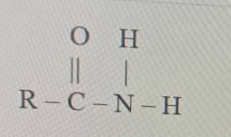
The above structure is
Attached Figure / Diagram
A
alkylamine
B
alkanone
C
alkanamide
D
amino acid
medium Difficulty
Verified Correct Answer: Option C
Chemical Principles & Mechanism
The structure RCONH₂ contains a carbonyl group (C=O) bonded directly to a nitrogen atom (NH₂). This specific functional group, CONH₂, is characteristic of an amide. In the general naming convention for this class of organic compounds, they are known as alkanamides.
Alkylamine: Amines have a general formula of RNH₂ (primary amine) without the carbonyl group (C=O) adjacent to the nitrogen.
Alkanone: Alkanones, also known as ketones, have a carbonyl group (C=O) bonded to two other carbon atoms (RCOR'), and do not contain a nitrogen atom.
Amino acid: Amino acids are organic compounds that contain both an amino group (–NH₂) and a carboxylic acid group (–COOH) attached to the same central carbon atom, along with a hydrogen atom and a variable side chain (R group). The structure RCONH₂ lacks a carboxyl group.
The correct option is C. alkanamide.
Source: Myschool Past Questions Archive (Record #74289)