Question Library
Browse, filter, and study verified past examination questions with step-by-step mathematical reasoning.
Searching 18,000+ Questions...
Sifting topics, KaTeX formulas & verified solutions
Showing 76–90 of 784 verified questions
Sort by:
Physics
UTME / JAMB 2018
Waves and Optics
Solution
A beam of light is incident from air to water at an angle of 30\(^o\). Find the angle of refraction if the refractive index of water is 4/3
A
15\(^o\)
B
18\(^o\)
C
22\(^o\)
D
24\(^o\)
medium Difficulty
Verified Correct Answer: Option C
Physical Principles & Numerical Solution
X = \(\frac{4}{3}\) r = ?
Shell’s law:. = \(\frac{Sin i^0}{ Sin r^0}\)
= \(\frac{Sin 30^0}{Sin r^0}\)
Sin\(r^0\) = \(\frac{3 Sin 30^0}{4}\)
Sin \(r^0\) = 0.375
R \(^o\) = Sin-1 (0.375)
R \(^o\) = 22.02 \(^o\)
R \(^o\) = 22 \(^o\)
Source: Myschool Past Questions Archive (Record #47704)
Physics
UTME / JAMB 2018
Waves and Optics
Solution
If the focal length of a camera is 20cm, the distance from the film at which the lens must be set to produce a sharp image of 100cm away is
A
17cm
B
20cm
C
25cm
D
100cm
medium Difficulty
Verified Correct Answer: Option C
Physical Principles & Numerical Solution
Focal length: \( f = 20 \, \text{cm} \)
Object distance: \( u = 100 \, \text{cm} \) (positive since it's in front of the lens)
\end{itemize}
Using the lens formula:
\(\frac{1}{f} = \frac{1}{v} + \frac{1}{u}\)
Substituting the known values:
\(\frac{1}{20} = \frac{1}{v} + \frac{1}{100}\)
Rearranging to solve for \( v \):
\(\frac{1}{v} = \frac{1}{20} - \frac{1}{100}\)
Finding a common denominator (100):
\(\frac{1}{20} = \frac{5}{100}\)
Thus, \(\frac{1}{v} = \frac{5}{100} - \frac{1}{100} = \frac{4}{100}\)
Solving for \( v \):
\(v = \frac{100}{4}\) = 25 cm
Source: Myschool Past Questions Archive (Record #47747)
Physics
UTME / JAMB 2018
Waves and Optics
Solution
A lens of focal length 15cm forms an erect image which is three times the size of the object. The distance between the object and the image is ___.
A
10cm
B
20cm
C
30cm
D
40cm
medium Difficulty
Verified Correct Answer: Option D
Physical Principles & Numerical Solution
F= 15cm
M = 3
M = \(\frac{v}{u}\)
V =3u
\(\frac{1}{f}\) = \(\frac{1}{u}\) + \(\frac{1}{v}\)
\(\frac{1}{15}\) = \(\frac{1}{u}\) - \(\frac{1}{3u}\)
\(\frac{1}{15}\) = \(\frac{2}{3u}\)
U =10cm
D = u + v
= 10 +30 = 40cm
Source: Myschool Past Questions Archive (Record #47754)
Physics
UTME / JAMB 2018
Waves and Optics
Solution
A boy receives the echo of his clap reflected by a nearby hill 0.8s later. If the speed of sound in air is 340ms\(^-1\), how far is he from the hill?
A
66m
B
136m
C
264m
D
528m
medium Difficulty
Verified Correct Answer: Option B
Physical Principles & Numerical Solution
2 \times Distance = speed \times time
2 \times Distance = (340) \times (0.8)
= 272/2
Distance = 136m
Source: Myschool Past Questions Archive (Record #47767)
Physics
UTME / JAMB 2018
Waves and Optics
Solution
The critical angle for light traveling from a transparent medium to air s measured as 34º. The refractive index of the medium is
A
0.56
B
1.50
C
1.79
D
2.02
medium Difficulty
Verified Correct Answer: Option C
Physical Principles & Numerical Solution
N = \(\frac{1}{sin\theta}\)
= \(\frac{1}{sin34}\)
= 1.79
Source: Myschool Past Questions Archive (Record #47769)
Physics
WAEC / WASSCE 2018
Waves and Optics
Solution
The bob of a simple pendulum takes 8.0s to complete 10 oscillations. Determine the frequency of oscillation of the bob.
A
0.125Hz
B
1.25Hz
C
7.50Hz
D
8.00Hz
medium Difficulty
Verified Correct Answer: Option B
Physical Principles & Numerical Solution
10 complete oscillations = 8.0s
1 complete oscillation (period) = \(\frac{8}{10}\)s
Frequency = \(\frac{1}{period}\) = \(\frac{1}{0.8} = 1.25Hz\)
Source: Myschool Past Questions Archive (Record #49698)
Physics
WAEC / WASSCE 2018
Waves and Optics
Solution
Two plane mirrors are inclined to each other such that an object placed between them has 11 images. Determine the angle of inclination
A
30°
B
45°
C
60°
D
90°
medium Difficulty
Verified Correct Answer: Option A
Physical Principles & Numerical Solution
Formula for number of images = \(\frac{360}{n} - 1\)
where n is the angle of inclination.
Given the number of images = 11, we have
\(\frac{360}{n} - 1 = 11\)
\(\frac{360}{n} = 12\)
\(n = \frac{360}{12} =30^\circ\)
Source: Myschool Past Questions Archive (Record #49731)
Physics
WAEC / WASSCE 2018
Waves and Optics
Solution
Frequency is measured in
A
meter per second
B
seconds
C
hertz
D
farad
medium Difficulty
Verified Correct Answer: Option C
Physical Principles & Numerical Solution
The unit of frequency is hertz, abbreviated Hz.
Source: Myschool Past Questions Archive (Record #49712)
Physics
WAEC / WASSCE 2018
Waves and Optics
Solution
Rainbow formation is a natural phenomenon illustrating that white light
A
splits into three components after rainfall
B
is dispersed by glass prisms
C
splits into its constituent colours before rainfall
D
is dispersed into its constituent colours after rainfall
medium Difficulty
Verified Correct Answer: Option D
Physical Principles & Numerical Solution
A rainbow is caused by the dispersion of sunlight by tiny water droplets present in the atmosphere, which can be seen after the rain.
Source: Myschool Past Questions Archive (Record #49726)
Physics
WAEC / WASSCE 2018
Waves and Optics
Diagram
Solution
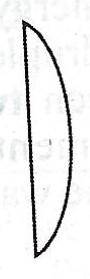
The lens illustrated above can best be described as a
Attached Figure / Diagram
A
converging meniscus
B
plano-convex
C
diverging meniscus
D
bi-convex
medium Difficulty
Verified Correct Answer: Option B
Physical Principles & Numerical Solution
The diagram is that of a plano-convex lens; a type of converging lens.
Source: Myschool Past Questions Archive (Record #49730)
Physics
WAEC / WASSCE 2018
Waves and Optics
Solution
To obtain a virtual, erect and magnified image from a thin converging lens, an object must be placed
A
between the focus and the lens
B
at the focus
C
between the focal length and twice the focal length
D
beyond twice the focal length
medium Difficulty
Verified Correct Answer: Option A
Physical Principles & Numerical Solution
When the object is placed between the optical centre of the lens and the focal length, the image formed is virtual, erect and magnified.
Source: Myschool Past Questions Archive (Record #49772)
Physics
WAEC / WASSCE 2018
Waves and Optics
Diagram
Solution
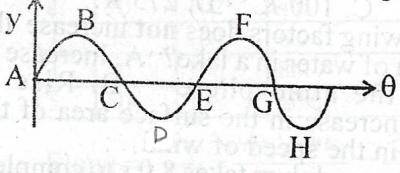
The diagram above represents a transverse travelling wave. Which two points are 180^\circ out of phase?
Attached Figure / Diagram
A
A and E
B
B and D
C
C and F
D
D and H
medium Difficulty
Verified Correct Answer: Option B
Physical Principles & Numerical Solution
This means that when one Point is at its highest point, the other is at its lowest point, resulting in a 180-degree phase difference.
Source: Myschool Past Questions Archive (Record #49775)
Physics
WAEC / WASSCE 2018
Waves and Optics
Solution
A wire of length 400cm is stretched between two fixed points. When plucked, its fundamental frequency is 150Hz. Calculate the speed of the wave produced.
A
250\(ms^{-1}\)
B
625\(ms^{-1}\)
C
1200\(ms^{-1}\)
D
1500\(ms^{-1}\)
medium Difficulty
Verified Correct Answer: Option C
Physical Principles & Numerical Solution
The fundamental frequency \((f_{0})\) = \(\frac{v}{2l}\)
\(f_{0} = 150Hz; l =400cm = 4m\)
\(150 = \frac{v}{2\times 4}\)
\(v = 150 \times 8 = 1200ms^{-1}\)
Source: Myschool Past Questions Archive (Record #49800)
Physics
WAEC / WASSCE 2018
Waves and Optics
Diagram
Solution
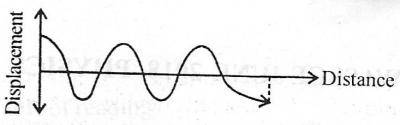
The diagram above illustrates a waveform. Determine the number of wavelengths in it
Attached Figure / Diagram
A
4
B
3\(\frac{1}{2}\)
C
2\(\frac{1}{2}\)
D
2
medium Difficulty
Verified Correct Answer: Option C
Physical Principles & Numerical Solution
Number of wavelengths = Number of oscillations
Number of wavelengths = \(\frac{1}{4} + \frac{1}{2} + \frac{1}{2} + \frac{1}{2} + \frac{1}{2} +\frac{1}{4}\) = 2\(\frac{1}{2}\)
Source: Myschool Past Questions Archive (Record #49804)
Physics
WAEC / WASSCE 2018
Waves and Optics
In which of the following situations is photoelectric effect employed?
I. Automatic devices for switching on light at dusk
II. Automatic doors in departmental stores
III. Automatic devices for switching on air conditioners
IV. Automatic voltage stabilizers
A
I, II and IV only
B
I, III and IV only
C
III and IV only
D
I and II only
medium Difficulty
Verified Correct Answer: Option A
Physical Principles & Numerical Solution
No expanded working has been attached for this question yet. The verified answer is Option A.
Source: Myschool Past Questions Archive (Record #49887)