Question Library
Browse, filter, and study verified past examination questions with step-by-step mathematical reasoning.
Searching 18,000+ Questions...
Sifting topics, KaTeX formulas & verified solutions
Showing 76–90 of 1709 verified questions
Sort by:
Physics
WAEC / WASSCE 2022
Mechanics and Properties of Matter
Diagram
Solution
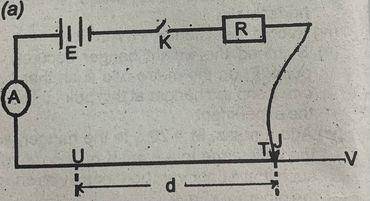
You are provided with a battery of e.m.f, E, a standard resistor, R, of resistance 2 \(\Omega\), a key, K, an ammeter, A, a jockey, J, a potentiometer, UV, and some connecting wires.
(i) Measure and record the emf, E, of the battery.
(ii) Set up the circuit as shown in the diagram above with the key open.
(iii) Place the jockey at the point, U, of the potentiometer wire. Close the key and record the reading, i, of the ammeter.
(iv) Place the jockey at a point T on the potentiometer wire UV such that d = UT = 30.0 cm.
(v) Close the circuit, read and record the current, I, on the ammeter,
(vi) Evaluate I\(^{1}\).
(vi) Repeat the experiment for four other values of d = 40.0 cm, 50.0 cm, 60.0 cm and 70.0 cm. In each case, record I and evaluate I\(^{1}\).
(vii) Tabulate the results
(ix) Plot a graph with d on the vertical axis and I on the horizontal axis stalling both axes from the origin (0,0).
(x) Determine the slope, s, of the graph.
(xi) From the graph determine the value \(I_1\), of I when d = 0. (ci) Given that=s, calculate 8.
(xii) State two precautions taken to ensure accurate results.
(xii) Given that \(\frac{E}{\delta}\) = s, calculate \(\delta\).
(b)(i) Write down the equation that connects the resistance, R, of a wire and the factors on which it depends. State the meaning of each of the symbols.
(ii) An electric fan draws a current of0.75 A in a 240 V circuit. Calculate the cost of using, the fan for 10 hours if the utility rate is $ 0.50 per kWh.
Attached Figure / Diagram
medium Difficulty
Verified Correct Answer: Option
Physical Principles & Numerical Solution
(a) OBSERVATIONS
(i) Value of E correctly read and recorded to at least 1 d.p in volts.
(ii) Value of i correctly read and recorded to at least 1 d.pin amperes.
(iii) Five values of d correctly determined and recorded to at least 1 d.p in cm.
(iv) Five values of I correctly read and recorded to at least 1 d.p in amperes and in trend.
Trend; As d increases, I decreases
(v) Five values of I\(^{1}\) correctly evaluated to at least 3 s.f.
(vi) Composite table showing at least d, I, and I\(^{-1}\).
(ii) P = IV
Power P = \(\frac{240 \times 0.75}{100}\)
0.18kw
Energy consumed in 10hr = 0.18 x 10
= 1.8kWh
Cost of energy = 1.8 x 0.5 = $0.9
OR
Cost of energy = \(\frac{\text {P x cost x time}}{100}\)
\(\frac{0.7 \times 240 \times 10}{1000}\)
= $0.9
Source: Myschool Past Questions Archive (Record #63755)
Physics
UTME / JAMB 2022
Mechanics and Properties of Matter
Solution
Water is not a good thermometric liquid because it?
A
expands unevenly between 0 ºC and 4 ºC
B
maintains fixed density
C
has low freezing point
D
wets glass
medium Difficulty
Verified Correct Answer: Option A
Physical Principles & Numerical Solution
Water is most anomalous at low temperatures, with a remarkable density maximum at 4^\circC.
water is not used as a thermometric liquid because it has low thermal expansivity, high specific capacity, high vapor pressure and wets glass.
Source: Myschool Past Questions Archive (Record #64945)
Physics
UTME / JAMB 2021
Mechanics and Properties of Matter
Solution
Which of the units of the following physical quantities are derived?
I. Area
II. Thrust
III. Pressure
IV. Mass
A
I, II, III and IV
B
I, II, and III only
C
I, II, and IV only
D
I and IV only
medium Difficulty
Verified Correct Answer: Option B
Physical Principles & Numerical Solution
Only 'mass' is a fundamental quantity
Source: Myschool Past Questions Archive (Record #60566)
Physics
UTME / JAMB 2021
Mechanics and Properties of Matter
Solution
A car of mass 800kg attains a speed of 25m/s in 20secs. The power developed in the engine is?
A
1.25 x 10\(^{4}\)W
B
2.50x 10\(^{4}\)W
C
1.25 x 10\(^{6}\)W
D
2.50 x 10\(^{6}\)W
medium Difficulty
Verified Correct Answer: Option A
Physical Principles & Numerical Solution
- Acceleration, a = \(\frac{\text{v}}{\text{t}}\) = \(\frac{25}{20}\) = 1.25ms\(^{-2}\)
- Force, F = ma = 800 x 1.25 = 1,000N
- Average power = Force \times average velocity = 1000 \(\times \frac{0 + 25}{2}\) = 12,500W = 1.25 x 10\(^4\) W
Source: Myschool Past Questions Archive (Record #60756)
Physics
WAEC / WASSCE 2021
Mechanics and Properties of Matter
Solution
Which of the following quantities is not an example of force?
A
Mass
B
Tension
C
Weight
D
Friction
medium Difficulty
Verified Correct Answer: Option A
Physical Principles & Numerical Solution
Mass is a measure of how much matter is in an object.
Source: Myschool Past Questions Archive (Record #61868)
Physics
WAEC / WASSCE 2021
Mechanics and Properties of Matter
The acceleration of a moving object can be determined from the?
A
slope of its distance-time graph.
B
area under its distance-time graph.
C
slope of its velocity-time graph.
D
area under its velocity-time graph
medium Difficulty
Verified Correct Answer: Option C
Physical Principles & Numerical Solution
No expanded working has been attached for this question yet. The verified answer is Option C.
Source: Myschool Past Questions Archive (Record #61899)
Physics
WAEC / WASSCE 2021
Mechanics and Properties of Matter
Solution
The handle of a screw jack is 35 cm long and the pitch of the screw is 0.5 cm. What force must be applied at the end of the handle to lift a load of 2000N, if the efficiency of the jack is 30% [\pi = \(\frac{22}{7}\)]?
A
152.0N
B
132.0N
C
15.2N
D
440.0N
medium Difficulty
Verified Correct Answer: Option C
Physical Principles & Numerical Solution
GIVEN:
Handle length r = 35cm = 0.35cm, pitch of screw = 0.5cm = 0.005cm, load W = 2000N, efficiency = 30%
V.R of screw = \(\frac{2\pi r}{p}\) = \(\frac{2 \times \frac{22}{7} \times 0.35}{0.005}\) = 440
Eff = \(\frac{\text{M.A}}{\text{V.R}}\) x 100
M.A = eff. x V. R = 0.3 x 440 = 132
Effort = \(\frac{L}{M.A}\) = \(\frac{2000}{132}\) ≈ 15.2N
Source: Myschool Past Questions Archive (Record #61901)
Physics
WAEC / WASSCE 2021
Mechanics and Properties of Matter
Solution
A current of 2A passes through a wire of resistance 4\Omega for 3 minutes. Calculate the energy lost.
A
960J
B
1440J
C
2880J
D
48J
medium Difficulty
Verified Correct Answer: Option C
Physical Principles & Numerical Solution
Power = current[I]\(^2\) * Resistance[R] → 2\(^2\) * 4 → 4 * 4 = 16watts
time = 3minutes → 3 * 60 = 180s
Energy = power * time → 16 * 180 = 2880j
Source: Myschool Past Questions Archive (Record #61918)
Physics
WAEC / WASSCE 2021
Mechanics and Properties of Matter
Solution
Which of the following statements best describes the particles in a solid at room temperature? They are
A
far apart and moving randomly.
B
close together and vibrating.
C
close together and stationary.
D
close together and moving randomly.
medium Difficulty
Verified Correct Answer: Option B
Physical Principles & Numerical Solution
The particles of a solid are packed closely together. The forces between the particles are strong enough that the particles cannot move freely; they can only vibrate. As a result, a solid has a stable, definite shape and a definite volume.
Source: Myschool Past Questions Archive (Record #62300)
Physics
WAEC / WASSCE 2021
Mechanics and Properties of Matter
Solution
A force of 10 N, acting continuously, increases the kinetic energy of an object from 20.J to 60 J. Find the distance moved by the object.
A
200m
B
40m
C
4m
D
400m
medium Difficulty
Verified Correct Answer: Option C
Physical Principles & Numerical Solution
according to the work-energy theorem; Workdone = change in kinetic energy.
W = ∆ K.E
force x distance = \(K.E_2 - K.E_2\)
10 x s = 60 - 20
s = \(\frac{40}{10}\) = 4m.
Source: Myschool Past Questions Archive (Record #62303)
Physics
WAEC / WASSCE 2021
Mechanics and Properties of Matter
Solution
The following statements about a loudspeaker are correct except?
A
its contains a permanent magnet.
B
sound signal converted to varying current signal enters the speech coil.
C
the current in the speech coil creates a magnetic force on the coil.
D
the magnetic force on the speech coil is uni-directional.
medium Difficulty
Verified Correct Answer: Option D
Physical Principles & Numerical Solution
The magnetic force on the voice coil is bi-directional, allowing it to move back and forth, producing sound waves.
Source: Myschool Past Questions Archive (Record #62306)
Physics
WAEC / WASSCE 2021
Mechanics and Properties of Matter
An ice cube has mass of 20 g at 5^\circC. Calculate the energy required to raise its temperature to 0^\circC. [Specific heat capacity of ice = 2.1 J/g^\circc]
A
105 J
B
100 J
C
42 J
D
210 J
medium Difficulty
Verified Correct Answer: Option D
Physical Principles & Numerical Solution
No expanded working has been attached for this question yet. The verified answer is Option D.
Source: Myschool Past Questions Archive (Record #62307)
Physics
WAEC / WASSCE 2021
Mechanics and Properties of Matter
Solution
A stone is thrown horizontally with initial velocity 15m/s from a tower 20 m high. How long does it take to reach the ground? [g= 10m/s\(^2\)
A
2s
B
4s
C
5s
D
1s
medium Difficulty
Verified Correct Answer: Option A
Physical Principles & Numerical Solution
\(h = \frac{1}{2} g t^2\), at max height v = 0m/s
Given: h = 20m, g = 10 ms\(^2\)
Rearranging:
\(t^2 = \frac{2h}{g} = \frac{2 \times 20}{10} = 4\)
\(t = \sqrt{4}\) = 2s
Thus, the time to reach the ground is: t = 2s
Source: Myschool Past Questions Archive (Record #62308)
Physics
WAEC / WASSCE 2021
Mechanics and Properties of Matter
According to Pascal's principle, the pressure in a fluid is always?
A
dependent on density of the fluid.
B
distributed partially in all directions.
C
transmitted equally in all directions.
D
increasing with height.
medium Difficulty
Verified Correct Answer: Option C
Physical Principles & Numerical Solution
No expanded working has been attached for this question yet. The verified answer is Option C.
Source: Myschool Past Questions Archive (Record #62313)
Physics
WAEC / WASSCE 2021
Mechanics and Properties of Matter
Solution
(a)(i) State Hooke's law. (ii) A spring has a length of 0.20 m when a mass of 0.30 kg hangs on it, and a length of 0.75 nm when a mass of 1.95 kg hangs on it. Calculate the: (i) force constant of the spring; (ii) length of the spring when it is unloaded. [g = 10m/s\(^2\)]
(b)(i) What is diffusion? (ii) State two factors that affect the rate of diffusion of a substance. (iii) State the exact relationship between the rate of diffusion of a gas and its density.
(c) A satellite of mass, m orbits the earth of mass. M with a velocity, v at a distance R from the centre of the earth. Derive the relationship between the period T, of orbit and R.
medium Difficulty
Verified Correct Answer: Option
Physical Principles & Numerical Solution
(a)(i) Hooke's Law: This states that provided the elastic limit is not exceeded, the extension or compression of an elastic material is directly proportional to the applied force. (ii) Calculation of force constant (K): From Hooke's law:
Mg = Ke = k(l - lo)
0.3 x 10 = k(0.20- lo).. ..(i)
1.95x 10 = k(0.75 - lo) 1) ...(ii)
From (i) lo = \(\frac{3+0.20 k}{lo}\)
From (ii) 19.5 k[0.75 - 0.2 - 3/k]
: K = 30N/m
lo = 0.2 - 3/20
: lo = 0.2 - 0.1 = 0.1m
(b)(i) Definition of diffusion: This is the intimate mixing of substance due to random motion of their molecules/particles.
(b)(ii) Factors that affect the rate of diffusion: (i) Temperature of the environment. (ii) Density of the substance. (iii) Medium of diffusion. (iv) Concentration gradient.
(b)(iii) Relationship between rate of diffusion of a gas and its density:
Rate of diffusion = \(\frac{1}{\sqrtdensity of gas}\)
(c) Derivation of the relationship between the period T, of orbit and R:
\(\frac{MV^2}{R}\) = \(\frac{GMM}{R^2}\)
\(\frac{2\piR}{T}\) = \(\frac{GM}{R}\)
\(T^2\) = \(\frac{4\pi^2R^3}{GM}\)
\(T^2\) \alpha \(R^3\)
Source: Myschool Past Questions Archive (Record #62324)