Question Library
Browse, filter, and study verified past examination questions with step-by-step mathematical reasoning.
Searching 18,000+ Questions...
Sifting topics, KaTeX formulas & verified solutions
Showing 76–90 of 5315 verified questions
Sort by:
Physics
UTME / JAMB 2025
Momentum Impulse Newtons Law of Motion
Solution
A body is moving initially at 4m/s. If it's impulse after accelerating at 5m/s\(^2\) for 2s is 60Kgms\(^{-1}\). What is its mass?
A
3Kg
B
4Kg
C
6Kg
D
5Kg
medium Difficulty
Verified Correct Answer: Option C
Physical Principles & Numerical Solution
C. 6 kg
Initial velocity \( u = 4 \, \text{m/s} \), Acceleration \( a = 5 \, \text{m/s}^2 \), Time \( t = 2 \, \text{s} \)
Final velocity: \(v = u + at = 4 + 5 \times 2 = 14 \, \text{m/s}\)
Change in momentum (impulse):
\(\Delta p = m(v - u) = 60\)
Substituting for \( v \): \(m(14 - 4) = 60\)
Simplifying: \(m \times 10 = 60\)
Thus, \(m = 6 \, \text{kg}\)
Source: WAEC / JAMB / NECO Classroom Archive (Record #74552)
Physics
UTME / JAMB 2025
Simple Harmonic Motion
Diagram
Solution
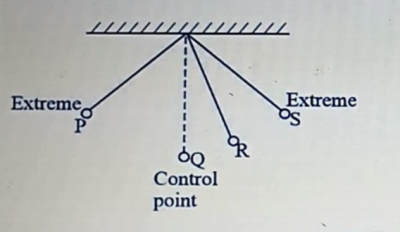
Using the oscillating simple pendulum above, the maximum kinetic energy is obtained at
Attached Figure / Diagram
A
Q
B
S
C
R
D
P
medium Difficulty
Verified Correct Answer: Option A
Physical Principles & Numerical Solution
A. Q
In a simple pendulum, kinetic energy is maximum at the lowest point (equilibrium position) where potential energy is minimum and speed is maximum.Here, Q is the control point (mean/equilibrium position), so maximum kinetic energy occurs at Q. At extremes P and S, kinetic energy is zero (velocity = 0). At R, it is between the extreme and the equilibrium.
Source: WAEC / JAMB / NECO Classroom Archive (Record #74550)
Physics
UTME / JAMB 2025
Simple Harmonic Motion
Solution
If the length of a simple pendulum is 120cm, calculate its frequency [\(\pi\) = \(\frac{22}{7}\) g = 10ms\(^{-2}\)]
A
2.8Hz
B
1.2Hz
C
12Hz
D
0.5Hz
medium Difficulty
Verified Correct Answer: Option D
Physical Principles & Numerical Solution
The frequency \( f \) of a simple pendulum is:
\(f = \frac{1}{2\pi} \sqrt{\frac{g}{L}} \quad \text{where } L = 1.2 \, \text{m}, \, g = 10 \, \text{m/s}^2, \, \pi \approx \frac{22}{7}\)
Calculate:
\(\frac{g}{L} = \frac{10}{1.2} = \frac{25}{3}, \quad \sqrt{\frac{25}{3}} = \frac{5}{\sqrt{3}}\)
\(f = \frac{1}{2 \times \frac{22}{7}} \times \frac{5}{\sqrt{3}} = \frac{35}{44\sqrt{3}}\)
Approximating \( \sqrt{3} \approx 1.732 \):
\(44 \times 1.732 \approx 76.208 \quad \Rightarrow \quad \frac{35}{76.208} \approx 0.459 \, \text{Hz}\)
Thus, the answer is \( D. \, 0.5 \) Hz.
Source: WAEC / JAMB / NECO Classroom Archive (Record #74574)
Physics
WAEC / WASSCE 2025
Simple Harmonic Motion
Solution
A student found out from a simple pendulum experiment that 20 oscillations were completed in 38 seconds.
A
8.0s
B
3.8s
C
1.9s
D
2.0s
medium Difficulty
Verified Correct Answer: Option C
Physical Principles & Numerical Solution
Period of oscillation = \(\frac{\text{ time}}{\text{no. of oscillations}}\) = \(\frac{38}{20}\) = 1.9s
Source: WAEC / JAMB / NECO Classroom Archive (Record #76331)
Physics
WAEC / WASSCE 2025
Simple Harmonic Motion
Solution
The angular speed of an object describes a circle of radius 4m with linear constant speed of 10m/s is
A
2.50 rads\(^{-1}\)
B
1.58 rads\(^{-1}\)
C
14.00 rads\(^{-1}\)
D
40.00 rads\(^{-1}\)
medium Difficulty
Verified Correct Answer: Option A
Physical Principles & Numerical Solution
Linear speed = \(\omega\) r
\(\omega\) = \(\frac{\text{v}}{\text{r}}\)
\(\omega\) = \(\frac{10}{4}\) = 2.5 rads\(^{-1}\)
Source: WAEC / JAMB / NECO Classroom Archive (Record #76333)
Physics
WAEC / WASSCE 2025
Simple Harmonic Motion
Solution
Which of the following will reduce the frequency of oscillation of a simple pendulum?
A
Increasing the mass of the bob
B
Decreasing the length of the string
C
Increasing the length of the string
D
Decreasing the mass of the bob.
medium Difficulty
Verified Correct Answer: Option C
Physical Principles & Numerical Solution
The frequency (f) of a simple pendulum is the number of oscillations it completes per second and is given by the formula: f = \(\frac{1}{2\pi}\)\(\sqrt{\frac{\text{g}}{\text{l}}}\)
where l is the length of the string and g is the acceleration due to gravity. Because the length l is in the denominator, the frequency is inversely proportional to the square root of the length. Therefore, increasing the length results in a slower swing rate, effectively reducing the frequency.
Source: WAEC / JAMB / NECO Classroom Archive (Record #76335)
Physics
UTME / JAMB 2025
Friction
Solution
A Force 18 N pulls a 40 kg mass on a horizontal floor at 0.3 ms\(^{-2}\). Find the coefficient of friction.
A
0.003
B
0.015
C
0.300
D
0.600
medium Difficulty
Verified Correct Answer: Option B
Physical Principles & Numerical Solution
Answer: B. 0.015
(Net F = ma = 40\times0.3 = 12 N;
friction = 18 - 12 = 6 N;
\mu = \(\frac{\text{friction}}{\text{mg}}\) = \(\frac{6}{(40\times10)}\) = 0.015.)
Source: WAEC / JAMB / NECO Classroom Archive (Record #74360)
Physics
UTME / JAMB 2025
Friction
Solution
The tangential force acting on an object that opposes it from sliding freely on the adjacent surface is called
A
Weight
B
Upthrust
C
Frictional force
D
Normal force
medium Difficulty
Verified Correct Answer: Option C
Physical Principles & Numerical Solution
Frictional force is the tangential force opposing an object's free sliding on an adjacent surface. It originates from surface irregularities and intermolecular attractions between materials, resisting relative motion or its initiation.
Source: WAEC / JAMB / NECO Classroom Archive (Record #74476)
Physics
UTME / JAMB 2025
Friction
Solution
A block with an initial speed of 10 m/s slides on a horizontal surface and comes to rest after traveling a distance of 25 m. What is the coefficient of kinetic friction between the block and the surface? (Take g = 9.8 m/s\(^2\)).
A
0.1
B
0.3
C
0.2
D
0.5
medium Difficulty
Verified Correct Answer: Option C
Physical Principles & Numerical Solution
Given: g = 9.8 m/s\(^2\), a = 10 m/s, v = 0( come to rest), s = 25m
v\(^2\) = u\(^2\) + 2as
- 100 = 2 x 25 x a
a = \(\frac{-100}{50}\) = - 2 deceleration is caused by kinetic friction
But, \(\mu\) = \(\frac{\text{f}}{\text{R}}\) = \(\frac{\text{ma}}{\text{mg}}\) = \(\frac{-2}{9.8}\) ≈ 0.2.
Source: WAEC / JAMB / NECO Classroom Archive (Record #75421)
Physics
UTME / JAMB 2025
Simple Structure of Matter
Diagram
Solution
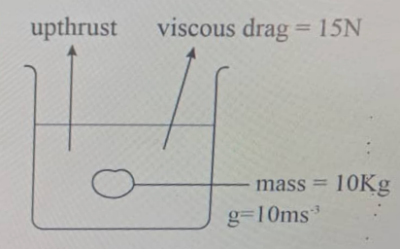
The acceleration of the body given above ( upthrust = 10N)
Attached Figure / Diagram
A
10.0m/s\(^2\)
B
20.0m/s\(^2\)
C
7.5m/s\(^2\)
D
6.8m/s\(^2\)
medium Difficulty
Verified Correct Answer: Option C
Physical Principles & Numerical Solution
The net force (\(F_{\text{net}}\)) is the weight (\(W\)) minus the total upward forces (upthrust (\(U\)) and viscous drag (\(F_{\text{drag}}\))), and this net force causes the acceleration (\(a\)) according to Newton's second law (\(F_{\text{net}}=ma\)):
\(F_{\text{net}} = W - U - F_{\text{drag}}\)
\(ma = (m \times g) - U - F_{\text{drag}}\)
\((10\text{ kg}) \times a = (10\text{ kg} \times 10\text{ m/s}^{2}) - 10\text{ N} - 15\text{ N}\)
\(10a = 100\text{ N} - 25\text{ N}\)
\(10a = 75\text{ N}\)
\(a = \frac{75\text{ N}}{10\text{ kg}}\)
\(a = 7.5\text{ m/s}^{2}\).
Source: WAEC / JAMB / NECO Classroom Archive (Record #74561)
Physics
WAEC / WASSCE 2025
Simple Structure of Matter
Solution
3a. What is surface tension? Explain the phenomenon in terms of intermolecular forces.
b. Describe a simple experiment to demonstrate the surface tension of a liquid.
c. State three examples to illustrate the effects of surface tension.
d. Why does water wet a clean glass surface, whereas mercury does not?
e. State two methods by which the surface tension of a liquid may be reduced.
medium Difficulty
Verified Correct Answer: Option
Physical Principles & Numerical Solution
a. Surface tension: Surface tension is a property of a liquid whereby its surface behaves as if it were covered by an elastic skin. Or it is the tangential force of a liquid.
b. The surface “skin” of a liquid exists because of the attractive forces between its molecules. A molecule inside the liquid is pulled equally in all directions by surrounding molecules, so the net force on it is zero. However, a molecule at the surface has more neighboring molecules below than above, creating a net inward (downward) pull. This inward force tends to minimize the surface area, causing the surface to behave like a stretched elastic skin. This effect is known as surface tension.
See diagram above.
Aim: To demonstrate surface tension in a liquid
Apparatus: A needle, water, a beaker, and a blotting paper
Procedure: The beaker of water is filled as shown above. A needle is now placed on a blotting paper and then pushed gently to the middle of the water surface. The paper wets and sinks, but the needle remains floating on the water's surface.
Conclusion: The surface acts like a skin covering the liquid, which can support the weight of the needle.
c. (i). When mercury spills on a glass sheet, it forms a spherical droplet (ii). A flowing needle on water (iii). A toy duck on liquid.
d. The cohesion force between molecules of water is less than its adhesion to glass, therefore when water is allowed to spill on glass, it wets. Conversely, the cohesion between the molecules of mercury is greater than its adhesion to glass. Hence, it does not wet glass.
e. (i). By adding detergents, (ii). By heating the liquid (ii). By addition of camphor
Source: WAEC / JAMB / NECO Classroom Archive (Record #76496)
Physics
UTME / JAMB 2025
Density and Relative Density
Solution
A wooden block of relative density 0.4 floats in a liquid of density 1600 kg m\(^{-3}\). What fraction of its volume is immersed?
A
0.15
B
0.10
C
0.25
D
0.20
medium Difficulty
Verified Correct Answer: Option C
Physical Principles & Numerical Solution
Answer: C
Fraction immersed = \(\frac{\text{density of block}}{\text{density of liquid}}\) = \(\frac{400}{1600}\) = 0.25.
Source: WAEC / JAMB / NECO Classroom Archive (Record #74381)
Physics
WAEC / WASSCE 2025
Density and Relative Density
Solution
A body weighing 10N in air is partially immersed in water. It displaces water of mass 0.3kg. What is the upthrust on the body?(g = 10m/s\(^2\))
A
7.0N
B
13.0N
C
3.3N
D
3.0N
medium Difficulty
Verified Correct Answer: Option D
Physical Principles & Numerical Solution
Upthrust = weight of fluid displaced = mg = 0.3 x 10 = 3.0N
Source: WAEC / JAMB / NECO Classroom Archive (Record #76338)
Physics
UTME / JAMB 2025
Deformation of Solids
Solution
When a spiral spring is compressed by an external force of 200 N, it stores 0.16 J of energy. What amount of energy will it store when compressed by an external force of 700 N?
A
1.12J
B
0.48J
C
1.96J
D
O.84J
medium Difficulty
Verified Correct Answer: Option C
Physical Principles & Numerical Solution
The elastic potential energy \( E \) is proportional to the square of the force:
\(E \propto F^2\)
(for the same spring).
The relationship between the energies for different forces is given by:
\(\frac{E_2}{E_1} = \left( \frac{F_2}{F_1} \right)^2\)
Now, substituting the known values:
\(E_2 = 0.16 \times \left( \frac{700}{200} \right)^2 = 0.16 \times (3.5)^2 = 0.16 \times 12.25 = 1.96 \, \text{J}\)
Source: WAEC / JAMB / NECO Classroom Archive (Record #74686)
Physics
UTME / JAMB 2025
Scalars and Vectors
Diagram
Solution
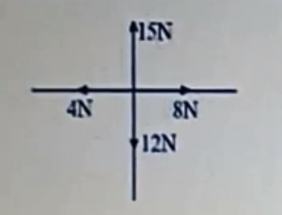
The resultant of the force shown above is
Attached Figure / Diagram
A
18.00N
B
5.00N
C
10.20N
D
3.15N
medium Difficulty
Verified Correct Answer: Option B
Physical Principles & Numerical Solution
Net force in the horizontal (x) direction:
\(F_x = 8 \, \text{N} - 4 \, \text{N} = 4 \, \text{N} \quad \text{(to the right)}\)
Net force in the vertical (y) direction:
\(F_y = 15 \, \text{N} - 12 \, \text{N} = 3 \, \text{N} \quad \text{(3 N upward)}\)
Magnitude of the resultant force: \(R = \sqrt{F_x^2 + F_y^2} = \sqrt{(4)^2 + (3)^2} = \sqrt{16 + 9} = \sqrt{25} = 5 \, \text{N}\)
Source: WAEC / JAMB / NECO Classroom Archive (Record #74542)