Question Library
Browse, filter, and study verified past examination questions with step-by-step mathematical reasoning.
Searching 18,000+ Questions...
Sifting topics, KaTeX formulas & verified solutions
Showing 76–90 of 345 verified questions
Sort by:
Mathematics
UTME / JAMB 2014
Statistics and Probability
Solution
The mean of 2 - t, 4 + t, 3 - 2t, 2 + t and t - 1 is
A
t
B
-t
C
2
D
-2
medium Difficulty
Verified Correct Answer: Option C
Step-by-Step Mathematical Solution
Mean x = \(\frac{\sum x}{n}\)
= [(2 - t) + (4 + t) + (3 - 2t) + (2 + t) + (t - 1)] \(\div\) 5
= [11 - 1 + 3t - 3t] \(\div\) 5
= 10 \(\div\) 5
= 2
Source: Myschool Past Questions Archive (Record #27031)
Mathematics
UTME / JAMB 2014
Statistics and Probability
Solution
\(\begin{array}{c|c}
Values & 0 & 1 & 2 & 3 & 4 \\
\hline
Frequency & 1 & 2 & 2 & 1 & 9
\end{array}\)
Find the mode of the distribution above
A
1
B
2
C
3
D
4
medium Difficulty
Verified Correct Answer: Option D
Step-by-Step Mathematical Solution
The number with the highest frequency = 4
Source: Myschool Past Questions Archive (Record #27032)
Mathematics
UTME / JAMB 2014
Statistics and Probability
Solution
Find the median of 5,9,1,10,3,8,9,2,4,5,5,5,7,3 and 6
A
6
B
5
C
4
D
3
medium Difficulty
Verified Correct Answer: Option B
Step-by-Step Mathematical Solution
First arrange the numbers in order of magnitude;
1,2,3,3,4,5,5,5,5,6,7,8,9,9,10
Hence the median = 5
Source: Myschool Past Questions Archive (Record #27033)
Mathematics
UTME / JAMB 2014
Statistics and Probability
Solution
\(\begin{array}{c|c}
Numbers & 1 & 2 & 3 & 4 & 5 & 6 \\
\hline
Frequency & 18 & 22 & 20 & 16 & 10 & 14
\end{array}\)
The table above represents the outcome of throwing a die 100 times. What is the probability of obtaining at least a 4?
A
\(\frac{1}{5}\)
B
\(\frac{1}{2}\)
C
\(\frac{2}{5}\)
D
\(\frac{3}{4}\)
medium Difficulty
Verified Correct Answer: Option C
Step-by-Step Mathematical Solution
Let E demote the event of obtaining at least a 4
Then n(E) = 16 + 10 + 14 = 40
Hence, prob (E) = \(\frac{n(E)}{n(S)}\)
\( = \frac{40}{100}\)
\( = \frac{2}{5}\)
Source: Myschool Past Questions Archive (Record #27036)
Mathematics
WAEC / WASSCE 2014
Statistics and Probability
Diagram
Solution
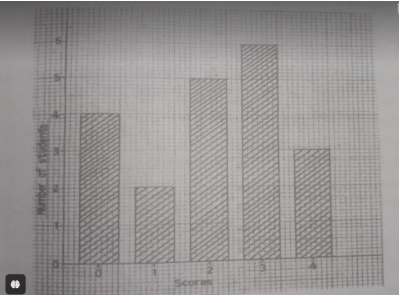
The bar chart above shows the scores of some students in a test. Use it to answer this question
If one student is selected at random, find the probability that he/she scored at most 2 marks
Attached Figure / Diagram
A
\(\frac{11}{18}\)
B
\(\frac{11}{20}\)
C
\(\frac{7}{22}\)
D
\(\frac{5}{19}\)
medium Difficulty
Verified Correct Answer: Option B
Step-by-Step Mathematical Solution
at most 2 marks = 5 + 2 + 4 students = 11 students
probability(at most 2 marks) = \(\frac{11}{20}\)
Source: Myschool Past Questions Archive (Record #36934)
Mathematics
WAEC / WASSCE 2014
Statistics and Probability
Solution
\(\begin{array}{c|c}height & 2 & 3 & 4 & 5 & 6 \\ \hline frequency & 2 & 4 & 5 & 3 & 1
\end{array}\)
The table shows the distribution of the height of plants in a nursery. Calculate the mean height of the plants.
A
3.8
B
3.0
C
2.8
D
2.3
medium Difficulty
Verified Correct Answer: Option A
Step-by-Step Mathematical Solution
\(\begin{array}{c|c} height(x) & frequency(f) & fx \\ \hline 2 & 2 & 4\\ 3 & 4 & 12\\ 4 & 5 & 20 \\ 5 & 3 & 15\\ 6 & 1 & 6\end{array}\)
mean\(\bar{x} = \frac{\sum fx}{\sum f}\)
= \(\frac{57}{15}\)
= 3.8
Source: Myschool Past Questions Archive (Record #36953)
Mathematics
WAEC / WASSCE 2014
Statistics and Probability
Solution
The probability of an event P happening is \(\frac{1}{5}\) and that of event Q is \(\frac{1}{4}\). If the events are independent, what is the probability that neither of them happens?
A
\(\frac{4}{5}\)
B
\(\frac{3}{4}\)
C
\(\frac{3}{5}\)
D
\(\frac{1}{20}\)
medium Difficulty
Verified Correct Answer: Option C
Step-by-Step Mathematical Solution
prob(p) = \(\frac{1}{5}\)
prob(Q) = \(\frac{1}{4}\)
Prob(neither p) = 1 - \(\frac{1}{5}\)
\(\frac{5 - 1}{5} = \frac{4}{5}\)
prob(neither Q) = 1 - \(\frac{1}{4}\)
\(\frac{4 - 1}{4} = \frac{3}{4}\)
prob(neither of them) = \(\frac{4}{5} \times \frac{3}{4} = \frac{12}{20}\)
= \(\frac{3}{5}\)
Source: Myschool Past Questions Archive (Record #36992)
Mathematics
WAEC / WASSCE 2014
Statistics and Probability
Diagram
Solution
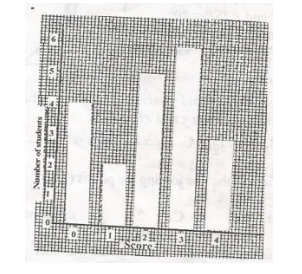
The bar chart shows the scores of some students in a test. If one students is selected at random, find the probability that he/she scored at most 2 marks
Attached Figure / Diagram
A
\(\frac{11}{18}\)
B
\(\frac{11}{20}\)
C
\(\frac{7}{22}\)
D
\(\frac{5}{19}\)
medium Difficulty
Verified Correct Answer: Option B
Step-by-Step Mathematical Solution
at most 2 marks = 5 + 2 + 4 students = 11 students
probability(at most 2 marks) = \(\frac{11}{20}\)
Source: Myschool Past Questions Archive (Record #37000)
Mathematics
WAEC / WASSCE 2014
Statistics and Probability
Solution
A building contractor tendered for two independent contracts, X and Y. The probabilities that he will win contract X is 0.5 and not win contract Y is 0.3, What is the probability that he will win :
(a) both contracts ;
(b) exactly one of the contracts ;
(c) neither of the contracts?
medium Difficulty
Verified Correct Answer: Option
Step-by-Step Mathematical Solution
Let A and B denote the events that the man wins contracts X and Y respectively.
Then P(A) = 0.5
P(A') = 1 - 0.5 = 0.5
P(B') = 0.3
P(B) = 1 - 0.3 = 0.7
(a) The probability that the man wins both contracts = \(0.5 \times 0.7 = 0.35\).
(b) The probability that the man wins exactly one of the contracts is \(P(A) \times P(B') + P(B) \times P(A')\)
= \(0.5 \times 0.3 + 0.7 \times 0.5\)
= \(0.15 + 0.35\)
= \(0.50\)
(c) Neither of the contracts (i.e not X, not Y) = \(P(A') \times P(B')\)
= \(0.5 \times 0.3\)
= \(0.15\)
Source: Myschool Past Questions Archive (Record #52603)
Mathematics
WAEC / WASSCE 2014
Statistics and Probability
Solution
Scores
1
2
3
4
5
6
Frequency
2
5
13
11
9
10
The table shows the distribution of outcomes when a die is thrown 50 times. Calculate the :
(a) Mean deviation of the distribution ; (b) probability that a score selected at random is at least a 4.
medium Difficulty
Verified Correct Answer: Option
Step-by-Step Mathematical Solution
(a)
Scores (x)
Frequency (f)
\(fx\)
1
2
2
2
5
10
3
13
39
4
11
44
5
9
45
6
10
60
\(\sum f = 50\)
\(\sum fx = 200\)
\(Mean (\bar{x}) = \frac{\sum fx}{\sum f} = \frac{200}{50} = 4\)
\(d = x - 4\)
\(|d|\)
f
\(f|d|\)
-3
3
2
6
-2
2
5
10
-1
1
13
13
0
0
11
0
1
1
9
9
2
2
10
20
\(\sum f|d| = 58\)
Hence, Mean Deviation = \(\frac{\sum f|d|}{\sum f} = \frac{58}{50}\)
= 1.16
(b) Let E denote the event of getting a score of at least 4.
\(n(E) = 11 + 9 + 10 = 30\)
\(p(E) = \frac{n(E)}{n(S)} = \frac{30}{50}\)
= \(0.6\)
Source: Myschool Past Questions Archive (Record #52635)
Mathematics
UTME / JAMB 2013
Statistics and Probability
Solution
Find the mean of t + 2, 2t - 4, 3t + 2 and 2t.
A
t + 1
B
2t
C
2t + 1
D
t
medium Difficulty
Verified Correct Answer: Option B
Step-by-Step Mathematical Solution
\(\sum x\) = (t + 2) + (2t + 4) + (3t + 2) + 2t = 8t
N = 4_
∴ Mean, x = \(\frac{\sum x}{N} = \frac{8t}{4} = 2t\)
= 2t
Source: Myschool Past Questions Archive (Record #27102)
Mathematics
UTME / JAMB 2013
Statistics and Probability
Solution
Age
20
25
30
35
40
45
No of people
3
5
1
1
2
3
Calculate the median age of the frequency distribution in the table above
A
25
B
30
C
35
D
20
medium Difficulty
Verified Correct Answer: Option A
Step-by-Step Mathematical Solution
N = \(\sum f\) = 15
Hence the median age is the \(\frac{N + 1}{2}\)th age, i.e.
\(\frac{15 + 1}{2}\)th = 8th
From the table, the age that falls on the 8th position when arranged in ascending order is 25years
Source: Myschool Past Questions Archive (Record #27111)
Mathematics
UTME / JAMB 2013
Statistics and Probability
Solution
\(\begin{array}{c|c} Score & 3 & 4 & 5 & 6 & 7 & 8 & 9 & 10 \\ \hline Frequency & 1 & 0 & 7 & 5 & 2 & 3 & 1 & 1 \end{array}\)
The table above shows the scores of 20 students in further mathematics test. What is the range of the distribution?
A
7
B
6
C
3
D
10
medium Difficulty
Verified Correct Answer: Option A
Step-by-Step Mathematical Solution
Range = Highest score - Lowest score
= 10 - 3
= 7
Source: Myschool Past Questions Archive (Record #27125)
Mathematics
UTME / JAMB 2013
Statistics and Probability
Solution
What is the probability that an integer x \((1 \leq x \leq 25)\) chosen at random is divisible by both 2 and 3?
A
\(\frac{1}{25}\)
B
\(\frac{1}{5}\)
C
\(\frac{4}{25}\)
D
\(\frac{3}{4}\)
medium Difficulty
Verified Correct Answer: Option C
Step-by-Step Mathematical Solution
\((1 \leq x \leq 25)\) = {1,2,3,4,5,6,7,8,9,10,11,12,13,14,15,16,17,18,19,20,21,22,23,24,25}
Number N of x divisible by both 2 and 3 is 4.
n(\(\varepsilon\)) = 25
= \(\frac{N}{n(\varepsilon)}\)
= \(\frac{4}{25}\)
Source: Myschool Past Questions Archive (Record #27130)
Mathematics
UTME / JAMB 2013
Statistics and Probability
Solution
A basket contains 9 apples, 8 bananas and 7 oranges. A fruit is picked from the basket, find the probability that it is neither an apple nor an orange.
A
\(\frac{3}{8}\)
B
\(\frac{1}{3}\)
C
\(\frac{7}{24}\)
D
\(\frac{2}{3}\)
medium Difficulty
Verified Correct Answer: Option B
Step-by-Step Mathematical Solution
n(apples) = 9
n(bananas) = 8
n(oranges) = 7
n(\(\varepsilon\)) = 24
Hence Prob(not apple, nor orange) = Prob(banana) = \(\frac{8}{24}\) = \(\frac{1}{3}\)
Source: Myschool Past Questions Archive (Record #27131)